Elekta Unity receives 510(k) clearance

The Elekta Unity MRI-guided radiotherapy system has received 510(k) premarket notification from the US Food and Drug Administration, clearing the technology for commercial sales and clinical use in the US. Elekta Unity combines high-field 1.5 T MR imaging, precision radiation therapy and intelligent software, allowing clinicians to see what they treat in real time.

“Since receiving CE mark in June 2018, Elekta Unity has been transforming the care of cancer patients in Europe, and we are excited that this cutting-edge technology is now commercially available to US patients,” says Richard Hausmann, president and CEO of Elekta. “With Elekta Unity, it is now feasible to develop personalized, precision radiation therapy regimens that are optimized for safety and efficacy and make radiation therapy a viable treatment option for more patients.”

Unity has the potential to transform how clinicians treat cancer by enabling the delivery of the radiation dose while simultaneously visualizing the tumour and surrounding healthy tissue with high-quality MR images. Unity also integrates advanced tools that allow clinicians to adapt the patient’s treatment to this current anatomical information within a treatment session.

“Unity is a tremendous leap forward in our ability to tailor radiation therapy to each patient’s tumour and anatomy and to adapt treatment in real time as the tumour changes shape and position relative to organs at risk,” says Christopher Schultz, chair of the Elekta MR-linac Consortium. “I believe this enabling technology will fundamentally transform how radiation therapy regimens are developed, implemented and adapted to achieve optimal outcomes for our patients. We are excited to offer Unity to our patients and are proud of our contributions to making this technology a clinical reality.”

Clinical proton system could enable small-animal studies

MEVION proton gantry

Image-guided radiation delivery systems for pre-clinical animal research have been helping researchers throughout the world to make discoveries and advancements in cancer treatment. If state-of-the-art photon research platforms could be economically adapted for proton therapy, this could open up a completely new field in pre-clinical research.

Researchers at Maastricht University Medical Centre and MAASTRO Clinic have investigated the feasibility of using a compact clinical proton therapy system for pre-clinical research with millimetric beams. They determined that the MEVION S250i proton system with HYPERSCAN pencil-beam scanning technology and adaptive aperture-controlled collimation could be potentially be used for small-animal radiation research (Br. J. Radiol. 10.1259/bjr.20180446).

The MEVION S250i uses a gantry-mounted superconducting synchrocyclotron proton accelerator, which rotates in the treatment room around a patient. The pencil-beam delivery path is designed to reduce delivery times, and the automated adaptive aperture generates layer-by-layer beam collimation with a 5–6 mm collimated spot sizes for all energies (0–32 cm depth).

For the dosimetric study, principal investigator Frank Verhaegen  and colleagues examined a sub-millimetric cone-beam CT (CBCT) image of a mouse with an orthotopic lung tumour of a few millimetres. First, the team used the SmART-ATP small-animal radiotherapy planning system to design an X-ray photon irradiation plan that delivered a prescribed dose of 2 Gy to the tumour.

To create the proton plans, the researchers modelled the nozzle of the proton beam line, including the energy modulation system (EMS) and the adaptive aperture. They performed Monte Carlo simulations of a single spot proton pencil beam aimed at the tiny tumour site. They simulated seven treatment scenarios, which combined two to three treatment fields, used five field sizes and different energies, including energies of less than 40 MeV, in which the Bragg peak stopped inside the tumour, and higher energies that extended beyond the tumour.

Plan comparisons

The researchers calculated the dose–volume histogram metrics D95 and D5 (dose to 95% and 5% of the tumour, respectively) for the large number of dose distributions simulated for each treatment scenario. From these, they selected the best plan for each scenario and evaluated the dose received by the tumour and the organs-at-risk. They determined that the proton plans achieved good tumour coverage, with potentially less damage to the organs-at-risk than the photon plans.

The team also calculated the delivery efficiency of the system, to quantify the number of protons generated, and whether the prescribed 2 Gy dose could be delivered by such a small beam in an acceptable irradiation time for a laboratory animal. They determined that for very small fields and low energies, the number of protons arriving to the target dropped to 1-3%, but that treatment times would be below 5 s.

The best-case tumour coverage, with the steepest slope between D5 and D95, was achieved for a three-field delivery with field sizes of 5×4, 5×3 and 5×3 mm. Although the “shoot through” technique would be expected to give better target coverage, the use of a single spot beam resulted in a non-uniformity of the dose distribution in the lateral direction.

Future prospects

The authors noted that the EMS could be a disadvantage for pre-clinical work because it prevents the easy production of sharper beams. “The EMS is a set of plastic plates that can be inserted in the proton beam. By doing this, protons lose energy in the plates, which decreases their range,” Verhaegen explains. “The protons emerging from the accelerator before the range shifter always have the same energy, a characteristic of a cyclotron. Therefore, the proton Bragg peak has approximately the same shape for all combinations of range shifters, so we cannot make it much narrower in the longitudinal direction; this could be a disadvantage when irradiating small targets of a few millimetres or less. For very small targets, we may prefer the shoot-through technique with multiple crossing beams to create high dose in the crossfire.”

The authors also point out that to perform the experiments that they simulated, a high-precision positioning platform with a coupled high-resolution CBCT imager would be necessary to assure sub-millimetric uncertainty of the mouse positioning while keeping the gantry at a fixed angle.

Verhaegen tells Physics World that a single platform with an X-ray irradiator onboard and an X-ray imager would be needed. Ideally, researchers would like to dock this type of photon system to an existing proton beam line.

“Proton beamlines will always be too expensive to develop one dedicated to small-animal research,” Verhaegen explains. “In our case at Maastricht, the photon irradiator is too heavy to move due to lead radiation shielding. We have applied for funding to develop a next-generation mobile research platform that can handle photon irradiation and can be docked to a proton beam. This is what we expect researchers to do in the future.”

Carbon emissions set to hit record high

Global emissions of carbon dioxide from fossil fuels and industry are projected to rise by more than 2% in 2018, to a new record. The increase is mainly due to sustained growth in oil and gas use, according to the Global Carbon Project.

“The 2018 rise in fossil CO2 emissions place us on a trajectory for warming that is currently well beyond 1.5 °C,” says Corinne Le Quéré of the University of East Anglia, UK. “It is not enough to support renewables. Efforts to decarbonise need to be expanded throughout the economy.”

The atmospheric CO2 concentration is set to reach 407 ppm on average in 2018, 45% above pre-industrial levels.

The project predicts that 2018 carbon-dioxide emissions will rise 2.7%, with an uncertainty range between 1.8% and 3.7%. In 2017, carbon emissions grew by 1.6% after a three-year hiatus.

In the 2000s, global fossil carbon-dioxide emissions – from fossil fuels, industry and cement – grew at over 3% per year. Growth has slowed since 2010, and from 2014 to 2016 emissions remained relatively flat with only a slight increase.

The UN is holding its COP24 meeting of annual climate negotiations in Katowice, Poland, this week.

According to the IPCC, to limit warming below 1.5 °C, CO2 emissions should decline by 50% by 2030 and reach net zero around 2050. Current country commitments lead to +3 °C of warming, well above the Paris Agreement goals.

Chinese emissions, which account for 27% of global emissions, look set to grow about 4.7% in 2018, according to the Global Carbon Budget. US emissions, totalling some 15% of the global output, are predicted to rise about 2.5% then decline in 2019. EU emissions, 10% of the global total, are on track for a decline of 0.7%, well below the declines of 2% a year in the decade up to 2014. Indian emissions, accounting for 7% of the total, look set to continue their strong growth with a rise of some 6.3% in 2018.

The 10 biggest emitters were China, the US, India, Russia, Japan, Germany, Iran, Saudi Arabia, South Korea, and Canada, with the EU28 as a whole ranking third.

Global energy growth is effectively outpacing decarbonisation efforts, fuelled by increasing demand for personal transport, freight, aviation and shipping, according to Future Earth.

“This news is particularly difficult, when it is clear that we have the technology, the knowledge and business acumen to cut our emissions exponentially,” says Future Earth executive director Amy Luers. “Tackling climate change has now become a win-win. We just need to start down the winning path.”

Although global coal use is still 3% lower than its historical high, it looks set to grow in 2018, driven by rising energy consumption in China and India. In the last decade, oil and gas use have grown almost unabated. Gas use has been pushed up by declines in coal use and increased demand for gas in industry. Oil fuels personal transport, freight, aviation and shipping, and is used to produce petrochemicals.

The Global Carbon Project published its 2018 Global Carbon Budget in Nature, Earth System Science Data and Environmental Research Letters (ERL).

  • This article is based on a press release from Future Earth.

Protein corona analysis helps improve cancer diagnostics

Researchers have succeeded in using the “protein corona” that naturally absorbs onto nanoparticles, such as liposomes, when they are placed in biological fluids to develop an advanced blood analysis technique. The new approach could allow for the identification of biomolecules that hitherto could not be detected by conventional blood plasma proteomic analyses. The nanotool might find applications in a number of areas in nanomedicine, including the early diagnosis of cancer.

Among the many drug delivery systems that exist today, nanoparticles known as liposomes (soft phospholipid-based vesicles) are one of the most advanced. These drug carriers help minimise the toxic side effects of many therapeutics including those used to combat cancer (one example is doxorubicin), while allowing the drugs to remain in the blood stream for longer.

The protein corona

“Despite the good clinical track record of liposomes, researchers have only recently started to pay attention to the role that the protein corona plays in liposome pharmacology,” says Kostas Kostarelos of the University of Manchester in the UK, who led this research effort. This “halo” refers to the spontaneous and layered adsorption of biomolecules onto the liposomes when they are injected into the blood stream and it could provide valuable information on which disease biomarkers a patient is carrying. Usually these markers are too small and present in too low concentrations to be detected.

Kostarelos and colleagues have now analysed blood samples taken from patients with advanced stage ovarian cancer who were treated with the anti-cancer drug CAELYX®, which contains doxorubicin encapsulated in a liposome nanoconstruct. “We recovered the liposomes from the blood circulation of the patients and were able to detect a wide variety of disease-specific proteins adsorbed onto the liposome surface,” explains Kostarelo. We found that the corona was particularly rich in low-molecular weight and low-abundant plasma proteins.”

The researchers analysed the liposomes and their coronas using a number of techniques, including dynamic light scattering, ζ-potential measurements, negative strain transmission electron microscopy and mass spectrometry.

In vivo and ex vivo experiments

The team compared the molecular composition of the protein corona that forms in vivo around intravenously injected CAELYX® liposomes with the ex vivo corona that forms after simply incubating the liposomes with plasma samples taken from the same ovarian carcinoma patients.

“In agreement with our previous data in rodents, we detected a more complex molecular fingerprint for the in vivo protein corona in comparison to its ex vivo counterpart,” says study lead author Marilena Hadjidemetriou. “Despite the fact that we did not detect one particular protein, the cDNA clone CS0DD006YL02 (which has never been described or reported on before) in any of the control plasma samples, we did identify it as the most abundant protein in both the in vivo and the ex vivo formed protein coronas, indicating that the nanoparticle protein corona allows the identification of previously unseen blood molecules.”

Kostarelos and colleagues also did the same experiments on a control group of healthy volunteers by incubating blood plasma samples taken from these volunteers with CAELYX® liposomes. They found that the CS0DD006YL02 protein was only the fifth most abun­dant protein in the ex vivo corona formed in this group. This result suggests that tumorigen­esis can be reflected in the molecular composition and dynamics of corona formation, but much more work is needed to confirm this hypothesis, they say.

“In previous work, we showed that protein coronas qualitatively and quantitatively change in tumour-bearing mice, thus allowing detection of differentially abundant marker molecules that distinguish between healthy and diseased states,” explains Kostarelos. “Although the in vivo protein corona allows analysis of a molecularly richer blood fingerprint and can be a valuable tool for biomarker discovery in mouse models, we now working to optimise the ex vivo protein corona analysis for biomarker discovery using human blood samples.”

Detecting early stage ovarian cancer

“We’re astonished at how rich the information was on the surface of the liposomes taken from blood,” he says. “We hope this technique could be a springboard for further research, from monitoring disease progression or recurrence, to identifying which treatment is best for each patient and potentially finding new biomarkers for early diagnosis.”

Blood is a potential goldmine of information but there’s a challenge to amplify cancer signals that would otherwise be buried within the “noise”, adds Hadjidemetriou. “More abundant proteins mask rarer and smaller molecules that could be significant in helping us to understand disease progression or finding potential new drug targets. Our technique overcomes this challenge.”

The researchers, who were funded by Cancer Research UK, are now planning to use their technique to discover the best biomarker patterns for early-stage ovarian cancer. They report their work in Advanced Materials 10.1002/adma.201803335.

Gamma rays shed light on ancient star formation

The history of star formation in the universe has been charted by astronomers who looked at how gamma rays interact with extra-galactic background light (EBL) – which is a diffuse glow of starlight that pervades the universe. While the results are consistent with direct measurements of star formation using light from galaxies, the study boosts our understanding of the mysterious era of cosmic reionization that occurred in the early universe.

The conventional way to estimate star-formation at a particular time in history of the universe is to study ultraviolet (UV) light from galaxies. This, explains astrophysicist Marco Ajello of Clemson University in South Carolina, “is almost always emission from short-lived stars with a mass more than 10 times that of our Sun”. First, researchers estimate how much longer-wavelength light from less massive stars remains undetected, then they correct for absorption of ultraviolet light by the dust clouds that usually surround star-forming regions. “Given these two corrections, the number of stars formed per year follows rather quickly,” Ajello says.

Direct observation becomes problematic, however, in the early universe. About 300,000 years after the Big Bang, the universe had cooled to the point where protons and electrons combined to form neutral hydrogen. This produced radiation that pervades the universe today as the cosmic microwave background. Measurements from around a billion years after the Big Bang, however, indicate that this hydrogen had been ionized again.

“You need UV photons to ionize the hydrogen,” says Ajello, “The community is converging on extremely faint, star-forming galaxies as the source for these.” Detecting faint galaxies at such long distances, however, is extremely challenging. The Hubble Space Telescope has detected hints that there may have been sufficient numbers of such galaxies through gravitational lensing experiments. The four values calculated thus far, however, vary widely, so independent constraints would be valuable.

Absorbing gamma rays

Clemson and colleagues detected not the emission of radiation but its absorption. They used the Fermi Large Area Telescope (LAT), which is a satellite-based gamma-ray telescope. Gamma rays emitted by astronomical sources such as supernovae and blazars must propagate through the EBL before reaching Fermi-LAT. Gamma rays interact with the EBL and the strength of this interaction increases with the energy of the gamma rays. As a result, the universe is essentially opaque to very high energy gamma rays.

The researchers looked at the change in brightness of 739 galaxies called blazars – which emit jets of intense gamma rays from central supermassive black holes – at redshifts up to 3. To allow them to see even further back, they also observed a single gamma ray burst – the brightest gamma ray emitters in the universe – at redshift 4.35. “Below 10 GeV [gamma-ray energy] there is zero absorption,” explains Ajello, “As you increase the energy you see 10% absorption…then 20%…until eventually the source has disappeared completely. For every source we want to find out how quickly this happens.” This provided the researchers with a measurement of the optical thickness of the EBL at various wavelengths.

The EBL has been evolving all the time that the light has been propagating between a source and Fermi. This presents the researchers with the data they need: “We use over 700 sources, all of them with different redshifts, and so we can reconstruct how the total spectrum of the EBL has been changing over time all the way back to redshift 6,” says Ajello. “If you’re just interested in the star-formation history, then from the UV background you can work out the star-formation history.” The results are consistent with the mid-range estimates from lensing observations.

Astrophysicist Elisa Prandini of the University of Padua in Italy, who was not involved in the research, describes the constraints on ancient galaxies as “significant”, but says it is valuable on other levels too. Notably, she says, it guarantees that direct measurements of the EBL are not missing light from some unidentified source: “With the measurement performed by Fermi, you by definition cannot miss light,” she says: “If it is there, it will interact with gamma ray photons.” She says that it is “dangerous” to place too much weight on the results at high redshift as there is a only a single data point (the gamma ray burst) available so far and says “this is something that can be improved with further observations.”

The research is described in Science.

Hydrogen: the word from the UK’s Committee on Climate Change

In a report on “Hydrogen in the low-carbon economy”, the UK government’s advisory Committee on Climate Change (CCC) says that “producing hydrogen in low-carbon ways and using it to meet challenging demands (e.g. for heat in industrial processes, for heating buildings on colder winter days and for heavy transport) is likely to be an important part of the next stage of the UK’s energy transition”.

However, as I noted in my last post, the CCC sees Power to Gas (P2G) production of hydrogen — using renewable electricity — as unviable. Although it says “the largest potential for hydrogen to contribute to decarbonisation is as a low-carbon fuel for heat in buildings and/or industrial processes”, it sees P2G as too expensive to meet these needs. “While there is some opportunity to utilise some ‘surplus’ electricity (e.g. from renewables generating at times of low demand) for hydrogen production, our modelling shows that the quantity is likely to be small in comparison to the potential scale of hydrogen demand,” the report says. “Producing hydrogen in bulk from electrolysis would be much more expensive and would entail extremely challenging build rates for zero-carbon electricity generation capacity.”

Not a terrible compromise, but whatever happened to heat grids?

Dave Elliott

This seems oddly dismissive, given recent progress on reducing P2G costs (see my last and earlier posts) and given that P2G doesn’t need costly and uncertain Carbon Capture and Storage (CCS), unlike the route to low-carbon hydrogen favoured by the CCC — high temperature Steam Methane Reformation (SMR) linked to CCS. For example, a Sustainable Gas Institute review suggested that the cost/kW of hydrogen from P2G electrolysers will soon be less than that from SMR with CCS. However, the CCC does not actually see hydrogen playing a major role, at least for heating, so the debate over the P2G and SMR/CCS routes is more of a side issue on that front. Instead, the CCC now favours the use of electric heat pumps for bulk domestic heating.

Double peak

This was the approach initially backed by the government, although reservations had subsequently been expressed. Given that the gas grid delivers up to four times more energy than the power grid, trying to meet heat demand by wire rather than pipe seemed likely to require very significant expansion or upgrading of the power grid system, especially since heat demand tends to peak in the early evening. Doubly so since, under the government’s plan, power from the grid would also be needed to charge electric vehicles (EVs), possibly at the same time.

However, it has been argued that the scale of the potential peak-demand conflict could be reduced to some extent if time-of-use power charges were imposed, so that EVs would be charged later at night, when demand was lower. The CCC has also now sided with the idea of combining heat pump use with booster power from gas-fired boilers (converted at some stage to use hydrogen) to meet peak demand, in a hybrid system: “based on new modelling, our assessment is now that heat pumps offer the potential to provide heat efficiently for most of the time, with hydrogen boilers contributing mainly to meet peak demands on the coldest winter days”.

So, some hydrogen is still needed, which implies developing the SMR/CCS route. The CCC also assumes that heat pumps can be made more reliable. Its CEO Chris Stark said that the CCC had initially been a “bit suspicious” of heat pumps but, although costs were still high, it was now confident enough to recommend their rollout in hybrid form. “Deployment of this combination of hydrogen and heat pumps could almost completely displace fossil fuel use in buildings,” the committee said. “While not without challenges, this solution would enable the energy system to reach very low emissions, with greater feasibility and public acceptance than is likely with strategies for the full electrification of heat or the full use of hydrogen as a like-for-like replacement for natural gas as we use it today.”

The CCC sees this approach as a low-cost mix, in part it seems since it sees electricity costs as falling. Maybe, but that would also make P2G cheaper. There are certainly other views, some of which claim that the hydrogen route could be the cheapest since, whatever the source of hydrogen, the gas grid would then still be used for most energy delivery, avoiding the need for electricity grid upgrades.

CCS or no?

The CCC doesn’t accept this: ”The sunk costs of having an extensive gas grid do not automatically mean that it will be lower cost to switch it over to hydrogen and use it in boilers as we do with natural gas at the moment. Our analysis finds that the costs of a range of pathways for heat decarbonization are similar, including those in which the gas grid has a much reduced role or is decommissioned.” What’s more, it says that “producing large volumes of hydrogen from natural gas with CCS could lock the UK into a path with insufficient emissions reductions by 2050 – this route offers a reduction in lifecycle emissions of 60-85% compared to natural gas boilers, so could leave residual emissions of 20-70 Mt. It also depends heavily on both deployment of CCS at very large scale and gas imports at around double today’s levels”.

So, it’s heat pumps and electricity as the main way ahead for heat, and not just in off-gas-grid areas, as is the current emphasis under the Renewable Heat Initiative. Heat pumps certainly can be very efficient. The CCC says 280–410% for their proposed system (i.e. COP 2.8–4.1), compared with 62% for the hydrogen route. But there are many cost unknowns in the system, including the cost of fitting heat pumps in every house across the UK.

These uncertainties may be one reason why an earlier EE/E4 Tech analysis saw the hydrogen route as cheaper, whereas an Imperial College study saw it as the most expensive, and the hybrid heat pump option as optimal. The Policy Exchange was annoyed by this confusion: “Granted, the model assumptions used by each organization are different. However, irrespective of the input assumptions, the overall lack of a coherent policy message is likely to obfuscate policy makers rather than enlighten them.” Well said!  Moreover, there are broader policy issues. Cynics might say the heat pump choice is really because the CCC assumes there will be a lot of inflexible nuclear capacity — so some use must be found for its surplus output at night.

The debate on these issues has been a long one, and this may not be the last word, but using gas/hydrogen for peak heating does reduce stress on the power grid. And the CCC does also see hydrogen playing a role in power-grid balancing (feeding back-up gas plants), in industrial heating and also for HGV transport. So, we now have a new package to discuss, with hydrogen playing more of a role, but not a dominant one, and with the gas grid still being used for some heating. Not a terrible compromise, but whatever happened to heat grids? They can make a significant contribution in urban areas, but hardly get a mention. A new report from the Energy Technologies Institute says, “nearly half of heat demand could be met by heat networks”, with that option being cheaper in urban areas than all others, including the use of heat pumps or piped hydrogen. Maybe the CCC needs to rethink on that a bit. And also perhaps on biomass too: see my next post.


Being human

“A light read” may seem a disingenuous descriptor for a book about algorithms, but Hello World: How to be Human in the Age of the Machine by Hannah Fry arguably reads more as an anthology of algorithm-related anecdotes. Indeed, the sheer range of narratives speaks volumes for how far algorithms have penetrated all aspects of human life. Ranging from Bach simulators to self-taught tumour identifiers and bluffing chess computers; from racist automated taps and dodgy recidivism calculators to apocalyptic-error-prone Cold War nuclear strike detectors; algorithms are “as much a part of our modern infrastructure as bridges, buildings and factories ever were” says Fry.

The chatty anecdotal illustration of each point makes the book anything but information-dense, and reading it is a pleasure. It seems no scenario is too foolish when it comes to our interaction with machines – someone, somewhere has been there and done that. Despite geekily entertaining and sometimes irreverent humour – I particularly liked the online shopping website algorithm coming up with a balaclava as a likely follow-up sale to someone trying to buy a baseball bat – Fry’s caveats to handing over responsibility to algorithms can be no laughing matter. Bearing in mind that these stark warnings come from a self-professed algorithm nerd, if she has such grave concerns you might wonder whether your regular non-binary reading public would trust an algorithm to help with even the most banal chores of daily life.

While Hello World does seem to give less airtime to the success stories than instances of algorithms failing on the values or illogical expectations of the people using them, the book does something to unpick what strengths to elicit from both sides for a fruitful human–machine partnership. Fry weaves these lines of reasoning so deftly through her convivial prose that by the end the conclusions seem self-evident. Of course, when it comes to the stars of the numerous hapless human–machine encounters recounted throughout the book, their ill-advised approach was far from obvious.

  • 2018 Penguin Random House 243pp £18.99hb

Machine learning algorithms generate realistic digital breast phantoms

The introduction of dedicated breast CT systems can help improve breast cancer detection by overcoming the tissue superposition problems associated with two-dimensional mammography. To develop this technology further, computer simulations of the image acquisition process provide an invaluable tool. And, ideally, such simulations should employ digital phantoms that reflect the three-dimensional structure of human breast tissue.

Voxelized digital phantoms based on clinical breast CT images benefit from incorporating the realism and variability of actual patient data. Their accuracy is, however, limited by the spatial resolution of the imaging device. If the clinical images do not fully capture the long edges and fine strands of glandular tissue, this leads to a loss in glandularity in the digital phantoms, thereby limiting the accuracy of all subsequent analysis.

To accurately simulate breast imaging, phantoms with higher spatial resolution than that of the simulated projections are needed. Now, a team from Radboud University Medical Center and the University of Trieste has used machine learning algorithms to generate such “super-resolution” digital breast phantoms, which have a higher resolution than that of the system used to acquire the underlying patient images (Phys. Med. Biol. 10.1088/1361-6560/aae78d).

“We developed these phantoms to be used for computer simulations of breast imaging,” explains lead author Ioannis Sechopoulos. “We can simulate the acquisition of a dedicated breast CT or breast tomosynthesis image using these phantoms as representative of the patient’s breast. In this way, we can optimize the design and settings of new imaging systems before they are actually built, and verify the accuracy of new image analysis methods.”

Upsampled images

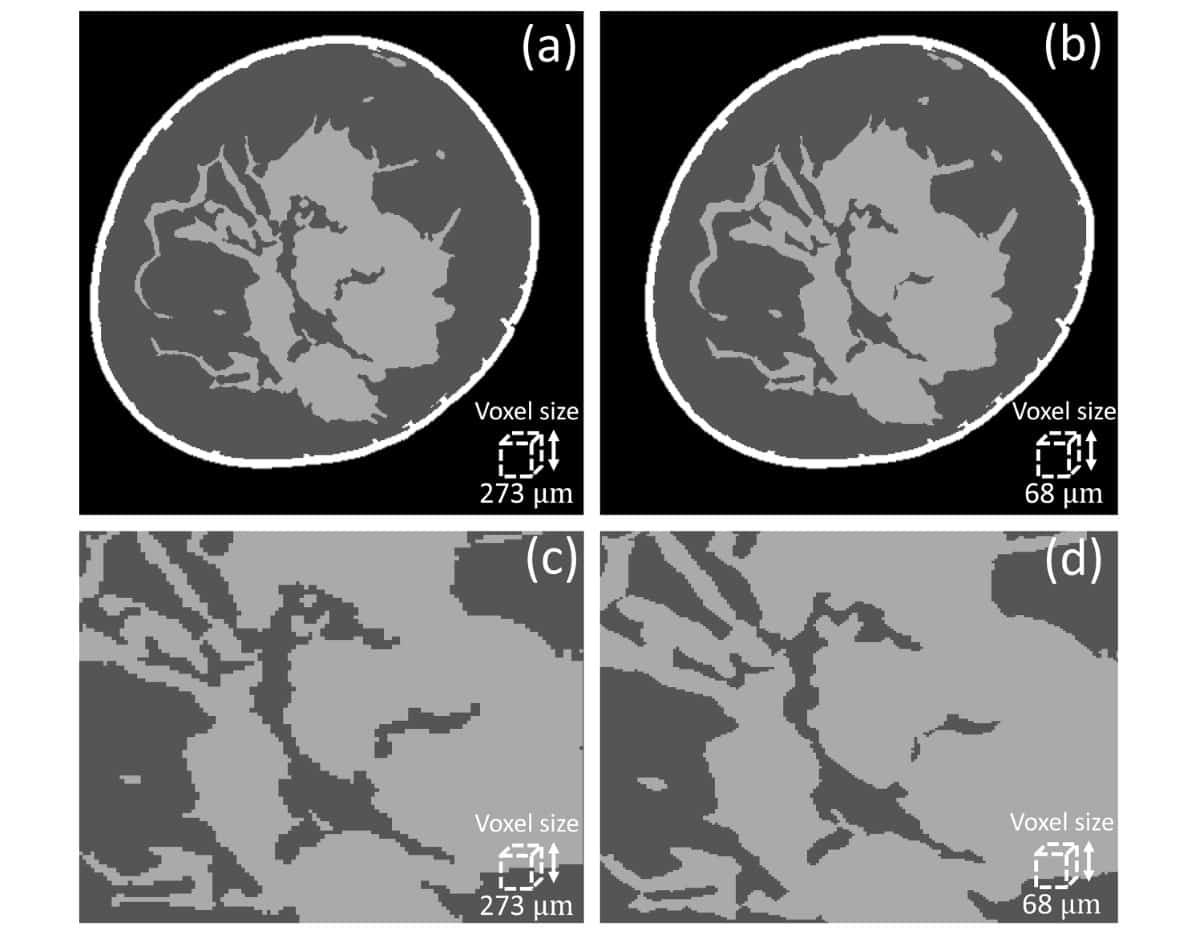
Sechopoulos and colleagues acquired images using a clinical breast CT system with a nominal pixel size of 194 μm and reconstructed with a voxel size of 273 μm. Aiming to increase the phantom resolution by a factor of four from the patient image, their first step was to reduce the voxel size in the clinical image from 273 to 68 μm.

Simply reducing voxel size, however, does not recover fine glandular details. Instead, first author Marco Caballo, PhD student at Radboud University Medical Center, used a machine learning-based regression algorithm to calculate the glandularity at the original resolution, the expected glandularity at 68 μm and the estimated glandular tissue loss. They then employed a second algorithm — a convolutional neural network — to iteratively recover glandular details by mapping between low- and high-resolution images until reaching the predicted glandularity.

Both algorithms were trained on high-resolution images of human breast tissue, acquired by a synchrotron system with a nominal pixel size of 60 μm. “The availability of high-resolution breast tissue CT images made this work more realistic than using simulated data,” says Sechopoulos.

Super-resolution phantom

Super-resolution phantoms generated using this approach demonstrated that glandular detail loss tended to increase with the amount of glandular tissue voxels. For example, the total absolute loss from 60 to 480 μm was 1.52% for volumes of interest (VOIs) starting with a glandularity of 8.03%, and 7.7% for VOIs starting with a glandularity of 48.04%.

To evaluate their proposed method, the researchers used 10 clinical breast CT images (reconstructed at 273 μm) to generate super-resolution phantoms with 68 μm voxels. They then downsampled these phantoms back to 273 μm. Comparing calculated glandularity values between the downsampled super-resolution phantoms and original breast CT images resulted in an average error of 0.27%.

The team also reconstructed 10 clinical images at both 273 and 194 μm. They used the algorithm to upsample the 273 μm images into 194 μm images and then compared the glandularity in the two 194 μm images. This also resulted in a small average error of 0.15%.

Finally, to evaluate the realism of the generated phantoms, the researchers showed pairs of images to an experienced breast radiologist, who was asked to distinguish true images from the corresponding phantoms. The comparison resulted in random outcomes (47% accuracy), confirming the realism of the generated super-resolution breast phantoms.

The researchers are now working to develop dynamic contrast-enhanced dedicated breast CT, which they believe will prove useful for many stages of breast cancer care. “So we developed these phantoms, together with previous work in which we added the dynamic aspects of contrast enhancement to the phantom, to optimize the image acquisition and analysis stages of this new modality,” Sechopoulos tells Physics World.

Robotics platform automates chemical synthesis

A modular robotics system could take chemistry a step closer to the complete automation of organic synthesis. A team of researchers have developed the ‘Chemputer’, along with a general chemical programming language to automate the assembly of complex molecules, reported in Science. They demonstrated its ability to synthesize pharmaceutical compounds without human intervention.

The synthesis of complex organic molecules is one of the most labour-intensive branches of chemistry. Despite advances in automation, driven by the availability of digital labware, current technologies are limited to single classes of reactions. Now, Sebastian Steiner and co-workers from The University of Glasgow have come up with a generalized approach to digitizing synthesis in order to tackle this problem.  Building on the experience of tens of thousands of chemists and hundreds of years of chemical literature, their advances could offer reliable access to complex molecules.

One device for all syntheses

The synthesis of drug molecules draws on techniques from many areas of chemistry. However, most of these reactions boil down to the same procedure. This involves mixing several reagents in the correct order, often with heating or cooling, followed by steps to isolate and purify the product. By devising a robotic platform capable of these operations, the team created a system that could handle a large fraction of all kinds of organic synthesis.

With the ambitious objective of automating all organic syntheses, flexibility in the team’s design for the Chemputer was key. Its architecture consists of a ‘backbone’ made up of traditional and inexpensive labware, with a number of syringe pumps and selection valves. The user can also increase the number of possible automated reactions by incorporating more modules. While trained chemists use visual cues to make decisions during a synthetic procedure, the researchers achieved automation using a conductivity sensor. They even suggest this could outperform human vision.

Coding Chemistry

The team developed software to combine individual steps into entire syntheses. They used a chemical programming language to map frequently used instructions into discrete steps and created the ‘Chempiler’ programme.  This produces instructions for the Chemputer. For example, after receiving the command ‘start stirring the reactor’, the Chempiler will identify the required module in the Chemputer and execute the instruction. Crucially, the instructions can be coded by users with little programming knowledge.

Each synthetic route is captured as a digital code that can be transferred between platforms. A user can then directly run any published synthesis. Ultimately it could be possible to go straight from reaction database to a chemical code that can run the robotic platform. This offers huge advantages to the reproducibility of any synthesis.

Synthesising drugs automatically

The researchers assembled three complex drug molecules (Nytol, sildenafil and rufinamide) to demonstrate the ability of the robotic platform. Beginning with traditional written schemes for the syntheses, they then used the Chemputer to perform all stages of the synthesis under Chempiler control. The whole process was executed autonomously, with no need for human intervention. As well as comparable yields and purity, the group also produced these molecules in a shorter time frame than would be possible manually.

Razorbills provide sharp insight into ocean currents

Photo of razorbill with GPS tag

Back in 2011, the UK’s Royal Society for the Protection of Birds (RSPB) fitted razorbills living on Puffin Island off the coast of Wales with GPS tags to study how they bred and fed. Little did the RSPB – or indeed the birds – know that the data the razorbills collected would seven years later provide details of ocean currents that could identify the best sites for generating tidal energy.

The initial study showed that at night the birds spent a lot of time resting on the sea surface. “We saw this as an opportunity to re-use the data and test if the birds might be drifting with the tidal current,” says Matt Cooper formerly of Bangor University, UK. Cooper and colleagues write in Ocean Science that “as far as we are aware, this paper is the first to describe the use of tagged seabirds for measuring currents of any kind”.

Traditionally scientists measure tides with radar or by deploying anchors and buoys fitted with scientific instruments but this is challenging and expensive. Tagged seabirds could potentially provide tidal data over a large area. The tags on the razorbills recorded their position every 100 seconds.

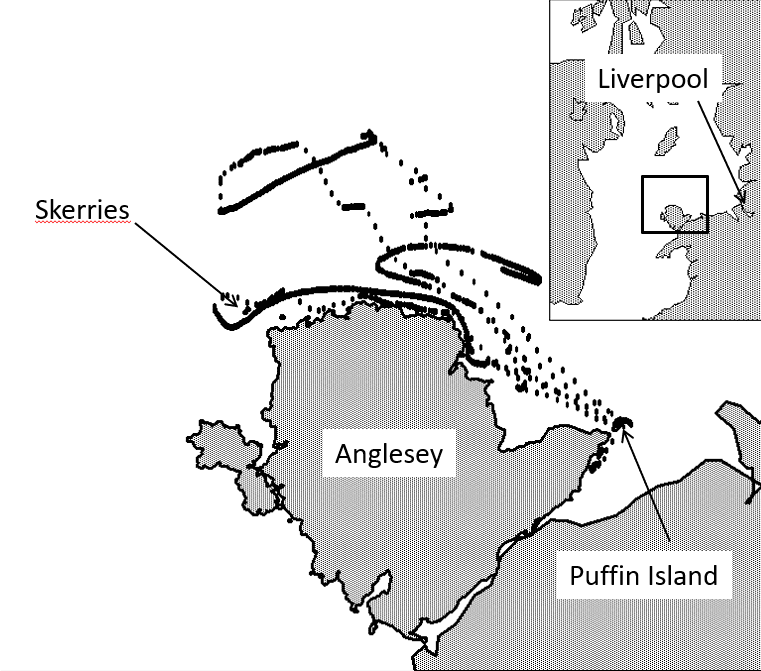
The track of one of the tagged birds from 17 to 21 May 2012. When the bird is flying from its base on Puffin Island, the points are relatively widely spaced. When it is sitting on the water, they are closely spaced and the movement is consistent with that of the travelling tide. The inset map shows the position of the study area within the Irish Sea and relative to Liverpool, which lies 70 km east of Puffin Island.

Razorbills come ashore only to breed; they spend most of their time at sea, foraging or resting on the ocean surface. After sunset the birds tended to float and drift. “[At these times] their changing position would reflect the movement of water at the ocean’s surface,” says Cooper.

The currents in the region of the Irish Sea that Cooper and colleagues studied have an average speed of more than 1 m/s. That’s faster than the birds can paddle but much slower than they can fly so it was easy to remove data from birds in flight. At times of low and high tide, the drifting birds changed direction as the currents moved from ebb to flow.

“We must remember that these birds are behaving naturally and we cannot determine where they go,” says Cooper. But the technique could provide tidal information over a wide area relatively cheaply, especially in remote regions. Cooper believes that the cost of generating tidal renewable energy “has been a barrier to the development of this much needed industry.”

  • This article is based on a press release by the EGU
Copyright © 2026 by IOP Publishing Ltd and individual contributors