Building platforms for materials innovation

How did you start Ossila?

David Lidzey, chair: About 10 years ago, I was working on a project with colleagues in the chemistry department at the University of Sheffield. I needed a postdoc to do this work, and out of the blue, James Kingsley phoned me up and said, “Have you got any postdoc positions?” Later, we got funding to develop self-assembly techniques for making polymeric solar cells, and our academic collaborators really liked what James was doing in terms of re-engineering things to make devices more efficiently. That’s when they started asking for spares.

James Kingsley, managing director: We spent a lot of time designing speciality components that we needed for our research, but when we’d approach a manufacturer and ask, “Could you make this for us?” they would usually reply, “Yes, that’s fine; how many thousands would you like?” A large part of the cost of producing these components was getting the first one made – after that, incremental ones could be made much more cheaply. So even though we only needed one or two ourselves, we would often get a few extra made and hand them out to our collaborators. After a while, it got to the point where I was posting five different sets of things to people around the UK, and we decided that since they weren’t the only people in the world doing this sort of research, maybe there was a small business in it.

What was it like to start the company?

JK: It was hard work, but the great thing was that I could do it part-time. At the start, I was working for the company one day a week (as well as in evenings, weekends, hobby time and holiday time). That fraction gradually increased as the business grew, but it was several years before I stopped working for David’s research group entirely. Being on campus and in the university ecosystem was helpful in the early days. For many jobs – everything from packing boxes to more complicated things like designing some of the new components – we often took on undergraduates or postgraduates on a part-time basis. By doing that, we were able to access a pool of very talented people and add fractions of them to our workforce as needed.

The fact that Ossila is a know-how-based company rather than an intellectual-property-based company makes us much less reliant on outside investment, but of course it also limits the rate of growth. This is often seen as a less attractive way of doing business. More often, people want to get rich quick or die trying, because there’s a sort of glamour in that. But of course, the reality is that a lot of start-ups will fail.

Can you elaborate on what it means to be know-how-based rather than IP-based?

JK: To be eligible for a patent, you need to have done something that is “non-obvious to somebody skilled in the art” – it needs to be a breakthrough, a non-trivial step forward. A product, in contrast, is anything that solves a pain point for a customer. When we started Ossila, a lot of people were trying to make research-sized solar cells, and it was very difficult and time-consuming – either they couldn’t find the right components or they couldn’t get the components to work together easily. So we’ve engineered a package of components, a platform, where everything works together nicely, and by providing an off-the-shelf packaging component that works out of the box (or at least with a minimum of further equipment), researchers can focus on their material and whatever interesting twist they’re working on, rather than spending lots of time designing every component from the ground up. That’s not really a patentable innovation, but it solves a problem for our customers. I’m not saying that operating on a know-how basis is easy, but if you’ve developed something in your lab that other people need, then there’s a potential product in it even if it can’t be patented. I think that’s often overlooked.

What have been your biggest challenges, either technical or otherwise?

JK: We’re very much a company of makers: we productize the things we like to make and that we needed for our own research. We’ve got a fantastic, highly trained staff, but finding those people has been a challenge. The other thing is that when you’ve only got two product lines, manufacturing is relatively easy, but when you start having multiple product lines with different supply chains and long lead times on speciality components with rigorous quality parameters, all those things need to be controlled tightly. Now that our manufacturing is scaling up, we’re starting to read books from all the way back to the 1980s about Toyota’s production system to learn how they did it.

DL: Another ongoing challenge is to identify the right product for the right market. It’s easy to have an idea for a product, spend lots of time developing it, and then launch it only to find that it doesn’t sell anywhere near as much as you thought, while other products seem to fly off the shelves. Understanding what makes a good product, what the market wants, and what price the market is prepared to pay for it is a real challenge. But I think we’re getting better at it.

What are the next steps for Ossila?

DL: Lots of our customers are developing new types of technologies (such as solar cells, light-emitting diodes or field-effect transistors) and are doing basic spectroscopy research. We started out in the photovoltaics and thin-film electronics sector as we knew this area well, but we’re now diversifying into materials science in general. We still sell lots of materials for solar-cell research and semiconducting polymer research, but we’re also selling things that you could use to make different types of films or coatings, or to look at the properties of coatings on surfaces, or to measure conductivities of films. That has meant diversifying the materials we work on, from conductive polymers right the way through to two-dimensional semiconductors, graphene, carbon nanotubes and so on.

Another notable recent development is that for eight of our first nine years, we were based in an innovation centre at the University of Sheffield, with everyone squashed into half a dozen relatively small labs and offices. But earlier in 2018 we moved out to a purpose-built site, and that’s been good for us. On a practical level, we have more space, but making a more formal break from the university environment has also made us grow up as a company.

What do you know now that you wish you’d known when you started back in 2009?

JK: The number one thing I wish I’d done is to read more. The number of books that I needed to read to fully understand our business model was really quite large. As scientists, we read technical articles all the time, but I can think of several business books that fundamentally changed the way we think. Some of them are relatively famous, like The Lean Start-Up, while others are more esoteric or unusual. Within any book, there’s always some useful nugget of information that changes the way you think about your business.

DL: I never really appreciated the importance of effective operational structures within a company. Companies only work well when the people within the company are working well together, and we’re paying attention to this right now in terms of deciding how to structure the company as it grows.

Any advice for others seeking to start a business in this field?

DL: When we were trying to start Ossila, we struggled to convince people that a company without IP could be valuable or interesting. But in our field we’ve found that model works well, so my first piece of advice is that you don’t have to have some hugely valuable patent to start commercializing what you’ve done.

The other thing I’d like to mention is that we have a third co-founder, our technical director Alastair Buckley. Alastair came to the Department of Physics and Astronomy at Sheffield from a company that was developing technologies based on polymer light-emitting diodes, but unfortunately went bust after running out of capital. That was an important lesson, because it showed us how vulnerable tech companies can be if they’re based on large amounts of venture-capital funding. For that reason, we’ve always liked the organic growth model inasmuch as you only spend what you’re making. That makes the company much safer and more sustainable.

Indirect emissions of supply chains skyrocket

Besides electricity consumption, the indirect emissions of supply chains are the fastest-rising area of emissions worldwide, according to researchers in the US and Norway.

In the two decades to 2015, such indirect emissions rose by over 80% – nearly double the rise of direct emissions. The non-electrical indirect emissions of the industry sector alone now stand at 32 billion tonnes of carbon dioxide, the study shows.

Edgar Hertwich at Yale University, US, believes his and colleagues’ study exposes “the potential agency different sectors have over supply chain emissions”. The message is to “look at your purchases in addition to your direct energy consumption, to identify opportunities for emission reductions”.

The Greenhouse Gas Protocol, a corporate standard, defines three categories of emissions. “Scope 1” are the direct emissions of a sector, “scope 2” emissions relate to electricity consumption whilst “scope 3” emissions relate to all other indirect emissions, for instance from purchased materials, secondary transport and waste disposal.

Many previous analyses focused on the direct emissions of facilities, or on the carbon footprints of consumption – that is, all the emissions incurred in a product that is delivered to a consumer. But, according to Hertwich, no-one before had analysed the indirect, scope 2 and 3 emissions allocated to where production occurs, from an economy-wide perspective.

“The benefit is that it indicates emissions-mitigation opportunities in production, and potentially also trade-offs associated with any changes,” he says.

Hertwich and co-author Richard Wood of the Norwegian University of Science and Technology looked at the trajectory of scope 1, 2 and 3 emissions for five sectors – energy supply, transport, industry, buildings, and agriculture and forestry – between 1995 and 2015. They found that, as a whole, scope 1 emissions rose by 47%, but scope 2 emissions rose by 78%, and scope 3 emissions by 84%.

Most of the rises occurred in developing countries. The final levels of scope 1, 2 and 3 emissions were 32, 10 and 45 billion tonnes of carbon dioxide, respectively.

Hertwich identified a potential means of improving the industry sector, which at 32 billion tonnes of carbon dioxide saw the biggest scope 3 emissions.

“Given that half of industry emissions are from the production of materials, we can say that moving towards light-weight design and low-carbon materials are promising strategies, in addition to looking at opportunities to extend the lifetime of the materials,” he says. “Of course, each of these potential opportunities needs to be investigated further in detail.”

Hertwich hopes that this type of analysis will feature in the next report by the Intergovernmental Panel on Climate Change (IPCC), which currently does not consider how changes in one sector can affect another.

“A lot of mitigation measures will require more inputs of equipment and materials, such as the insulation and heat-recovery ventilation systems for buildings or high-speed trains,” he says. “We need to understand these trade-offs.”

The team published the study in Environmental Research Letters (ERL).

Quantum adiabatic and quantum circuit algorithms are equivalent, say physicists

Practical quantum computers could be one step closer thanks to physicists in China, who have published a rigorous proof that “quantum circuit” algorithms can be transformed into algorithms that can be executed at the same running time on adiabatic quantum computers .

A quantum circuit algorithm runs on a quantum computer made up of a sequence of quantum-logic gates. This set-up resembles a conventional computer, which runs algorithms on sequences of classical logic gates. However, fundamental differences between quantum and classical computation mean that certain problems can be solved much more quickly on a quantum computer.

A big challenge for researchers trying to create practical quantum computers is decoherence – the degradation of quantum information caused by interactions with the surrounding environment. This makes it very hard to maintain the quantum nature of information as it is being processed, which is why only very basic quantum computations have been possible so far.

Ground-state solution

Adiabatic quantum computers take a different approach by using a network of quantum nodes (such as superconducting circuits) that can be configured to represent a complicated computational problem. The solution to the problem is given by the lowest energy – or ground – state of the system, which can be very complicated to determine.

The trick is to first configure the system so that it has a much simpler ground state and then transform it into the much more complicated system representing the solution. If the transformation is done adiabatically, which means there is minimal transfer of energy into or out of the system, then the system will remain in its ground state during the transformation – thus revealing the solution to the problem. Because the system is in its ground state throughout the process, decoherence may not be as much of a problem as it is in systems running quantum circuit algorithms.

Algorithms for adiabatic quantum computers were first proposed in 2000 and since then, researchers have shown that quantum adiabatic algorithms and quantum circuit algorithms are “polynomially equivalent”. This means that if one type of algorithm takes time t to solve a problem, then the other will take a polynomial value of t to the nth power to complete the task.

Rigorous proof

Now, Biao Wu and colleagues at Peking University have shown that the two types of algorithm are even more similar by publishing a “rigorous proof that quantum circuit algorithm can be transformed into quantum adiabatic algorithm”. This means that if one type of algorithm takes time t to solve a problem, then the other will take t multiplied by a constant.

Wu told Physics World that the result is good news for people trying to build adiabatic quantum computers: “In principle, any quantum-computing problem can be solved using a quantum adiabatic algorithm as efficiently as using quantum circuit algorithm.

The proof is described in Chinese Physics Letters.

Fuelling the planet

JTSI Group at St Andrews University, Scotland

For John Irvine, energy and materials researcher at the University of St Andrews in Scotland and founding editor-in-chief of the recently launched Journal of Physics: Energy (published by IOP Publishing), the path to solving our current climate and energy dilemmas lies at the intersection of fundamental research and technology.  His unique contributions to the science of energy materials – especially fuel cell and energy-conversion technologies – cover both fundamental and applied science. Irvine’s research is highly interdisciplinary, ranging from chemistry and material science, through to physics, bioenergy and engineering.

Irvine is having an impact on and bringing together academia and industry, and tackling the bureaucracy and biases of politics and government. I ask him what he loves about working in energy research, as well as his hopes for the future of the field.

How would you describe your current role?

I guess I’m simply a professor in the energy field, doing basic research and some teaching – and quite a lot of leadership as well. My research group has quite a broad focus from ionic conductors through to fuel cells, batteries, photocatalysts and bioenergy.

You’ve also been involved with industry?

I lead an Energy Materials Network that brings together UK researchers in the “materials for energy” domain, and an Engineering and Physical Sciences Research Council project on emergent nanomaterials too. My work is also about translating science into useful engineering and applications, so we’re bringing communities together within Scotland and beyond.

I am proud of my role as one of the founders of the Scottish Hydrogen and Fuel Cell Association, which I chaired from 2007 to 2013. It brings together large and small businesses, government and even academia to deliver these important new technologies to society. Its aim is to promote hydrogen and fuel cells, with a sub-theme to emphasize the use of renewables and bring renewables into the energy system. It is now one of the largest hydrogen fuel cell associations in the world.

How did you come to work in such a broad field, straddling academia and industry?

Being indecisive! I was never sure whether I was more of a chemist or a physicist, and then I became a material scientist. Now I’m slowly becoming an engineer. Being able to bring all my training together is quite a benefit, as all the fun stuff is at the interface.

As for bringing together the academic and industry focus, we’re very lucky that our fundamental work impacts industry – we’re in a really good place for translation of research into useful products. For a lot of big devices, the important technology is actually at the nanoscale and interfaces. Take something such as “activation”, where a physical or chemical process is triggered. If you engineer at the nanoscale you can actually improve performance by working on the interfaces between, say, the electrode and electrolyte. But you have to understand what’s going on at the nanoscale before you can apply that on a system scale.

Has it been difficult to work with both industry and academia?

No. It’s actually very useful to know what people want and what they need, because that can help you to think about what direction to take with the fundamentals.  For example, our nanoparticle emergence work is growing catalysts at point of need, within a fuel cell.

So rather than having catalysts in parts of the structure where you don’t need them, we actually discovered a way of growing them at the active point. We had to develop this thanks to a company that had a cell where we couldn’t access the active zone: the only way for us to do our chemistry, or to develop new materials solutions, was to produce nanoparticles in situ. So that’s a case where technology has driven us to some fundamental new physics.

What are some of the biggest challenges in your field today?

Although people talk about renewables as being unfairly favoured, fossil fuels are ingrained in the structure of the modern world, and there is a lot of hidden support for them. If you want to change the industry system, people always compare it to the incumbent system and, of course, the incumbent system works rather well. So the status quo is quite difficult to overturn.

There’s also a lot of politics involved.  Coming from Scotland, one could say that it’s quite shocking how England doesn’t want to have onshore wind farms, which may even be driving a lot of the energy policy.  Whereas in Scotland, we’re very keen to have as much renewables as we can. And that’s just the politics on this one island.

John Irvine

So politics has a considerable impact on the renewable-energy industry?

Perhaps the challenge is more in government than politics.  In industry, there’s rightfully a reluctance to try new technologies. If you’ve spent three years building a system on a certain chemistry, you won’t be in too big a rush to change it. You have to be grounded and realistic. It’s hard enough for new technologies, but if you look at solar photovoltaics, it’s really interesting how that’s come so far.  There are some technical changes that we didn’t expect, but there are also major political implications, thanks to a lot of the technology being supplied by China. So we can get solar energy at a cost that is 10 times cheaper than we thought possible 10 years ago.

The other thing, of course, is that politicians are not so well educated in science in this country as maybe they should be. Other countries do have more science-based politicians, although it doesn’t always work in the science’s favour. I think that if politicians and policy-makers were a little bit more careful about their approach to science and technology, it would be beneficial.

Are there other skills or attributes, technical knowledge aside, that have been useful in getting you to where you are?

It’s good to have an open mind. Always try to understand what’s going on, because sometimes the most interesting things are those that you didn’t expect.  You don’t want to miss the fun things because you had preconceptions. Often it is quite nice to be challenged – say, by students – with something that you didn’t expect because there’s often another level of detail that one wasn’t aware of.

What part of your work do you enjoy least?

Bureaucracy and ticking boxes. I’m much more pragmatic, if I can be.  I probably spend too much time writing proposals too, like we all do. It seems quite inefficient, but one has to do it.

With all these different strands to your work how would a typical working day pan out for you?

I don’t know if there is a typical working day. It depends what I’m doing. I spend a lot of time travelling. We’ve got links with China, Korea, the US, Australia, India and Europe. I could certainly have weeks where I’m mostly out of the office giving lectures and meeting people.

Will Brexit affect your work?

It’s really good to be able to work with people with different backgrounds and cultures – it’s currently a real advantage of being a scientist. I think we have 14 nationalities in my group at present.  I’m not looking forward to Brexit. Science brings people together and Brexit doesn’t. It’s going to make it more difficult and, at least in the short term, it could be harder to attract and retain people.

I’m Northern Irish, from the border, so I actually have very strong opinions on the matter. One thing about the Northern Irish is we’re very stubborn.  For me, it’s been very useful because I don’t give up easily, but who knows? Our stubbornness might actually work to our benefit this time and make Brexit essentially impossible. I live in hope.

What motivated you to become the inaugural editor-in-chief of Journal of Physics: Energy?

There are few, if any, journals in physics that really address energy, yet physics is absolutely core to the field. This journal is multidisciplinary, but it’s important that it has a strong physics base. I think it’s bringing fundamental science to play in real applications – good opportunities to translate. I’d like to have good industry contributors so that businesses can have a chance to say what they want from the scientists.

Hopefully we can lead the way with new science and new directions in energy research. It’s easy to follow bandwagons and publish in areas where people are going to be cited a lot. We want to get a little ahead of the field.  We still want a high impact factor, but if we can publish really good science that’s got important implications before it becomes a “hot topic” that everybody’s rushing to contribute to, that’s really important. My other reason for [taking on the role] is that IOP Publishing’s got a good platform and it’s a trustworthy publisher.

The journal is open access. What’s your view on this kind of publishing?

There are a lot of open-access journals that are out there to make profit rather than deliver science. I think this journal will not set profit above all other criteria, so if one’s going to get involved in an open-access journal, this is a good base. I would say I’m a little bit nervous about open access. It’s obviously a very good idea but sometimes you could end up with pay-to-publish, and that’s something we don’t want to do in the Journal of Physics: Energy. Open access is a good thing to do, but how we achieve it is difficult and I think journals like this probably are a good way forward.

What advice would you give to, an undergraduate who wanted to follow in your footsteps?

Obviously doing a PhD is the right way forward, to really understand what’s going on. But make sure to try and balance a PhD choice that has a good degree of science but also clear application. It doesn’t have to work out, but if you can’t see the possibility of applying what you’re doing, then it’s a weakness. You want to feel as though it’s productive.

  • edited Tuesday 20th November 2018

What is proton beam therapy?

In this short video for our 100 Second Science series, medical physicist Ranald Mackay explains the principles behind proton beam therapy. Mackay works at The Christie hospital in Manchester, which is the first UK hospital to offer proton therapy on the National Health Service (NHS). Mackay explains why, in specific cases, protons offer advantages over conventional radiotherapy based on high-energy X-rays.

This article is based on fictional events

Anyone who has ever been to the cinema or watched a film in the last 50 years is probably familiar with lines like “This film is based on a true story”, “A significant moment in human history” or “A breakthrough scientific discovery”. But what if it worked the other way around? What if cinema could inform truth, shape human thinking or inspire science?

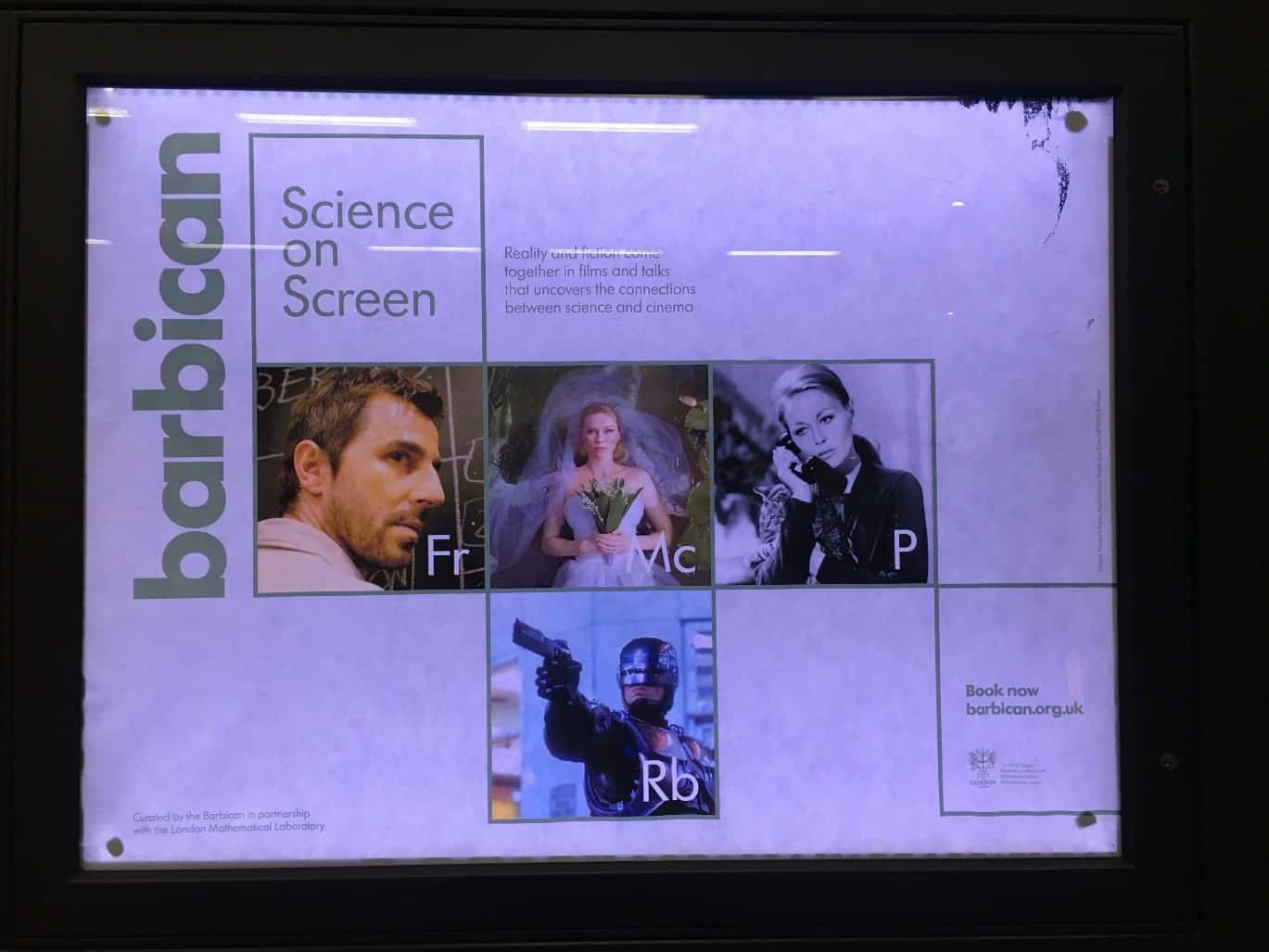
That train of events can happen, as I discovered last week at an event at the Barbican Centre in London. Organized in collaboration with the London Mathematical Laboratory, the event was part of the Barbican’s Science on Screen season of films and talks, which seeks to uncover connections between science and the cinema.

Our speaker was Valerio Lucarini, a statistical physicist from the University of Reading in the UK, who in 2011 was working in Hamburg, struggling to define his latest research project. Ideas had been floating around his mind – fluid dynamics, geophysics, mathematical modelling, turbulence. But how did the individual pieces fit together?

One evening, his movie-loving wife suggested a trip to the cinema as a distraction. The film they saw was Melancholia by the Danish film director Lars von Trier. To Lucarini’s surprise, the film inspired in him a new way of thinking and provided the missing piece of the puzzle for his research. His findings resulted in a proper scientific paper, which was published last year in the IOP Publishing journal Nonlinearity,

Photo of Valerio Lucarini

The event at the Barbican saw Lucarini present the main findings of his paper, “Edge states in the climate system: exploring global instabilities and critical transitions”, before Melancholia itself was shown in full.

Released in 2011, Melancholia is ostensibly a disaster movie, in which a giant planet – “Melancholia” – is on course to collide with the Earth. But there are broader themes too, including mental illness, family relations, paranoia and existentialism.

The story is told in two parts, each focusing on one of the two protagonists: the sisters Justine (Kirsten Dunst) and Claire (Charlotte Gainsbourg). In the first part we see Justine, who is living with depression, attempting to navigate the logistical and emotional maelstrom of her wedding day, which her sister has lovingly organized. The film’s second part focuses on Claire who is already married – to an astronomer (Kiefer Sutherland) – and living a life of (material) comfort in a grand country mansion.

As the planet Melancholia moves visibly into the the Earth’s orbit, and the film draws towards its seemingly inevitable conclusion, we see the two sisters react and try to cope with the situation, often in contrasting and unexpected ways. I’m reminded of a line from Lucarini’s paper: “We find situations where the Melancholia state has chaotic dynamics.”

Before the screening, I caught up with Lucarini at the Barbican to find out more about the story behind this unusual research. “The director takes scientific ideas that are perhaps even beyond his understanding and renders them on screen with extreme accuracy,” Lucarini told me enthusiastically over coffee. Central to the film’s dramatic tension is a sense of waiting, an inability to predict what’s going to happen, and it’s this, Lucarini says, that provided the spark of inspiration for his paper: or, as he puts it, “a meeting of rigorous mathematical modelling with a new way of looking at climate change”.

The paper focuses on fluctuations in the Earth’s climate system between two stable states: a “snowball state” (like an ice age), and the warm climate we currently live in. The boundary between these two climatic states – the so-called edge, or Melancholia, state – is the paper’s central theme, taking direct inspiration from the film. It’s like the snowball and warm states are two mountains and the edge/Melancholia state is the valley in-between. As a system encounters the edge/Melancholia state, it becomes harder to predict what effect even the smallest forces, or perturbations will have on its overall stability.

It might all sound rather esoteric, but the Barbican event was packed with a mixture of film fans, Barbican regulars, Lucarini’s friends and science enthusiasts of varying ages. There was even a contingent of secondary-school children, whose audible amusement at some of the film’s more graphic scenes drew sharp shushing from some quarters.

Photo of the Science on Screen event at the Barbican in London

“We can understand states – climatic or emotional – but what do we know about the transition between them, and what mechanism decides where we end up?,” Lucarini told the audience. “Science is about exploring the limits of what you don’t know.” It sounded profound at the time and, with hindsight, it feels like Lucarini may have been encouraging us to view the film with an open and inquisitive mind, which is good advice.

If you’re familiar with von Trier’s oeuvre, you’ll know that he seldom makes things easy for his audience, and Melancholia is no exception. The film is peppered with ambiguity, symbolism, nonsensical dialogue and unanswered questions. No doubt this is part of its appeal for some cinema-goers, including Lucarini himself, who told me with a smile how he likes “questions more than answers”. He was referring to scientific research but he could so easily have been extolling the film’s ability to raise questions in the mind of the viewer. For me, it was indeed a thought-provoking film, and visually beautiful to boot – if a bit long.

Both Lucarini’s paper and von Trier’s film emphasize the importance of the space in-between states; the former in its potential for understanding changes in climate, the latter in terms of understanding the human condition.

But what did the director make of a scientist taking inspiration from his work? Lucarini says he sent a copy of his paper to Zentropa (the production company behind the film) and received a nice response from von Trier to say he was surprised and proud.

Melancholia is not, of course, the first time cinema foretold the future. Were those iPads we saw in 2001: a Space Odyssey? Was Arnold Schwarzenegger riding a driverless car in Total Recall? Even James Bond’s jetpack now seems more science fact than science fiction. Those examples may be frivolous , but – as with Lucarini and his edge states – they’re all about fiction informing fact and about life (or science) imitating art imitating life.

Alliance with 2D materials boosts sulphur-based batteries

Sulphur has recently proved a cheap and competitive partner for lithium ion batteries with an energy density of 2600 Wh/kg, in theory. In practice lithium-sulphur batteries have suffered from low cycling lifetimes attributed to the polysulphide ions shuttling to and from the electrodes during charge and discharge. Now researchers at the Dalian Institute of Chemical Sciences, the Chinese Academy of Science, have developed a hybrid interlayer combining graphene and Co(OH)2 nanosheets that prevents sulphide movement and enhances use of the sulphide ions to improve the battery capacity and cyclability.

Reporting their results in the first issue of the Journal of Physics: Energy Zhong-Shuai Wu and colleagues highlight the electrical insulation of elemental sulphur and the discharge products Li2S/Li2S2, as a challenge for optimizing performance, as well as the sulphide ion shuttling, which alongside volumetric expansion and lithium dendrite formation diminish the cycling lifetime.

Zhong-Shuai Wu

Interlayer innovations

Other groups have previously experimented with modifying the separator – a standard battery component between cathode and anode – with nonpolar carbon materials to prevent the sulphide ion shuttling. However, the interactions between sulphide ions and those modified separators were too weak to effectively block their diffusion. Wu and colleagues get around this with the hybrid interlayer they coat on the separator because the Co(OH)2 nanosheets are polar and so increase chemical interactions with the sulphides, while the graphene nanosheets  serve as a physical barrier for preventing the diffusion and migration of the dissolved polysulfides. The high functionality of the graphene and Co(OH)2 nanosheets with a strong synergistic effect for suppressing the shuttle effect also allows low mass loading of just 0.20 mg cm-2.

“The EG [exfoliated graphene] sheets in hybrid interlayer can serve as a polysulfides physical barrier and electrical conductive network to increase the reuse of polysulfide trapped while the polar Co(OH)2 nanosheets can fulfil the role of chemical adsorption of polysulfides,” they explain in their report. “As a consequence, high-capacity Li-S batteries with 918 mAh/g at 0.5 C, accompanied with exceptional rate capability (677 mAh/g at 5 C) and stable cycle stability (565 mAh/g after 300 cycles at 0.5 C), are achieved.”

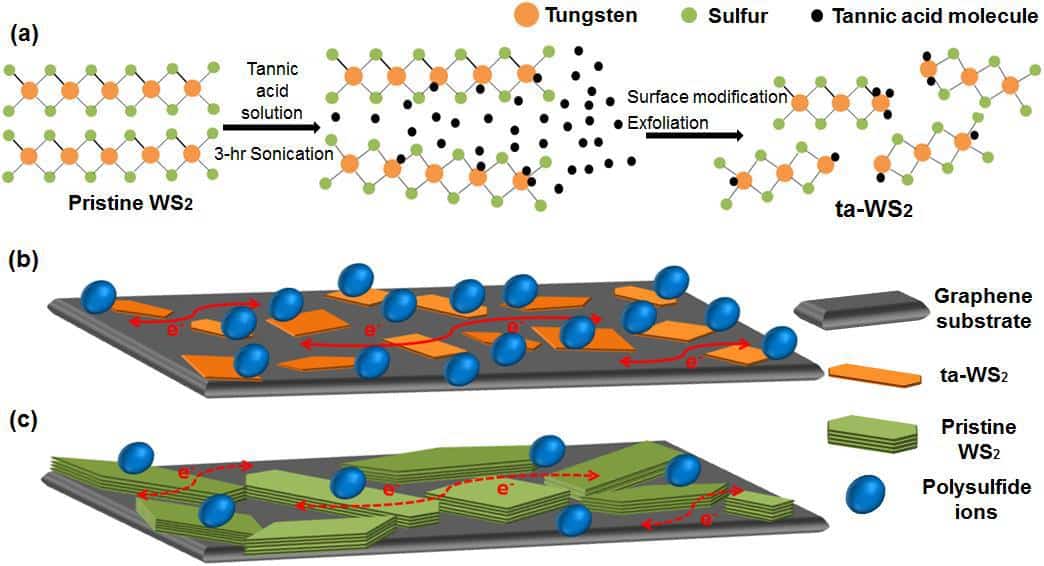
Tannic WS2 enhancements: (a) Schematic representation for effective exfoliation and modification of pristine WS2 with tannic acid assistant. (b) and (c) Schematic illustration of polysulfide species on the graphene mixed with ta-WS2 and pristine WS2, respectively. Credit: Journal Physics: Energy

Optimizing reaction rates

Da-Wei Wang at the University of New South Wales in Australia and Xin Tan at Australian National University and colleagues also report results of research focused on polysulphide batteries in the first issue of Journal of Physics: Energy. They suggest, “Although substantial effort has been devoted to the improvement of LIBs [lthium ion batteries] and various vigorous studies toward further development still continue, the present Li-ion technologies cannot fulfil the ever-increasing requirements of the modern society, because of the limited energy density and expensiveness in the large-scale applications.”

They add that the main barrier to uptake for polysulphide organic battery systems is the cost and flammability, which has prompted a lot of effort to make organic polysulphide systems that operate with an aqueous-based electrolyte. This has in turn led to frustrations with “sluggish” reaction rates. Wang and Tan and their colleagues tackle this with a conducting graphene support decorated with hydrophilic WS2 nanosheets exfoliated using tannic acid. In their report they highlight that as well as enabling efficient exfoliation of WS2 nanosheets, the tannic acid modifies them to enhance the hydrophilic properties thereby improving the electrocatalytic activity of the WS2 and boosting the battery reaction rates.

“The incorporation of tannic acid imposed the collective interactions between polysulfide and the WS2 nanosheets via the hydrophilic molecules and the polar surfaces,” they explain in their report. “With a 0.5 M Li2S2 electrolyte, the graphene and modified WS2 mixture gave an areal specific capacity of 0.37 mA h/cm2, compared to 0.27 mA h/cm2 for the pure graphene.”

Full details of both papers are available in the first issue of Journal of Physics: Energy.

It’s all smoots and garns

How much beauty does it take to launch a ship? How much does a male physicist’s beard grow in a second? And what is the optimal length of a lecture? These may not seem like typical phenomena you need to measure, but they’ve nonetheless inspired creative souls to forge new units of measurement.

They are just some of the weird scales that exist in the shadows of the formal SI units and their spin-offs. With the recent redefinition of our beloved kilogram, ampere, kelvin and mole, now is the perfect moment to acknowledge those other units that escape the close scrutiny applied to scientific inquiry. Yes, they may lack the precision of nature’s numbers, such as the Planck constant – the cornerstone of the new kilogram measurement – but they more than make up for that deficiency with grit, character and insight. Or at least funny backstories.

The man is the measure

Oliver R Smoot knows perhaps better than anyone how an unlikely unit of measurement, born in a flash of youthful necessity, can endure over decades. In the autumn of 1958, he was a fresh-faced first-year student at the Massachusetts Institute of Technology (MIT) in Cambridge, US. Smoot had pledged to join the Lambda Chi Alpha fraternity and, as such, was at the mercy of the group’s pledgemaster – an older student charged with delegating ridiculous tasks to new recruits. On a cool October night, the challenge took place on the Harvard Bridge, which spans the Charles River and connects Cambridge with Boston.

The task? Measure the bridge. The ridiculous element? Do it in smoots.

As the shortest “pledge” – 5 feet 7 inches or 1.70 m – Smoot was declared the unit of measurement. He lay down over and over again, his feet picking up where his head had been moments before. The other students marked his progress with chalk and then painted “smoot marks”. The bridge turned out to be about 364.4 smoots long, plus or minus an ear, and the stunt has gone down in history.

“It illustrates how something that can take you an hour and a half when you’re a freshman in college can live to affect your whole life,” Smoot says. “It turned out to be in a good way.”

The next year, the new Lambda Chi Alpha pledges returned to the scene of the smoots and repainted the lines, a practice that grew into an annual tradition and means even today’s visitors to the Harvard Bridge can mark their progress across the river in smoots. Indeed, when the bridge was rebuilt in the 1980s, Smoot says, the project manager was so impressed with the measure that he planned to space the expansion joints by exactly one smoot.

Oliver R Smoot and colleagues

That decade also saw Smoot’s son attend MIT but he declined his dormmates’ passionate exhortations to join them on the bridge and re-measure the bridge in next-generation smoots. Standing at 6 feet 1 inch (1.85 m), this would have led to confusion.

Smoot senior’s original stunt turned out to be predictive of his achievements in later life. After MIT, he went to Georgetown University law school, and then worked on policy issues affecting the computer industry. But in 2001 Smoot was appointed chair of the American National Standards Institute, before becoming the president of the International Organization for Standardization two years later. In other words, Smoot – the man and the measure – eventually led the leading organizations behind setting standards of measurement.

In 2008 Smoot, who now lives in San Diego, returned to campus for the 50th anniversary of that night, during which a plaque was installed on the bridge and the human unit – Oliver himself – was given a “smoot stick” measuring 5 feet 7 inches long.

We know standards change – for example, the International Prototype Kilogram has not kept the same mass over the years – which is one reason why the SI units are being redefined in terms of universal constants. Smoot says that over the years people have asked if he’s lost height and what that would mean for redefining the smoot, but so far it hasn’t happened – he remains 5 feet 7 inches, just like that night in 1958. “I think my mother, who is now 98, is at least four or five inches shorter than she used to be,” he says, “so I guess it will happen. And then we’ll have to go back to the Harvard Bridge and just trust those marks made in 1958.”

The Garn scale

Of all the units to take your name, being the standard for space sickness is probably not top of your wish list. But for Senator Edwin Jacob “Jake” Garn, that would forever be a legacy from his trip into space following anecdotes about him throwing up.

While plenty of astronauts have gone on to have political careers, Garn was the first to go in the opposite direction. Having served as a senator from Utah from 1974 to 1993, Garn was tightly connected to NASA’s finances in his role as the leader of a Senate sub-committee that had to approve the space agency’s budget. But he was also an experienced pilot and, according to Jeff Bingham – once Garn’s chief of staff – the senator opened a meeting with NASA officials with the question: “When do I go?” It sounded like a joke, but it sank in. At a later meeting, NASA’s deputy administrator Hans Mark supported the idea of sending Garn into space: “The whole purpose of the Space Shuttle is to have routine access to space. What better way to demonstrate that than to fly a member of Congress?”

Garn joined a seven-day mission on the NASA Space Shuttle Discovery in April 1985 as a payload specialist. For the mission, he was the subject of medical studies so that scientists could look at the effects of catapulting a body into space.

Jake Garn

Despite his previous experience as a pilot, anecdotes about his training inspired a new unit of measurement for nausea. “Garn represents the maximum level of space sickness that anyone can ever attain, and so the mark of being totally sick and incompetent is one garn,” recalled the late Bob Stevenson – an oceanographer who taught astronauts – in an oral history interview for NASA’s Johnson Space Center. “Most guys will get maybe to a tenth [of a] garn, if that high.”

The “Garn scale” quickly gained momentum as a measure of how sick a person became during spaceflight, though its application isn’t standardized. Some, like Stevenson, characterized it as a measure between 0 and 1. Others refer to it as a scale from 1 to 10. A month after that Discovery mission, a biochemist studying how some test animals had fared on another space voyage told The New York Times that some squirrel monkeys were “two garns”. What he meant was that the critters were pretty sick, but they could have been sicker.

Garn himself has always maintained a sense of humour about the metric. He has acknowledged that just being able to report a Garn scale showed that a person had experienced an adventure unlike any other. “And believe me, I’d throw up every day just to go into space again,” he said in a 2005 interview.

Erdős–Bacon number

The title of Paul Hoffman’s 1998 biography of Paul Erdős called the Hungarian-born mathematician “the man who loved only numbers”. Erdős, who as a student declared prime numbers his best friends, was phenomenally prolific and a titan of 20th century mathematics. “If numbers aren’t beautiful,” he liked to say, “I don’t know what is.” During his lifetime, fuelled by coffee and amphetamines, he published about 1500 papers, and roughly half of those were in the field of number theory. After his death in 1996, his former student Carl Pomerance, then a mathematician at the University of Georgia in the US, called him a “kind and generous man, one who would seek out young mathematicians, work with them, give them ideas, teach them, and in the process make a lifelong friend and colleague”.

You could argue that Erdős treated mathematics as a social event; during his career he collaborated with more than 500 other mathematicians. The importance of his contributions, combined with his vast network of collaborators, gave rise to a prestigious unit of measurement: the Erdős number. A person’s Erdős number is a status symbol. It represents the number of “steps” – measured by collaborations through published papers – that connect a mathematician to Erdős. Each of his 509 collaborators, for example, has an Erdős number of 1. Albert Einstein published a paper with Ernst Gabor Straus in 1945, and Straus published a paper with Erdős in 1953. That means Einstein’s Erdős number is 2. Meanwhile, Stephen Hawking’s is 4 and Marie Curie’s is 7.

However, you can do more with your Erdős number, and a select few have. It requires going to Hollywood. Forget the Oscars; among some actors, one unit of prestige is their Bacon number. This represents how many “steps” – measured by collaborations in feature films – connect the actors to Kevin Bacon, who has starred in many films and TV shows including Footloose, Tremors and Apollo 13.

Erdos and Bacon

In the 1990s three college students introduced a party game called “Six Degrees of Kevin Bacon”, in which players connect actors to Bacon through mutual appearances in movies, not unlike the way mathematicians are connected to Erdős. Julia Roberts starred with Kevin Bacon in the 1990 movie Flatliners, which means she has a Bacon number of 1. Physicist Neil deGrasse Tyson voiced a character in 2016’s Ice Age: Collision Course, which also starred Queen Latifah, who was in the 2005 film Beauty Shop with Kevin Bacon. That means deGrasse Tyson’s Bacon number is 2.

There exists a small set of people in the world who have both Erdős numbers and Bacon numbers, which can be conveniently combined into Erdős–Bacon numbers. That is, they can connect to Kevin Bacon through their filmography, and connect to Paul Erdős through their publication history. The actress Natalie Portman, for example, earned an Erdős number of 5 through a research paper she co-authored while a student at Harvard, and a Bacon number of 2 through her film career (she was in Mars Attacks! in 1996 with Jack Nicholson, who starred with Kevin Bacon in A Few Good Men in 1992). Her Erdős–Bacon number is therefore 7. Carl Sagan’s Erdős–Bacon number is 6.

Not to be left out, Erdős himself, because he appeared in a documentary about his life, has an Erdős–Bacon number of 3. Kevin Bacon, as far as we know, does not have an Erdős–Bacon number. Time for him to take up some mathematics, I think.

Banana equivalent dose

When it comes to measuring the amount of ionizing radiation we absorb, we have many tools to choose from. We can measure in sieverts, rads, curies, grays – and even bananas. “Some time ago (when I almost had time to do such things) I calculated the dose one receives from the average banana,” begins a legendary 1995 note from Gary Mansfield, a health physicist at the Lawrence Livermore National Laboratory in the US, who has since retired. Marshall sent the note to the lab’s RADSAFE electronic bulletin board.

“As best as I can remember, my intent on ‘cooking up’ this new unit was to emphasize that people were getting all worked up about truly trivial doses of radiation,” he says. “And the BED [banana equivalent dose] seemed to be a good way of doing that.”

Radioactive bananas

Translating units of radiation to the general public can be a tricky art for scientists. A sievert (Sv) is a dose of radiation equal to one joule of energy per kilogram of mass. There’s a natural background of about 10 μSv that an average person receives in one day, and a flight from New York to Los Angeles brings an exposure of about 40 μSv. An exposure of 1 Sv causes symptoms of radiation poisoning, such as nausea and vomiting. Studies suggest, however, that receiving a massive dose all at once is much more dangerous than receiving the same amount over a long time period.

Many foods contain radioactive elements that emit radiation. Bananas contain potassium-40 (40K), a naturally occurring isotope and Mansfield found in a radiation reference manual that they have a 40K concentration of about 3520 picocuries per kilogram. Assuming that an average banana has a mass of about 150 g, he calculated the ionizing radiation from a banana at 5.28 × 10⁻⁴ microcuries, or about 0.1 μSv.

Mansfield wrote that BED gave him a useful way to talk to the public about everyday minuscule doses – and their minuscule risks. Critics of the BED have, however, noted that the human body naturally maintains a fairly steady concentration of potassium, so eating bananas won’t cause an accumulation.

Looking back, Mansfield acknowledges that the critics have a point, and the idea of getting additional radiation from eating lots of bananas is probably inaccurate. “However, I think I would still argue that if bananas are part of one’s normal diet, the 40K in those bananas does contribute to one’s annual dose from 40K,” he says – even if the radiation doses in the range of a banana are “truly trivial”, and not worth worrying about.

Mansfield ended his original 1995 post to the RADSAFE bulletin board with a stern warning: “Considering the fact that the DOE [Department of Energy] has officially stated that ‘there is no safe dose of radiation’, my advice to you all is to stop eating immediately.”

Ships, beards and lectures

So what about our ship-launching beauty, beard growth and perfect lectures? According to the biochemist and science-fiction writer Isaac Asimov, it takes a “millihelen” of beauty to launch one ship – in honour of Helen of Troy (of The Iliad, The Odyssey and The Aeneid) who was famously described in a 17th-century play as having a “face that launch’d a thousand ships”. An article in the Journal of Irreproducible Results, a science humour magazine, once estimated that in one second, a male physicist’s beard grows about 5 nm and defined that as a “beard-second”. And finally, mathematician John von Neumann allegedly proposed that the optimal length of a lecture is one “microcentury”, which comes out to about 52 minutes, 34 seconds – as long as you ignore leap years.

I’m sure I’ve missed some of your favourite strange units. If so, do let the editors of Physics World know. I’m off to measure my beard.

Machine learning identifies foetal size from ultrasound images

Deep learning-based AC measurement

Bukweon Kim and colleagues from Yonsei University have developed a machine learning-based method for automated analysis of foetal ultrasound images. They report excellent levels of accuracy in determining foetal biometric parameters in this way (Physiol. Meas. 39 105007).

Currently, measurements of foetal head circumference and abdominal circumference (AC), for instance, are estimated manually from ultrasound images by skilled clinicians. These parameters are useful benchmarks to gauge gestational age, but the process can be time consuming and laborious. To get around those problems, the research team has developed a machine learning method that takes into account clinicians’ decisions in order to automate the estimation process.

In comparison, previous efforts to automate foetal biometric estimates have relied on image intensity. This often leads to good segmentation of well contrasted anatomical structures but can fail when measuring low-contrast features.

Substituting clinicians with a machine-learning algorithm

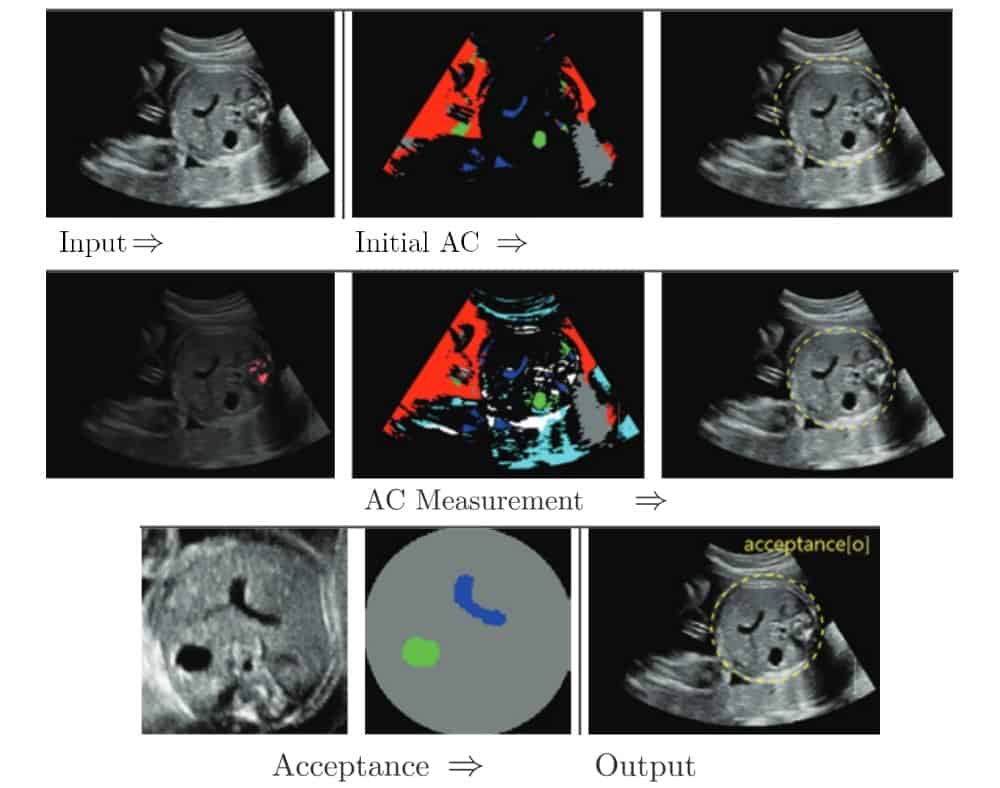
The researchers used a three-stage approach. In the first step, they obtained an initial estimate of the AC. They used a convolutional neural network (CNN) to determine the stomach bubble, amniotic fluid and umbilical vein in the ultrasound image, and from these three features, derived an estimate of the AC.

Yonsei University team

The novelty of Kim’s approach is contained in the second step, where the images together with the AC estimates were fed into a second CNN. This CNN then used these data to estimate the position of bony structures such as the mother’s ribs. This information was then used to refine the initial AC estimate.

In the final step, the researchers passed the final AC measurement along with the ultrasound images to a specific class of CNN known as a U-net. The U-net decided whether or not the ultrasound images, together with the AC estimate, are accepted or rejected, in a manner that mimics the decision of the clinician. In this way, the machine learns what to look for.

Kim and colleagues used 112 images to train each CNN and the U-net, and 62 images to evaluate abdominal circumference. They obtained accurate segmentation of the ultrasound images, including images rejected by the machine because they showed the wrong anatomical plane, in 87.10% of the verification cases.

More details for better diagnostics

Commercial systems are available to estimate the abdominal cavity volume from ultrasound images. However, these methods often fall short of clinical requirement due their inability to utilize structural information within the ultrasound image, such as shadowing artefacts caused by the ribs. By using a combination of several CNNs and a U-net, Kim and colleagues have shown that machines have the capacity to learn how to provide this structural information, which can in turn assist clinicians by automatically segmenting images with a good degree of accuracy.

Purple bacteria produce hydrogen from waste water

Domestic and industrial wastewater contains organic substrates and nutrients that could be used to produce biofuels, such as hydrogen, as well as to recover carbon if the right extraction method were found. A team of researchers in Spain has now put forward one such method that makes use of purple phototrophic bacteria, which can store energy from infrared light when an electric current is applied.

These microorganisms can recover nearly 100% of carbon from any type of organic waste while generating hydrogen gas for electricity production, explains co-team leader Daniel Puyol of King Juan Carlos University (URJC) in Madrid.

Purple bacteria

Purple phototrophic bacteria are extremely versatile thanks to their complex metabolic system that involves major carbon, nitrogen, sulphur, phosphorus and iron pathways, catalysed by various enzymes, he says. They absorb infrared energy through their photosystem, which is composed of carotenoids and bacteriochlorophylls. This means that they can be used to extract valuable products, such as biofuels like biohydrogen, bioplastics like PHA and even single-cell proteins, from waste sources.

The end product obtained very much depends on the environmental conditions in which the bacteria find themselves, however. These include the intensity of IR light they receive, surrounding temperature and nutrient concentration, to name but three parameters.

In their experiments, the researchers varied these conditions to tune the metabolism of the bacteria to different end-applications. For example, wastes rich in nitrogen help the bacteria to grow and produce biomass with a high protein content that can subsequently be used as an animal food additive. In organic waste lacking nutrients, the bacteria can amass large amounts of PHA (up to 70-90% w/w) and are thus an interesting alternative to fossil-fuels for producing plastics.

When the waste contains a lot of organic matter such as butyrate, it can be used produce biogenic hydrogen, a clean and renewable biofuel, by applying an electric current. “What is unique about our approach is that we use this current to optimize the productive output of purple bacteria,” says co-team leader Abraham Esteve-Nuñez of the University of Alcala. “This is possible since the different metabolic pathways rely on bioelectrochemical reactions that require a supply of electrons.”

Analysing the hydrogen-producing capacity of the bacteria

The researchers obtained their results by analysing the hydrogen-producing capacity of the purple bacteria when grown in various nutrient cultures containing different nitrogen and carbon sources. They inoculated the test samples with a mixed culture of the bacteria enriched from a wastewater influent taken from the pilot-scale wastewater treatment plant at URJC. They then exposed the cultures to near IR light.

The team found that maximum amount of hydrogen was produced using a mixture of malic acid and Na-glutamate and that this blend also minimized the production of CO2. It also found that when electrodes were connected to the culture, the bacteria again produced considerable amounts of hydrogen (by capturing electrons produced by the negative electrode, or cathode) but negligible traces of CO2.

“This result also suggests that the bacteria can interact with the cathode to extract electrons to capture more carbon from organic compounds via photosynthesis,” says Esteve-Nuñez. “This is the first time that a phototroph has been seen to adapt its metabolism due to interaction with an electrode.”

The study is detailed in Frontiers in Energy Research 10.3389/fenrg.2018.00107.

Copyright © 2026 by IOP Publishing Ltd and individual contributors