A common maxim about climate change says that wet places will grow wetter, while dry places will dry more. A recent study by US scientists suggests that, when it comes to effects on humanity, rising dryness will be key.
“We show that although some regions do get wetter, many of those are sparsely populated,” says Megan Lickley of the Massachusetts Institute of Technology (MIT), US. “So from the viewpoint of humanity, ‘wet-get-wetter, dry-get-drier’ doesn’t characterize our human future, which is [actually] heavily dominated by drying.”
By 2100, half the world’s population will live in regions where dryness has risen by at least 5%, Lickley and colleague Susan Solomon showed. Assuming a high, “business as usual” emissions scenario, areas that are technically arid will be home to 700 million more people than today.
The populations worst affected will be in Africa and Asia, according to the team. Northern Africa has already begun to see rises in aridity.
Lickley and Solomon calculated an aridity index from parameters such as temperature, precipitation and humidity generated by a collection of climate models, for different areas and for all years in the 20th and 21st centuries. Then they overlaid changes in the aridity index with data on current and forecast population distributions.
The researchers found that drier regions are projected to dry earlier, more severely and to a greater extent than relatively humid regions, mostly because of changes in precipitation. The dry regions tended to coincide with regions of high and increasing population.
“As climate change continues to impact human life, improving our understanding of the timing, drivers, and how such changes coincide with human populations will better inform adaptation and mitigation strategies,” says Lickley. “Our research aims to shed some light on what the future – given the business-as-usual emissions scenario – might hold for populations, and in particular vulnerable populations with fewer means to adapt to a rapidly changing climate.”
In this short video from our 100 Second Science series, medical physicist Rachael Hall explains the different processes involved in radiotherapy. Hall, who works at the Christie Hospital in Manchester, talks about the underlying physics and the different stages in the patient journey. She explains what medical professionals do to make treatment as effective as possible while minimising damage to surrounding healthy tissues.
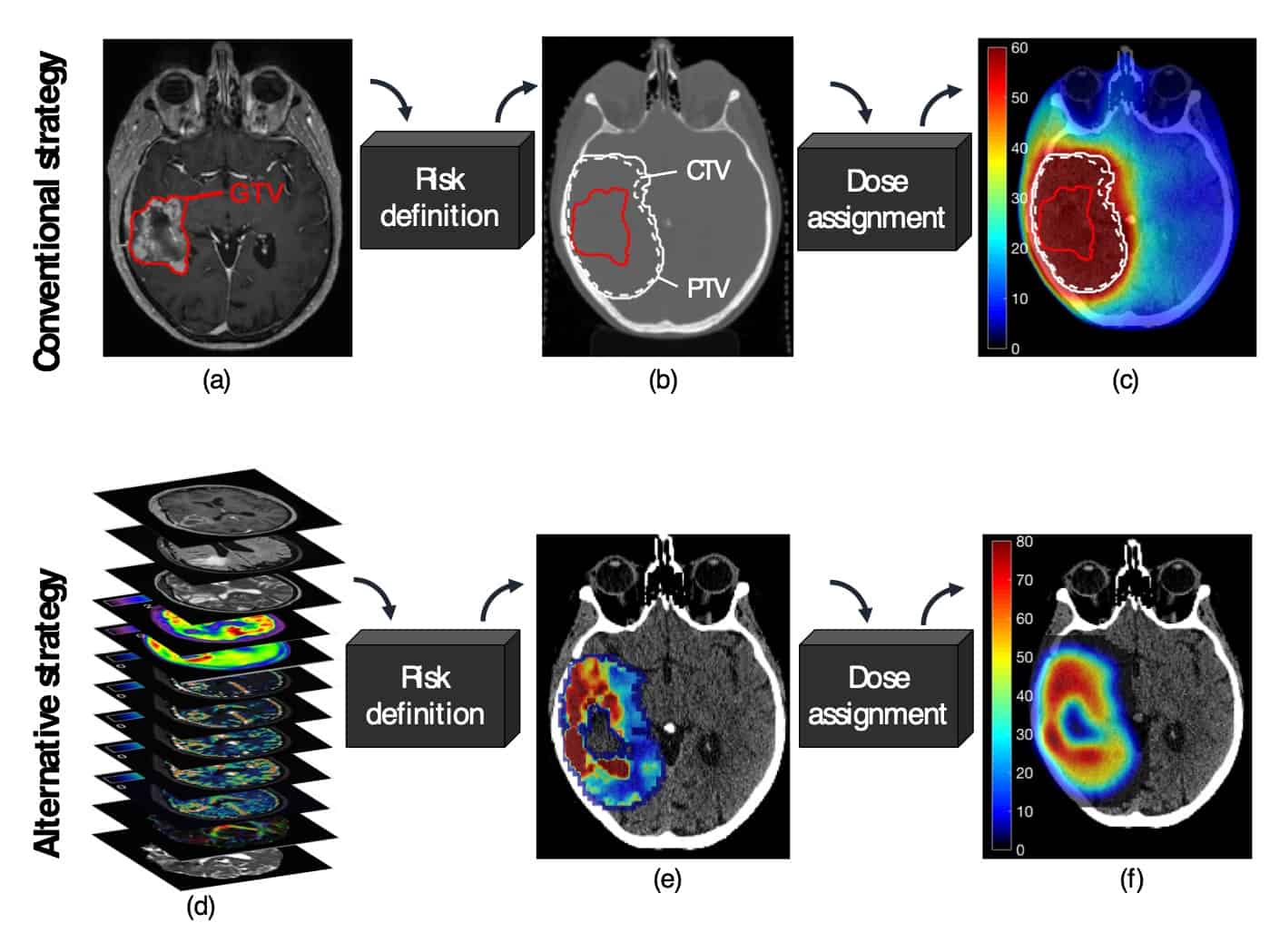
In conventional radiotherapy planning, the gross tumour volume (GTV) is defined (a) and expanded to create the clinical target volume (CTV), with a planning target volume (PTV) margin to account for uncertainties (b). A uniform dose to the PTV is prescribed (c). For the hypothetical planning strategy, anatomical and functional images (d) are used to create a map of response probability (e), which can be used to modulate the dose prescription (f). (Courtesy: Michael Lundemann)
Using advanced imaging to predict the likelihood of a malignant brain tumour recurring after radiation treatment could enable creation of a more effective treatment plan. With this aim, researchers at the University of Copenhagen have developed a model that uses pre-treatment PET and MRI to create patient-specific maps of recurrence probability for glioblastoma tumours (Eur. J. Nucl. Med. Mol. Imaging 10.1007/s00259-018-4180-3).
Radiotherapy for the brain cancer glioblastoma is conventionally planned using anatomic MRI to define radiation dose targets. Failure rates are high, however, often attributed to the target not receiving a high enough radiation dose — a trade-off of minimizing toxicity to surrounding healthy brain tissues. If a more specific target volume could be determined, identifying the area exhibiting a high risk of recurrence, this could enable delivery of a more precise, and potentially more effective, patient-specific radiation dose.
Principal investigator Michael Lundemann, a clinical scientist in biomedical engineering at Rigshospitalet, and colleagues compared multi-parametric PET and MR scans, performed prior to and after radiotherapy, to determine whether the risk model could predict a voxel-wise probability of tumour recurrence
The researchers included nine patients in the analysis. All patients had undergone a routine MRI for radiotherapy planning, a sequential 18F-FET-PET/CT scan, where the CT was used for radiation dose calculation and PET attenuation correction, and a simultaneous 18F-FDG-PET/MRI scan. These images yielded 63,862 voxels within the clinical target volume (CTV), of which 6944 voxels registered recurrent tumour. Five patients also developed recurrent lesions outside the CTV, but these were not included in the analysis.
The patients had surgical resection, followed by 60 Gy of radiotherapy and up to six cycles of chemotherapy. Tumour progression occurred between 124 and 545 days (median time of 357 days) and the overall survival was 631 (range: 290–766) days.
For the image analysis, the researchers separated the voxels within the CTV into four regions-of-interest (ROIs): contrast-enhanced lesion, non-enhancing lesion, normal appearing white matter and normal appearing grey matter. They delineated recurrent tumour volume locations, and assessed voxel-wise correlations between imaging parameters for each of the four ROIs, categorizing them as recurring or non-recurring. They created maps of tumour recurrence probability from the pre-treatment multi-parametric images, and developed four voxel-wise binomial logistic regression models (one for each tissue class).
The research showed that:
Voxels included in the recurrent tumour volume at the time of recurrence showed larger 18F-FET-uptake than voxels in non-recurring parts of the CTV;
An increased uptake of both 18F-FDG and 18F-FET was observed in recurring voxels that originated from either the contrast-enhanced lesion or the non-enhancing lesion;
An increased vascular permeability was observed in recurring voxels that originated from otherwise healthy appearing grey and white matter;
Significant median differences between recurring and non-recurring voxels were also observed for fractional anisotropy, mean diffusivity, mean transit time, extra-vascular and extra-cellular blood volume derived from scans prior to chemo-radiotherapy.
Overall, 18F-FET proved to be the most important parameter for recurrence prediction. When all models of recurrence probability were combined, the area under the ROC curve (AUC) for prediction of recurrence was 0.77.
“Our study could be a first step to enable a higher degree of patient-specific planning of dose delivery by specifically targeting areas with high risk of recurrence,” wrote the authors. “Our results are based on a low number of patients and need further validation before the clinical utility can be tested in a prospective setting. However, the results are encouraging and serve as a starting point for further studies.”
The authors do recommend use of a simpler, shorter and more manageable multi-parametric imaging protocol prior to radiotherapy. This would include PET/MRI employing 18F-FET PET, dynamic contrast-enhanced MRI and possibly diffusion weighted imaging.
“If we know in advance in which parts of the brain a tumour is more likely to recur, a radiation oncologist could decide to increase the dose delivered to high-risk areas and lower the dose to low-risk areas,” Lundemann tells Physics World. “We hypothesize this could lead to a better local tumour control without damaging healthy parts of the brain and in turn extend patient survival.”
Lundemann says that he is continuing research within brain tumours, while colleagues in his department are investigating tumour recurrence in head-and-neck tumours, lymphomas and cervical tumours.
By dropping tiny projectiles into clumps of dust, physicists in Germany and Japan may have uncovered important clues about how dust particles stick together in space to form planets. The work has been carried out by Hiroaki Katsuragi at Nagoya University and Jürgen Blum at the Technical University of Braunschweig, who looked at how a single particle collides with clumps of soft porous dust and also with clumps of hard beads.
The experiments were carried out by dropping a projectile from inside the top of a 1.5 m tall tower held in a vacuum to simulate conditions in space. The projectile, which accelerates under gravity, travels towards a target held in a cup at the bottom of the drop tower. Just before it reaches the target, however, the cup is rapidly removed so that the target material also begins to freefall. But because the projectile is falling much faster than the target, it quickly catches up and collides with the target.
Falling camera
The researchers studied a total of 64 impacts – 36 with porous-dust targets some 1-1.6 mm in size and 24 with glass-bead targets that were 1 mm in diameter. The soft, porous particles were created by sieving together irregularly-shaped pieces of silicon dioxide about 0.1-10 µm in size that tended to stick together.
A range of different projectiles was used, including glass beads of diameter 4 mm, 6 mm and 10 mm; lead shot at 4.5 mm; and plastic beads at 6 mm. By varying the release times of the projectile and targets, the velocity of an impact could be set within the range 0.045-1.6 m/s. The researchers captured the collisions using a high-speed camera falling outside the tower that keeps pace with the projectile.
Slowly does it
By inspecting the high-speed images of a collision, the team determined the deceleration of the projectile as it transfers kinetic energy to the target. When they analysed data from the 64 collisions, they found that a universal scaling law describes the relationship between the impact velocity, the projectile deceleration and the diameter of the projectile. This law applied regardless of the impact velocity of the type of projectile and target used.
Further analysis revealed that in every collision about 5% of the kinetic energy of the projectile is transferred to the target, with a further 80% of the projectile energy being dissipated by heat or the deformation of the target.
This universal behaviour in the collisions of particles with clusters could shed light on the processes whereby dust particles in space collide, clump together and eventually form a planet.
Nitrogen is one of the most abundant elements on the planet, but until the turn of the 20th century nitrogen compounds were still hard to come by. So-called nitrogen fixation in compounds such as ammonia and amides is crucial for fertilizers and other industrial chemicals, but producing ammonia or amides from nitrogen means wrestling with the triply bonded nitrogen dimolecule – one of the strongest bonds known to man.
Fritz Haber and his assistant Robert Le Rossignol developed a process that could efficiently produce ammonia from nitrogen using a combination of catalysts and high-pressure devices. Working with Carl Bosch at BASF Haber showed that the process could be used in industrial production of ammonia. Yet while the Haber–Bosch process was massively more efficient than anything previously attempted, allowing vast increases in food production to serve a ballooning population, the process requires temperatures of around 450 °C and pressures of 300 bar. As a result, this process alone is responsible for 2% of the world’s energy consumption.
It’s significant, then, that Marinella Mazzanti and colleagues at Ecole Polytechnique Fédérale de Lausanne (EPFL) showed in 2017 that ammonia could be synthesized from nitrogen and hydrogen under ambient conditions by using a catalyst made up of two uranium ions and three potassium centres bridged by a nitride group. This week, in new research published in Nature Chemistry, they report successful ammonia synthesis using a similar catalyst but with an oxide bridging group instead of nitrogen. With this new catalyst, Mazzanti and colleagues also showed that they could produce cyanamide, another industrially valuable chemical for agriculture and pharmaceuticals, in ambient conditions by cleaving the uranium-bound dinitrogen with carbon monoxide.
The Nobel and the not so noble
The result is particularly timely, since this year marks 100 years since Haber was awarded the 1918 Nobel Prize for Chemistry for his contribution to the development of the Haber–Bosch process. (Bosch also won the prize in 1931.) However, as a result of subsequent research projects connected to the First World War, Haber has also earned the less covetable accolade of “Father of Chemical Warfare”.
In fact, in many instances over the course of his life Haber seemed to attract death and trauma like a plague. His wife shot herself soon after he personally oversaw the first successful deployment of chlorine as a weapon. She was found not quite yet dead by their son Hermann Haber – who also ended his own life in later adulthood, after fathering three daughters. Hermann’s eldest daughter committed suicide as well, soon after her research into an antidote for the effects of chlorine gas was terminated to resource the race to build an atomic bomb.
Following his grisly services to the nation during the First World War, Haber found his life in Germany untenable when Hitler assumed power, as a result of his Jewish heritage. He left Germany along with his family in 1933.
Haber’s involvement in the development of chemical weapons during the First World War sparked controversy over his award of a Nobel Prize – to which he is said to retort that most of Nobel’s money came from armaments. In fact the First World War saw him pit his wits against another Nobel laureate, Victor Grignard, who was also working in chemical weaponry, in this case on the manufacture of phosgene and a detector for mustard gas.
The Second World War too took its toll on the course of progress in science, as some of the world’s most talented researchers found themselves staring out at a mushroom cloud with the haunting realization – for at least a couple of them – that despite the cerebral thrill of scientific endeavour, the means could not justify the end. While it is easy to wish some things could be undiscovered, most research aims to provide new solutions that offer a brighter future for all, and the majority of discoveries – like this week’s new ambient active catalyst – give great cause for hope.
Being able to precisely locate individual nanoparticles in a device is no easy task but it is important for many research fields, including nanometrology, medicine and biophysics. A team of scientists in Germany has now taken an important step forward towards this goal with an all-optical technique that works thanks to an effect known as Kerker scattering. The technique can locate nano-objects with a spatial resolution of less than one angstrom, which is the size of an atom.
The Kerker effect is named after Milton Kerker who used light scattering to study aerosols and colloids. Kerker showed that when ordinary, plane-polarized, light scatters from a nanoparticle (that is much smaller than the wavelength of light), highly asymmetric patterns are produced. The effect occurs in particles that respond in a similar way to both magnetic and electric fields and comes about thanks to interactions of the electric and magnetic components of the light beam and the particle.
Transverse Kerker scattering
The new technique, developed by Peter Banzer of the Max Planck Institute for the Science of Light and colleagues relies on this effect but their experiment is slightly different. The researchers use a tightly focused, azimuthally polarized light beam instead of a plane-polarized one to excite a silicon sphere measuring 156 nm across coated with a 6-nm-thin layer of SiO2. The asymmetric scattering pattern produced perpendicular to this beam changes whenever the particle moves away from an original, central position. The effect, which is known as transverse Kerker scattering, can be observed using a CCD camera and easily measured, explains Banzer.
“While Kerker originally suggested pronounced anisotropic (forward and backward) light scattering by the simultaneous excitation of electric and magnetic dipoles in a particle using a planar, unstructured wave, we have now modified this approach by utilizing nanostructured light. In our scheme, we observe a strong directionality of the signal not along the propagation direction of the exciting light beam, but orthogonal (transverse) to it. In simple terms, we redirect light, if you will, by directional interference.”
Technique could help stabilize positioning systems in microscopes
“We expect our work to have an impact on a number of applications and research fields,” he tells Physics World. “By monitoring the location and motion of a nanoparticle with an accuracy and precision below the size of a single atom (less than one angstrom), we could stabilize positioning systems in microscopes and lithography probes. This could help increase the achievable resolution in these instruments.”
The researchers, reporting their work in Physical Review Letters doi.org/10.1103/PhysRevLett.121.193902, say they are now busy developing an extension of their transverse Kerker-based localization scheme that will allow for ultra-fast time-resolved position sensing as well as the high spatial resolution described in the present work. “Such a system could serve as a sensor with a feedback-loop to stabilize positioning stages in nanometrology, imaging and fabrication,” says Banzer.
People in the United Kingdom who waste heat by failing to ensure their homes, offices and factories are leak-proof will soon have the prospect of spies in the sky to persuade them to mend their ways.
Currently buildings in the UK must be visited individually to check on their fuel use and to identify properties that could be insulated or have their heating systems updated to prevent fuel poverty.
But that is about to change. Satellite technology will make it possible to use heat mapping to pinpoint districts and even individual buildings that could be radically improved to save energy instead of wasting it.
Part of their plan is to identify homes and districts where people cannot afford to insulate their homes and suffer fuel poverty as a result, so that the UK government-funded energy efficiency plan ECO can be used to help them.
UK Business and Energy Secretary Greg Clark said: “This government-backed technology could boldly go where no technician in a van has gone before, with the potential to pinpoint households in fuel poverty or those at risk.
“Matched with government data, this heat-mapping technology could mean less time spent on the road and more time dedicated to upgrading homes through our £6bn [US$7.8bn] energy efficiency ECO scheme.”
Pinpointing the vulnerable
At the moment it is difficult to locate whole areas or communities that would benefit most from improvements, because residents may be wary of reporting themselves as vulnerable or in need of extra help.
The scheme is to be developed over the next 18 months in various cities in the UK to pinpoint these communities. If it is successful it will be introduced in other parts of Europe.
Using government data on deprived areas and information from housing associations and local authorities, researchers will be able to identify the people who will benefit most from better energy efficiency and so help to alleviate the problem of fuel poverty.
Big data
Michael Lewis, E.ON’s UK chief executive, said: “Delivered on the doorstep but driven by big data gathered from Earth orbit, our work with Astrosat, in collaboration with ESA, is about using the almost endless possibilities of space to deliver real benefits on the ground.
“This exciting project is about harnessing the power of space, alongside our experience working with local authorities and delivering real change in terms of fuel poverty and carbon emissions, to help reduce heat loss and unnecessary energy expenditure in regional areas across the UK.
“This is a UK trial at this stage, but all involved have the ambition to prove the benefits across countries and continents to help create a better tomorrow.”
The three partners believe that if the trial is successful the same technology can be used to identify areas suffering from air pollution, making it possible to ease traffic congestion in affected areas.
Zond 6 was an unmanned Soviet mission to the Moon that launched in November 1968. This was just one month before the US launched the manned Apollo 8 mission, which successfully orbited the Moon.
Radio signals from Zond 6 were captured by astronomers at the UK’s Jodrell Bank observatory and the audio was preserved on a reel-to-reel tape. Now, 50 years later, the observatory is releasing the audio. Although no-one was aboard the spacecraft, the broadcast included human voices – either being relayed from Earth and back, or from an on-board recording.
Not having a Russian speaker on-site, Jodrell Bank astronomer Tim O’Brien asked his University of Manchester colleague Kostya Novoselov to translate. Novoselov’s day job is studying graphene, for which he shared the 2010 Nobel Prize for Physics with Andre Geim.
Metrologists and policy-makers from 60 countries around the world have unanimously agreed to change the definition of four units of measurement. At a meeting today at the General Conference on Weights and Measures (CGPM) in Versailles, France, delegates voted to redefine the International System of Units (SI), changing the world’s definition of the kilogram, the ampere, the kelvin and the mole. The changes will now come into force on 20 May 2019.
There are seven base units of the SI: the second, metre, kilogram, ampere, kelvin, mole and candela. Some have long been based on physical constants. The metre, for example, has been defined since 1983 as the length of the path travelled by light in vacuum during a time interval of 1/299 792 458 seconds. But the four that metrologists today agreed to redefine were previously based on something – i.e. an object, experiment or phenomenon — meaning that its value is not universal.
New definitions
Today’s decision means that all seven SI units will now be defined in terms of physical constants. The biggest change will be to the kilogram, which is currently set by a 143-year-old platinum alloy cylinder, dubbed “Le Grand K” housed in the International Bureau of Weights and Measures (BIPM) in Paris. The kilogram will now be defined in terms of the Planck constant, h, which has been measured with extraordinary precision in recent years. Its agreed value will be set as 6.626 070 15 × 10–34 kg m2 s–1.
The ampere, meanwhile, will be set by the elementary electrical charge, e, which is given as 1.602 176 634 × 10–19 when expressed in coulombs. The Kelvin will be defined by taking the fixed numerical value of the Boltzmann constant k to be 1.380 649 × 10—23 when expressed in the unit J K-1 and the mole by the Avogadro constant (NA) contains exactly 6.02 214 076 × 1023 elementary entities. This number is the fixed numerical value of the Avogadro constant, NA, when expressed in the unit mol–1.
In daily life, however, the new SI units will have little immediate practical consequence. While the units may be defined differently, the goal has been to keep their size the same. Yet defining the units based on physical constants means that scientists will be able to measure them at any place or time, and on any scale. “The SI redefinition is a landmark moment in scientific measurement,” says Jan-Theodoor Janssen, director of research at the UK’s National Physical Laboratory. “This will pave the way for far more accurate measurements and lays a more stable foundation for science.”
A round-up of some recent international patent applications in radiation therapy.
Silicon photomultipliers line up for Cerenkov-guided radiotherapy
Cerenkov emission during external-beam radiotherapy provides a useful quality assurance tool and potential for online tracking of tumours during treatment. However, molecular probing of the cancer status during delivery has not been developed — mainly due to the limited sensitivity of current photodetectors for Cerenkov emission and a lack of tools to fit into the complex treatment delivery environment. Silicon photomultipliers (SiPMs) offer the high sensitivity of photomultiplier tubes, with a similar a form factor to silicon photodiodes, allowing for improved flexibility in device design. In patent application WO/2018/208775, University of Michigan researchers present a SiPM array-based multispectral optical probe. They assess the feasibility of using SiPMs to detect Cerenkov emission and interrogate physiological information during radiotherapy.
Dose calculations compensate for inhomogeneous tissue
Particle therapy of inhomogeneous tissues such as lungs, which include an irregular pattern of air cavities, is difficult as the structure of such tissue affects the trajectory of the ions and can cause errors. Raysearch Laboratories has developed ion radiotherapy dose calculations that compensate for tissue in which voxels may be inhomogeneous in density, by approximating a portion of the voxel as an air cavity (WO/2018/189364). Each dose voxel is inscribed in a 3D grid comprising a number of cells, preferably in such a way that the voxel overlaps at least one cell fully. Each cell comprises one portion representing the density of tissue and a second representing the density of air, the first and second portions forming a cell pattern. The propagation of ions through the voxel is then calculated based on the cell pattern in any cells overlapping the voxel.
Compact system delivers gantry-less particle therapy
A team from Massachusetts General Hospital has published details of a gantry-less particle therapy system (WO/2018/204579). The described methods can be used to treat patients in the same room as the particle therapy system by positioning the treatment area inward from the system’s beam track. Charged particles are extracted from an ion source and accelerated in a beam transport system. This transport system has an annular portion that extends in one plane and circumscribes a volume, an arcuate portion in a second plane, and a transition portion that connects the two. The arcuate portion terminates at a beam nozzle that extends radially inward from the annular portion to deliver an ion beam to a treatment area within the volume defined by the annular portion.
Motion target volume accounts for shape changes
Elekta has devised a way to generate a motion target volume that represents changes in the shape of the target in a patient during radiotherapy delivery (WO/2018/208390). At least one computer system is configured to receive a series of medical images that include the target region, with each image taken at a different time point. The computer defines a 3D volume containing the target in each image; this 3D volume may be different in at least two of the images due to differences in the shape of the target region. The system then co-registers the 3D volumes and generates the motion target volume, which encompasses each of the 3D volumes.
Dermatology system delivers fast skin treatments
Sensus Healthcare has invented a dermatological radiotherapy system with a hybrid imager that can be used to diagnose, treat and verify treatment of skin cancers or lesions (WO/2018/187619). The system provides a means to deliver the required radiation dose to the patient in a significantly shorter period of time — for example, less than 1 min as opposed to more than 5 min — by increasing the flow of photons emitted from a radiotherapy treatment device. This is achieved by shortening the removable applicator of the radiotherapy device, and using either relatively thick filters with normal dose rates (less than 1000 cGy/min), or thin filters with relatively high dose rates (above 1000 cGy/min).