Transparent microelectrodes improve brain activity mapping

Transparent electrodes

Arguably the biggest scientific challenge of the century is to delve into how the brain works – what stimulus activates which neuron(s) and how does that affect behaviour and thinking? There are a lot of different technologies with brain mapping functionality, but none have the resolution needed to track underlying cellular and molecular patterns in the brain.

Scientists want to combine the temporal resolution of electrophysiology recordings with the spatial resolution acquired with two-photon imaging of neuronal calcium fluctuations. But this requires fabrication of a special electrode that possesses good electrical function for electrophysiology, whilst allowing light to pass through for two-photon imaging.

A number of different materials have been trialled for use in transparent electrodes, but when scaled to measure single neuronal activity, the electrodes all had poor electrical performance. Signal-to-noise ratio suffers, because at the micrometre scale, complex resistance leads to high impedance and corresponding large noise.

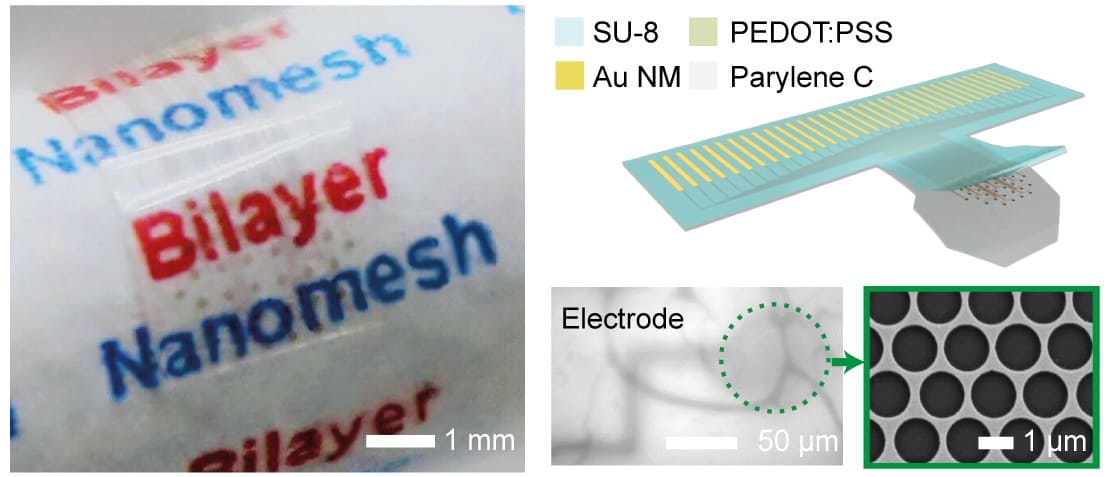
Over the past two years, Hui Fang‘s group at Northeastern University produced a new type of transparent microelectrode material. It was fabricated from traditional electrode materials with nanoscale “holes” forming a lace-like, nanomesh structure that imparts macroscale transparency.

Fang has now developed his material into a fully functioning microelectrode array and collaborated with neurobiologist Michela Fagiolini from Boston Children’s Hospital to validate electrode functionality in the visual cortex of live mice (Science Advances 4 eaat0626).

“We’ve bridged two major brain mapping modalities,” says Fang, pointing out that the mapping this microelectrode achieves in small animals could be correlated to humans, with potentially “enormous” impact on understanding the brain.

Nano-meshing

To turn the metal nanomeshes into high-performance electrodes, the bioengineers applied a low-impedance coating of poly(3,4-ethylenedioxythiophene) polystyrene sulfonate, creating a 25 nm-thick gold/85 nm-thick coating bilayer. However, this was a fiddly task, as the lace-like holes in the coating needed to perfectly align with those in the metal nanomesh to prevent blocking the nanoholes and thereby light’s passage through the electrode. Fang credits the students in his team for the diligent work that eventually led to a coating that faithfully protected the transparent nanomesh structure.

The 32-channel microelectrode bilayer was fabricated on a transparent flexible parylene C film, to aid bio-application. Fang’s group then went on to test the electrical and physical properties of the new microelectrodes.

Scalability was demonstrated, with 130 kW impedance at 1 kHz for each of the 20 µm diameter channels, a performance comparable to the best non-transparent electrode arrays. “The high yield we found from bench testing was really remarkable,” says Fang. Mechanical bending and long-term soaking tests also showed that the electrodes were physically and chemically robust and flexible.

Before in vivo testing, the team needed to remove artefacts in electrophysiology recordings known to be induced by neuronal stimulation. They established a collaboration with bioengineers at the University of California, Los Angeles, who used their advanced artefact rejection and wireless system to remove artefacts from recordings.

Live neurons

Fangolini’s group at Boston Children’s Hospital took the promising microelectrode array and tested its capabilities in live mice.

Brain mapping

The transparent microelectrodes were implanted with cranial windows into the skulls of adult mice, and a headbar was fitted to enable head restraint when imaging. After surgery, a calcium indicator expressing virus was injected into the visual cortex.

Twenty days after surgery, the team applied visual stimuli and made concurrent electrophysiology readings alongside two-photon imaging of neurons in layer 2/3 of the visual cortex.

Electrophysiology readings achieved high yields with stable low impedance throughout, whilst high transparency enabled good two-photon image quality. “We validated that electrophysiology matches calcium imaging,” says Fang.

But Fang also points out that the calcium dynamics limited the two-photon imaging to low frequencies. “At low frequency level the data matched, but at high frequencies we can only rely on electrophysiology,” he notes.

Mapping neuronal activity

Fang’s group is now working on new transparent electrode arrays that have hundreds of channels. However, advanced algorithms need to be developed to accurately map each signal detected to individual neurons.

“Our next step is to take the good spatial resolution from calcium imaging, and the good temporal resolution from electrophysiology and fuse the data together to provide a complete picture,” explains Fang.

The group hope that, despite the fact that most optical methods cannot be ethically performed on humans, this work will lead to insights into human neurobiology. “If we can better understand how optical mapping and electrophysiology correlates together, we can better infer how the human brain is functioning from the human electrophysiology data,” says Fang.
Ignition pending

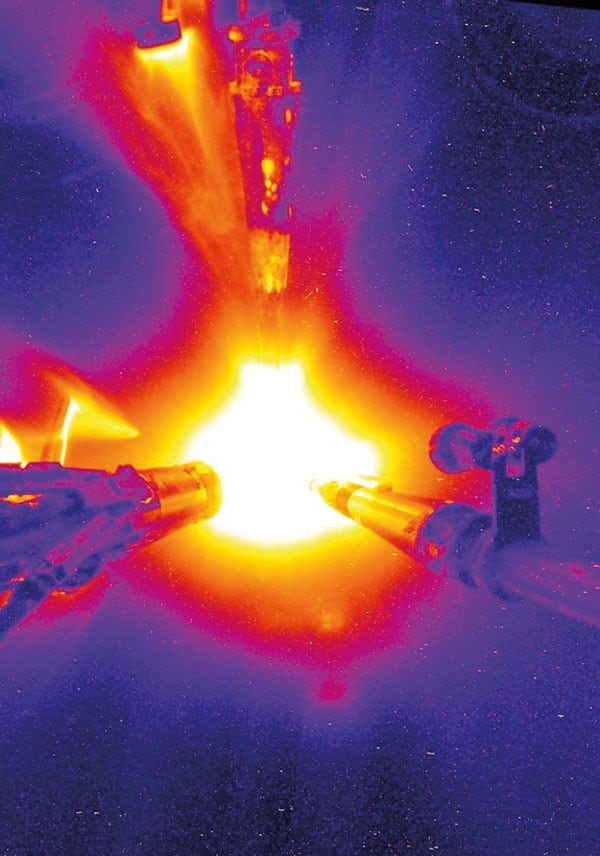
Scientists have been trying to harness nuclear fusion – the energy of the stars – since the 1930s. The reaction, in which atomic nuclei form one larger nucleus, releases huge amounts of energy according to Einstein’s E = mc2. But it requires extreme conditions for the positively charged nuclei to overcome the Coulomb repulsion between them. That’s why fusion occurs naturally only at the centre of stars.

Scientists are keen to reproduce the process on Earth because it could mean an almost-unending power source. The journey so far has not been smooth, with media sensations, funding worries and false hopes. And yet, despite the setbacks, there has been steady progress towards the dream of clean and abundant energy.

Physics World’s debut year saw one of the biggest dramas in fusion research. On 23 March 1989 Stanley Pons from the University of Utah in the US and Martin Fleischmann of the University of Southampton in the UK announced that they had achieved fusion at room temperature – so-called cold fusion. They had performed an electrolysis experiment that involved deuterium from heavy water being crammed into a palladium electrode. And they believed that if the deuterium could be packed tightly enough, fusion could occur. Pons and Fleischmann detected excess heat, which they said could not be explained by chemical processes alone so must be due to nuclear fusion.

Teams from various institutions around the world immediately attempted to replicate the findings but everyone had difficulty reproducing the results and most failed entirely.

Writing in the May 1989 issue of Physics World, Thornton Greenland – a theoretical physicist from Harwell Laboratory in the UK – calculated how much the Coulomb interaction between deuterons would need to be screened out to explain the fusion rates implied by Pons and Fleischmann’s data. His conclusion: “It is difficult to find simple explanations for the phenomena [they] reported…there are severe difficulties in establishing a consistent experimental picture.”

Cold fusion seemed dead and planned meetings between Pons and the US Congress regarding a National Cold Fusion Institute were cancelled. Experiments continued into the 1990s, all discrediting Fleischmann and Pons’ claim. While a small amount of cold-fusion research continues to this day, it now usually goes by the name LENR (low-energy nuclear reactions) – perhaps to avoid association with the drama of 30 years ago.

Bad times continued

Cold fusion wasn’t the only bad news for fusion research during that first year of Physics World. In December 1988 the magazine reported that Britain’s fusion programme was to be slashed by £5m over the following three years, representing a 25% cut to its budget. Since funding was protected for the Joint European Torus (JET) – the tokamak located at what is now the Culham Centre for Fusion Energy in the UK – the decision meant cuts to other research lines such as a reverse-field pinch experiment. One senior source at Culham dubbed the cuts as “silly” given that other techniques “may in the long term have better potential”.

Although some experts quoted in that December 1988 issue were critical of how long fusion was taking to become commercially viable, Paul Thomas of JET and Mike Key from the Rutherford Appleton Laboratory in the UK were reported as saying that “the next generation of experiments should be able to demonstrate thermonuclear ignition” – the point at which fusion reactions become self-sustaining. At this time there were several “next step” magnetic confinement devices on the table. There was a divergence of opinion between compact designs with high magnetic fields such as Italy’s IGNITOR, and large reactor-like devices. The latter included Europe’s Next European Torus (NET) and the International Thermonuclear Experimental Reactor (ITER) – a collaboration then run by Europe, the US, the Soviet Union and Japan. The former, high-field approach was seen to be more risky because the high-temperature operation of such devices was unproven.

Meanwhile, the inertial-confinement fusion community was also divided between two promising approaches. On the one hand, there was direct drive, where powerful laser beams are focused on a peppercorn-sized spherical fuel pellet, compressing it through ablation of the outer layer. On the other there was indirect drive, where the laser light used to compress the fuel pellet is converted into soft X-rays inside a cavity to improve the uniformity of illumination.

ITER

Yet to ignite

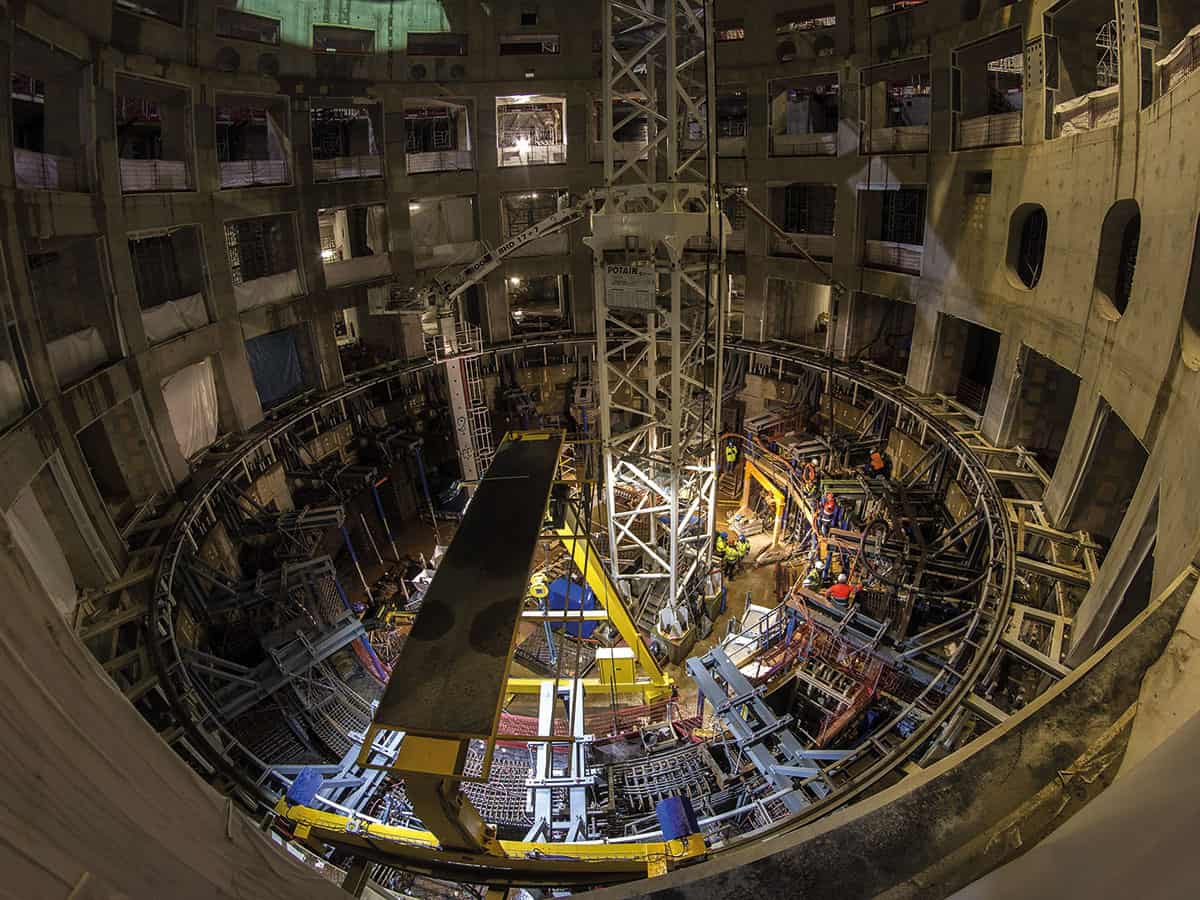
Skip forward 30 years and we are still waiting for ignition. The problem is that most funding and effort have gone into approaches that might be less scientifically risky, but are big and expensive. Those in the magnetic-confinement camp abandoned plans for NET and indefinitely delayed IGNITOR, focusing instead on the large, reactor-like device ITER. Meanwhile, those championing inertial confinement directed their attention to the indirect-drive approach, building facilities such as the National Ignition Facility (NIF) at Lawrence Livermore National Laboratory in the US. Such approaches seem sensible to reduce risk, but with hindsight I feel that the political will and consequent funding did not match the ambitions of the fusion community, which has caused long delays in both programmes. NIF did not begin operating until 2009, while ITER is still being built in Cadarache, France, with first plasma not expected to be reached until 2025 – some 40 years after the project was first envisioned.

That’s not to say there’s been no progress. We have learnt a lot about plasma physics and particularly the plasma instabilities that prevent the high temperatures required for fusion – hundreds of millions of degrees – from being reached. Tokamaks around the world have furthered our knowledge of how to magnetically contain fusion fuel and heat it to achieve the conditions required for fusion. In the 1990s experiments with a deuterium–tritium (D–T) fuel mix at magnetic-confinement machines JET and the Tokamak Fusion Test Reactor (TFTR) at Princeton Plasma Physics Laboratory in the US produced fusion despite never managing to get past energy breakeven, where Q – the ratio of fusion power to heating power – exceeds 1. JET still holds the world record of Q = 0.64 from 1997.

JET has been running successfully now for over 30 years and is still at the forefront of fusion research. Much of its work is in preparation for ITER, such as plasma-physics research, systems testing and materials investigations. As for NIF, it has not managed to achieve ignition – even if it has come close – but it has recently set a new record on its laser system, firing 2.15 MJ of energy at its target chamber, which is 15% over its design specification of 1.8 MJ. Expanding NIF’s energy limit will significantly boost the pursuit of ignition, as will improving the uniformity of its pellet implosions. NIF researchers have even reported this year generating fusion energy twice that of the kinetic energy of the implosion, although this latest energy output is less than a thirtieth of that needed for ignition.

The optimism of 30 years ago has been rather thoroughly dissipated. Sadly, the scale of the endeavour and the difficulty of obtaining funding were rather underestimated

“The optimism of 30 years ago has been rather thoroughly dissipated,” says Paul Thomas who now works for fusion start-up Tokamak Energy. “While the D–T experiments on JET and TFTR were successfully carried out, most of the next-step paths have either come to nothing or are substantially delayed. Sadly, the scale of the endeavour and the difficulty of obtaining funding were rather underestimated.”

Revisiting old ideas

Looking back at articles from Physics World’s first year, it is interesting to note a resurgence in some of those old ideas that were thrown out 30 years ago. Private money is increasingly being invested in start-ups investigating a range of different approaches including magnetized target fusion, the field-reversed configuration, dense plasma focus and inertial confinement fusion in bubbles, as well as more mainstream approaches such as the tokamak. In 2015 the US Department of Energy’s Advanced Research Projects Agency-Energy (ARP-E) – which aims to advance high-potential, high-impact energy technologies that are too early for private-sector investment – launched a programme to support alternative approaches to fusion energy. And where the familiar tokamak is concerned, start-ups such as Tokamak Energy, for which I am a consultant, are revisiting the high-field, compact approach now made possible by the commercial availability of high-temperature superconductors.

All these private attempts are focused on easing the transition to commercialization, and some have come together to form a consortium to push for a fusion XPRIZE or equivalent award. They recognize that the key to achieving fusion is – as it ever has been – funding. Stimulating excitement, investment and innovation in the way the first Ansari XPRIZE drove the private space programme could be just the thing needed to achieve fusion lift-off. Much more public engagement is also needed to challenge the old stigma of fusion being always 30 years away – essentially impossible. The reality is that seeking to sustain conditions found naturally only in stars is no simple undertaking.

It is hard to predict where fusion will be in another 30 years. I’m sure I speak for the whole fusion community when I say that I hope we have commercial fusion power plants up and running. If any of the start-ups achieve their ambitious goals, we will have. What is clear is that the will to achieve fusion is reaching beyond the academic community and into the commercial realm, so it will be interesting to look back on this period in 30 years’ time.

The favoured fuel and techniques

Deuterium–tritium implosion

Deuterium (D or 2H) and tritium (T or 3H) are generally the fuels chosen for fusion power on Earth. Although hydrogen–boron reactions don’t produce damaging neutrons, D–T fusion wins out because the temperature required for it is only about 150 million °C, making it easier to achieve. But to harness the incredible potential of fusion, you have to hold the fuel plasma with sufficient ion density at the necessary temperature for long enough for fusion reactions to get started.

Various approaches have been investigated to fulfil this criterion. Magnetic confinement involves holding stable a relatively lower density plasma for a relatively longer time using magnetic fields, while inertial confinement uses rapid compression (usually by lasers) to create higher densities for very short periods of time. Both these methods can initiate fusion.

The tokamak is the best-performing magnetic-confinement device, though other designs such as the stellarator, Z-pinch and reverse field pinch are also being studied. Tokamaks use an internal vacuum vessel shaped like a ring doughnut, with magnetic coils wrapped around this “toroid” to create a magnetic field through the ring. A current flowing in the same direction through the plasma generates a perpendicular magnetic field to stop particles drifting outwards. Other external magnetic coils shape and control the plasma, which is heated externally by firing in either radio waves or beams of neutral particles that transfer their energy to it.

Posthumously publishing Hawking

“Stephen had an especially broad legacy,” said Imperial’s Fay Dowker, citing Hawking’s commentary on fields ranging from cosmology to condensed matter and information science. Of course, his legacy reaches still wider than that, as felt evident climbing the stairs to the Science Museum’s Imax auditorium for the launch of his last book, led by an elderly lady leaning heavily on her stick while a young girl of school age brought up the rear. Hawking kindled an interest in physics in young and old, academic and lay, and the excitement over the this new publication was tangible.

Hawking’s daughter Lucy Hawking explained that this final book, Brief Answers to the Big Questions – published posthumously and completed through the collaboration of family, friends and the Stephen Hawking Estate – aims to bring together the clearest and most authentic answers to the questions he was asked most regularly. This may sound like a disclaimer for novelty, but the fundamental nature of the questions posed, which includes “Is there a God?” and “How did it all begin?”, as well as his passion for communicating science in a way his daughter described as “accessible, engaging, enlightening, and in a way that people can relate to”, should make it a tantalizing read. Asked what question was most important to him, she replied: “Will people understand my answers?”

The panel at the launch, chaired by the Science Museum’s director of external affairs Roger Highfield and introduced by the chair of the trustees of the museum Mary Archer, included both Lucy Hawking and her younger brother Timothy Hawking, as well as frequent co-authors Malcolm Perry and Andrew Strominger, and his former PhD student Fay Dowker. In addition to the book, we were invited to learn more about Hawking’s final paper, co-authored by Perry and Strominger, which sheds further light on what are now believed to be not quite so black holes. It should raise no eyebrows to hear that black-hole theory reneges on yet another previously held maxim – as Strominger pointed out, black holes are complex, even for the likes of Albert Einstein who he describes as writing a “spectacularly wrong paper” on the subject 25 years after they had first been discovered. Like any other tricky endeavour, explanations of black holes are not necessarily perfect at first attempt.

Black holes provided a lifelong fascination for Hawking, whose life was spent “travelling across the universe, inside my mind”. The Cambridge physicist wrote these words in the opening chapter of Brief Answers to Big Questions, although they echo the media’s oft-pedalled image of a scientist physically incapacitated by disease yet freed through an intellect of supergalactic capacity to explore unfathomable depths of the cosmos. (Whether this image is a true reflection of the man is explored in Margaret Harris’s book review “In search of the real Stephen Hawking“.)

Those familiar with one of Hawking’s biographies will already know that the physicist had a deeply human side. Having his family on the panel, visibly emotionally affected at the sound of his voice in the brief clips played, emphasized that Hawking was a father as well as a great mind, someone ready to engage with family high jinks as much as questions of the universe. His son Timothy Hawking told launch attendees that his father had a lively sense of humour and hated to be alone. Asked what he might think of his current religious environment in Westminster Abbey, given his view that “the simplest explanation is that there is no God”, Lucy Hawking suggested that he would be happy to be in same company as Isaac Newton and Charles Darwin.

Importantly, Hawking was ready to concede errors in prior work. “He was prepared to change his mind if you could convince him with rigorous calculation,” said Dowker, and there have been numerous examples of his willingness to put data before dogma. Hawking gives his own delightful example in Brief Answers to the Big Questions in the section on time travel, where he describes how he sent invitations to a party after the event, only to be disappointed that no-one had travelled back in time to attend – even though this would contradict his understanding of general relativity.

While highlighting his concerns on the current challenges facing the world, Lucy describes his outlook at the end of his life as still very optimistic “because he believed in human beings”. The humanitarian flavour of his science communication explains much of his appeal to non-specialists, and this final book – which straddles societal, philosophical and scientific interests – epitomizes the reach of his ideas, and the ability of his work to spark genuine curiosity and excitement in all his readers.

Stephen Hawking’s final book: a review of Brief Answers to the Big Questions

Photo of the cover of Brief Answers to the Big Questions by Stephen Hawking

Publishers are normally so desperate to have their new books reviewed that they’ll bombard newspapers, websites and magazines with unsolicited pre-publication copies to garner coverage when the titles are launched. Just look at the Physics World filing cabinet: it’s full of books we didn’t ask for but were sent on spec by publicity-hungry publishers. With Stephen Hawking’s latest – and final – book, however, something very different happened.

To get a preview of Brief Answers to the Big Questions, which is released today, the publishers John Murray made Physics World jump through various hoops. Having done so, I was expecting great things of the book – and I can imagine many readers will too.

Hawking’s first popular-science book, A Brief History of Time, has sold more than 25 million copies since it came out 30 years ago and every further title he’s written since then has been a publishing sensation. His latest book is bound to be huge too. Indeed, I can imagine a cottage industry of “lost” or unfinished Hawking books and papers being published for decades, just as they have with the works of that other great superstar physicist Richard Feynman.

Hawking was still working on Brief Answers to the Big Questions when he died last March. To fill the gaps, the publishers decided to draw on Hawking’s “enormous personal archive” of responses he’d given as speeches, interviews, essays and articles to the many questions people had asked him. The book was then completed in collaboration with “his academic colleagues, his family and the Stephen Hawking Estate”. A percentage of the royalties are earmarked for the Motor Neurone Disease Association and the Stephen Hawking Foundation.

So what of the book itself? It’s divided into 10 chapters, each posing a different question. Three are open-ended: “What is inside a black hole?”, “How did it all begin?” and “How do we shape the future?”. The other seven are all yes/no questions, such as “Is there a God?”, “Is time travel possible?” and “Will we survive on Earth?”, all of which seduce the reader into thinking there will be easy answers. Except, as you might expect, it’s not that straightforward.

Take the chapter on “Can we predict the future?”. Starting with regular astronomical events, it swiftly moves on to scientific determinism, quantum physics, hidden variables and Heisenberg’s uncertainty principle. Under the guise of a simple question, Hawking has managed to take the reader on a whistle-stop tour of the quantum world (bottom line: no we can’t predict everything). It’s a clever ruse. Ask a simple question and you’ll draw in readers who might otherwise not know they’d be interested in complex science.

Hawking ticks off all the big ideas you’d expect from one of his books. General relativity. The Big Bang. Inflation. Galaxy formation. Gravitational waves.

Matin Durrani

Elsewhere, Hawking ticks off all the big ideas you’d expect from one of his books. General relativity. The Big Bang. Inflation. Galaxy formation. Gravitational waves. There are also some niche topics too: imaginary time, M-theory and cosmic strings (although surprisingly nothing on dark matter or dark energy). The final three chapters touch on the future of humanity, the prospects for colonising space, and whether artificial intelligence will outsmart us (answer: probably, so we should embrace the prospect but plan carefully for any unwanted side effects).

One of the more accessible chapters is entitled: “Will we survive on Earth?”. It contains all the usual suspects that threaten the planet from over-population and nuclear weapons to global warming, terrorism and Donald Trump. It’s a sobering reality check, with Hawking predicting it as “almost inevitable that either a nuclear confrontation or environmental catastrophe will cripple the Earth at some point in the next 1000 years”.

I can imagine it must have been incredibly frustrating for Hawking to communicate, given that in later life he could do so only by twitching a facial muscle in response to a computer screen. This difficulty meant that anything Hawking said or wrote was concise and with no redundant words. It also made his spoken messages memorably pithy, especially as they were delivered in his trademark computerized and almost Delphic voice.

However, reading more than 200 pages of text in that style is hard. Ploughing through Brief Answers to the Big Questions is like eating a thick slice of rye bread. Good for you, but not that easy to digest and I kept craving a fluffy white croissant to leaven the pace. Actor Eddie Redmayne says in the foreword that Hawking was “the funniest man I have ever had the pleasure to meet” and I’d have liked more evidence to back up that claim. Redmayne famously got to know Hawking, whom he credits with owning a “pair of exceptionally expressive eyebrows”, while playing him in the 2014 Hollywood film The Theory of Everything.

There are some amusing moments. When Hawking went to the University of Cambridge in the 1960s, he originally wanted to do a PhD with the astronomer Fred Hoyle. But as Hoyle had enough students, Hawking was assigned to Denis Sciama instead. “It was just as well,” Hawking recalls, “because I would have been drawn into defending his steady-state theory, a task which would have been harder than negotiating Brexit.” (Hoyle famously argued that we live in a universe where matter is continually created.)

I also enjoyed Hawking’s sense of self-deprecation. To Hawking’s colleagues, he was “just another physicist”. But to the wider public, he claims to have been possibly the best-known scientist in the world. “This is partly because scientists, apart from Einstein, are not widely known rock stars, and partly because I fit the stereotype of a disabled genius. I can’t disguise myself with a wig and dark glasses – the wheelchair gives me away.”

I was left continually wondering if each sentence was what Hawking had said in the past or was something entirely new.

Matin Durrani

The problem with these passages, as with the rest of the book, is that it’s not clear whether they are fresh or culled from the archives. To the book’s credit, the editing is seamless, but I was left continually wondering if each sentence was what Hawking had said in the past or was something entirely new. Short of combing through his past books or utterances, readers will just have to carry on regardless.

Hawking also loves to veer off-topic: no sooner has he tackled nuclear Armageddon than he’s onto infinite numbers of closed loops of particles, Planck lengths and DNA. Another problem is that Hawking didn’t begin at page 1 and write a coherent story that unfolds through the book. Instead, many chapters repeat points that went before, although it does allow each to be read pretty much independently.

This book will stand as Hawking’s manifesto. Optimistic, upbeat and visionary, it sees science – and scientific understanding – as vital for the future of humanity.

Matin Durrani

With an entertaining introduction by Hawking’s US colleague Kip Thorne, who shared the 2017 Nobel Prize for Physics for the discovery of gravitational waves, the book concludes with a moving afterword from his daughter Lucy Hawking. In it, she recalls the events of his funeral on “the bleak greyness of a Cambridge spring day” and pays tribute to how her father “at the age of 75, completely para­lysed and able to move only a few facial muscles…still got up every day, put on a suit and went to work”.

Brief Answers to the Big Questions will appeal to school students, undergraduates and non-scientists with an appetite for the grand challenges in physics. Those who are more familiar with cosmology, relativity and astronomy will not find much that is new, although it is always interesting to see Hawking’s take on affairs. In essence, this book – especially the final chapter “How do we shape the future?” – will stand as Hawking’s manifesto. Optimistic, upbeat and visionary, it sees science – and scientific understanding – as vital for the future of humanity.

  • 2018 John Murray 256pp £14.99hb

Quantum dot characteristics prove not so permanent

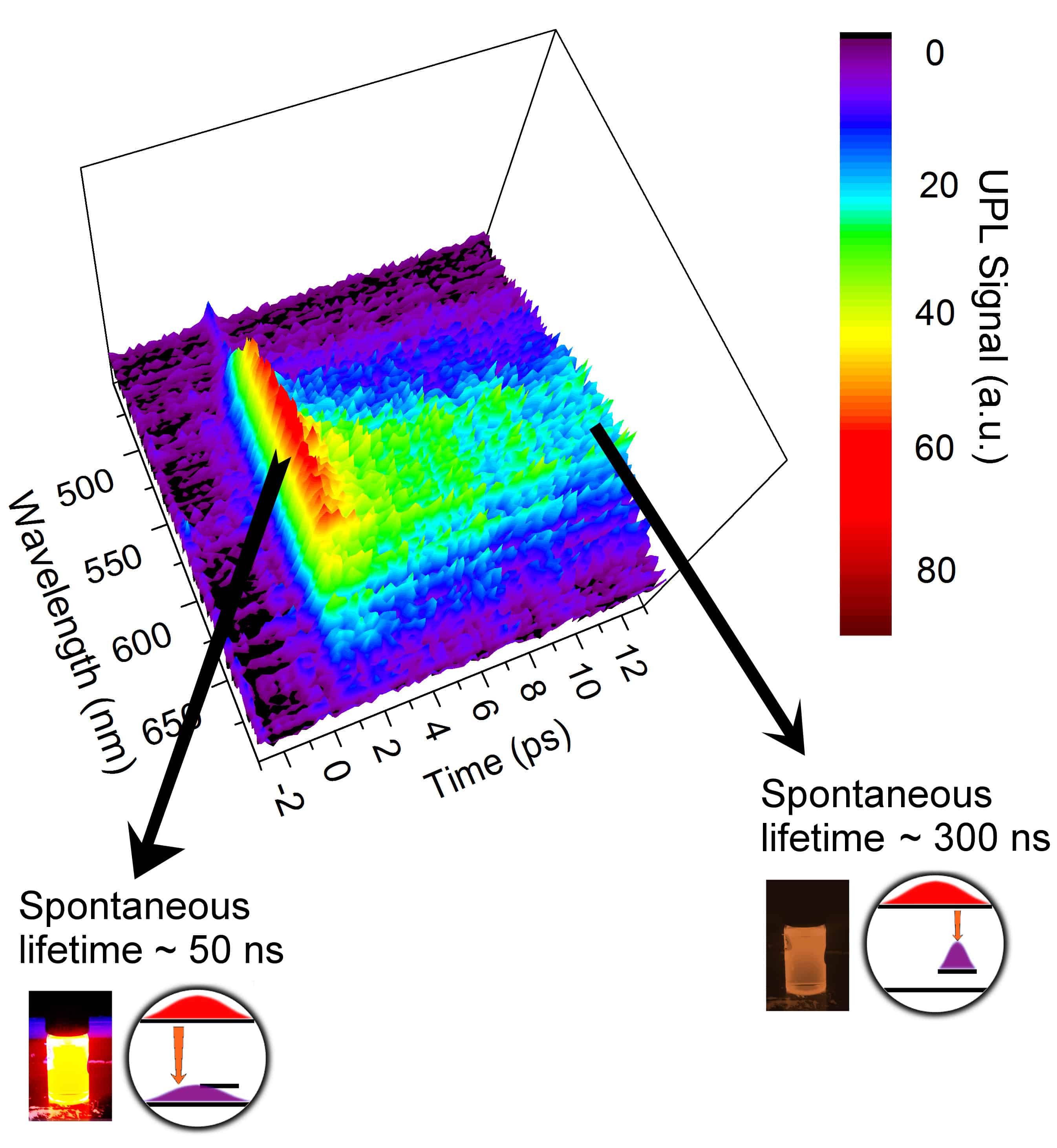
Researchers at the Indian Institute of Science reveal changes in the emission lifetime of CdS coated CuInS2 nanocrystals. Credit: Nano Futures

“The spontaneous lifetime of an isolated emitter is a constant that should not vary with time and here you have a spontaneous emitter whose lifetime is changing,” says Anshu Pandey as he expresses his surprise at the recent results from his group.

Alongside Arpita Mukherjee and Biswajit Bhattacharyya at the Indian Institute of Science (IISc), Bangalore, Pandey has been investigating the emission characteristics of CuInS nanocrystals. These are very stable emitters, which makes them a desirable candidate for a number of optoelectronic applications. However, a number of observations of the emission behaviour did not add up, prompting the IISc researchers to develop deconvolution techniques to study how the emission lifetime characteristics of their nanocrystals evolved over time.

“When we say a nanocrystal has a lifetime of so and so that’s a physical property determined by the material and the density of photon states around it. It’s somewhat like saying a semiconductor has a certain bandgap – you don’t come back five minutes later and say ‘what is its bandgap now?’” Mukherjee, first author of the article, tells Physics World. “But in the case of CuInS2/CdS nanocrystals, the spontaneous radiative rate changes over time.”

The results – so far unique to the CuInS2 quantum dots in their study – reveal coupling between the hole wavefunction and the lattice modes after the first few picoseconds and allow a better understanding of the hole localization dynamics. They also provide an explanation for a number of photophysical properties, including the strong stability of the quantum dots that does not compromise other optoelectronic properties.

Suspicions roused

“Essentially the deconvolution procedures were adopted because we suspected changes in the lifetime,” says Pandey. He points out that others had already hypothesized the localization of the valence band hole to explain why the numbers defining the dielectric properties of CuInS2 nanocrystals did not stack up with the observed lifetimes.

“There are other properties as well, such as an anomalously large Stokes Shift and so on,” adds Pandey, describing observations that were made by other researchers in the field. “So these all pointed very strongly towards the idea that there must be a localization phenomenon somewhere but a direct observation was absent.”

Hole tracking

Mukherjee, Bhattacharyya and Pandey were primarily trying to track the state of the hole wavefunction. To make the emission bright enough for their characterization techniques they used CuInS2 nanocrystals coated in CdS.

The usual approach would be to probe the transient absorption – “a standard go to for spectroscopists studying nanocrystals” as Pandey points out. Here changes of the absorption are measured over time after a flash of light. However it is not possible to use this technique to track valence band holes in CuInS2 based nanocrystals.

As a result, the IISc researchers also looked at the upconversion photoluminescence, which allows the measurement of luminescence transients with a high temporal resolution. With these measurements they could detect a faster contribution to the decay over the first 15 nanoseconds. Normally researchers explain fast decay transients as the result of non-radiative decay processes but this explanation would mean a quantum yield of around 0.4% whereas the quantum yield Pandey and co-workers measured was around 60%. Localization of one of the carrier wavefunctions seemed the only plausible cause.

Stability explained

Investigation of the transient absorption with various parameters allowed the researchers to rule out the role of the conduction band electrons, so that they could conclude the hole wave function was relaxing to yet another state located below the band edge. Calculations to deconvolute the upconversion photoluminescence based on a series of models with different assumptions of the non-radiative decay characteristics provided model-independent insights into the hole dynamics. They identified a fast transient lifetime of 46 ns that changes to a longer lifetime of 294 ns after the first 15 ns when the hole wave function collapses.

“This offers an explanation for the extraordinary stability of these materials” says Pandey, highlighting that this desirable attribute is already widely acknowledged. “That’s happening because their emission is coming from these localized states, and the bulk of the emission is taking place after this localization. So this provides a very direct explanation of how this material behaves.”

Full details in Nano Futures .

Interstellar object ‘Oumuamua is an asteroid, not a comet argues astrophysicist

Is the cigar-shaped interstellar object ‘Oumuamua a comet or an asteroid? In the latest installment of this ongoing debate, Roman Rafikov at the University of Cambridge, UK, argues that the mysterious object is far too rotationally stable to have comet-like ejections of gas. His conclusion is at odds with a previous study of ‘Oumuamua, which suggested that the trajectory of the object is being affected by outgassing. Whether ‘Oumuamua is a comet or an asteroid could have important implications for understanding where the object came from.

In October 2017 the Hawaii-based Pan-STARRS survey telescope spotted a highly elongated, 230 m-long object that astronomers soon realized had originated from outside the solar system. Named after the Hawaiian word for “scout” to commemorate its interstellar voyage, ‘Oumuamua has both a highly eccentric orbit and a shiny surface, leading some astronomers to identify the object as a comet. However, the lack of a coma of gas and dust around ‘Oumuamua suggested to others that it is an asteroid.

In a study published earlier this year, researchers led by Marco Micheli at the European Space Agency measured  ‘Oumuamua’s trajectory through the solar system and concluded that its motion cannot be explained by gravitational forces alone. Rather, they argued that the object is being accelerated by the propulsive effect of gas being released as the object is heated by the Sun.

Comet hallmark

Such outgassing is a hallmark of a comet. Regarding the lack of a coma, Micheli and colleagues speculated that the object’s surface could have been modified during its long journey to the solar system.

Now, in a preprint uploaded to arXiv, Rafikov describes how he has analysed precise astrometric measurements of ‘Oumuamua’s motion that have been gathered since the object was first spotted last year.

Rafikov points out that if ‘Oumuamua is ejecting gas like a comet, the resulting torques on its cigar-like form would cause its rate of rotation to accelerate rapidly. In just a few days, he adds, rotational forces would tear the object apart. In contrast, the astrometric data show that ‘Oumuamua’s rotation is stable over timescales of many months. Rafikov argues that this suggests that gas is not being ejected.

When combined with the lack of an observed coma around ‘Oumuamua, Rafikov believes his analysis suggests that ‘Oumuamua should not be classified as a comet. This could have important implications regarding the origins of the object.

Unlike asteroids, comets in the solar system have highly eccentric orbits making it much more likely that a comet could be ejected into interstellar space. Asteroids, on the other hand, tend to have tighter and more circular orbits. Therefore, if ‘Oumuamua came from an extrasolar planetary system like our solar system, it is much more likely to have begun its journey as a comet. The ejection of an asteroid from an extrasolar system is much less likely and could involve a violent event such as the explosion of a star.

IPCC Special Report on 1.5 °C: the reaction

Monday 8 October saw the release of the long-awaited IPCC Special Report on Global Warming of 1.5 °C. The broadest findings probably weren’t a shock to researchers in this field but there were still surprises.

“Every scientist worth their salt would have told you that stabilizing climate at 1.5 °C instead of 2 °C above pre-industrial levels would be the right play,” Dann Mitchell of the University of Bristol, UK, told the Science Media Centre. “But the surprisingly thing…is just how many different climate impacts were detected with very high confidence between the two temperature scenarios.” Mitchell cites coral reefs, fisheries and flooding of coastal areas among the inevitable repercussions. “All directly impact us living on the planet, perhaps none more so than the clear increase in heat and heatwaves on species mortality, which was detected with high confidence in the special report,” he said. “The report provides a tangible way to avoid these climate consequences; governments now have no excuse to claim ignorance.”

But what about the public? Matters started badly in the UK when, as Leo Hickman of Carbon Brief pointed out, only two national newspapers – The Guardian and the i – chose to lead with the report on their front pages. Others focused instead on gossip from the Strictly Come Dancing TV show.

Over in the US, a country that withdrew from the Paris Agreement on climate change in June 2017, Kendra Pierre-Louis of the New York Times tweeted that “I’m listening to the UN’s climate change panel and they’re basically saying, it would take a Herculean effort to stop us from hitting 1.5 °C. Based on their description the difference between 1.5 °C and 2 °C is basically the difference between The Hunger Games and Mad Max.”

That’s a great soundbite as, despite its cheerily psychedelic cover art based on a graph showing how we could change direction to limit global warming to 1.5 °C, the contents of this IPCC special report make grim reading. “This isn’t just a science report,” reported Grist. “This is a few hundred of the world’s best scientists screaming (in terrifyingly politely worded specificity) for the world to step up.”

Time for action

According to Piers Forster of the University of Leeds, UK, lead author of chapter two, “the report shows that limiting warming to 1.5 °C is barely feasible and every year we delay the window of feasibility halves.” Forster added that to prevent global warming of more than 1.5 °C, the whole world must halve its emissions in ten years; current policies put us on course for 3 °C of warming. “Nevertheless, if we were to succeed…benefits across society will be huge and the world will be all the richer for it. It’s a battle worth winning.”

So how can we win? Forster believes we need to scale up massively transformations on energy that are already underway, whilst transport, buildings and agricultural need to go zero carbon. Corinne Le Quéré of the University of East Anglia, UK, agrees that we need widespread and concerted action across the economy to cut carbon emissions to zero. “For the UK, this means a rapid switch to renewable energy and electric cars, insulating our homes, planting trees, where possible walking/cycling and eating well (more plants/less meat), and developing an industry to capture carbon and store it underground,” she said. “It also means adapting to the growing impacts of climate change that are felt here, particularly to the increasing flood risks from heavy rainfall and from sea level rise along our coasts. The solutions are already here.”

But will we use them in time? According to Eric Holthaus at Grist, the Washington Post’s headline “The world has just over a decade to get climate change under control” is the wrong way to frame this. “We only have a decade left to finish our initial coordinated retooling of society to tackle this challenge,” he wrote.

Dave Reay of the University of Edinburgh, UK, also believes we may be going about this the wrong way. “The strapline to this whole special report could arguably be that hackneyed advice to lost travellers ‘If you want to get there, I wouldn’t start from here’,” he said to the Science Media Centre. “But here we all are. With each year that rolls by without global emission cuts so our opportunities to avoid dangerous climate change diminish. The IPCC have shown us what could be, the world must now decide what will be.”

With the US government reportedly in stage 5 climate denial – “it’s too late”, Reay’s final sentence is a worry. Especially given that Fox News posted an article on the report under its Doomsday category. But let’s give the last word to Mark Maslin of University College London, who’s more optimistic. “By linking climate change mitigation and adaptation options to the Sustainability Development Goals, we now – for the first time ever – have a blueprint of how to save the planet while improving the wellbeing of all the predicted 10 billion people on Earth by 2050,” he said. “At the end of this century historians will look back and realize that the IPCC 1.5 °C Special Report was the moment when a new vision for the twenty first century emerged, leading to a safer, sustainable and more equitable world.” Let’s hope Maslin’s right.

  • This article was amended on October 16 to include an affiliation for Leo Hickman.

30 years of Physics World covers

The October 2018 issue of Physics World marks the 30th anniversary of the magazine. This short video takes you on a fly-by tour of Physics World cover art from the past three decades, starting with the first issue in October 1988. For more information about Physics World‘s 30th anniversary issue, see this article from Physics World editor Matin Durrani.

Variable RBE impacts proton therapy of liver cancer

Liver tumour proton therapy

Liver cancer is the second leading cause of cancer death, and radiotherapy is an important treatment option for patients with unresectable tumours. Liver tumours, however, are typically surrounded by healthy liver and dose to the target is limited by the tolerance of this tissue. Proton therapy could provide more conformal dose delivery, thus minimizing high-dose irradiation of normal liver tissue.

“Proton therapy offers advantages over photon-based radiation treatments because it allows sparing of more normal liver volume at low to moderate doses,” explains Harald Paganetti from Massachusetts General Hospital (MGH) and Harvard Medical School. “Radiation therapy for hepatocellular carcinoma is currently being investigated in several clinical trials, including proton therapy.”

Currently, proton therapy is delivered assuming a fixed relative biological effectiveness (RBE) of 1.1. But RBE is dependent on factors including dose, linear energy transfer (LET) and tissue-specific parameters such as α/β. To investigate the impact of different RBE values, Paganetti and colleagues investigated how variable RBE affects normal tissue complication probability (NTCP) and tumour control probability (TCP) in proton therapy of the liver (Phys. Med. Biol. 63 195001).

RBE comparisons

The study included data from 16 liver cancer cases treated with proton therapy at MGH. Twelve patients received either 40 Gy in five fractions or 58.05 Gy in 15 fractions. Four were treated with slightly different schedules that, for comparison, were converted to match the majority.

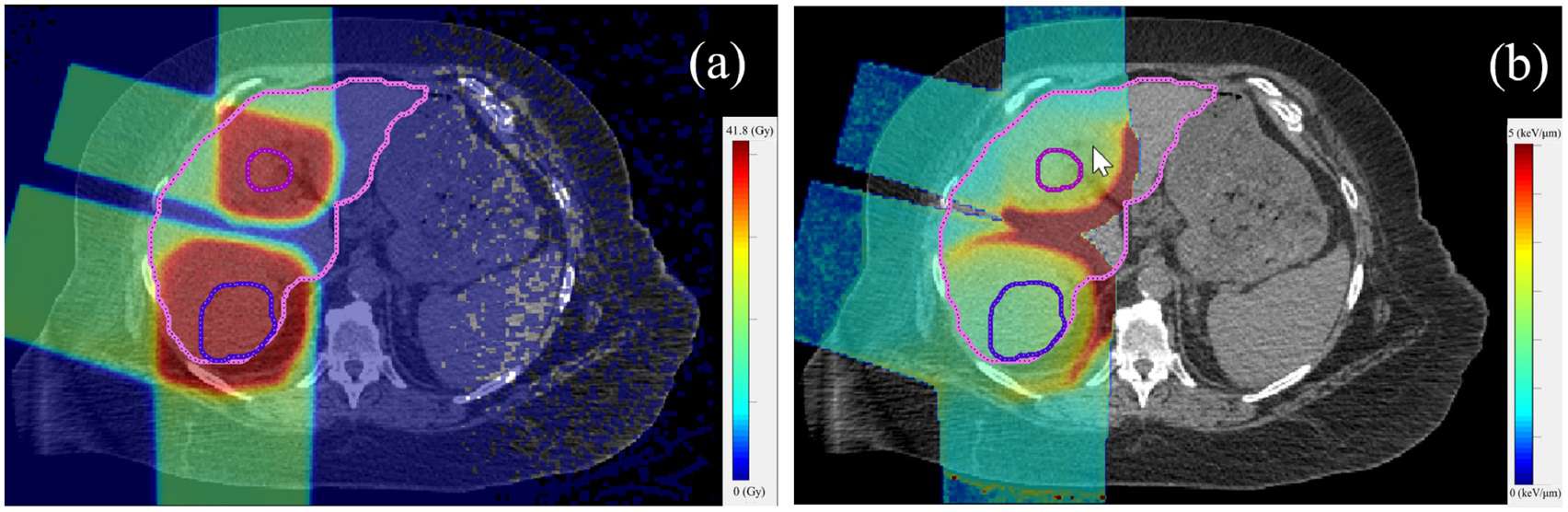
The researchers used the TOPAS Monte Carlo system to calculate dose and LET distributions in the patients. They then utilized an in-house developed empirical model  to generate RBE values — calculated as a function of proton physical dose, dose-averaged LET and α/β for photons — and RBE-weighted dose distributions. Finally, they modelled the NTCP of normal liver and TCP of the liver tumour.

The mean RBE-weighted dose and fraction-size equivalent dose (FED, normalized to 1.5 Gy/fraction) differed widely among the 16 patients, due to variation in patient anatomy and radiation fields. This led to considerable differences in NTCP for both RBE scenarios and both fractionation regimens. In all cases, however, NTCP calculated using variable RBE was higher than that using an RBE of 1.1. The size of this NTCP increase depended upon the mean FED in the normal liver.

Variable RBE

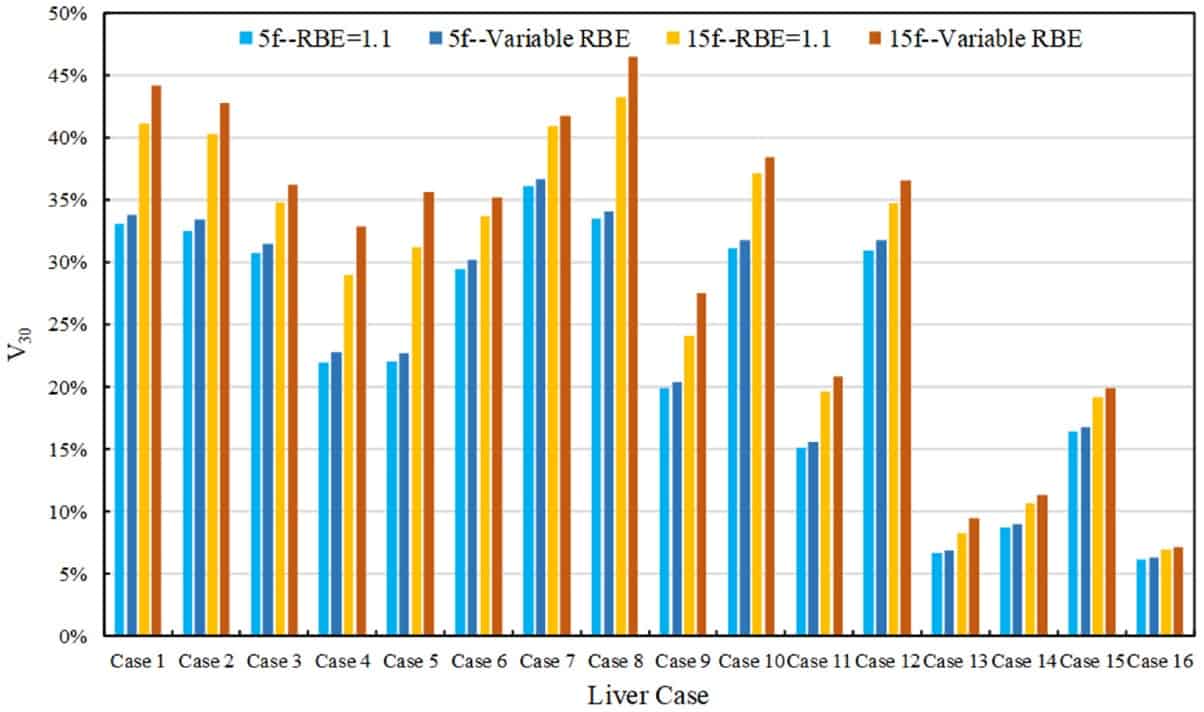
For patients with a mean FED larger than 29.8 Gy, applying the variable RBE model resulted in an NTCP increase averaging 11.6%. For cases with NTCP approaching zero, on the other hand, the impact of variable RBE was negligible. The researchers also examined the volume of normal liver receiving over 30 Gy RBE-weighted dose (V30), a parameter used to predict radiation-induced liver disease. They found that V30 using variable RBE was larger (by 0.1-4.4%) than V30 using RBE of 1.1, for all cases.

The mean RBE-weighted dose to the tumour was about 2.5% less with variable RBE, resulting in a 3-4% smaller TCP in all cases and implying that an RBE of 1.1 may slightly overestimate TCP for liver tumours.

The team also assessed how variable RBE influenced differences in NTCP and TCP between the two fractionation schemes. They found that the impact of variable RBE on differences in NTCP between the two schemes was highly case-specific. For example, variable RBE decreased the NTCP difference from 23.2% to 19.1% for case 1, and increased it from 10.4% to 13.3% for case 12. The difference in TCP between the two fractionation schedules did not change significantly when using variable RBE.

α/β uncertainties

The models employed to calculate variable proton RBE, NTCP and TCP depend on α/β, a tissue-specific parameter that varies among the patient population. As such, the researchers also examined the impact of α/β uncertainty on mean RBE-weighted dose, NTCP and TCP, using α/β values of 2, 2.5 and 3 Gy for normal liver and 7.2, 10 and 15 Gy for liver tumour. For both fractionation schemes, the RBE-weighted dose in normal liver and the target decreased with increasing α/β, as did the NTCP and TCP.

The authors conclude that assuming a constant RBE of 1.1 may overestimate the therapeutic ratio for proton therapy of the liver, mainly due to significant underestimation of NTCP. Paganetti notes that the use of variable RBE would not complicate treatment planning. “If one assigns a homogeneous RBE across the tumour volume, [this is] equivalent to simply adjusting prescription doses,” he explains.

For normal tissues, however, the variation in RBE would typically be larger due to more inhomogeneous doses and LET distributions. “RBE-based treatment planning for normal tissue is currently associated with significant uncertainties and thus not practical,” Paganetti tells Physics World.

Perovskite devices break new records

Solar cells made from perovskites with their record-breaking power conversion efficiencies (PCEs) of more than 23% could be ideal for generating sustainable solar energy if they weren’t thermally unstable. A new technique to replace one of the least stable components in these cells could change this. The feat is a real advance towards commercialization.

Perovskites have an ABXstructure, where A is caesium and methylammonium (MA) or formamidinium (FA), B is lead or tin and X is chlorine, bromine or iodine. They are one of the most promising thin-film solar-cell materials around today because they can absorb light over a broad range of solar spectrum wavelengths thanks to their tuneable bandgaps. Charge carriers (electrons and holes) can also diffuse through them quickly and over long lengths. All these excellent properties have allowed the solar cell efficiencies of these materials to skyrocket from an initial 3.8% (in 2009) to nearly 23% now. This makes their performance comparable to that of established technologies such as silicon, GaAs and CdTe.

Replacing methylammonium and bromine

The most efficient perovskite solar cells contain bromide and MA, which unfortunately is thermally unstable. To overcome this problem, researchers replace MA with FA since it is not only more thermally stable than MA but it also has an optimal redshifted bandgap. Unfortunately, because of its large size, FA does distort the perovskite lattice and produces a photoinactive “yellow” phase at room temperature. The other photoactive “black phase” can only be seen at high temperatures.

Researchers led by Michael Saliba of the Adolphe Merkle Institute in Fribourg and Anders Hagfeldt of the Ecole Polytechnique Fédérale de Lausanne have now found a way to stabilize the black phase of FA at room temperature. They did this by replacing the bromine with iodine and the MA with a combination of rubidium and caesium. The resulting cells, which are reported in Science 10.1126/science.aat3583, have a PCE of 20.35%, which is one of the best-reported efficiencies yet for a non-MA perovskite solar cell.

Compatible with a planar architecture

“As well as being thermally stable, the new material is also compatible with a planar architecture, which means that flexible solar cells are an exciting possibility,” Saliba tells Physics World.

Replacing the organic MA with the inorganic FA was only one step, he adds. “Previous attempts to stabilize the photoactive black phase of FA came at the cost of a blue-shifted bandgap, which absorbs less light and thus reduces device performance. We succeeded in removing Br and still achieved a phase-stable perovskite with a smaller bandgap that can collect more light and therefore produce more electricity.”

LEDs with >20% EQE

As well as solar cells, perovskites also show great promise for other optoelectronics devices such as light-emitting diodes that could be used in applications like flat panel displays and solid-state lighting. These devices can be made using simple solution-processing techniques and their colours can be tuned.

However, the problem is that the highest reported external quantum efficiency, or EQE (which is the number of photons produced per electron consumed) of green and red-light emitting perovskites is around 14 and 12%, respectively. These values lag behind those of organic LEDs and inorganic quantum dot LEDs. A team of researchers in China, Singapore and Canada may now have solved this problem too by making LEDs from halide perovskites that have an EQE of over 20%.

“Compositional distribution management”

The researchers achieved this using a new strategy that they have dubbed compositional distribution management. “We fabricated high quality perovskite films by spin-coating a special precursor of CsPbBr3with an MABr additive,” explains team leader Zhanhua Wei of Huaqiao University in Xiamen. “During the spin coating process, the two compounds crystallize at different times because of their very different solubilities in the precursor solvent and eventually form a quasi-core/shell structure of a new composite material, CsPbBr3/MABr.”

The MABr shell not only passivates the non-radiative defects that would otherwise be present in the CsPbBrcrystals, so boosting the photoluminescence quantum efficiency, but it also balances charge carrier (electron and hole) injection into the material, he says. Such balanced charge injection is important in LEDs because when electrons meet holes in these devices they can release energy in the form of photons in a radiative recombination process.

Wei and colleagues, who report their work in Nature 10.1038/s41586-018-0575-3, say that they are now busy working on improving the operational lifetimes of their devices, which are only around 100 hours at present. “This is obviously not long enough for practical applications, so we need to extend this to over 10 000 hours or even 100 000 hours,” he tells Physics World.

Copyright © 2026 by IOP Publishing Ltd and individual contributors