Gold nanorods may affect genomic DNA

Gold nanorods are one of the most extensively studied nanomaterials and are beginning to be used in nanomedicine in applications such as cancer treatments and diagnostics. They are thought to be relatively non-toxic to cells, but a new study by researchers at the University of Western Australia (UWA) in Perth is now casting doubt on this.

Gold nanorods (GNRs) are employed to deliver payloads such as small drug molecules into targeted cells. They are ideal for use in nanomedicine because of their unique properties, which include the fact that they absorb light in the near-infrared part of the electromagnetic spectrum. This not only makes them suitable for deep tissue imaging but also for phototherapy.

The nanomaterials are usually synthesized with a non-covalently bound bilayer of cetyltrimethylammonium bromide (CTAB) that dissociates from the GNR surface under normal physiological conditions, making the GNRs toxic to cells. Researchers have overcome this problem by replacing CTAB with its thiolated analogue, (16-mercaptohexadecyl)trimethylammonium bromide (MTAB), which covalently binds to the gold surface and thus makes it non-cytotoxic. Or does it?

Researchers led by Nicole Smith of the School of Molecular Sciences at the UWA are now saying that they have the first experimental evidence that this thiol-based conjugation might not be so perfect after all.

Changes in gene expression profiles

Some previous studies have revealed that exposure to GNRs can result in changes in gene expression profiles but the mechanisms behind this were unclear. Smith and colleagues may now have discovered a pathway that could explain this phenomenon. Using a technique called nanoscale secondary ion mass spectrometry (nanoSIMS), the researchers have found that the Au-thiol species change following endocytosis, which results in the formation of Au(I)-thiolates that then localize in the cell nucleus. Such nuclear localization went hitherto undetected using high-resolution electron microscopy techniques, says Smith.

And that is not all: “When we then evaluated the toxicity profile of the GNRs in (HEK-293T and MCF-7) cells, we found that this localization perturbs the dynamic microenvironment within the nucleus. It thus alters gene expression in human (MYC, BCL2 and HNRPAB) cells as a result of leached gold species,” she tells Physics World.

“In our study, we focused on looking at the changes that occur in genomic DNA using ‘G4’ structures as a marker. We suspect that nuclear localization of gold may also affect the interactions and dynamics of other regulatory molecules (including transcription factors and histone proteins) with genomic DNA as a result of changes in the chemical microenvironment,” she adds.

Going beyond traditional cytotoxicity evaluations

“Our understanding of the subtle changes in genomic DNA has greatly expanded over the last decade and we now understand that alterations beyond the genetic code including epigenetic and structural alterations are indeed important markers that play pivotal roles in cell signalling and function. We obtained our results using quantitative visualization of ubiquitous DNA G-quadruplex structures, which are sensitive to ionic imbalances, as an indicator of the formation of structural alterations in genomic DNA.

“Our study, which is published in Nature Nanotechnology 10.1038/s41565-018-0272-2, provides clear evidence that to develop medically translatable technologies using gold nanoparticles and other inorganic nanostructures, we must explore in situ chemical changes within the context of the genomic environment in detail. Such studies need to go beyond the traditional ‘coarse’ cytotoxicity evaluations that have been the mainstay in this field so far.”

Moons can have moons and craters that celebrate Earthrise

Craters

Every physicist knows that the most vexing questions come from non-physicists – and in particular, from children. Back in 2014 Juna Kollmeier’s son, then four, stumped her by asking can moons have moons? Being an astrophysicist at the Carnegie Institution for Science, she realized that no-one seemed to have worked-out the answer.

As far as we know, none of the moons of the planets in the Solar System have their own moon. But that doesn’t mean that such “submoons” can’t exist. Working together with Sean Raymond from the University of Bordeaux, the duo found that small submoons – around 10 km in radius – could survive but they would have to orbit large moons and be far away from the host planet. Moons that are too close to the planet or too small might lose their submoons as they crash into the moon or planet or are shot out into space.

So the answer is, yes, possibly. Hopefully her now eight-year-old son will be happy with the answer, despite it taking four years.

What do Copernicus, Langevin, Rutherford and Shackleton all have in common? They happen to have a crater on the Moon named after them. There are hundreds of thousands of craters on the Moon and while some have names, especially after famous scientists and adventures, many are instead specified by letters.

Now, two more craters have been officially named after the International Astronomical Union’s working group for planetary system nomenclature approved “Ander’s Earthrise” and “8 Homeward”. They have been designated to commemorate the 50th anniversary of the Apollo 8 mission, which carried out 10 orbits of the Moon in late December 1968. Indeed, the two craters are visible in the foreground of the iconic Earthrise colour photograph taken by astronaut William Anders aboard Apollo 8.

Working in medical physics: proton therapy

Imran Patel is the head of proton therapy physics at The Christie NHS Trust, in Manchester, UK. In this video interview, he describes how his career enables him to apply his technical knowledge while developing his communication skills when working with patients. Patel discusses the various aspects of his role and offers advice for early-career medical physicists and those thinking of a career in medical physics.

This video film is part of a series of Physics World films produced at The Christie, which we will be sharing on this site over the next few weeks. In the meantime, take a look at our medical physics research updates, as well the careers section of our site, lots of case studies and practical information for physics graduates.

New type of noise found lurking in nanoscale devices

A new type of electronic noise has been discovered by a team of physicists and chemists in Israel and Canada. Dubbed “delta-T noise”, the effect occurs when two sides of a tiny electrical junction are at held at different temperatures. As electronic devices become ever smaller, the researchers predict that delta-T noise could become increasingly problematic. The good news is that delta-T noise could be used to measure temperature differences in nanometre-scale objects – something that is extremely difficult to do.

When physicists think of noise it is not the clamour from a pop concert or a busy road, but rather electrical signals that are an intrinsic property of a device. For almost 100 years, physicists have known about two sorts of fundamental noise in electrical signals. Thermal noise is proportional to temperature and is a result of the random motion of electrons. This creates fluctuations in electrical current even if there is no applied voltage and the average current is zero. Thermal noise can have negative consequences in a circuit, but it can also be used to measure the absolute temperature of an object. The second type of noise is called shot noise and does require an applied voltage. Shot noise occurs at very low currents when the discrete nature of electrons causes fluctuations in current.

The idea of delta-T noise first came to Oren Tal of the Weizmann Institute of Science when he was studying the effect of thermal noise on a molecular junction. The junction comprised a single molecule between two electrodes, which were at different temperatures. He realized that in addition to thermal noise, there may also be a noise associated with the temperature difference.

Uncorrelated motion

In an electrode near absolute zero, Tal reasoned, almost all the electrons are in the lowest possible energy level. Therefore, almost all the states up to a particular energy (the Fermi energy) are filled, whereas the higher energy levels are empty. In a warmer electrode, however, thermal excitation allows some electrons to jump to higher energy levels, leading to empty states below the Fermi energy and filled states above it.

In a junction between a warm and a cold electrode, therefore, electrons are transmitted in both directions. Above the Fermi energy, they travel from hot to cold; below the Fermi energy, they travel from cold to hot. The average currents may be equal and opposite and therefore add to zero. Each current, however, experiences shot noise and, being uncorrelated, the random fluctuations do not cancel each other.

Tal consulted theoreticians Dvira Segal at the University of Toronto and Abraham Nitzan at Tel Aviv University. They confirmed that this new noise term is described by the widely-used Landauer theory of electron transport, despite never having been properly investigated before in this theoretical framework.

Gifted experimentalist

Actually detecting the noise, however, was an extremely challenging task for Ofir Shein Lumbroso, Tal’s PhD student. She was confronted with the conflicting goals of incorporating electrical heaters and thermometers into a nanoscale molecular junction, while simultaneously keeping it sufficiently well isolated from external electrical noise signals to allow measurement of the tiny intrinsic noise as a function of temperature difference. “It took several years to optimize our measurement setup to be able to measure the delta-T noise,” explains Tal, “but Ofir is a very gifted experimentalist and she eventually overcome these difficulties.”

Designers of today’s integrated circuits concentrate solely on thermal noise when considering heat management. However, Tal explains as devices continue to shrink, inherently quantum noise becomes more and more important. “Thermal noise will always be the main noise at room temperature, but shot noise and delta-T noise should be taken into consideration,” he says. More positively, he says that delta-T noise could be useful for nanoscale measurements of temperature differences. This is an important application because just a few research groups worldwide can make nanoscale thermometers.

“I think [the research] is a very important contribution to the field of quantum transport,” says Wolfgang Belzig of University of Konstanz in Germany: “If you think about some experiments that have been conducted in the past few years that have found an unexpected increase in noise, it might now be important to check whether or not this is related to delta-T noise.”

The research is described in Nature.


High Arctic plant spurts raise climate concerns

The Arctic is becoming greener, warmer and leafier as small plants that once hugged the ground to trap snow and insulate their roots in the permafrost have started to gain in stature.

In the high latitudes, plants have begun to respond to climate change and warmer, moister soils by reaching for the sky.

It is estimated that, by 2100, the northernmost vegetation could have grown by up to 60% taller.

European scientists, backed by an international team of more than 120 biologists, report in Nature journal  that tundra plants are gaining in height, and that species from further south are advancing towards the Arctic Circle.

Close survey of growth

Their conclusion is based on more than 56,000 observations of tundra vegetation and a close survey of growth at 117 sites around the high latitudes in Alaska, Canada, Iceland, Scandinavia and Siberia.

“The increase in height we saw was not just in a few sites but nearly everywhere,” says Anne Bjorkman, a researcher at Germany’s Senckenberg Biodiversity and Climate Research Centre. “If taller plants continue to spread at the current rate, the plant community height could increase by 20% to 60% by the end of the century.”

Her research colleague, Isla Myers-Smith, of the University of Edinburgh’s School of Geosciences, says: “While most climate change models have focused on increasing temperatures, our research has shown that soil moisture can play a much greater role in changing plant traits than we previously thought.

“We need to understand more about soil moisture in the Arctic. Precipitation is likely to increase in the Arctic region, but that is just one factor that affects soil moisture levels.”

The Arctic is one of the fastest-warming places on Earth. Sea ice has been in dramatic retreat and other research teams have repeatedly observed dramatic changes in the plants and animals that cling to life in the hemisphere’s harshest climate.

Ground reflectivity

What happens to tundra vegetation matters as a vast community of birds, insects and mammals survives on the annual growth in the brief northern summer.

Plants both respond to climate change and play a part in that change. They affect the reflectivity of the ground surface, and warm the soil in ways that could release ever more greenhouse gases.

Half of the planet’s stored carbon could be trapped in the permafrost, and any escapes could only accelerate global warming.

“This is the first time that a biome-scale study has been carried out to get to the root of the critical role that plants play in this rapidly-warming part of the planet,” Dr Myers-Smith says.

And Bjorkman warns: “Shorter plants trap more snow, which insulates the underlying soil and prevents it from freezing as quickly in winter. An increase in taller plants could speed up the thawing of this frozen carbon bank, and lead to an increase in the release of greenhouse gases.”

NASA must revamp search for life beyond Earth, experts warn

NASA must revamp its astrobiology strategy if it to make progress tackling the question of whether life exists beyond Earth. That is according to a report issued on 10 October by the National Academies of Sciences, Engineering, and Medicine (NASEM), which recommends that the space agency increase collaboration with other scientific disciplines as well as with organizations inside and outside the government.

The report – An Astrobiology Strategy for the Search for Life in the Universe – says that recent advances in astrobiology have been helped by rapid advances in detecting exoplanets in the so-called habitable zone that could support liquid water on their surfaces. Of particular interest are the seven planets of the relatively nearby TRAPPIST-1 system that was detected by TRAPPIST and other telescopes. That research, the report states, “has matured the search for evidence of life beyond the solar system enough to warrant taking the next steps toward the discovery of life on exoplanets”.

NASA should not just go for water and methane

Alan Boss

The 196-page report states that future missions – such as the Transiting Exoplanet Survey Satellite, the Atmospheric Remote-sensing Infrared Exoplanet Large-survey and the Wide Field Infrared Survey Telescope – will advance the characterization of potential “exoEarths”. Yet zeroing in on the detection of life will demand advanced technologies – such as coronagraphs and star shades – that deliver three to four times the resolution of the James Webb Space Telescope, which is due to launch in 2021.

Beyond water

Just as important, the report notes, is the definition of habitability, which currently involves spotting the potential for liquid water. “Water is important, but we need to look at the interplay of multiple parameters, such as temperature and pressure and the way that habitability is the result of those parameters,” says panel chair Barbara Sherwood Lollar from the University of Toronto. That leads to the concept of “dynamic habitability” – what Sherwood Lollar calls “an evolving continuum, not a hit-or-miss issue”. Recent studies of subsurface life on Earth have added strength to that approach, including the idea of “slow life” that draws from chemosynthetic rather than photosynthetic processes.

Indeed, to cover all the possible types of life forms, the report recommends that NASA should support research on “agnostic biosignatures” to detect life different from what we are familiar with. “NASA should not just go for water and methane,” adds Alan Boss of the Carnegie Institution for Science, who is a member of the NASEM panel. Sherwood Lollar adds that future NASA missions should integrate astrobiology requirement “right at the beginning of mission [design]”.

The 17-strong NASEM panel also calls on NASA to look beyond its traditional boundaries in terms of academic collaborations and financial support. “The existence of technologies outside of the space industry – for instance biomedical applications and artificial intelligence – that could be used in the search for life provide prime areas for establishing partnerships with the commercial sector,” the report states. Boss puts it more pithily. “We don’t expect one agency or one nation to answer the question of whether we are alone,” he says. “So we encourage NASA to partner on it.”

Simultaneous EEG and fMRI measure sleep ‘inertia’

An alarm goes off, shocking you into consciousness. You blearily mute the too-loud beeping and try to reacquaint yourself with reality, lumbering out of bed. It takes about 30 minutes before the grogginess has dissipated…  

Waking up can feel like an emergency stop on our nightly ruminations; the slow return to some semblance of normality can take a few minutes or many more, depending on whether one is sleep deprived, and in which sleep cycle one wakes from. Fast recovery from this leftover “inertia” is crucial for those operating in emergency conditions, such as medical or military staff, for example, and hence a deeper understanding of this concept would be valuable.

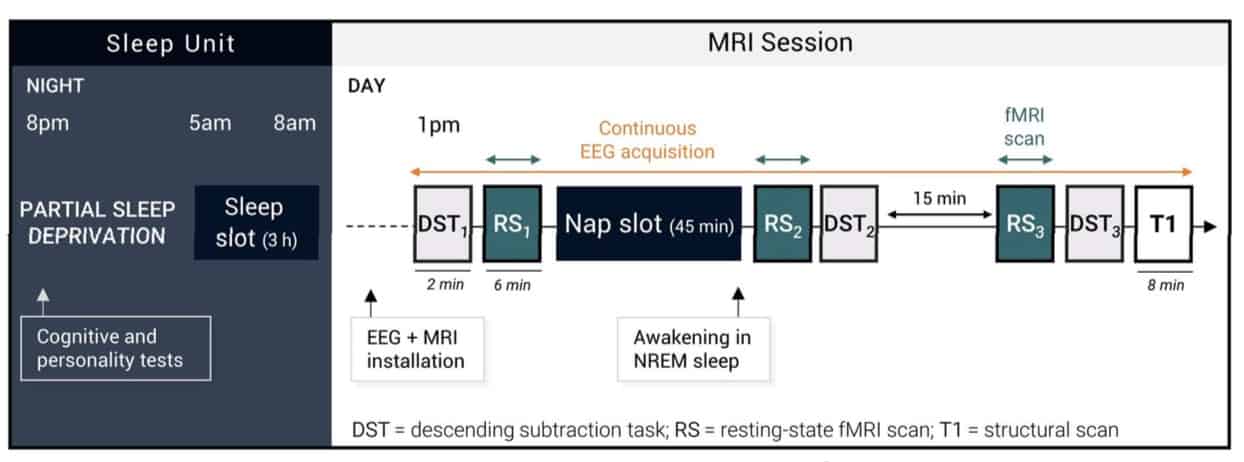
Scientists at the Lyon Neuroscience Research Center in France have probed the cerebral correlates of sleep inertia using a combination of electroencephalography (EEG), functional MRI (fMRI) and a behavioural task. Combining multiple resting state fMRI scans and continuous EEG allowed the researchers to measure brain function just before a 45-min afternoon nap, 5 min immediately after awakening and then 25 min after.

Post-awakening, participants had fewer responses in the behavioural task, increased EEG delta-band power (brain waves oscillating at 0.5-4.5 Hz), and reduced anti-correlation (as usually seen when awake) between brain networks (NeuroImage 10.1016/j.neuroimage.2018.09.033).

Measuring sleep inertia

After a night of only three hours sleep, 34 participants were hooked up to a polysomnographic cap (an EEG cap with nine electrodes) to measure the tiny summed electric fields of thousands of neurons. Over time, these brain waves can be grouped into different frequency bands, for example, delta waves at 0.5-4.5 Hz.

Summary of sleep stages

Next, the subjects performed a descending subtraction task (DST) in which they had to subtract a suite of preceding numbers from a given a three-digit number. This was done prior to a 6 min resting-state fMRI scan. Following this, participants had the 45 min afternoon nap (monitored continuously by EEG) and were then awakened: 14 during N2 sleep and 20 during N3.  Five minutes after awakening, a second resting state fMRI scan was acquired, followed by a repeat of the DST; 25 min after awakening, the fMRI and DST were repeated again.

Experimental design

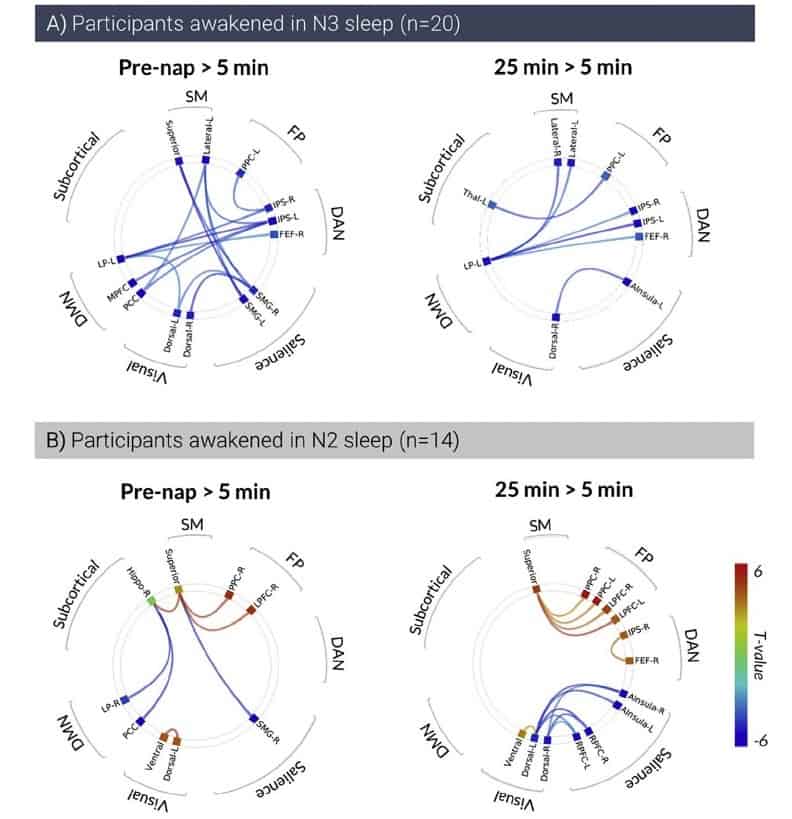
The researchers extracted sleep statistics from the EEG hypnogram, such as which sleep cycles were attained and sleep efficiency. They also performed functional connectivity analysis on the fMRI data, correlating mean, spontaneous BOLD (blood oxygenation level dependent) fluctuations from predefined network regions of interest (ROIs) to mean BOLD time series from every other ROI (within and between networks).

Sleep intrudes into wakefulness

The authors suggest that increased EEG delta power at 5 min compared with 25 min post-awakening could be a signature of sleep inertia. Additionally, a reduced anti-correlation between two different default mode networks measured with fMRI (as compared to waking) at 5 min compared with 25 min post-awakening, is indicative of certain sleep-specific features “intruding” into wakefulness.

The lack of difference within and between networks pre-afternoon nap compared with 25 min post-awakening from the nap implies that sleep inertia has dissipated by this time, as evidenced by the connectivity returning to “normal”.

Although there was little difference in the EEG or behavioural results based on whether participants were awakened from N2 or N3 stages, the researchers noted a larger disruption in functional connectivity from N3-to-awake than N2-to-awake.

From N2-to-awake, the biggest differences in ROI-to-ROI connectivity were seen when comparing 25 min to 5 min post-awakening, whereas from N3-to-awake, it was when comparing pre-afternoon nap to 5 min post nap. This suggests that the dissipation of sleep inertia is “faster” when waking from N2, than N3.

ROI-to-ROI functional connectivity

Feeling awake yet?

This study shows that sleep-specific brain activity does not disappear immediately after we wake up, but rather, this inertia persists for several minutes post-awakening. This phenomenon is associated with a decrease in cognitive performance, an increase in delta power and a disruption of functional networks, with this loss of functional segregation (how separate brain networks appear to be) worse when waking from deeper sleep (N3 versus N2). This exciting work paves the way for possible extension to studying sleep in more depth, for example measuring sleep inertia following N1 and REM sleep.

Lab-grown human retinas shed light on colour vision

Biologists at Johns Hopkins University have grown human retinal tissue from stem cells to determine how the various cells that allow people to see in colour develop. The work lays the foundation for developing therapies for diseases such as colour blindness and macular degeneration. The study also further establishes organoids — 3D organ models grown in vitro— as a powerful system for studying human development on a cellular level (Science 10.1126/science.aau6348).

“Everything we examine looks like a normal developing eye, just growing in a dish,” says Robert Johnston, a developmental biologist at Johns Hopkins. “You have a model system that you can manipulate without studying humans directly.”

Johnston’s lab is exploring how a cell’s fate is determined — or what happens in the womb to turn a developing cell into a specific type of cell. Here, the team focused on the three types of cone photoreceptors in the human eye, which respond to different wavelengths of light to give humans colour vision.

The authors note that most vision research is performed on mice and fish, which do not have the dynamic daytime and colour vision of humans. The mechanisms underlying the specification of red, blue and green cone cell subtypes in the human retina are thus largely unknown. This study represents some of the first vision research to be performed using human tissue.

“Trichromatic colour vision delineates us from most other mammals,” explains lead author Kiara Eldred, a Johns Hopkins graduate student. “Our research is really trying to figure out what pathways these cells take to give us that special colour vision.”

Eldred and colleagues grew stem cells into retinal tissue organoids that closely mirrored the developmental stages observed in in vivo retinal tissue. As the cells grew into full-blown retinas, the blue-detecting cells developed first, followed by the red- and green-detecting ones. The switch was determined by thyroid hormone signalling. The researchers point out that the level of this hormone wasn’t controlled by the thyroid gland (which obviously is not present in the in vitro set-up), but entirely by the eye itself.

By varying the amount of thyroid hormone during specific stages of development, the team was able to create organoids with only one type of cone. For example, they created retinas that — if they were part of a complete human eye — would only see blue, and ones that would only see green and red.

The finding that thyroid hormone is essential for creating red- and green-detecting cones provides insight into why pre-term babies, who have low levels of thyroid hormone, often have a higher incidence of colour vision defects. “If we can answer what leads a cell to its terminal fate, we are closer to being able to restore colour vision for people who have damaged photoreceptors,” says Eldred.

In the future, the team hope to use organoids to learn more about colour vision and how other regions of the retina, such as the macula, are created. Macular degeneration is one of the leading causes of blindness, thus understanding how to grow a new macula could lead to clinical treatments.

How the world of physics has changed in the past 30 years

This episode of the Physics World Weekly podcast celebrates the 30th anniversary of Physics World magazine. The first issue of the magazine came off the presses in October 1988 and this month’s special birthday issue looks back on the state of physics in that year and how much physics has (or has not) changed over the last three decades.

In this podcast you will hear from the five Physics World editors who put together the anniversary issue. As well as talking about the main themes of the issue, they reflect on how physics-related companies have changed over the years. We also discuss what was hot in physics news 30 years ago and find out what 14 leading authors think are the best science books published since 1988.

If you enjoy the podcast, then you can subscribe via the Apple podcast app or your chosen podcast host.

Stephen Hawking’s ‘final paper’ on hairy black holes hits the headlines

A few days after Stephen Hawking died in March, you might recall us covering what we said was  the great cosmologist’s “last” paper. Now, however, it seems that the article wasn’t actually his last: the Guardian is running two stories about what it dubs Hawking’s “final” scientific paper. And in what seems a carefully planned publicity exercise,  Hawking’s “final book” is scheduled for publication next week too.

Uploaded to the arXiv preprint server last week and updated on Tuesday, Hawking’s “final” paper is called “Black hole entropy and soft hair”. It contains calculations that aim to help solve the “information paradox” that arises when stuff is sucked into a black hole.

Conventional thinking going back to Albert Einstein is that a black hole can be described only in terms of its mass and spin. This is the “no-hair” theorem, the idea being that like bald heads, black holes have few features to distinguish themselves. No-hair means that information about the physical state of matter must be lost as the matter is sucked into a black hole – otherwise, this information would distinguish one black hole from another.

In 1974 Hawking made the landmark conjecture that black holes do not simply suck in everything, but rather behave as black bodies that emit radiation as well as absorbing it. He calculated the black-body temperature of a black hole using an equation that now graces his memorial in Westminster Abbey.

Microscopic arrangements

Having a distinct temperature implies that a black hole has entropy, which Hawking also calculated. Entropy is a measure of the number of different ways the microscopic constituents of a black hole can arrange themselves. This goes against the no-hair theorem, which says that a black hole can only be arranged in one way – as defined by its mass and spin.

In 2015, Hawking teamed up with his Cambridge colleague Malcolm Perry and Harvard University’s Andrew Strominger to address the decades old paradox. A year later the trio published a paper that suggested that information-preserving massless particles known as “soft hair” could surround black holes.

In this latest research, Hawking, Perry and Strominger joined forces with Cambridge’s Sasha Haco to calculate the entropy of a black hole that has a certain kind of soft hair. The physicists conclude that their result agrees with Hawking’s original calculation of black-hole entropy.

Writing in one of the Guardian articles, Perry says “While this is not a resolution of the information paradox, we believe it provides some considerable insight into it”.

Is this Hawking’s last paper? Perry describes it as “perhaps the last paper that Stephen was involved in,” so maybe there are more out there.

And if you cannot get enough Hawking, the celebrated cosmologist’s last book will be published on 16 October. Stay tuned to Physics World for a review of the book and much more next week.

Copyright © 2026 by IOP Publishing Ltd and individual contributors