In this episode of the Physics World Weekly podcast, industry editor Margaret Harris discusses her recent visit to IBM’s R&D facility in Hursley, UK. She explains why industrial research is still a fruitful place for physics research, even though it is sometimes overlooked by the academic community.
Later in the podcast, general physics editor Hamish Johnston is joined by multimedia editor James Dacey. The pair discuss the new film on this website the 1000 m2 model of the Mississippi delta, housed at the Center for River Studies at Louisiana State University. Johnston and Dacey also give their predictions for the Nobel Prize for Physics, which will be announced next Tuesday.
If you enjoy what you hear, then you can subscribe via the Apple podcast app or your chosen podcast host.
An artificial intelligence (AI) algorithm can produce synthetic brain MR images, solving a number of challenges in training AI algorithms, according to research presented at the International Conference on Medical Image Computing and Computer Assisted Intervention (MICCAI) in Granada, Spain.
Researchers from NVIDIA, Massachusetts General Hospital and Brigham and Women’s Hospital in Boston, and the Mayo Clinic in Rochester, MN, have trained a type of AI algorithm called a generative adversarial network (GAN) to generate synthetic abnormal brain MR images. These synthetic images could be used to augment a small dataset or even on their own to train a deep-learning algorithm, according to Hoo-Chang Shin, a senior research scientist at NVIDIA.
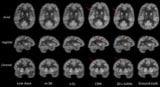
Examples of synthetic brain MR images generated by the GAN. The first row depicts the real images on which the synthetic tumours were based. (Courtesy: NVIDIA).
“We showed that you don’t have to have access to a large number of patient images,” he told AuntMinnie.com. “You can generate a lot of synthetic images and train your AI on these synthetic images — with only a handful of real images to fine-tune the pretrained AI — and achieve almost the same performance as if you had trained on a large number of real data.”
The use of GANs in medical imaging has been on the rise lately for applications such as creating a synthetic head CT image from a brain MR image and for producing synthetic X-ray images to aid in algorithm training. In their project, the researchers trained a GAN using the Alzheimer’s Disease Neuroimaging Initiative (ADNI) dataset and the Multimodal Brain Tumor Image Segmentation Benchmark (BRATS) dataset.
The algorithm allows developers to alter the size of a tumour on the MR image, change its location, or place it on an otherwise normal brain — enabling hundreds or even thousands of these synthetic images to be created, according to the researchers. In testing, they found that adding synthetic data to augment real MRI data improved the performance of a deep-learning algorithm.
“Secondly, which is even more exciting, we can achieve similar performance using synthetic data only,” Shin said.
The algorithm tackles one of the big challenges of training deep-learning algorithms for medical imaging AI: the lack of reliable and accurate data for training the neural networks, he said. It can be challenging to find enough cases for a specific disease to train AI — especially if it’s a rare condition.
“And secondly, even if we had enough [disease cases], annotating them takes a really long time and is very costly,” Shin said.
The algorithm also addresses the patient privacy issues that have hindered the creation of large datasets needed for training these algorithms.
“Our algorithm can generate synthetic patient images which are not tied to a specific patient, so they are anonymous,” Shin said. “It’s easier to share [the dataset] outside of clinical institutions or a hospital, so we can get a large medical image dataset and train AI for a well-performing AI algorithm.”
Regular readers of the magazine will be familiar with “Lateral Thoughts” – Physics World’s long-running column of humorous or otherwise offbeat essays, puzzles, crosswords, quizzes and comics, all written by our readers – that appears on the back page each month. This month, siblings Eugenia Viti and Ivan Viti have crafted a comic that takes a wry look at the physics of Schrödinger’s cat. Eugenia is a cartoonist, illustrator and writer living in Chicago. Follow her on instagram (ayokdit) to see how much pizza she eats. It’s a lot. Ivan has a PhD in physics and is currently working as a postdoctoral researcher at the University of Notre Dame, Indiana. He lives with his wife, two cats, two dogs and one goldfish. And once you’ve had your fill of cats, take a look at their other special comic, on the the theme of time – this one involves dogs.
“Our analysis demonstrates that the argument [in the US] that the primary beneficiaries of reductions in carbon dioxide emissions would be other countries is a total myth,” says Kate Ricke of the University of California San Diego, US. “We consistently find, through hundreds of uncertainty scenarios, that the US always has one of the highest country-level social costs of carbon. It makes a lot of sense because the larger your economy is, the more you have to lose.”
Ricke was surprised just how consistently the US is one of the biggest losers, even when compared to other large economies.
To assess the level of economic harm from carbon emissions around the world, Ricke and colleagues used climate model projections, empirical climate-driven economic damage estimations and socioeconomic forecasts. According to their study, the global social cost of carbon is significantly higher than the figure used by the US government to inform policy decisions.
“Evaluating the economic cost associated with climate [change] is valuable on a number of fronts, as these estimates are used to inform US environmental regulation and rulemakings,” Ricke says.
The US Environmental Protection Agency calculates a global social cost of carbon of $12–62 per tonne of carbon dioxide emitted by 2020. This latest research put the global figure at $180–800 per tonne. What’s more, it assessed the social cost of carbon for the US as around $50 per tonne, meaning that the nearly five billion tonnes of carbon dioxide that the US emits each year costs the nation’s economy some $250 billion.
“We all know carbon dioxide released from burning fossil fuels affects people and ecosystems around the world, today and in the future,” adds Ricke. “However, these impacts are not included in market prices, creating an environmental externality whereby consumers of fossil fuel energy do not pay for and are unaware of the true costs of their consumption.”
India’s social cost of carbon was the highest at around $86 per tonne of CO2, followed by the US at $48 per tonne and Saudi Arabia at $47 per tonne. Brazil, China and the United Arab Emirates all had values above US$20 per tonne. Northern Europe, Canada and the Former Soviet Union had negative social cost of carbon values in 2020, the study found, because their current temperatures are below the economic optimum. Under continued warming, however, their social cost of carbon would be likely to become positive.
“Climate decision-making does not occur in a vacuum,” write the researchers in Nature Climate Change. “Some countries, such as northern Europe and Canada, are leaders on climate policy despite potentially negative SCCs [social costs of carbon], whereas other countries with the highest country-level SCCs, like the United States and India, lag behind. Clearly, a host of other strategic and ethical considerations factor into the international relations of climate change mitigation.”
There is an entire genre of journalism dedicated to conversations with taxi drivers. Pretty much every political hack in the business has filed a column of this type at least once, and a few of them, such as Thomas Friedman of the New York Times, do it so regularly that they’ve become (in)famous for it. Until last week, though, I’d never felt inclined to make my own contribution – but then I went to a “Festival of Innovation” at IBM’s Hursley Park campus, and the conversation with my taxi driver unexpectedly turned into a 15-minute version of the festival itself.
The Festival of Innovation was held to mark the 60th anniversary of Hursley Park, and it featured demos from more than 60 IBM scientists on topics including artificial intelligence (AI), cybersecurity and cloud computing. But before I even set foot inside the elegant mansion at the heart of the IBM campus, the man from Steve’s Taxi ensured that I was well-briefed. During the short drive from Winchester railway station, he treated me to a monologue on technologies such as drones (“Why spend billions on a submarine when you can have all these drones just swarming around?”), self-driving cars (“Brilliant – about time we got terrible drivers off the road”), smart devices and more. By the time we arrived, he had moved on to quantum computers (they’re going to change the world, apparently), and as I left he was singing the praises of nanotechnology as a tool for future cancer treatments. All in all, it’s fair to say that I was well-primed to learn about innovation even before I walked through the grand entrance of IBM’s UK headquarters.
Once inside, my first stop was the festival’s “Mad Science Zone”. There I encountered Tim Minter, an IBM scientist, inventor and electronic artist who was showing off his “Brexit Sentimometer”. This cute little device (see photo) combs Twitter for messages about the UK’s impending exit from the European Union, uses a rudimentary AI tool to assess whether they are positive or negative, and displays the aggregated results on a dial. Though far from scientifically rigorous – Minter admitted that a pro-Brexit tweet along the lines of “Bloody get on with it already!” would probably register as a “negative” — whenever I looked, the dial always seemed to be hovering near the centre. This is, at least, in line with current opinion polls.
Artificial intelligence engines have a way to go before they can replicate the language skills of Winchester’s finest BBC Radio Four-listening cabbie
Meanwhile, over in the AI Zone, Andy Barnes was demonstrating an innovation that my taxi driver might have appreciated. Watson Assistant for Automotive is a relatively new application for IBM’s natural language-based AI engine, and it is designed to parse common navigation queries in a way that feels natural to human operators. As an example, Barnes described a sequence of queries about a coffee shop. Unlike many AIs, Barnes explained, if you ask Watson for information about the nearest coffee shop, and then follow it up with additional queries (“When’s it open?”) or issue commands (“Take me there”), it “knows” you’re still talking about the coffee shop even if you don’t repeat the shop’s name. For humans, that is second nature, but for computers it is apparently very difficult – which just goes to show that AIs have a way to go before they can replicate the language skills of Winchester’s finest BBC Radio Four-listening cabbie.
The Watson AI engine also made an appearance at one of the festival’s cybersecurity displays. According to Sean at the “Stop and Spot Cryptojackers” booth, nearly two-thirds of UK businesses (probably including some taxi firms) have experienced cryptojacking attempts, where criminals try to infect legitimate websites with code that co-opts visitors’ computing power and uses it to mine bitcoin or other cryptocurrencies. Sean went on to explain that an IBM-made platform called QRadar uses Watson to help security experts characterize such attacks, but the thing I found most interesting is that cryptojacking doesn’t require its ultimate victims to click on a dodgy link or download a suspicious attachment. Instead, all they have to do is point their browsers to a compromised website and watch the cryptomining code send their CPU usage through the roof.
Both of these applications show that AI engines can be powerful, commercially useful tools, but elsewhere at the festival the talk centred around some of their weaknesses . During one of the event’s mini-lectures, IBM software engineer Dan Cunnington explained that image-processing AIs such as the ones used in self-driving cars are relatively easy to confuse. A few strategically-placed stickers can, for instance, be enough to make an algorithm decide that a “Stop” sign is actually a speed limit – with possibly tragic consequences. One way around this is to develop algorithms that not only identify what they see but also explain how they made that identification. That way, human engineers can double-check the algorithm’s “reasoning” and, if necessary, take steps to improve it. In Cunnington’s example, a navigation AI might inform my taxi driver that, based on data from webcam images, his preferred route from Winchester to Hursley Park was experiencing heavy traffic. To check the accuracy of this information, one might ask the AI which parts of the webcam images it interpreted as “traffic”. Then, if the AI gives a nonsensical answer (such as an image showing trees blowing in the wind), the algorithm was clearly mistaken, and programmers can go in and fix it.
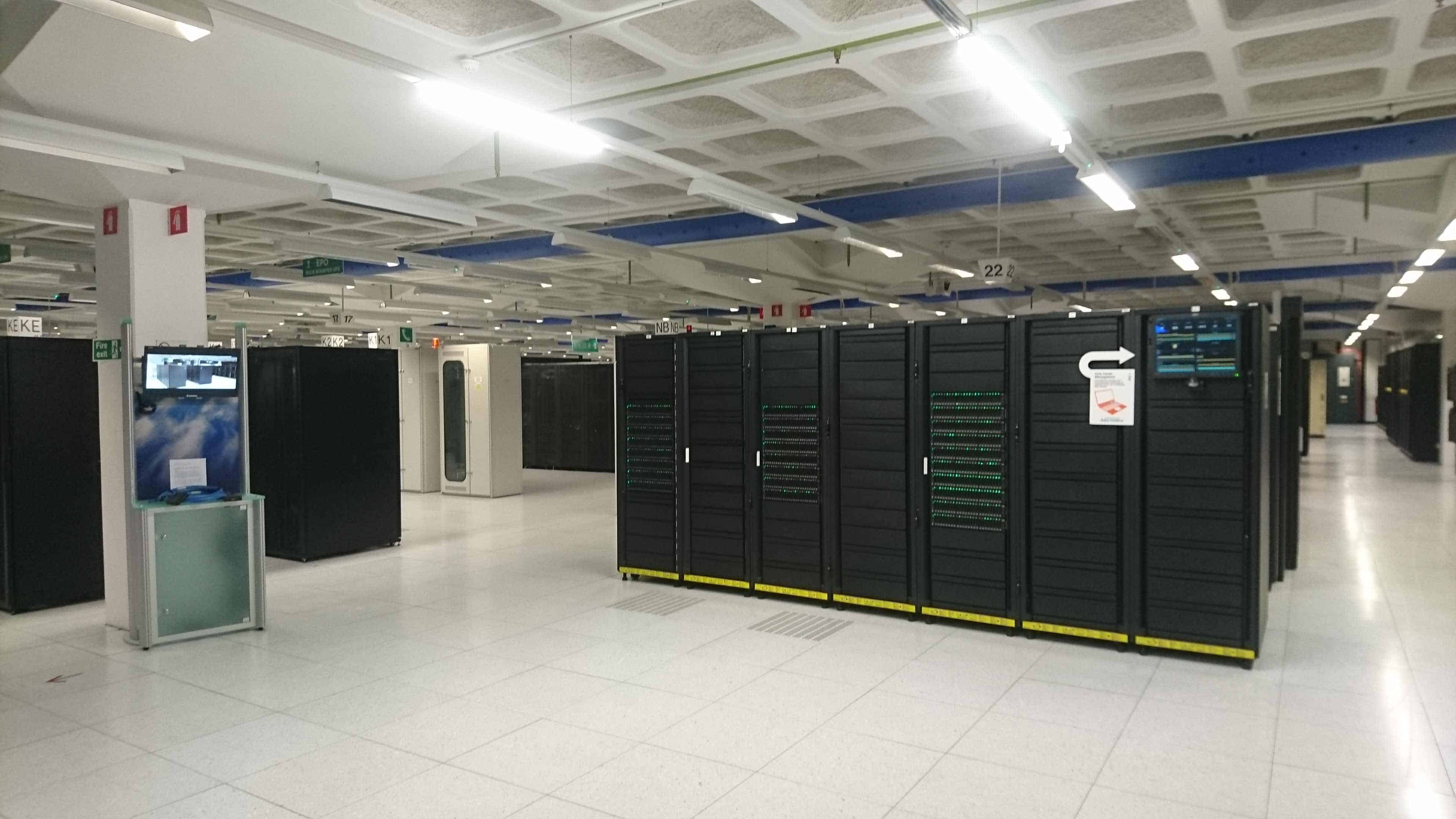
A view of IBM’s Hyperscale Cloud Data Centre
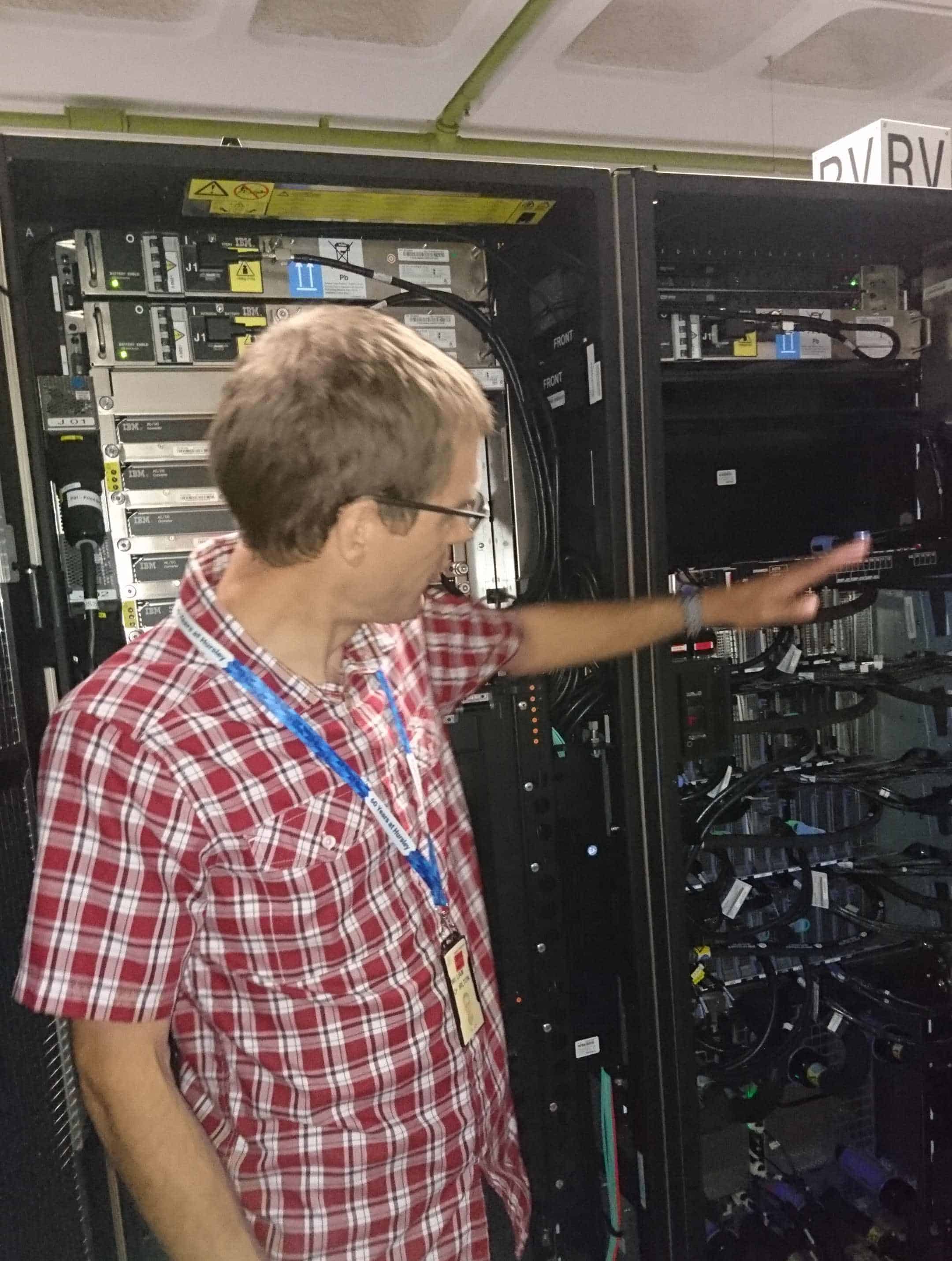
A lot of the stalls at the IBM festival referred to “the cloud” – that is, to data, storage or computing power that is held remotely and accessed when needed. Discussions about “the cloud” can get pretty nebulous (pardon the pun), so as a corrective, I went on a tour of IBM’s Hyperscale Cloud Data Centre (HCDC). Located on a lower floor of a nondescript office block, this vast, noisy room was filled with racks upon racks of the servers and other equipment required to run IBM’s internal systems and customer services. Above the din of the HCDC’s cooling system, tour guide William Chorlton described some of the steps IBM has taken to conserve energy. These ranged from simply rearranging the racks for better airflow (a 28% energy saving, Chorlton said) to using weather forecasts to predict and manage the centre’s future cooling requirements. Chorlton also “opened the bonnet”, so to speak, on an IBM Z14 mainframe. This refrigerator-sized unit holds up to 32 terabytes of RAM, transfers data internally at a rate of 16 GB/s via cables as thick as my finger, and costs approximately £1m. (“This is the closest I’ll ever get to a million pounds,” one of my fellow visitors observed.) The processors on these mainframes are water-cooled, Chorlton said, but the machines themselves are kept at a suitable operating temperature by an AMD – an “Air Movement Device”, otherwise known as a fan. (“IBM loves three-letter acronyms,” he quipped.)
IBM hardware and software support specialist William Chorlton shows off one of the company’s Z14 mainframes
By the time my tour group had finished admiring the Z14, the festival was nearly over, so I had to miss exhibits on quantum computing, AI in medicine and dozens of other topics. But as my second taxi of the day (driven, alas, by a polite but largely silent cabbie) pulled away from Hursley House, I left with the impression that, 60 years after the lab’s founding, reports of the death of industrial research in the UK have been greatly exaggerated.
The shape of red blood cells depends on where they are in the body and now researchers in Germany and France have used microfluidics in combination with numerical simulations to gain important new insights into how this shape-shifting occurs.
Red blood cells are disk-like objects with diameters of about 8 microns and account for almost half of the blood’s composition. At rest, the cells have a symmetric biconcave-disk shape that is thicker at the edge than in the centre (see figure).
They are not rigid particles and comprise a liquid cytoplasm that is encapsulated by a membrane, making the overall cell structure flexible. As the cell travels through the body, it flows through wide arteries and veins, but can also negotiate narrow vessels. All the while, the cells are immersed in relatively thick and viscous blood plasma – which can affect their shape.
Shape and mobility
The deformation of blood cells during their journey through the body plays a crucial role in their mobility and affects how blood circulates. Therefore, understanding how shape affects mobility is crucial to understanding basic blood circulation, some blood-related diseases and how drugs move through the body.
Scientists know that red blood cells undergo shape transformations in narrow blood vessels due to the presence of shear stresses. With increasing shear rate, the cells first tumble and roll, then change into a tumbling and rolling “stomatocytes”, which are reminiscent of an asymmetrical parachute. At higher shear rates, red blood cells form exotic multi-lobed shapes.
Now, Dmitry Fedosov and colleagues at the Institute of Complex Systems at the Research Center Jülich and the University of Montpellier have looked at how transitions between various red blood cell shapes depend on a wide range of shear rates and viscosity ratios between the cell’s cytosol (the fluid inside a cell) and blood plasma.
Fedosov says that the team’s study, “aimed to explain the basic behaviour of red blood cells and their possible shapes and dynamics from the physics point of view”. He adds, “We already understand how these cells behave in simple flows; understanding their movement in more complex flows within the microvasculature represents the next step”.
Tiny channels
To explore the behaviour of red blood cells under physiological conditions, one needs to apply high shear rates with relatively strong flows. However, working with water-like solutions in a conventional rheometer at high shear rates would be very difficult from the experimental point of view. This is because the solution may not be viscous enough to remain within the fluid chamber. Fedosov and colleagues overcame this limitation using microfluidics, which involves moving fluids through tiny channels.
The researchers obtained red blood cells from fresh human blood. The cells were then diluted in a viscous fluid and passed through a slit-like rectangular channel. The shapes and motions of the cells were recorded using a microscope equipped with a high-speed camera. As the team increased the flow rate within the microfluidic channel, the cells started to change shapes from something resembling a rolling doughnut to multilobed structures.
The observed shapes and dynamics were exactly in line with predictions made by 3D simulations that were done using two different hydrodynamic techniques.
Future steps
The research group plans to continue the investigation and make connections between the dynamics of red blood cell shapes and their pathological changes in various diseases. Fedosov explains, “we want to go to more complex geometries and realistic blood flow conditions. In reality, blood is a little bit denser than what we have simulated.”
“Theoretically, it should be possible to apply our findings to blood cells in different diseases. For example, we have already worked on malaria. It should also be possible to explore sickle cell anaemia. We could create a model system, which mimics changes in blood cells in these diseases, for studying their behaviour in flow and the effect on oxygen delivery,” he adds.
Timm Krüger of the University of Edinburgh told Physics World that an important strength of the research is that it “used two different and quite different modelling approaches along with an experiment”.
He adds, “In order to model complicated systems of red blood cells in larger vessels, we need information about the single cell behaviour”. The work of Fedosov and colleagues provides that information and Krüger says it “can be used as input for more advanced models”.
Krüger also foresees potential applications in medical diagnostics. “Some diseases, such as malaria or sickle cell anaemia, affect the shape of red blood cells. Understanding the flow behaviour of [red blood cells] better could hypothetically lead to improved diagnostics from a small amount of blood.”
The quantum Hall effect (QHE) is one of the most important effects being studied by solid-state physicists today. Measuring the limits at which it breaks down is extremely important – not only for fundamental physics but also for applying the effect as a resistance standard for redefining the kilogram. Researchers in France have now found that collective excitations of interacting electrons are responsible for the onset of the breakdown of the QHE in bilayer graphene at high electric fields and they have even calculated the “Landau velocity” at which this happens. The new result lends weight to the idea that the long-held single-electron picture is not a realistic description of the QHE. The breakdown mechanism also looks very much like what happens in superconductors at the limit at which correlated electron pairs (responsible for the supercurrent in these materials) break apart and at the point at which superfluidity collapses in systems like liquid helium.
Universal value for the quantum Hall resistance
The quantum Hall effect (QHE) is the appearance of a voltage across opposite faces of a thin, 2D conducting sheet (like graphene, which is a layer of carbon just one atom thick) when a current is passed along the plane of the sheet and a magnetic field is applied perpendicular to it. The magnetic field forces conduction electrons in the sheet to drift in circular, quantized, orbits (known as Landau levels). This movement normally depends on factors such as the density of electrons in the material and the thickness of the sheet. When the Hall voltage is compared with the current running through the sheet, the resulting quantum Hall resistance is h/Ne2, where h is the Planck constant (h), e is the electron charge and N is an integer.
All experiments to date appear to agree on a universal value for the quantum Hall resistance. “The accuracy of the experimental determination of this resistance may rely on correlated particle effects like those we have observed in our study though,” says Bernard Plaçais of the Laboratoire Pierre Aigrain in the Physics Department at the Ecole Normale Supérieure in Paris, who led this research effort. “Besides, graphene, which has a high electron mobility and in which the quantum Hall resistance has been measured with great accuracy, is now recognized as being a valuable platform for making a future QHE resistance standard.”
At the moment, the kilogram is defined by a small platinum and iridium cylinder crafted in 1889 and held at the Bureau International des Poids et Mesures in Paris, but recent comparisons of this standard with identical “witness” copies suggest that its mass is changing. Researchers would thus like to redefine the kilogram in a new way based on fundamental constants alone and one promising way to do this is in terms of the quantum Hall resistance.
Collective excitations of interacting electrons
Thanks to high-frequency shot-noise measurements, which were employed for the first time in this context, Plaçais and colleagues have now found that, at high electric fields, the QHE in bilayer graphene samples breaks down at a critical electron drift velocity thanks to collective excitations of electrons with a large momentum at the so-called magneto-exciton minimum. “This result is exciting because until now the QHE had been described by a single electron picture,” explains Plaçais. “We show here that this picture is incorrect at high electric fields where correlated electron transport effects are at play.
This situation is very much reminiscent of the superconducting currents in a superconductor, he states. “These currents are protected by the superconducting gap up to the limit at which the superconducting electron pairs (responsible for the supercurrent in these materials) break apart.
Analogies with the breakdown of superfluidity
“We studied the critical field at which this Hall insulator to metal transition occurs n collaboration with our theory colleagues from LPS-Orsay (led by Mark Goerbig) and ENS Lyon (led by David Carpentier),” he continues. The explanation we put forward also closely matches the breakdown of superfluidity in liquid helium. Helium gas is a very weakly interacting system, but it can be liquefied by applying a large pressure and transforms into a cloud of liquid helium droplets (in the so-called Joule-Thomson transformation).
Mark Oliver Goerbig
“In our system, the high electric field is analogous to the large pressure, and collective excitations of the Hall insulators (the magneto-excitons) analogous to the liquid helium droplets,” he explains. “These magneto-excitons disperse in a particular way thanks to the short-range interactions between them. This dispersion drastically reduces the excitation energy at finite wavelengths (the Landau gap), which extends to around the same length as the inverse of the so-called inter-Landau Level (LL) wavefunction distance.
David Carpentier
“When electrons in bilayer graphene are submitted to a high electric field, their dispersion is simply modified as a Galilean transformation resulting from their drift velocity. The Landau gap can then reach zero and even become negative. This phenomenon is known as the critical Landau velocity and is responsible for the proliferation of collective electronic excitations dissipating the current.”
Until now, researchers believed that single electron tunnelling in 2D materials like graphene started from the last occupied LL and gradually propagated to the deeper-lying LLs. “Our experiments invalidate this picture,” Plaçais tells Physics World. “The scenario we put forward is completely different in that the electron excitations are collective and involve the full set of occupied and unoccupied LLs. This is why it occurs so suddenly and looks like a bulk phase transition.”
Functional contact lenses are an exciting method of drug delivery to the eye, but have so far been limited by difficulties in controlling drug release and monitoring this release in situ. Now Jingzhe Deng and his groups at China Pharmaceutical University and Southeast University, China show that a combination of molecular imprinting and structural colour could provide a solution.
The researchers report (ACS Applied Materials & Interfaces) a contact lens containing specific drug-binding sites with the capability of sustained release over time. Furthermore, they show that the device can also self-report this drug-delivery process. As the binding and release of the target molecule to the contact lens results in a change of the refractive index of the matrix, drug release can be observed directly as a colour change of the lens.
pH responsive photonic crystals
In this study, Deng and his co-workers designed the lens as a photonic crystal, where the bright colour contact lens iris is a result of the 3D porous structure of the matrix. By using a regular arrangement of identical silicon dioxide nanoparticles as a template, the group created the well-defined structured polymeric lens with spherical cavities. The colour of the material is directly related to the size of templating nanoparticles: the greater the size of the spherical cavities, the longer the wavelength of light reflected from the contact lens.
In addition, the researchers show that the binding and release processes can be stimulated by the change in pH experienced when the lens is transferred from the drug-loading solution to an artificial tear fluid. This is because the pH affects the specific interactions between drug molecules and the functional monomer used to construct molecular-specific binding cavities.
As the binding and release of the drug molecule causes the expansion and contraction of the matrix, the team were then able to measure this directly by measuring the wavelength of the reflected light. They showed that the release of the drug from the lens for 12 hours decreased the reflected wavelength by 36.4 nm. A shift of this magnitude is perceivable as a colour change even by the naked eye.
Save your tears
This innovative method of monitoring the drug release means that the tricky task of collecting and analyzing tears can be avoided. The researchers also suggest that the design of this functional lens based on these techniques can be applied to a range of drugs, where the combination of these techniques has the potential to address some of the major challenges encountered in drug delivery to the eye.
Moreover, the team demonstrated the reusability of these lenses. The molecular imprinted matrix was shown to be capable of repeated drug binding and release. The timescales of these binding and release processes could fit easily into a patient’s lifestyle, where the lens could provide treatment for 12 hours during the day, and then be subsequently re-loaded for 12 hours at night.
Researchers from the University of Texas and the Scripps Research Institute have demonstrated that adding a new adjuvant, Diprovocim, to a cancer vaccine can draw cancer-fighting cells to the tumour site and boost the immune response (PNAS 10.1073/pnas.1809232115).
As cancer spreads, it inhibits the activity of T cells, the immune cells responsible for fighting off cancerous cells. Immunotherapy aims to harness the immune system to combat tumours and lately, cancer vaccines have been investigated as a potential trigger for this reaction. The vaccines are usually associated with adjuvants, molecules that are added to enhance the immune response to some specific antigens. This addition usually augments the response to cancer antigens both inside and outside of the tumour, making the vaccine more efficient.
Senior author Dale Boger.
Several adjuvants have been reported to improve the immune response in preclinical models for cancer treatment, but they are difficult to synthesize and can be toxic as they disseminate within the host organism. To find a safer alternative that would be easier to produce, a research team led by Bruce Beutler and Dale Boger screened a library of synthetic compounds. The researchers identified an adjuvant, Diprovocim, that is able to bind to the same immune receptors (TLR1/TLR2) as other adjuvants commonly used, while bearing no structural similarities and hence reducing the aforementioned shortcomings.
100% success in mice
The researchers tested this adjuvant on mice with a common form of aggressive melanoma. All mice in the experiment were given the anti-cancer therapy anti-PD-L1. They were then split into three groups: eight received the cancer vaccine, eight received the cancer vaccine plus Diprovocim, and eight received the cancer vaccine plus an alternative adjuvant derived from aluminium, alum.
The results spoke for themselves. All mice who received the cancer vaccine/Diprovocim combination were alive after 54 days, while none of the mice who were only given the vaccine (without Diprovocim) survived longer than 38 days. Comparatively, only 25% of the mice treated with the cancer vaccine with alum survived past 54 days.
Further investigations showed that Diprovocim boosted the ability of the vaccine to fight tumours by stimulating the immune system to produce more T cells, a feat that the other two vaccines could not achieve. Those T cells contributed to eliminating about 70% of target cells in mice immunized with the vaccine containing Diprovocim, compared with about 10% in mice who received alum as an adjuvant.
Preventing tumour recurrence
The vaccine is not just effective at suppressing tumours, it can also prevent them from reappearing. When the researchers tried to re-establish tumours in the surviving mice (without giving them any further treatment), the tumours failed to expand in mice treated with Diprovocim, while they grew rapidly in those who received alum. This finding shows that Diprovocim produces antigen-specific responses that protect the mice from tumour regrowth.
One important feature of this technique compared with others lies in the site of injection. Unlike some vaccines being developed, this Diprovocim-based alternative does not need to be injected directly into the tumour. Here, the researchers gave it as an intramuscular injection away from the tumour site.
This new vaccine obviously requires further testing and trials on other types of tumours and in combination with different cancer therapies, but these promising results provide grounds for optimism in the quest for an efficient cancer treatment.
In my first ever physics class, in high school, I loved learning that everyday concepts, such as velocity and acceleration, electricity and magnets, gravity, friction and sound, all had equations that described their behaviour. I loved the logic of it all and how physics and mathematics were really the underlying foundation of everything one encountered in the physical world. Based on that and my love of all things space (from NASA and sky‑gazing to Star Wars), I attended a residential summer camp during high school called the Summer Science Program, where my interest and understanding of physics took a quantum leap. We took graduate‑level courses to learn everything from spherical trigonometry to computer coding, which we used to write our own software to calculate the orbital parameters of asteroids that we were tracking with telescopes. My experience during this collaborative, hands-on, magical summer left me with no other choice than to pursue a physics-based degree when I got to college.
What did your physics and engineering degrees focus on?
I chose physics and mechanical engineering as my undergraduate focus areas at Duke University in the US, to provide a foundation for the aerospace work I wanted to do. It was in my postgraduate degrees that I really was able to deep-dive into what would become my academic speciality: fluid dynamics. As a Churchill Scholar at the University of Cambridge, UK, my research was all about bird flight: studying a new wing/feather phenomenon using wind tunnels (no birds were hurt in the completion of the degree!) and providing an aerodynamics analysis to explain the phenomena. During my PhD at Stanford University, I spent most of my time at NASA Ames Research Center working with the advanced supercomputing team to develop a new aerodynamic concept for landing high-mass missions on Mars.
Did you ever consider a permanent academic career, and how did your interest in science policy and working with the government emerge?
Until my last year of grad school, I was on the path to become an aerospace academic and, hopefully one day, an astronaut. But during those last few years the news was full of stories about the Space Shuttle programme ending, and I realized that, although I was planning a future devoted to advancing human space flight, I didn’t understand how the major policy decisions that affected that future’s vision, scope and funding were getting made by the government. So I decided to take a year off to pursue a science policy fellowship (the ASME Federal Government Fellowship Program) in Washington DC to learn how policy gets made. One year turned into five – I was hooked.
What was it like working as a senior policy adviser at the White House Office of Science and Technology Policy?
Humbling. I was part of a cohort of “doers” – visionaries with big ideas, wanting to help people and make our nation and the world a better place – inspired by our boss, John Holdren, the president’s science adviser and a giant in the science and technology world.
What is involved in your current role as director of the Center for Advanced Energy Studies (CAES) at Idaho National Laboratory?
CAES is a collaboration hub between the Idaho National Laboratory and the public research universities in Idaho and Wyoming: the University of Idaho, the University of Wyoming, Boise State University and Idaho State University. I direct the integrated research, education and innovation efforts that bring together teams of scientists, engineers, faculty members, industry and students to solve grand challenges in energy through collective innovation. CAES focus areas include the water–energy nexus, advanced manufacturing, nuclear energy, cybersecurity, policy and supercomputing.
Any advice for today’s students?
Find and interact with other stakeholders related to your work or research. Very often academic connections happen naturally through conferences, but don’t dismiss the private sector, government (local/state/federal), trade associations, think tanks and non-profits. If you want your work applied to something in the real world, make sure people know about it and help them implement change. Also, practise communicating science to your peers and the public. You should be able to explain your work or research, and why it’s important, to someone who doesn’t have a scientific background.