Whales are huge, and you would know it if you collided with one. Neutrinos, on the other hand are tiny and rarely collide with anything. So, what could they possibly have in common? It turns out that physicists working on the KM3NeT neutrino detector in the Mediterranean Sea have managed to hear the clicking sounds produced by sperm whales. You can read more in “A whale of a tale” by Jordan Rice.
Can the human eye detect cosmic radiation? The astronaut Scott Kelly thinks so, but does this stand up to the scrutiny of a particle physicist? Adam Falkowski seems to agree with Kelly in “Human eye can detect cosmic radiation”
Finally, the sprinter Usain Bolt has joined Stephen Hawking in the ranks of people who have experienced weightlessness onboard a diving aircraft. The French aeroplane is usually used for research purposes, but on this flight Bolt demonstrated at device for drinking champagne in zero gravity. See “Bubbling Bolt toasts zero-gravity with champagne”.
A practical technique that can quickly and efficiently transport ultracold atoms into a hollow fibre has been created by Patrick Windpassinger and colleagues at Johannes Gutenberg University Mainz in Germany. The technique involves allowing the atoms to ride on an “optical conveyor belt” created by two laser beams. Once inside the optical fibre, the atoms could be used in a wide range of applications, including quantum computing and sensing.
Over the past few decades, ensembles of ultracold atoms have proved incredibly for applications such as simulating quantum states of matter, measuring tiny forces and storing and processing quantum information. Most applications involve the interaction of laser light with atoms, so physicists are keen to find ways of making this interaction as precise as possible.
One way to do this is to confine a cloud of ultracold atoms within a hollow fibre before firing the appropriate laser light into the fibre. However, getting the atoms into a fibre without heating them up or losing most of them is a big challenge.
Keeping cool
One way of doing this is to let the atoms fall under gravity into a fibre or using a “magnetic funnel”. Another is the optical conveyor belt, which was first demonstrated in 2014 at the University of Tokyo by Hidetoshi Katori and colleagues. A key benefit of this technique, according to Windpassinger and colleagues, is that the atoms can be transported and positioned with great precision. However, doing so without losing lots of atoms or without heating the atoms remain important goals.
Now, Windpassinger and colleagues have built and characterized an optical conveyor system and shown that atoms can be transported in relatively large numbers while keeping them ultracold.
It involves first trapping and cooling of a cloud of rubidium-87 atoms in a magneto-optical trap (MOT). The atoms are initially held about 6 mm from the end of a fibre that is 10 cm long with a hollow core of diameter 60 µm.
Nodes and antinodes
The team then switches on a 1D optical lattice that is created by two counter-propagating laser beams that pass through the centre of the MOT and the fibre core. The lattice comprises nodes and antinodes of laser light that trap atoms at regular intervals.
The frequencies of the lasers are then changed slightly, which causes the nodes and antinodes to move towards and into the fibre at velocities as high as 0.4 m/s. This transports some of the atoms out of the MOT and about 6 mm into the fibre.
The transport process involves first accelerating and then decelerating the atoms, and Windpassinger and colleagues looked at how these processes affect the numbers of atoms that can be moved to the entrance to the fibre. Initially, they found that sharper accelerations (corresponding to shorter transport times) result in greater numbers of atoms being moved. They concluded, however, that this was not related to the transport process itself, but rather to the fact during shorter transport times fewer atoms have the chance to escape the conveyor.
Keeping cool
The team also looked at how acceleration and deceleration affected the temperature of the transported atoms. The atoms begin at a temperature of about 100 µK and the team predicted that this temperature should increase as the atoms are transported towards the tip of the fibre – which was confirmed experimentally. They also showed that by changing the amplitude of the trapping lasers during the transport process, they can nearly eliminate heating. However, this comes at the cost of losing atoms more and therefore a reduction in transport efficiency.
Windpassinger and colleagues also looked at transport efficiency and final temperature for atoms that had been moved 6 mm inside the fibre – and found these parameters to be broadly similar to what was measured outside the fibre. For example, the team was able to transport atoms chilled to 70 µK with an efficiency of about 10%, whereas 40% was possible for atoms at 940 µK.
Windpassinger told Physics World that this work marks the end of the development phase of their optical conveyor and the next step for the team is to investigate potential applications of the technology. At the top of his list is to create Rydberg states within the trapped atoms. These states can mediate interactions between photons, creating “molecules of light” that could be useful for storing quantum information. Rydberg states in fibres could also be useful for creating sensors for detecting electromagnetic fields.
The boom, which shows no sign of abating, was in part helped by the introduction of the 1000 Talents programme a decade ago. Designed to persuade top Chinese researchers who have spent time abroad to return home, the policy has been a roaring success with many scientists bringing back experience of working in top labs from around the world.
Yet there has been one gaping hole in the success of that programme, namely its inability to attract foreign-born researchers to make a permanent move to China. In this year’s report – the fourth Physics World special report on physics in China following publications in 2011, 2016 and 2017 – we examine a recent document released by the Ministry of Science and Technology of China indicates a new shift in emphasis in China’s talent-recruitment drive. Through the new policy, the Chinese government is ramping up its quest to attract non-Chinese scientists, recognizing that the country needs to foster a more collaborative approach to become truly innovative.
One foreign scientist frustrated by career progression in China is the astronomer Richard de Grijs. Originally from the Netherlands, he spent eight years in Beijing at the Kavli Institute for Astronomy and Astrophysics, before leaving for Australia earlier this year. Writing in the special report, however, he points out that he was told on “multiple occasions” that his ambitions to get a new position in the country had been “cut short” because of his foreign citizenship. De Grijs was also informed that he didn’t receive government funding he had applied for because he was not Chinese.
Still, the issues faced by de Grijs – and others like him – will need rectifying if China hopes to welcome more foreign scientists, especially if the country builds the CEPC in the coming decade.
Here is a run-down of what’s in the issue:
Building the next collider – Yifang Wang, director of China’s Institute of High Energy Physics, discusses the country’s plan to build a huge 100 km particle collider
Taking a lead on renewables – As China begins to lead the world in alternative forms of energy, Dave Elliott, from Open University in the UK, look at the impact this will have
A new vision for research – Qionghai Dai, head of Tsinghua University’s Broadband Network and Digital Media Lab, outlines his lab’s work in the burgeoning field of computational photography
My Chinese experience – Richard de Grijs from Macquarie University in Sydney, Australia, describes how his eight years in China have benefited his research
I hope you find this special report interesting, and if you’d like to share your thoughts on it, please get in touch by e-mailing us at pwld@iop.org.
Listen to this week’s edition of the Physics World Weekly podcast, which features a discussion about the 2018 special report and the China Electron Positron Collider.
Matching the subwavelength confinement capabilities of plasmonic resonators, with the ultralow losses and cavity lifetimes of photonic crystals may be a step closer thanks to the work of a team lead by Sharon Weiss from the Electrical Engineering and Computer Science Department of Vanderbilt University (US). The researchers have, for the first time, experimentally demonstrated light confinement in a silicon “bowtie” crystal cavity. Published in Science, the article confirms the theoretical prediction that the group made in 2016 and paves the way towards all-dielectric field enhancement and confinement, crucial for applications in photovoltaic, computing, sensing, and quantum optics.
Confining light in a subwavelength volume is a longstanding challenge. It is attractive as it circumvents the traditional diffraction limit of optical microscopes, allowing smaller areas to be probed. Moreover, the associated local field enhancement induces a strong light-matter interaction, which could be manipulated to produce next-generation photonic technologies.
One way of trapping light is through temporal confinement, in which the light is kept inside a cavity of quality factor, Q for as long as possible. Indeed, dielectric-based cavities can have very high Q-factors making them well-equipped to retain incident light. But in contrast to their plasmonic counterparts, the confinement of light in a dielectric nanostructure is diffraction-limited, meaning that the volume of light that the cavity holds can never be substantially smaller than the incident wavelength.
In this recent work, Weiss and colleagues have managed to combine high Q factors with modal volumes comparable to those achieved by plasmonic structures, using a photonic crystal cavity whose unit cells are bowtie shaped. This strong confinement is underpinned by what they call a “two-steps localization process”. The first confinement step is that of any photonic material, due to the contrast in refractive index between the two constituent materials of the crystal, in this case silicon with air holes. The different refractive indexes of the structure force light to be scattered in certain preferential directions and prevent it from propagating in others. This is fully analogous to the way the atomic potential creates bandgaps for the electrons of a crystal and has therefore been called the photonic bandgap effect.
In contrast to conventional photonic crystals, however, the lattice holes of this cavity present a dielectric inclusion in the shape of a nano bowtie, which further acts to localize light between its tips. This two-step phenomenon is effective in preserving the high Q factors of the photonic crystal cavity while achieving a strong spatial confinement of the light on the tips of the bowtie.
The experiment
To fabricate such an effective material, precise nanoscale control is essential. The thickness of the bowtie unit cell of the silicon photonic crystal is modulated to achieve a v-shaped groove. The cavity is then built by assembling consecutive unit cells, with centres separated by 450 nm. The central unit cell has a radius of 150 nm, which is progressively increased in each subsequent unit cell up to 187 nm for the furthermost unit cells on both sides of the cavity. In total, the cavity presents 20 unit cells and 10 mirror unit cells on each side of the central cell. The results for the single bowtie unit cell show an 80-fold increase of the peak value of the electric field compared with a standard circular photonic crystal unit cell.
To measure the mode distribution inside the structure, the team has relied on near-field scanning optical microscopy (NSOM). The cavity, as a whole, has a quality factor of the order of Q=105, a value which is comparable to that of photonic crystals, and a mode volume which is two orders of magnitude smaller than other photonic crystals and comparable with plasmonic counterparts.
The team predicts that “Such an unprecedented strong light-matter interaction platform can facilitate the advancement of science in a broad range of applications, including low-power opto-electronics, nonlinear optics, and quantum optics.”
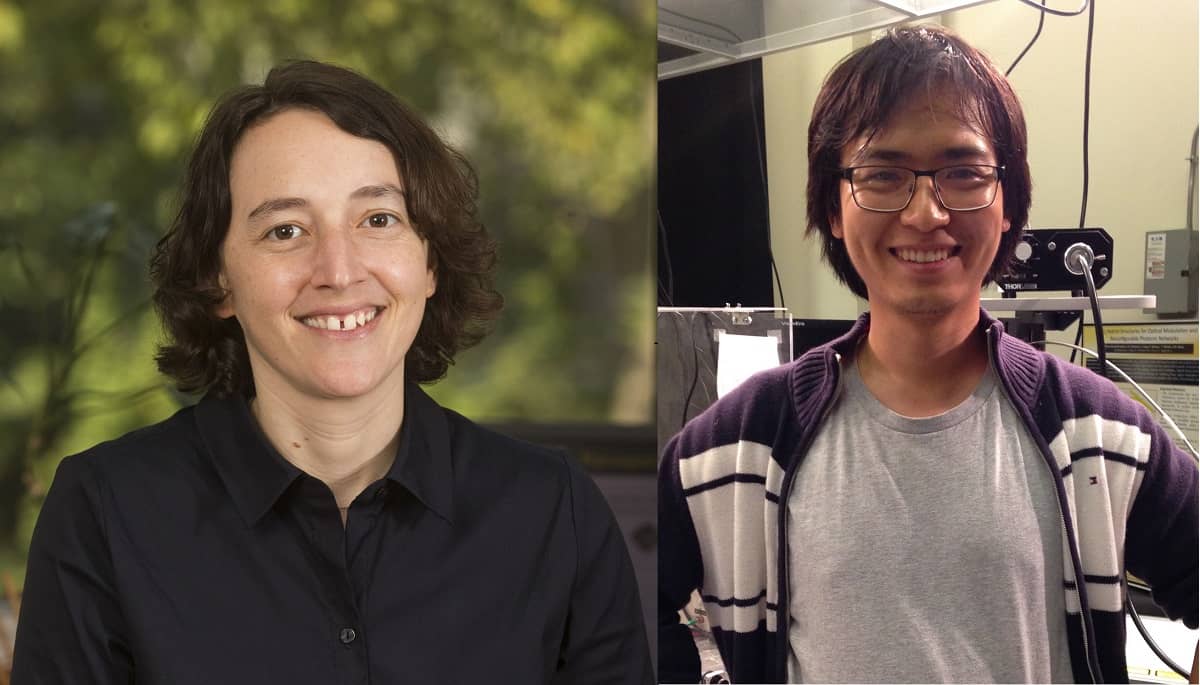
The researchers Sharon Weiss and Shuren Hu
It all started with the theory
Shuren Hu, first author of the paper, now working as a Principal Engineer in Silicon Photonics at GlobalFoundries, told me a little bit about the journey and the people behind this work:
“Thinking back on this research project, it has been a really long journey, especially the experimental part. When Prof. Weiss and I first submitted the theory paper, we got very mixed feedback. Some reviewers were very interested, some doubted the feasibility of such a design. Thanks to our collaborators, we were able to fabricate such a photonic crystal with <10nm bowtie tip definition, and then to successfully characterize it. I want to give a shout out to our awesome collaborators and co-authors: Marwan Khater and Will Green are at IBM Silicon Photonics Group, and Ernst Kratschmer and Sebastian Engelmann are at IBM Material Research Lab. They together came up with several innovations in fabricating the bowtie photonic-crystal structures with high uniformity and v-groove depth modulation. Rafael Salas-Montiel at University de Technologie de Troyes also did a fantastic job characterizing optical mode distribution inside the structure using near-field scanning optical microscopy (NSOM).”
He also says that, together with Weiss, they are continuing to collaborate on this project through a new National Science Foundation grant, and they welcome new collaborations to further advance the science and applications of their bowtie photonic crystal.
Today marks the end of Peer Review Week 2018, a global celebration of the essential role that peer review plays in maintaining scientific quality and progress. The theme of this year’s event is diversity and inclusion, with the organizers hoping to stimulate an “open debate on what diversity and inclusion in peer review looks like, why it’s important, and how to support it”.
Events throughout the week have brought together scientists, learned societies and publishers to understand and address the underlying biases in peer review. Here at IOP Publishing – which publishes Physics World along with more than 70 scientific journals – it has provided an impetus for us to examine the diversity of the authors, referees and editorial board members of journals owned by IOP Publishing.
But it was surprisingly difficult to find reliable data on the gender and geographic make-up of journal contributors, reveals Kim Eggleton, who manages the peer-review teams at IOP Publishing. “We generally don’t capture any demographic data as part of the peer-review process, as we are only interested in the quality of the science and the expertise of the reviewer,” Eggleton explains.
Speaking in the latest edition of the Physics World Weekly podcast, Eggleton highlights the importance of diversity in peer review. “Recent studies in other fields have shown that greater diversity in the reviewer database leads to better science because it allows different points of view to be represented,” she says. “So we commissioned a report to find out where we are, and to see whether we need to change anything.”
The result is a detailed analysis of the gender and geographic diversity of all contributors to journals owned by IOP Publishing. Physics World news editor Michael Banks has reported on the key findings from the study – which includes 12 recommendations to boost diversity and inclusion in IOP Publishing’s peer-review processes – while the 30-page report can be read in full via the IOP Publishing website. “In common with many other publishers, we wanted to be transparent about our findings, whether good or bad,” says Eggleton.
You can listen to the complete interview with Kim Eggleton in this week’s edition of the Physics World Weekly podcast. The podcast also features a discussion about Physics World’s recently published Special Report on China.
“Bisphenol free” products may not be so safe after all and may even produce the same endocrine-disrupting effects in the body as bisphenols themselves, according to a new study by researchers at Washington State University. The new finding comes 20 years after the discovery – by the same team – that bisphenol-A (BPA) produces chromosomal abnormalities in mice that can be passed on from generation to generation.
“In 1998, mice in our lab, which were housed in polycarbonate cages, were inadvertently exposed to BPA during a set of experiments when someone used the wrong detergent in the cage washer,” explains study lead author Patricia Hunt of the Center for Reproductive Biology at Washington State. “This detergent damaged the plastic and caused BPA to leach out from the cages, which caused a sudden increase in the number of abnormal eggs in normal females. Our finding received a lot of coverage at the time, and BPA became a household word.”
Since then thousands of other studies have also reported on the endocrine-disrupting effects of BPA, and “BPA-free” products, promoted as being safer, have subsequently flooded the market. “Unfortunately, manufacturers have simply replaced BPA with structurally similar bisphenols, and preliminary studies suggest that these chemicals may induce similar effects to BPA itself,” says Hunt.
Strange déjà vu experience
“Following our misadventure with BPA, we switched to a more stable caging polymer, polysulphone (a replacement bisphenol comprised of BPA and diphenyl sulphone), for our lab mice. We have been using these cages for years without incident, but our new study, published in the same journal as last time, Current Biology 10.1016/j.cub.2018.06.070, describes a remarkably strange déjà vu experience.”
Hunt and colleagues made their new discovery during studies of meiosis in male and female mice. Meiosis refers to the process in sexual reproduction by which germ cells divide to produce gametes (eggs and sperm). It is a specialized form of cell division that halves the chromosome number, thus creating four haploid cells, each genetically distinct from the parent cell from which they originate.
In their experiments, the researchers observed changes in “meiotic recombination” with levels in some controls reaching values similar to those in BPA-exposed animals. “Low recombination rates can be lethal because spermatocytes with homologues that fail to recombine face certain death due to a mechanism that arrests and destroys cells with unpartnered chromosomes at metaphase,” explains Hunt.
“Same types of effects on the gamete-making process”
“To our surprise, our data changes coincided with the appearance of physical damage (manifesting itself as white residue) on some of the cages in use in the facility. We tested these cages and found that they were leaching bisphenols. Although not all cages were damaged and we couldn’t determine how the damage occurred, the data changes we observed point to the same types of effects on the gamete-making process that we had previously seen in studies on BPA.”
Gamete formation is controlled by subtle changes in hormone levels, she explains, which makes the process extremely sensitive to the effect of compounds like BPA that can mimic or interfere with our body’s hormones. “We call these chemicals ‘endocrine disrupting chemicals’ (EDCs) and it is becoming increasingly difficult to limit our exposure to them because a growing number of EDCs are contaminating our daily lives.”
Germline effects may impact multiple generations
“Our findings reveal that exposure to common replacement bisphenols induces germline effects in both sexes that may impact multiple generations. They also suggest that chemical contaminants may affect research results. “Reproducibility is essential in science and the confounding effects of these chemicals (which are not usually taken into account in biology experiments) ‘muddy the waters’.”
The researchers say that there are dozens of replacement bisphenols in use today – and that these will need to be tested for their safety. “In addition to this rapidly growing family, we suspect that other classes of EDCs will also have adverse effects on reproductive health,” Hunt tells Physics World. “These include the parabens, perfluorinated compounds (PFCs), phthalates, flame retardants and quaternary ammonium compounds. All these chemicals are not only increasingly being employed in our everyday lives, they are also significant environmental contaminants and as such need to be investigated too.”
Researchers at Yale University have reported a new imaging modality, known as deuterium metabolic imaging (DMI), in which sugars and other nutrients are labelled with a heavy hydrogen (2H) atom and subsequently administered to track and monitor their uptake and metabolism (Science Advances4 eaat7314).
Mapping glucose metabolism is important for monitoring the development and treatment of cancer, as tumours metabolize glucose both at an elevated rate and through a different set of chemical reactions compared with healthy tissue — a phenomenon known as the Warburg effect.
2H, a form of atomic hydrogen with one extra neutron, is harmless and exists naturally in a very small abundance. In comparison, current methods of imaging glucose metabolism in the clinic rely on radioactive labelling of glucose molecules for detection by PET scans. In addition to the radiation risk, PET is unable to track the downstream metabolites of glucose and often gives misleading results in organs with intrinsically high glucose metabolism, such as the brain and the liver.
The researchers knew that 2H generated a signal in nuclear magnetic resonance (NMR) spectroscopy. This gave them the idea that 2H might also function as a metabolism tracer in traditional MRI scans.
“2H-labelled substrates are used in metabolic research in humans, but not combined with imaging. Our interest was piqued when we saw that 2H-labelled metabolites originating from 2H-labelled glucose could be detected in vivo at ultra-high magnetic field strengths,” explains first author Henk De Feyter. “Then it came down to trying this out at field strengths similar to those used in clinical MRI scanners. After those experiments were successful, it was obvious that DMI has great potential to become a widespread metabolic imaging tool.”
De Feyter, Robin de Graaf and colleagues showed how the DMI technique revealed dramatic differences in glucose metabolism between brain and tumour tissues in a rat glioma. They then went on to detect similar metabolic distributions in human subjects with brain tumours and in healthy controls.
While MRI scanners are significantly less sensitive to 2H than to the single proton of hydrogen nuclei, this loss is in part offset by the spin characteristics of the 2H nucleus. A DMI scan of a human patient with a brain tumour who drank 2H-labelled glucose dissolved in water revealed that the tumour was well contrasted to background healthy brain tissue, due to the Warburg effect.
The versatility of the DMI technique is also not limited to the brain, as the researchers were able to efficiently detect deuterium-labelled sugars stored as glycogen in both rat and human livers.
De Feyter and his team’s work showcases an exciting new clinical prospect for monitoring tumour metabolism in a non-invasive, patient-friendly way. This may have far reaching consequences for the development of novel cancer therapies based on the interruption of cancer cell metabolism.
The planet’s greenery – prairie grasslands, riverine swamps, Sahel drylands, European woodlands, tropical rainforest and Alpine meadows – could be about to be overtaken by a huge vegetation change as the world warms at a dangerous rate.
The warning comes not from computer simulations of what could happen under the notorious “business-as-usual” scenario, in which humans go on burning ever greater quantities of fossil fuel, to raise the levels of greenhouse gases in the global atmosphere, but from a simple natural experiment while humans were still Neolithic nomads.
Between 21,000 and 14,000 years ago, near the end of the last Ice Age, the world warmed by between 4 °C and 7 °C. And the world’s plants preserved a register of the changes during that era.
An international research team reports in the journal Science that they collated and examined the data based on the fossilised pollen evidence of bygone ecosystems from 594 sites on every continent except Antarctica, to record the way forests died back, new species invaded, and the nature of the landscapes changed.
And, they say, there is evidence that climate change is already imposing a new plant hierarchy on the landscape, and major transformation could be on the way. But there are two big differences between the climate shift near the end of the last Ice Age and the present global warming.
Back then, the temperature rise, and the shifts in vegetation, took thousands of years. Then, the temperature shifted between familiar boundaries: glacial and interglacial.
But under the business-as-usual scenario, humans are now warming the world at a rate an estimated 65 times faster than late in the last Ice Age. And since the temperatures are already much higher, any changes in the next century or so could exceed anything the world experienced in the last two million years.
“If we allow climate change to go unchecked, the vegetation of this planet is going to look completely different than it does today, and that means a huge risk to the diversity of this planet,” said Jonathan Overpeck, of the University of Michigan, US, one of the scientists who launched the five-year study.
“We’re talking about global landscape change that is ubiquitous and dramatic. And we’re starting to see it in the United States, as well as around the globe.”
The researchers calculate that if nations go on driving economies by coal, oil and natural gas combustion, the chance of large-scale change in the planet’s vegetation is more than 60%. If nations implement their Paris promises the probability of global-scale change is less than 45%. Most of this change will occur in this century and, because of the rate of warming, people now alive will see some of these vegetation shifts.
“We’re talking about the same amount of change in 10 to 20 thousand years that is going to be crammed into a century or two. Ecosystems are going to be scrambling to keep up,” said Stephen Jackson, who directs the US Geological Survey’s southwest climate adaptation centre, and is one of the co-authors. In the US West, forests incinerated by wildfires – in turn driven by drought and extremes of heat – may be colonized by unfamiliar species.
“You take the ponderosa pine forests of the Sky Islands and turn it into oak scrub – we are starting to see that,” he said.
“Then you can’t go up to those pine forests any more for shade or coolness or the experience of walking through a beautiful grove of trees.”
In this episode of the Physics World Weekly podcast, James Dacey is joined by the Physics World news editor, Michael Banks. The pair discuss the recently published Physics World special report on physics in China. That free-to-read report explores China’s ambitions to become a global leader in particle physics, and its latest drive to attract the top international talent to relocate to the country.
Dacey is then joined by Kim Eggleton, a senior managing editor at IOP Publishing – the academic publisher that produces Physics World. Eggleton speaks about Peer Review Week 2018, which has been taking place this week. Publishers, scientists and many others have been celebrating the vital role peer review plays in science. The theme of this year’s event is “diversity in peer review”, so Eggleton discusses a new report that evaluates diversity and inclusion within IOP Publishing’s peer-review process.
Finally, Physics World’s general physics editor Hamish Johnston returns to the show to talk about some of the research highlights from the week. He’s been getting particularly excited about an unusual type of radio that exploits the quantum properties of a cloud of atoms. Listen to the podcast and all will be revealed.
If you enjoy what you hear, then you can subscribe via the Apple podcast app or your chosen podcast host.
A “topological” alloy of iron and tin has been found to respond surprisingly strongly to magnetic fields, according to research carried out by Zahid Hasan at Princeton University and colleagues in the US, China and Taiwan. The material, which is layered, can be easily cleaved to create surfaces with honeycomb crystal structures with six-fold rotational symmetry. When studying the surface, Hasan and colleagues found that the symmetry of the electronic structure does not match that of the atomic lattice.
Materials with properties that respond strongly to electric or magnetic fields are interesting because they are so useful for technological applications. Those boasting giant magnetoresistance (GMR), for example, are used in a wide range of magnetic-field sensors, notably in hard-disk drives. These materials have a resistance that changes dramatically when subject to a magnetic field.
We found a new control knob for the quantum topological world
Zahid Hasan
Topological properties can arise in materials with a strong quantum-mechanical coupling between the spin and orbital angular momentum of electrons. On the surface of some materials, this spin-orbit coupling can lock the motion of an electron to its spin, preventing the electron from scattering. This results in a topological insulator that conducts electrons on its surface, but not in its bulk. Given that electron spin is related to the magnetic properties of a material, any magnetic materials with strong spin-orbit coupling could have exotic and potentially useful topological properties.
Cleaved crystal
In an ordinary crystalline solid, the electronic structure normally has the same symmetry as the surrounding atomic lattice. But instead of having the expected six-fold symmetry, the researchers found the electronic structure on the surface of the iron-tin alloy has two-fold rotational symmetry.
“We had expected to find something six-fold, as in other topological materials, but we found something completely unexpected,” says Princeton’s Songtian Sonia Zhang. “We kept investigating, and we found more unexpected things. It’s interesting because the theorists didn’t predict it at all. We just found something new.”
Big surprise
The next big surprise was that that the axis defining the two-fold symmetry can be rotated by applying a magnetic field. Furthermore, the electronic structure could be aligned in any direction that the researcher chose.
Hasan’s team is unable to explain why a magnetic field has such a dramatic effect on the electronic properties of the material. Indeed, the response to the magnetic field is about 100 times stronger than predicted by current theory. The implication is that the g-factor of the material’s electrons – which relates the magnetic moment of a particle to its spin – is about 100-times greater than for electrons in free space.
“Nobody predicted that in topological materials,” says Hasan, “This gigantic and tunable quantum effect opens up the possibilities for new types of quantum technologies and nanotechnologies.” He believes his team has found “a new control knob” for the quantum topological world. “We expect this is tip of the iceberg,” he adds. “There will be a new subfield of materials or physics grown out of this.”
David Hsieh from Caltech, who was not involved in the research, adds that the research could be evidence of a new quantum phase of matter. “That’s, for me, exciting,” he says. “They’ve given a few clues that something interesting may be going on, but a lot of follow-up work needs to be done, not to mention some theoretical backing to see what really is causing what they’re seeing”.