In an era where video games often prioritize fast-paced action and instant gratification, Exographer offers a refreshing change. With a contemplative journey that intertwines the realms of particle physics and interactive storytelling, this beautifully pixelated game invites players to explore a decaying alien civilization through the lens of scientific discovery while challenging them with dexterity and intellect.
Exographer was developed by particle physicist and science-fiction author Raphaël Granier de Cassagnac and his video-game studio SciFunGames. At its core, it is a puzzle-platformer – where the player’s character has to move around an environment using platforms while solving puzzles. The character in question is Ini, an alien explorer who discovers a multifunctional camera in the opening scenes of the game’s narrative. Stranded on a seemingly deserted planet, Ini is tasked with unlocking the mystery of the world’s fallen civilization.
The camera quickly becomes central to gameplay, allowing for environmental analysis, teleportation to previously visited locations and, most intriguingly, the discovery of subatomic particles through puzzles inspired by Feynman diagrams. These challenges require players to match particle trajectories using various analytical tools, mirroring the investigative processes of real-world physicists.
It is in these games where the particle physics really shines through. Beamlines have to be tracked and redirected to unveil greater understanding of the particles that make up this strange land and, with that, Ini’s abilities to understand the world.
As you crack one puzzle, a door opens and off you pootle to another blockage or locked door. Players will doubtless, as I did, find themselves wandering around areas pondering how to unlock it. A tip for those a little stuck: use the camera wherever a background seems a little different. In most circumstances, clues and cues will be waiting there.
Pixels and particles
The game’s environments are meticulously crafted, drawing inspiration from actual laboratories and observatories. I played the game on Nintendo Switch, but it is also available on several other platforms – including PS5, Xbox and Steam – and it looks pretty much identical on each. The pixel art style is not merely a visual choice but a thematic one, symbolizing the fundamental “pixels” of the universe of elementary particles. As players delve deeper, they encounter representations of particles including electrons, gluons and muons, each unlocking new abilities that alter gameplay and exploration.
Meanwhile, the character of Ini moves in a smooth and – for those gamers among us with a love of physics – realistic way. There is even a hint of lighter gravity as you hold down the button to activate a longer jump.
Game with depth An undersea puzzle in Exographer features a Km3Net-inspired neutrino observatory. (Courtesy: SciFunGames)
What sets Exographer apart is its ability to educate without compromising entertainment. The integration of scientific concepts is seamless, offering players a glimpse into the world of particle physics without overwhelming them. However, it’s worth noting that some puzzles may present a steep learning curve, potentially posing challenges for those less familiar with scientific reasoning.
Complementing the game’s visual and intellectual appeal is its atmospheric soundtrack, composed by Yann Van Der Cruyssen, known for his work on the game Stray. As with Stray – where you take the role of a stray cat with a backpack – the music enhances the sense of wonder and discovery, underscoring the game’s themes of exploration and scientific inquiry.
Exographer is more than just a game; it’s an experience that bridges the gap between science and (pixelated) art. It challenges players to think critically, to explore patiently, and to appreciate the intricate beauty of the universe’s building blocks. For those willing to engage with its depth, Exographer offers a rewarding journey that lingers after the console is turned off.
2024 SciFunGames and Abylight Studios Nintendo Switch £17.99; PS5 £15.99; Xbox £16.74; PC £16.75
Researchers in Japan have directly visualized the formation and evolution of quasiparticles known as excitons in carbon nanotubes for the first time. The work could aid the development of nanotube-based nanoelectronic and nanophotonic devices.
Carbon nanotubes (CNTs) are rolled-up hexagonal lattices of carbon just one atom thick. When exposed to light, they generate excitons, which are bound pairs of negatively-charged electrons and positively-charged “holes”. The behaviour of these excitons governs processes such as light absorption, emission and charge carrier transport that are crucial for CNT-based devices. However, because excitons are confined to extremely small regions in space and exist for only tens of femtoseconds (fs) before annihilating, they are very difficult to observe directly with conventional imaging techniques.
Ultrafast and highly sensitive
In the new work, a team led by Jun Nishida and Takashi Kumagai at the Institute for Molecular Science (IMS)/SOKENDAI, together with colleagues at the University of Tokyo and RIKEN, developed a technique for imaging excitons in CNTs. Known as ultrafast infrared scattering-type scanning near-field optical microscopy (IR s-SNOM), it first illuminates the CNTs with a short visible laser pulse to create excitons and then uses a time-delayed mid-infrared pulse to probe how these excitons behave.
“By scanning a sharp gold-coated atomic force microscope (AFM) tip across the surface and detecting the scattered infrared signal with high sensitivity, we can measure local changes in the optical response of the CNTs with 130-nm spatial resolution and around 150-fs precision,” explains Kumagai. “These changes correspond to where and how excitons are formed and annihilated.”
According to the researchers, the main challenge was to develop a measurement that was ultrafast and highly sensitive while also having a spatial resolution high enough to detect a signal from as few as around 10 excitons. “This required not only technical innovations in the pump-probe scheme in IR s-SNOM, but also a theoretical framework to interpret the near-field response from such small systems,” Kumagai says.
The measurements reveal that local strain and interactions between CNTs (especially in complex, bundled nanotube structures) govern how excitons are created and annihilated. Being able to visualize this behaviour in real time and real space makes the new technique a “powerful platform” for investigating ultrafast quantum dynamics at the nanoscale, Kumagai says. It also has applications in device engineering: “The ability to map where excitons are created and how they move and decay in real devices could lead to better design of CNT-based photonic and electronic systems, such as quantum light sources, photodetectors, or energy-harvesting materials,” Kumagai tells Physics World.
Extending to other low-dimensional systems
Kumagai thinks the team’s approach could be extended to other low-dimensional systems, enabling insights into local dynamics that have previously been inaccessible. Indeed, the researchers now plan to apply their technique to other 1D and 2D materials (such as semiconducting nanowires or transition metal dichalcogenides) and to explore how external stimuli like strain, doping, or electric fields affect local exciton dynamics.
“We are also working on enhancing the spatial resolution and sensitivity further, possibly toward single-exciton detection,” Kumagai says. “Ultimately, we aim to combine this capability with in operando device measurements to directly observe nanoscale exciton behaviour under realistic operating conditions.”
Topological insulators are materials that behave as insulators in their interior but support the flow of electrons along their edges or surfaces. These edge states are protected against weak disorder, such as impurities, but can be disrupted by strong disorder. Recently, researchers have explored a new class of materials known as topological Anderson insulators. In these systems, strong disorder leads to Anderson localization, which prevents wave propagation in the bulk while still allowing robust edge conduction.
The Fermi energy is the highest energy an electron can have in a material at absolute zero temperature. If the Fermi energy lies in a conductive region, the material will conduct; if it lies in a ‘gap’, the material will be insulating. In a conventional topological insulator, the Fermi energy sits within the band gap. In topological Anderson insulators, it sits within the mobility gap rather than the conventional band gap, making the edge states highly stable. Electrons can exist in the mobility gap (unlike in the band gap), but they are localized and trapped. Until now, the transition from a topological insulator to a topological Anderson insulator has only been achieved through structural modifications, which limits the ability to tune the material’s properties.
In this study, the authors present both theoretical and experimental evidence that this phase transition can be induced by applying heat. Heating introduces energy exchange with the environment, making the system non-Hermitian. This approach provides a new way to control the topological state of a material without altering its structure. Further heating prompts a second phase transition, from a topological Anderson insulator to an Anderson insulator, where all electronic states become localized, and the material becomes fully insulating with no edge conduction.
This research deepens our understanding of how disorder influences topological phases and introduces a novel method for engineering and tuning these phases using thermal effects. It also provides a powerful tool for modulating electron conductivity through a simple, non-invasive technique.
Lepton flavour universality is a principle in particle physics that concerns how all leptons (electrons, muons and taons) should interact with the fundamental forces of nature. The only difference between these interactions should be due to the different masses of the three particles.
This idea is a crucial testable prediction of the Standard Model and any deviations might suggest new physics beyond it.
Although many experimental results have generally supported this claim, some recent experimental results have shown tensions with its predictions.
Therefore the CMS collaboration at CERN set out to analyse data from proton-proton collisions, this time using a special high-rate data stream, designed for collecting around 10 billion proton decays.
They looked for signs of the decay of B mesons (a bottom quark and an up antiquark) into electron-positron or muon-antimuon pairs.
If lepton flavour universality is true, the likelihood of these two outcomes should be almost equal.
The authors found exactly that. To within their experimental uncertainty, there was no evidence of one decay being more likely than the other.
These results provide further support for this principle and suggest that different avenues ought to be studied to seek physics beyond the Standard Model.
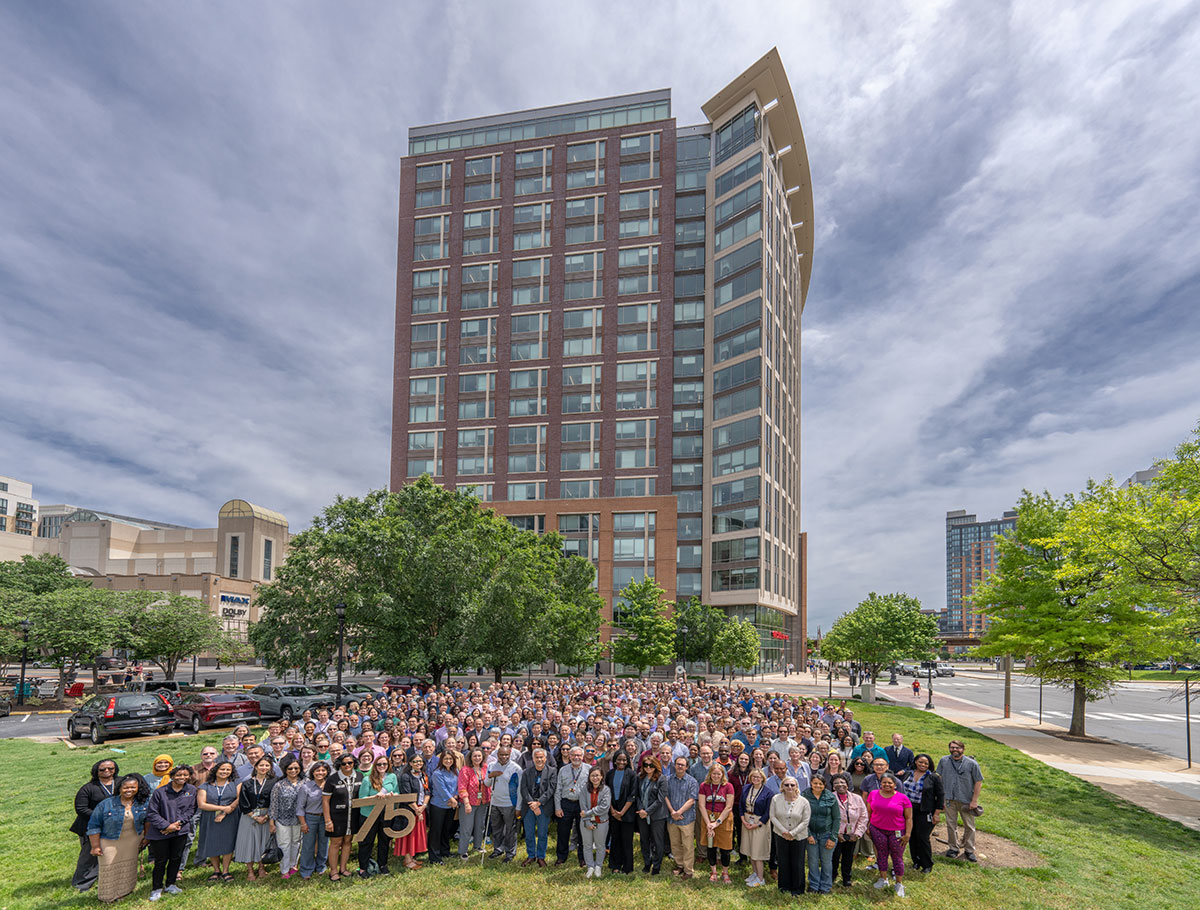
Stormy times Hundreds of staff at the National Science Foundation marked the agency’s 75th birthday in May with a group photo. (CC BY SA 4.0 Matthew Herron)
A total of 139 employees at the US Environmental Protection Agency (EPA) have been suspended after signing a “declaration of dissent” accusing Donald Trump’s administration of “undermining” the agency’s mission. The letter, dated 1 July, stated that the signatories “stand together against the current administration’s focus on harmful deregulation, mischaracterization of previous EPA activities, and disregard for scientific expertise”.
Addressed to EPA administrator Lee Zeldin, the letter was signed by a total of more than 400 EPA workers, of whom 170 put their names to the document, with the rest choosing to remain anonymous. Zeldin suspended the employees on 3 July, with EPA officials telling them to provide contact information so the agency could be in touch with them while they are on leave.
Copied to leaders of the US Senate and House of Representatives, the letter was organized by the Stand Up For Science pressure group. The letter states that “EPA employees join in solidarity with employees across the Federal government in opposing this administration’s policies, including those that undermine the EPA mission of protecting human health and the environment.”
The document lists five “primary concerns”, including the scientific consensus being ignored to benefit polluters, and undermining public trust by EPA workers being distracted from protecting public health and the environment through objective science-based policy.
The letter adds that the EPA’s progress in the US’s most vulnerable communities is being reversed through the cancellation of environmental justice programmes, while budget cuts to the Office of Research and Development, which helps support the agency’s rules on environmental protection and human health, mean it cannot meet the EPA’s science needs. The letter also points to a culture of fear at the EPA, with staff being forced to choose between their livelihood and well-being.
In response to the letter, Zeldin said he had a “ZERO tolerance policy for agency bureaucrats unlawfully undermining, sabotaging and undercutting the agenda of this administration”. An EPA statement, sent to Physics World, notes that the letter “contains information that misleads the public about agency business”, adding that the letter’s signatories “represent a small fraction of the thousands of [agency] employees”. On 18 July Zeldin then announced a plan to eliminate the EPA’s Office of Research and Development, which could lead to more than 1000 agency scientists being sacked.
Climate concerns
In late July, more than 280 NASA employees signed a similar declaration of dissent protesting against staff cuts at the agency as well as calling on the acting head of NASA not to make the budget cuts Trump proposed. Another example of the tension in US science took place in May when hundreds of staff from the National Science Foundation (NSF) gathered in front of NSF headquarters for a photo marking the agency’s 75th birthday. NSF officials, who had been criticized for seeking to cut the agency’s budget and staff, and slash the proportion of scientific grants’ costs allowed for ancillary expenses, refused to support the event with an official photographer.
Staff then used their own photographer, but they could only take a shot from a public space at the side of the building. In late June, the administration announced that the NSF will have to quit the building, which it has occupied since 2017. No new location for the headquarters has been announced, with NSF spokesperson Michelle Negrón declining to comment on the issue. The new tenant will be the Department of Housing and Urban Development.
The Department of Energy, meanwhile, has announced that it will hire three scientists who have expressed doubts about the scientific consensus on climate change – although details of the trio’s job descriptions remain unknown. They are Steven Koonin, a physicist at Stanford University’s Hoover Institution, along with atmospheric scientist John Christy, director of the Earth System Science Center at the University of Alabama in Huntsville, and Alabama meteorologist Roy Spencer.
The appointments come as the administration is taking steps to de-emphasize government research on climate and weather science. The proposed budget for financial year 2026 would close 10 labs belonging to the National Oceanic and Atmospheric Administration (NOAA). The NOAA’s National Weather Service has already lost 600 of its 4200 employees this year, while NASA has announced that it will no longer host the National Climate Assessment website globalchange.gov.
When lockdown hit, school lab technician Emanual Wallace started posting videos of home science experiments on social media. Now, as Big Manny, he’s got over three million followers on Instagram and TikTok; won TikTok’s Education Creator of the Year 2024; and has created videos with celebrities like Prince William and Brian Cox. Taking his science communication beyond social media, he’s been on CBBC’s Blue Peter and Horrible Science; has made TV appearances on shows like This Morning and BBC Breakfast; and has even given talks at Buckingham Palace and the Houses of Parliament.
But he’s not stopped there. Wallace has also recently published a second book in his Science is Lit series, Awesome Electricity and Mad Magnets, which is filled with physics experiments that children can do at home. He talks to Sarah Tesh about becoming the new face of science communication, and where he hopes this whirlwind journey will go next.
Making science fun Big Manny (right) on ITV show This Morning with host Alison Hammond and Paddy McGuiness. (Courtesy: Ken McKay/ITV/Shutterstock)
What sparked your interest in science?
I’ve always been really curious. Ever since I was young, I had a lot of questions. I would, for example, open up my toys just so I could see what was inside and how they worked. Then when I was in year 8 I had a science teacher called Mr Carter, and in every lesson he was doing experiments, like exciting Bunsen burner ones. I would say that’s what ignited my passion for science. And naturally, I just gravitated towards science because it answered all the questions that I had.
Growing up, what were the kind of science shows that you were really interested in?
When I was about 11 the show that I used to love was How it’s Made? And there’s a science creator called Nile Red – he creates chemistry videos, and he inspired me a lot. I used to watch him when I was growing up and then I actually got to meet him as well. He’s from Canada so when he came over, he came to my house and we did some experiments. To be inspired by him and then to do experiments with him, that was brilliant. I also used to watch a lot of Brian Cox when I was younger, and David Attenborough – I still watch Attenborough’s shows now.
You worked in a school for a while after your degrees at the University of East London – what made you go down that path rather than, say, staying in academia or going into industry?
Well, my bachelor’s and master’s degrees are in biomedical science, and my aspiration was to become a biomedical scientist working in a hospital lab, analysing patient samples. When I came out of university, I thought that working as a science technician at a school would be a great stepping stone to working as a biomedical scientist because I needed to gain some experience within a lab setting. So, the school lab was my entry point, then I was going to go into a hospital lab, and then work as a biomedical scientist.
Sparking interest Big Manny has now written his own series of children’s science books. (Courtesy: Penguin Books)
But my plans have changed a bit now. To become a registered biomedical scientist you need to do nine months in a hospital lab, and at the moment, I’m not sure if I can afford to take nine months off from my work doing content creation. I do still want to do it, but maybe in the future, who knows.
What prompted you to start making the videos on social media?
When I was working in schools, it was around the time of lockdown. There were school closures, so students were missing out on a lot of science – and science is a subject where to gain a full understanding, you can’t just read the textbook. You need to actually do the experiments so you can see the reactions in front of you, because then you’ll be more likely to retain the information.
I started to notice that students were struggling because of all the science that they had missed out on. They were doing a lot of Google classrooms and Zoom lessons, but it just wasn’t having the full impact. That’s when I took it upon myself to create science demonstration videos to help students catch up with everything they’d missed. Then the videos started to take off.
How do you come up with the experiments you feature in your videos? If you’re hoping to help students, do you follow the school curriculum?
I would say right now there’s probably three main types of videos that I make. The first includes experiments that pertain to the national curriculum – the experiments that might come up in, say, the GCSE exams. I focus on those because that’s what’s going to be most beneficial to young people.
Secondly, I just do fun experiments. I might blow up some fruit or use fire or blow up a hydrogen balloon. Just something fun and visually engaging, something to get people excited and show them the power of science.
And then the third type of video that I make is where I’m trying to promote a certain message. For example, I did a video where I opened up a lithium battery, put it into water and we got an explosion, because I wanted to show people the dangers of not disposing of batteries correctly. I did another one where I showed people the effects of vaping on the lungs, and one where I melted down a knife and I turned it into a heart to persuade people to put down their knives and spread love instead.
Who would you say is your primary audience?
Well, I would say that my audience is quite broad. I get all ages watching my videos on social media, while my books are focused towards primary school children, aged 8 to 12 years. But I’ve noticed that those children’s parents are also interested in the experiments, and they might be in their 30s. So it’s quite a wide age range, and I try to cater for everyone.
In your videos, which of the sciences would you say is the easiest to demonstrate and which is the hardest?
I’d say that chemistry is definitely the easiest and most exciting because I can work with all the different elements and show how they react and interact with each other. I find that biology can sometimes be a bit tricky to demonstrate because, for example, a lot of biology involves the human body – things like organ systems, the circulatory system and the nervous system are all inside the body, while cells are so small we can’t really see them. But there’s a lot that I can do with physics because there’s forces, electricity, sound and light. So I would say chemistry is the easiest, then physics, and then biology is the hardest.
Do you have a favourite physics experiment that you do?
I would say my favourite physics experiment is the one with the Van de Graff generator. I love that one – how the static electricity makes your hair stand up and then you get a little electric shock, and you can see the little electric sparks.
You’re becoming a big name in science communication – what does an average day look like for you now?
On an average day, I’m doing content creation. I will research some ideas, find some potential experiments that I might want to try. Then after that I will look at buying the chemicals and equipment that I need. From there, I’ll probably do some filming, which I normally just do in my garden. Straight after, I will edit all the clips together, add the voiceover, and put out the content on social media. One video can easily take the whole day – say about six or seven hours – especially if the experiment doesn’t go as planned and I need to tweak the method or pop out and get extra supplies.
In your videos you have a load of equipment and chemicals. Have you built up quite a laboratory of kit in your house now?
Yeah, I’ve got a lot of equipment. And some of it is restricted too, like there’s some heavily regulated substances. I had to apply for a licence to obtain certain chemicals because they can be used to make explosives, so I had to get clearance.
What are you hoping to achieve with your work?
I’ve got two main goals at the moment. One of them is bringing science to a live audience. Most people, they just see my content online, but I feel like if they see it in person and they see the experiments live, it could have an even bigger impact. I could excite even more people with science and get them interested. So that’s one thing that I’m focusing on at the moment, getting some live science events going.
I also want to do some longer-form videos because my current ones are quite short – they’re normally about a minute long. I realize that everyone learns in different ways. Some people like those short, bite-sized videos because they can gain a lot of information in a short space of time. But some people like a bit more detail – they like a more lengthy video where you flesh out scientific concepts. So that’s something that I would like to do in the form of a TV science show where I can present the science in more detail.
Researchers in Australia say that they have created the first CMOS chip that can control the operation of multiple spin qubits at ultralow temperatures. Through an advanced approach to generating the voltage pulses needed to control the qubits, a team led by David Reilly at the University of Sydney showed that control circuits can be integrated with qubits in a heterogeneous chip architecture. The design is a promising step towards a scalable platform for quantum computing.
Before practical quantum computers can become a reality, scientists and engineers must work out how to integrate large numbers (potentially millions) of qubits together – while preserving the quantum information as it is processed and exchanged. This is currently very difficult because the quantum nature of qubits (called coherence) tends to be destroyed rapidly by heat and other environmental noise.
One potential candidate for integration are the silicon spin qubits, which have advantages that include their tiny size, their relatively long coherence times, and their compatibility with large-scale electronic control circuits.
To operate effectively, however, these systems need to be cooled to ultralow temperatures. “A decade or more ago we realized that developing cryogenic electronics would be essential to scaling-up quantum computers,” Reilly explains. “It has taken many design iterations and prototype chips to develop an approach to custom silicon that operates at 100 mK using only a few microwatts of power.”
Heat and noise
When integrating multiple spin qubits onto the same platform, each of them must be controlled and measured individually using integrated electronic circuits. These control systems not only generate heat, but also introduce electrical noise – both of which are especially destructive to quantum logic gates based on entanglement between pairs of qubits.
Recently, researchers have addressed this challenge by separating the hot, noisy control circuits from the delicate qubits they control. However, when the two systems are separated, long cables are needed to connect each qubit individually to the control system. This creates a dense network of interconnects that would prove extremely difficult and costly to scale up to connect millions of qubits.
For over a decade, Reilly’s team have worked towards a solution to this control problem. Now, they have shown that the voltage pulses needed to control spin qubits can be generated directly on a CMOS chip by moving small amounts of charge between closely spaced capacitors. This is effective at ultralow temperatures, allowing the on-board control of qubits.
CMOS chiplet
“We control spin qubits using a tightly integrated CMOS chiplet, addressing the interconnect bottleneck challenge that arises when the control is not integrated with qubits,” Reilly explains. “Via careful design, we show that the qubits hardly notice the switching of 100,000 transistors right next door.“
The result is a two-part chip architecture that, in principle, could host millions of silicon spin qubits. As a benchmark, Reilly’s created two-qubit entangling gates on their chip. When they cooled their chip to the millikelvin temperatures required by the qubits, its control circuits carried out the operation just as flawlessly as previous systems with separated control circuits.
While the architecture is still some way from integrating millions of qubits onto the same chip, the team believes that this goal is a step closer.
“This work now opens a path to scaling up spin qubits since control systems can now be tightly integrated,” Reilly says. “The complexity of the control platform has previously been a major barrier to reaching the scale where these machines can be used to solve interesting real-world problems.”
A large, low density region of space surrounding the Milky Way may explain one of the most puzzling discrepancies in modern cosmology. Known as the Hubble tension, the issue arises from conflicting measurements of how fast the universe is expanding. Now, a new study suggests that the presence of a local cosmic void could explain this mismatch, and significantly improves agreement with observations compared to the Standard Model of cosmology.
“Numerically, the local measurements of the expansion rate are 8% higher than expected from the early universe, which amounts to over six times the measurement uncertainty,” says Indranil Banik, a cosmologist at the University of Portsmouth and a collaborator on the study. “It is by far the most serious issue facing cosmology.”
The Hubble constant describes how fast the universe is expanding and it can be estimated in two main ways. One method involves looking far into the past by observing the cosmic microwave background (CMB). This is radiation that was created shortly after the Big Bang and permeates the universe to this day. The other method relies on the observation of relatively nearby objects, such as supernovae and galaxies, to measure how fast space is expanding in our own cosmic neighbourhood.
If the Standard Model of cosmology is correct, these two approaches should yield the same result. But, they do not. Instead, local measurements suggest the universe is expanding faster than the expansion given by early-universe data. Furthermore, this disagreement is too large to dismiss as experimental error.
Local skewing
One possible explanation is that something about our local environment is skewing the results. “The idea is that we are in a region of the universe that is about 20% less dense than average out to a distance of about one billion light years,” Banik explains. “There is actually a lot of evidence for a local void from number counts of various kinds of sources across nearly the whole electromagnetic spectrum, from radio to X-rays.”
Such a void would subtly affect how we interpret the redshifts of galaxies. This is the stretching of the wavelength of galactic light that reveals how quickly a galaxy is receding from us. In an underdense (of relatively low density) region, galaxies are effectively pulled outward by the gravity of surrounding denser areas. This motion adds to the redshift caused by the universe’s overall expansion, making the local expansion rate appear faster than it actually is.
“The origin of such a [void] would trace back to a modest underdensity in the early universe, believed to have arisen from quantum fluctuations in density when the universe was extremely young and dense,” says Banik. However, he adds, “A void as large and deep as observed is not consistent with the standard cosmological model. You would need structure to grow faster than it predicts on scales larger than about one hundred million light–years”.
Testing the theory
To evaluate whether the void model holds up against data, Banik and his collaborator Vasileios Kalaitzidis at the UK’s University of St Andrews compared it with one of cosmology’s most precise measurement tools: baryon acoustic oscillations (BAOs). These are subtle ripples in the distribution of galaxies that were created by sound waves in the early universe and then frozen into the large-scale structure of space as it cooled.
Because these ripples provide a characteristic distance scale, they can be used as a “standard ruler” to track how the universe has expanded over time. By comparing the apparent size of this ruler as observed at different distances, cosmologists can map the universe’s expansion history. Crucially, if our galaxy lies inside a void, that would alter how the ruler appears locally, in a way that can be tested.
The researchers compared the predictions of their model with twenty years of BAO observations, and the results are striking. “BAO observations over the last twenty years show the void model is about one hundred million times more likely than the Standard Model of cosmology without any local void,” says Banik. “Importantly, the parameters of all these models were fixed without considering BAO data, so we were really just testing the predictions of each model.”
What lies ahead
While the void model appears promising, Banik says that more data are needed. “Additional BAO observations at relatively short distances would help a lot because that is where a local void would have the greatest impact.” Other promising avenues include measuring galaxy velocities and refining galaxy number counts. “I would suggest that it can be essentially confirmed in the next five to ten years, since we are talking about the nearby universe after all.”
Banik is also analysing supernovae data to explore whether the Hubble tension disappears at greater distances. “We are testing if the Hubble tension vanishes in the high-redshift or more distant universe, since a local void would not have much effect that far out,” he says.
Despite the challenges, Banik remains optimistic. With improved surveys and more refined models, cosmologists may be closing in on a solution to the Hubble tension.
The Cockcroft Walton lecture series is a bilateral exchange between the Institute of Physics (IOP) and the Indian Physics Association (IPA). Running since 1998, it aims to promote dialogue on global challenges through physics.
Lee Packer, who has over 25 years of experience in nuclear science and technology and is an IOP Fellow, delivered the 2025 Cockcroft Walton Lecture Series in April. Packer gave a series of lectures at the Homi Bhabha Research Centre (BARC) in Mumbai, the Institute for Plasma Research (IPR) in Ahmedabad and the Inter-University Accelerator Centre (IUAC) in Delhi.
Packer is a fellow of the UK Atomic Energy Authority (UKAEA), in which he works on nuclear aspects of fusion technology. He also works as consultant to the International Atomic Energy Agency (IAEA) in Vienna, where he is based in the physics section of the department of nuclear sciences and applications.
Packer also holds an honorary professorship at the University of Birmingham, UK, where he lectures on nuclear fusion as part of its long-running MSc course in the physics and technology of nuclear reactors.
Below, Packer talks to Physics World about the trip, his career in fusion and what advice he has for early-career researchers.
When did you first become interested in physics?
I was fortunate to have some inspiring teachers at school who made physics feel both exciting and full of possibility. It really brought home how important teachers are in shaping future careers and they deserve far more recognition than they often receive. I went on to study physics at Salford University and during that time spent a year on industrial placement at the ISIS Neutron and Muon Source based at the Rutherford Appleton Laboratory (RAL). That year deepened my interest in applied nuclear science and highlighted the immense value of neutrons across real-world applications – from materials research and medicine to nuclear energy.
Can you tell me about your career to date?
I’ve specialized in applied nuclear science throughout my career, with a particular focus on neutronics – the analysis of neutron transport – and radiation detection applied to nuclear technologies. Over the past 25 years, I’ve worked across the nuclear sector – in spallation, fission and fusion – beginning in analytical and research roles before progressing to lead technical teams supporting a broad range of nuclear programmes.
When did you start working in fusion?
While I began my career in spallation and fission, the expertise I developed in neutronics made it a natural transition into fusion in 2008. It’s important to recognize that deuterium-tritium fuelled fusion power is a neutron-rich energy source – in fact, 80% of the energy released comes from neutrons. That means every aspect of fusion technology must be developed with the nuclear environment firmly in mind.
Why do you like about working in fusion energy?
Fusion is an inherently interdisciplinary challenge and there are many interesting and difficult problems to solve, which can make it both stimulating and rewarding. There’s also a strong and somewhat refreshing international spirit in fusion – the hard challenges mean collaboration is essential. I also like working with early-career scientists and engineers to share knowledge and experience. Mentoring and teaching is rewarding, and it’s crucial that we continue building the pipelines of talent needed for fusion to succeed.
Tell me about your trip to India to deliver the Cockcroft Walton lecture series?
I was honoured to be selected to deliver the Cockcroft-Walton lecture series. Titled “Perspectives and challenges within the development of nuclear fusion energy”, the lectures explored the current global landscape of fusion R&D, technical challenges in areas such as neutronics and tritium breeding, and the importance of international collaboration. I shared some insights from activities within the UK and gave a global perspective. The reception was very positive – there’s strong enthusiasm within the Indian fusion community and they are making excellent contributions to global progress in fusion. The hosts were extremely welcoming, and I’d like to thank them for their hospitality and the fascinating technical tours at each of the institutes. It was an experience I won’t forget.
What are India’s strengths in fusion?
India has several strengths including a well-established technical community, major national laboratories such as IPR, IUAC and BARC, and significant experience in fusion through its domestic programme and direct involvement in ITER as one of the seven members. There is strong expertise in areas such as nuclear physics, neutronics, materials, diagnostics and plasma physics.
Meeting points: Lee Packer meeting senior officials at the Homi Bhabha Research Centre in Mumbai. (Courtesy: Indian Physics Association)
What could India improve?
Where India might improve could be in building further on its amazing potential – particularly its broader industrial capacity and developing its roadmap towards power plants. Common to all countries pursuing fusion, sustained investment in training and developing talented people will be key to long-term success.
When do you think we will see the first fusion reactor supplying energy to the grid?
I can’t give a definitive answer for when fusion will supply electricity to the grid as it depends on resolving some tough, complex technical challenges alongside sustained political commitment and long-term investment. There’s a broad range of views and industrial strategies being developed within the field. For example, the UK government’s recently published clean energy industrial strategy mentions the Spherical Tokamak for Energy Production programme, which aims to deliver a prototype fusion power plant by 2040 at West Burton, Nottinghamshire, at the site of a former coal power station. The Fusion Industry Association’s survey of private fusion companies reports that many are aiming for fusion-generated electricity by the late 2030s, though time projections vary.
There are others who say it may never happen?
Yes. On the other hand, some point to several critical hurdles to address and offer more cautious perspectives and call for greater realism. One such problem, close to my own interest in neutronics, is the need to demonstrate tritium-breeding blanket-technology systems and to develop lithium-6 supplies at the required scale for the industry.
What are the benefits of doing so?
The potential benefits for society are too significant to disregard on the grounds of difficulty alone. There’s no fundamental physical reason why fusion energy won’t work and the journey itself brings substantial value. The technologies developed along the way have potential for broader applications, and a highly skilled and adaptable workforce is developed with this.
What advice do you have for early-career physicists thinking about working in the field?
Fusion needs strong collaboration between people from across the board – physicists, engineers, materials scientists, modellers and more. It’s an incredibly exciting time to get involved. My advice would be to keep an open mind and seek out opportunities to work across these disciplines. Look for placements, internships, graduate or early-career positions and mentorship – and don’t be afraid to ask questions. There’s a brilliant international community in fusion, and a willingness to support those with kick-starting their careers in this field. Join the effort to develop this technology and you’ll be part of something that’s not only intellectually stimulating and technically challenging but is also important for the future of the planet.
The UK should focus on being a “responsible, intelligent and independent leader” in space sustainability and can make a “major contribution” to the area. That’s the verdict of a new report from the Institute of Physics (IOP), which warns, however, that such a move is possible only with significant investment and government backing.
The report, published together with the Frazer-Nash Consultancy, examines the physics that underpins the space science and technology sector. It also looks at several companies that work on services such as position, navigation and timing (PNT), Earth observation as well as satellite communications.
In 2021/22 PNT services contributed over 12%, or about £280bn, to the UK’s gross domestic product – and without them many critical national infrastructures such as the financial and emergency systems would collapse. The report says, however, that while the UK depends more than ever on global navigation satellite systems (GNSS) that reliance also exposes the country to its weaknesses.
“The scale and sophistication of current and potential PNT attacks has grown (such as increased GPS signal jamming on aeroplanes) and GNSS outages could become commonplace,” the report notes. “Countries and industries that address the issue of resilience in PNT will win the time advantage.”
Telecommunication satellite services contributed £116bn to the UK in 2021/22, while Earth observation and meteorological satellite services supported industries contributing an estimated £304bn. The report calls the future of Earth observation “bold and ambitious”, with satellite data resolving “the disparities with the quality and availability of on-the-ground data, exacerbated by irregular dataset updates by governments or international agencies”.
Future growth
As for future opportunities, the report highlights “in-space manufacturing”, with companies seeing “huge advantages” in making drugs, harvesting stem cells and growing crystals through in-orbit production lines. The report says that In-Orbit Servicing and Manufacturing could be worth £2.7bn per year to the UK economy but central to that vision is the need for “space sustainability”.
The report adds that the UK is “well positioned” to lead in sustainable space practices due to its strengths in science, safety and sustainability, which could lead to the creation of many “high-value” jobs. Yet this move, the report warns, demands an investment of time, money and expertise.
“This report captures the quiet impact of the space sector, underscoring the importance of the physics and the physicists whose endeavours underpin it, and recognising the work of IOP’s growing network of members who are both directly and indirectly involved in space tech and its applications,” says Alex Davies from the Rutherford Appleton Laboratory, who founded the IOP Space Group and is currently its co-chair.
Particle physicist Tara Shears from the University of Liverpool, who is IOP vice-president for science and innovation, told Physics World that future space tech applications are “exciting and important”. “With the right investment, and continued collaboration between scientists, engineers, industry and government, the potential of space can be unlocked for everyone’s benefit,” she says. “The report shows how physics hides in plain sight; driving advances in space science and technology and shaping our lives in ways we’re often unaware of but completely rely on.”