Last December I was sitting in the departure lounge at Blagnac Airport in France, waiting for my flight back home to the UK. I had been at the Airbus Leadership University for the concluding part of a course, the last of several trips I made to Toulouse in 2017. Looking back over the last 30 years of my career, from starting my PhD to my current role in the Defence and Space division of Airbus, I began to think about how I progressed to my current role. Was it chance, being in the right place at the right time; was it my own making; or was it the influence of colleagues and managers? I came to the conclusion that it was a combination of all of the above, together with a carpe diem attitude in an evolving business environment that brought me here.
Having intended to study chemistry at university, I was fortunate that the broad natural-sciences course at the University of Cambridge in the UK gave me the chance to decide that chemistry was not for me after one year. So I read physics for the rest of my degree. And having been interested in astronomy since childhood, I took up some astrophysics and cosmology options in my final year, including a short dissertation on pulsar magnetospheres.
At this point I knew that I wanted to deepen my knowledge in an area of physics, but my third-year work had made me feel that I wanted to study something more tangible than stars. Inspired by some excellent solid-state physics teaching in my third year, I therefore decided to apply for a PhD in semiconductor physics at Cambridge. One of the attractions was the prospect of working in the group led by physicist Michael Pepper – known for his work on semiconductor nanostructures – and another was that the PhD was partly sponsored by the General Electric Company (GEC) Hirst Research Centre, thereby keeping open the possibilities of staying in academic research or moving into industry.
I enjoyed my research into thermoelectric transport in two-dimensional electron gases at low temperature, but by the end of my PhD, I decided to take up a research role at GEC, in its Long Range Research Lab. For most of my first three years, I was mainly based at the Cavendish Laboratory because I was working on a project based on new quantum-electronic devices, in which both the university and GEC were taking part. At this stage, I was directly using my knowledge of physics and mathematics every day – whether this was designing semiconductor devices, solving electron-transport equations or measuring the microwave performance of devices.
However, the head of GEC, Lord Arnold Weinstock, had decided he wasn’t getting enough return on his investment in a central research facility and the Hirst Research Centre gradually shrank, ending up as a division of GEC-Marconi Materials Technology before disappearing completely by the 1990s. By now I had started spending half my time working for a department that designed and manufactured quartz oscillators, surface acoustic wave (SAW) filters and thick/thin film hybrids. My first work in this group was understanding the theory behind SAW filters, and converting some SAW design-software to work in a new computing environment.
Moving forward
I quite enjoyed getting back to using Green’s functions for solving the electrostatic problem and the various tricks for getting the software to run fast enough on the mainframe computer – a job that would take three or four hours, compared with 3–4 seconds on a desktop PC today. The other half of my time was spent in the microwave group. This included some interesting work on modelling the propagation of microwaves through ferrites, and also a taste of project management, on the repair and provision of spares for the radiofrequency communications system for the Phoenix unmanned air vehicle.
I was directly using my knowledge of physics and mathematics every day
Richard Syme
I then had the opportunity to either move with the quartz oscillator group to what was then Matra-Marconi Space (now Airbus), or to keep working on the microwave systems for what would eventually become part of BAE Systems or Leonardo. I decided on the former and have been associated with quartz products ever since – first as an engineer, then a project manager and now as head of the group. Our quartz products provide the frequency or timing references in satellite payloads, mostly telecommunications satellites. The space environment is challenging for quartz oscillators – the two main difficulties are withstanding mechanical shocks and in-orbit radiation. The latter requires quartz that is very pure, since it is the impurities (principally aluminium) that give rise to a change in quartz resonator frequency with radiation. At Airbus, we grow our own quartz and it is generally recognized to be the purest in the world.
I do still use my physics knowledge regularly – my semiconductor physics helped in understanding a recent problem at a supplier of transistors – but my objectives at work now are more in line with achieving financial targets, developing people, improving products and processes and ensuring delivery of products. Physicists can be found in many groups at Airbus Defence and Space, from those working on instruments for science missions such as Solar Orbiter, BepiColombo and the Jupiter Icy Moons Explorer (JUICE), to those working on the latest digital signal-processing technology and algorithms.
One of the great things about working at Airbus is the variety of career opportunities that are available, and the training and support that exists to help you. As I mentioned earlier, I’ve been to Toulouse several times this year, to meet Airbus Defence and Space employees from all over Europe, as well as colleagues from the company’s other divisions (commercial aircraft and helicopters) – collaborative work being vital to innovate and improve for the future. This range of opportunities, and the pride in helping to produce some of the world’s best satellite products, are two of the main factors that have kept me at Airbus and given me an enjoyable and satisfying career. Airbus will always have vacancies for physicists, new graduates or those further into their careers, so I hope I have whetted your appetite to find out more about Airbus.
NASA has successfully launched a dedicated exoplanet probe that will aim to discover thousands of planets outside our solar system. Launched yesterday at 18:51 local time from Cape Canaveral Air Force Station in Florida via a SpaceX Falcon 9 rocket, the $337m Transiting Exoplanet Survey Satellite (TESS) will spend about two years surveying 200 000 of the brightest stars to search for planets.
First conceived in 2006, the mission was selected in 2013 as an astrophysics mission in NASA’s “Explorers Program”. TESS, which is 3.9 m long and 1.5 m high with a mass of 350 kg, will feature four identical 16.8 megapixel CCD cameras that each have seven stacked mirrors that help focus the light from distance stars.
The targets TESS finds are going to be fantastic subjects for research for decades to come
Stephen Rinehart, TESS project scientist
It will detect exoplanets via the transiting method, which involves looking for dips in the visible light of from a star as a planet crosses in front of it along our line of sight. By looking at how much light an object blocks, astronomers can get information about the planet’s size and by studying how long it takes a planet to orbit its star, it is possible to determine the shape of the planet’s orbit and how long it takes the planet to circle its sun.
‘A new era’
TESS’s main goal will be to detect nearby small planets that have bright host stars in the solar system so that detailed characterizations of the planets and their atmospheres can then be carried out. This will be mostly performed on existing ground-based instruments as well as with the James Webb Space Telescope when it launches in 2020.
TESS will carry on the work carried out by NASA’s Kepler mission and K2 craft, which together have discovered around 2300 and 300 confirmed exoplanets, respectively, with thousands more waiting for confirmation. While Kepler could spot planets around 300,000 light-years from Earth, it only covers 0.25% of the sky. TESS, however, will be able to see 85% of the sky searching for planets much closer to Earth, up to 300 light-years away.
“We’re going to be able study individual planets and start talking about the differences between planets,” says Stephen Rinehart, TESS project scientist at NASA’s Goddard Space Flight Center in Maryland. “The targets TESS finds are going to be fantastic subjects for research for decades to come. It’s the beginning of a new era of exoplanet research.”
A new technique that uses magnetic fields to detect underwater objects has been unveiled by physicists in the UK. The fields induce electric currents in metallic objects and the resulting magnetic echo is detected by an array of atomic magnetometers.
Detecting objects in water using electromagnetic radiation is extremely difficult because light and other radiation attenuates rapidly as it passes through water. This is not the case with sound, which is why sonar is “unrivalled in deep water” for detecting objects, according to Luca Marmugi of University College London (UCL). In shallower depths, however, the echo from the seabed can blind sonar to an object.
An alternative to sonar is magnetic detection, which can discriminate magnetic objects from non-magnetic ones. Existing schemes, says Marmugi, are passive – simply looking for any magnetic fields created by an object. “There is an obvious [military] countermeasure,” explains Marmugi. “All the steelwork composing the hull of a ship or submarine can be demagnetized and you can design engines to limit or if possible cancel all the magnetic signature.”
Secondary fields
One way forward is magnetic induction tomography, which was originally developed for industrial monitoring. This uses an oscillating “primary” magnetic field to induce electric currents in target objects that, in turn, produce “secondary” magnetic fields. By detecting these secondary fields one can, in principle, characterize any object that is an electrical conductor – as long as the object, sensors and primary source sufficiently close to one another.
“There are no countermeasures, unless you want to build a submarine completely out of something like plastic, which I don’t think is feasible,” says Marmugi.
In practice, however, deploying magnetic induction tomography in water involves overcoming severe technical hurdles, says Marmugi. Classical coil sensors are not sensitive enough to measure very weak secondary fields, so unfeasibly strong primary fields would be required.
Now, Marmugi and colleagues at UCL have created an array of four radio-frequency atomic magnetometers that can be placed under or over a container of water (see video). These magnetometers work by measuring the precession of atomic spins in a room-temperature vapour, with the precise nature of the precession being very sensitive to the presence of external magnetic fields.
Precession triggering
The primary field triggers the precession of spins in the magnetometers. If no secondary fields are excited in response to this primary field, the spins in all four magnetometers precess with the same amplitude and phase. However, any magnetic fields induced in a target will affect the precession in different magnetometers in different ways. Therefore, by monitoring the amplitude and phase in the four sensors, the researchers could detect the presence of a conductive object in the water and also determine the object’s position relative to each sensor.
The researchers demonstrated 100% success in detecting, and 91% success in locating, an aluminium plate in a beaker of salt water placed 120 mm beneath their sensor array. Salt water poses additional challenges because of its higher conductivity than fresh water.
At the 10 kHz primary-field frequency used, the wavelength of the primary signal is much longer than the range of the signal (the penetration distance). This near-field configuration had several advantages: little energy was projected deeper into the water, greatly reducing both the power consumption and the echo from deeper objects. Furthermore, the secondary field strength gives a clear indication of an object’s depth.
The researchers are now working towards testing the measurement protocol in open water. “You can achieve [near-field] penetration distances of kilometres in water if you drop the oscillation frequency to a few hundreds or tens of Hertz,” explains Marmugi. Such a system could potentially be battery powered, he says.
Better than a metal detector?
Atomic physicist Michael Romalis of Princeton University in the US, whose group has developed some of the most sensitive magnetometers ever produced, describes the research as “a fine demonstration” although he notes that the sensitivities reported are well below the best achieved with traditional coil detectors. “An old-fashioned metal detector works by just using an inductive coil for pickup. My question is ‘Is it really better than an old-fashioned metal detector?’ and it’s not obvious to me that it would be.”
Arne Wickenbrock of the University of Mainz is more optimistic: “Vapour cell magnetometers are hugely sensitive over a huge frequency range over which you cannot really build very sensitive coils,” he says, “You can also tune the frequency very easily over a broad range, which is very difficult for coils…There’s a considerable literature on eddy current detection with vapour cells but this is, I believe, the first time anybody’s used an array and detected something under water.”
There is no one right or wrong way to grow a company. Every start-up’s journey will have unique twists and turns, and although venture capital (VC) gets a lot of attention as a means of helping entrepreneurs obtain outside funds, it is hardly the only game in town. In fact, in most situations, VCs are not the optimal funding source for early-stage companies commercializing novel physical science innovations – and I say that even though I am a VC investor at a firm that supports companies doing just that. The numbers back me up: according to the crowdfunding platform Fundable, fewer than 1 in 100 start-ups are funded by angel investors and about 1 in 2000 (0.05%) are funded by VCs.
But if VC (probably) isn’t going to help your company grow, what will? Broadly speaking, external funding sources fall into four groups: grants, strategic partnerships, equity investment and debt. This list omits profits, which is perhaps the best funding source of all: when your business’s growth can be supported organically by reinvesting the profits you make from selling your product or service at a positive margin, you don’t need to bother with external entities. However, many start-ups simply cannot grow completely organically, or they want to grow faster than organic growth alone allows, at least at the outset. Therefore, external funds are often required to push a technology out of the lab.
Each external funding option has advantages and disadvantages, as well as a time and place, in the commercial journey of an advanced materials start-up. Let’s explore these in more detail, in an order that roughly aligns with how companies pass through commercial stages.
A grant to get started
Grants are often the funding source of choice to take a great idea or lab result and turn it into a bona fide start-up company. To keep things simple, when I refer to “grants”, I am also lumping in other non-equity, non-strategic-partnership funding sources. These include university business plan competitions such as the Rice Business Plan competition at Rice University in the US (the world’s richest and largest student start-up competition) and grand challenge-type programmes like the Carbon XPRIZE – a $20m global competition sponsored by NRG COSIA to mitigate or reduce CO2 emissions. Many grant programmes have a geographic component, so depending on where you are, you might want to consider applying for Horizon 2020 (EU), SBIR/STTR (US), ARPA-E (energy-related innovations in the US), or SDTC (Canada) funding if you want to commercialize a physics-based, hard tech innovation – and this is by no means an exhaustive list.
Just as in academia, grants for start-ups are competitive, and the granting body may restrict how you can use the funds.
Early in a company’s gestation, grants are a great way to bring in enough money to advance an idea into a prototype product, validate a market hypothesis, or perform additional technical development. Not only are they typically designed for early-stage and high-risk, high-reward propositions, they also don’t require you to give up any ownership or control in your company. Typically, the intellectual property – patents, trade secrets or process knowhow — developed with the support of a grant remains the company’s sole property.
Another advantage of grant funding is that companies become more valuable the closer they get to commercialization and reduced technical risk. Thus, the longer you can wait to raise outside capital, the more favourable the terms of that capital will be for you and your founding team. Hence, grants represent a good way to increase a company’s value in the eyes of a potential investor or acquirer.
The downside of grants is that, just as in academia, grants for start-ups are competitive, and the granting body may restrict how you can use the funds. Oftentimes, expenses such as marketing activities, patent legal costs and capital expenditures cannot be funded by a grant. Another word of caution is that grants are often not directly aligned with the vision, mission or strategy of a start-up. Their influence can be defocusing for a founding team, and the monetary support they offer must be weighed against the time and effort required to apply for them and comply with their terms. VC investors often avoid start-ups with an “SBIR shop” mentality as it can be hard to change the company culture into a high-growth, product-focused business.
A final challenge is that some grant programmes require the company or other investors to put up matching funding. In some circumstances, however, this can be a good way to use a small amount of outside equity capital to bring in a larger amount of money. From an investor’s point of view, this is a form of free leverage: it means that our investment buys more for our money than a traditional venture round of funding.
Howdy, partner
Start-ups are typically good at developing novel out-of-the-box solutions and nimbly pivoting and refining their approach. However, scaling up manufacturing, creating a channel to the market and/or developing the requisite trust in your (currently) no-name brand are often not a start-up’s strong suit(s). No one wants to reinvent the wheel, though, so at this stage, smartly crafted win-win partnership agreements can really help accelerate product development and market launch. Furthermore, a collaboration with a large, established company in your target market or supply chain can help validate the market’s interest in what you’re developing. For physics-based entrepreneurs, capital efficiency is the name of the game: most investors don’t have the appetite or knowledge to play in this space, so utilizing strategic money is a great path to a successful venture.
We almost always encourage start-ups to engage with strategic partners from an early stage.
Strategic partnerships can take various forms, and the devil is always in the details. However, two of the more popular strategic partnership funding models for a physical science start-up and a large company (“BigCo”) are non-recurring engineering (NRE) funding and joint development agreements (JDAs). While the nomenclature may vary, NRE typically refers to a one-time payment or a series of milestone-tied payments from BigCo to start-up that help the latter design, develop and test a new or improved product. JDAs, on the other hand, usually involve BigCo paying a start-up to develop a tailored solution that fits BigCo’s specifications and ties into a particular market; common design elements where each company pays their own expenses; and innovations that fall outside of the defined scope of the JDA, but which the start-up created while developing a solution on behalf of BigCo.
Here is an example. Let’s suppose a large steel producer signs a JDA with a thermoelectric start-up on a project to recapture and utilize waste heat from their industrial processes. During the JDA, the start-up develops a manufacturing improvement that reduces the cost of producing its industrial waste heat recovery modules by 60%. However, this improvement also applies to the combined heat and power systems that the start-up is developing for a residential market. Typically, this improvement IP, as it falls outside the scope of the JDA, is solely owned by the start-up. Hence, innovations that result from JDA funding often have important spillover effects for the start-up company’s technology platform as a whole.
The next question, of course, is how to find a suitable partner. Even if you have identified a BigCo that would benefit from partnering with you, locating the right person to speak to within their 10,000+ employee organization can be surprisingly difficult. This is an area where VC firms like Pangaea can be helpful. Our limited partners (that is, the investors in our funds) include many of the world’s leading material, chemical, industrial and electronics companies, and because we’ve been investing in advanced materials companies for over 15 years, we have developed a good network. Based on this experience, we almost always encourage start-ups to engage with strategic partners from an early stage. Assuming the agreements can be crafted in a mutually beneficial way, we believe the myriad benefits (including de-risking product development, obtaining market validation, help with creating a channel to market, identifying a potential future acquirer and, of course, the cash) outweigh potential downsides such as giving up a slice of the pie or scaring off competing strategic partners.
A stake in the game
Matthew Cohen, director of technology at Pangaea Ventures. (Courtesy: Pangaea Ventures)
The equity investor mix includes high-net-worth individuals (typically referred to as “angel investors”); “angel groups” where several such individuals participate in deals together; “family offices” where managers invest an ultra-wealthy family’s money; venture capital and private equity firms. It’s hard to generalize about why these various entities would invest or pass on a start-up, but typically, equity investors want to “add fuel to the fire” to help a start-up build its operations and thus create shareholder value. This means that, all else being equal, this group of investors will eschew “science projects” where money is earmarked for fundamental R&D work in favour of start-ups where a capital infusion will enable rapid commercial expansion.
Most VCs are looking for a plausible path to obtaining 10 times their initial investment within three to seven years. If that sounds like a tall order, that’s because it is: most investments fall well short. However, if an entrepreneur cannot convince a VC that the addressable market is large enough; the “pain point” for consumers is acute enough; the team is strong enough; and a potential acquirer will pay a high enough price – well, we’re probably going to pass. Most business cases do not fit these stringent requirements, but this certainly does not mean that they should be abandoned. It just means that VCs aren’t the right choice for funding them (at least not right then).
Raising a round of venture capital speeds up the clock for a start-up. Venture rounds typically last one to two years, and if key milestones are not achieved within that time frame, it will be tough for that start-up to raise additional funds in a successive round. Venture money can solve some problems, such as shortages of working capital or funding for expanding a firm’s capacity, but it often cannot break down fundamental technical or commercial barriers – at least, not during the time frame of a funding round.
On top of this, the rate at which firms burn through cash typically ramps up after they get VC funding. This makes it more difficult for a start-up to reposition and pursue a different path or adjacent opportunity. In general, a round of VC funding means making a bet on a specific market opportunity. There may be pivots along the way, but getting the market opportunity completely wrong is usually a death sentence. For that reason, VC funding should come in when the start-up is ready to make a good, educated guess about the market, rather than just throwing things at the wall and seeing what sticks. This is especially true for physics-based innovations. For example, a start-up company in this sector might develop a new semiconductor manufacturing process that can be used for silicon-based anodes in lithium-ion batteries, solar cells, thermoelectrics and non-volatile memory – a classic “platform” innovation. However, if they try to go after all of these opportunities simultaneously, it’s unlikely they’ll succeed with any of them. VCs want to see concrete progress on solving a major pain point in a large market, not just potential.
Venture money can solve some problems, but it often cannot break down fundamental technical or commercial barriers.
A final item to note is that when a start-up gets VC funding, its corporate governance and oversight can change almost overnight. Typically, a new board of directors is formed or an existing one significantly changed. This board will play a range of roles, including de facto “boss”. If the board believes things are not going well, or the CEO or key team members lack the skills necessary to increase shareholder value, it is the board’s fiduciary responsibility to supplement or even change the team. Even though the chances of a founder being fired from the start-up he or she founded are low, the mere possibility can be a very tough pill for an entrepreneur to swallow.
Indebted
The last source of funding for a start-up company is debt. Usually, this is more appropriate for later-stage companies with sizable balance sheets, revenue and purchase orders. While it may be possible for a pre-revenue start-up to take on debt, it’s a risky proposition. Terms around interest rates, payback periods, and penalties for missing repayment deadlines vary widely, but the last of these could include losing control of your company. Furthermore, debt holders are almost always senior to all other stakeholders and will get paid first if the company is liquidated or acquired. Some company-friendly, economic development debt programmes are certainly worth considering at almost any stage in a start-up’s life-cycle, but until a company can make good predictions about revenue amounts and timing, it’s tough to make traditional debt funding work.
The bottom line
Grants, partnerships, equity and debt are all valid options for funding start-ups. When considering which route to follow, it is worth remembering that venture capital and private equity are only appropriate for very specific subsets of early stage corporate growth. As such, VC won’t be right for most companies. However, for advanced materials start-ups that do fit the mould, we encourage you to consider getting in touch. Even if Pangaea declines to fund your venture – and that’s what we do most of the time – we always strive to assist. If we can provide feedback, introduce you to a potential partner, or even just stay on each other’s radar screens as you make commercial progress, we’re always happy to connect as you progress your innovations from the lab bench all the way through to global deployment.
“When land-clearing extent reached 40% in out models, international standards for safe drinking water were exceeded nearly 40% of the time, even if best practices for logging were followed,” said Amelia Wenger of the University of Queensland, Australia.
Wenger and colleagues believe that the logging’s impacts will compromise the integrity of the land for future agricultural uses, interrupt access to clean drinking water and degrade important downstream ecosystems, according to their press release.
Commercial logging accounts for about 18% of government revenue in the Solomon Islands and at least 60% of exports.
The Kolombangara Island Biodiversity Conservation Association is leading efforts to create a national park that will safeguard forests above 400 m with cultural and ecological significance.
“Saving tropical forests worldwide depends on tighter regulation of national laws and policies, as well as local buy-in for forest management,” said Stacy Jupiter of the Wildlife Conservation Society (WCS). “This study nicely illustrates why we need to take action now to protect the world’s remaining intact forest landscapes in order to preserve their biodiversity and important ecosystem services for people.”
Spring has just about sprung here in the UK, as the bluebells and daffodils are emerging after a long gruelling winter. In Physics World April podcast, Andrew Glester embraces the botanical theme by looking at a selection of technological innovations inspired by plants.
First up, Glester speaks with Claudia Zeiger about the idea of cleaning up oil spills using lotus leaves and a type of aquatic fern called Salvinia. Zeiger’s team at Karlsruhe Institute of Technology is interested in how these hairy-leaved species can selectively soak up oil particles while repelling water. It’s a property that could inspire more efficient clean-up operations than current approaches.
Later in the episode Glester catches up with Amirkhosro Kazemi from the department of ocean and mechanical engineering at Florida Atlantic University. Kazemi’s studies the physical properties of mangroves – common in tropical and subtropical regions – which provide a natural buffer to flood waters as well as the more routine coastal erosion. Gaining a better understanding of how these shoreline trees can dissipate water and its kinetic energy could inform the design of innovative coastal defence structures.
To find out about more nature-inspired research, check out the April issue of Physics World, a special edition on the physics of plants.
The so-called phase-separated state in perovskite nickelate materials might be put to good use in nanoscale devices such as switches or memristors. In contrast to some other technologies that exploit these materials, such devices would operate electronically rather than through redox processes or the movement of ions, and could thus be much faster.
Perovskite rare-earth nickelates, which have the formula RNiO3 are correlated oxides that undergo a metal-insulator transition during which their resistivity changes dramatically. This transition occurs at a temperature that depends on the ionic radius of the rare-earth, R. Although researchers are still unsure as to where this transition originates, it can be exploited in a variety of applications, including resistive switching and even neuromorphic computing.
Resistance maps
To date, this transition was mainly studied using macroscopic techniques. A team led by Manuel Bibes of the CNRS/Thales/Université Paris-Sud in France has now succeeded in directly imaging the local resistance of a neodymium nickelate thin film as it undergoes this transition using a scanning probe technique called conductive atomic force microscopy (AFM). The resistance maps obtained using this technique show that metallic domains between 100 and 300 nm in size nucleate in the insulating state and then grow and percolate as the temperature increases.
“In NdNiO3, the metal-insulator transition is very sharp, with the resistance dropping by a factor of 1000 or more,” explains Bibes. “What is more, the transition does not occur at the same temperature when measured upon cooling or upon warming – that is, it is hysteretic. In these types of so-called first-order transitions, the material does not continuously transform from one phase to the other, but co-exists in both phases. This is what we call phase separation.”
Pixel by pixel
Bibes and colleagues have directly observed this phase separation. “As with conventional AFM, we use a nanosized tip and scan the film surface to collect local information pixel by pixel and build up an image,” says Bibes. “The difference in our work is that we use a conductive tip (made of doped diamond) and the collected information is the local resistance. We thus construct images of the local resistance, pixel by pixel.”
At each pixel, the researchers measure the series resistance between the intrinsic resistance of the tip itself, the series resistance of the film and the contact resistance between the tip and film. “Here the total resistance is dominated by the contact resistance, which strongly depends on the metallic or insulating nature of the region in contact with the tip,” Bibes tells nanotechweb.org. “This is how we can image insulating or metallic regions.”
Faster switches
The phase-separated state might be harnessed in nanoscale devices behaving as switches or memristors, he adds. And in contrast to some other technologies, these could operate through a purely electronic mechanism rather than through redox processes or the movement of ions, and could thus be much faster.
The team, which includes researchers from ICMAB-CSIC in Barcelona, Spain, and Helmholtz-Zentrum Berlin für Materialien und Energie in Germany, says that it will now be looking into the phase-separated state in nanoscale devices made from NdNiO3. “We will also be imaging the dynamics of the resistance switching effect,” says Bibes.
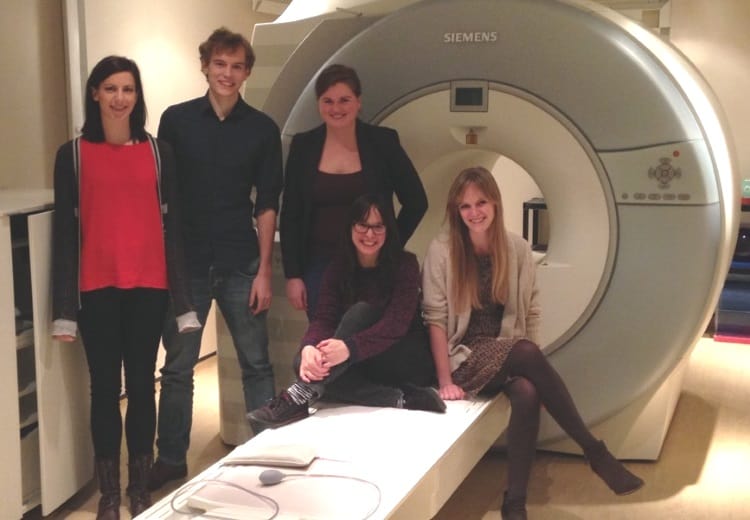
The study authors, including first author (far right) Fiona van den Heiligenberg and corresponding author (far left) Tamar Makin.
Functional MRI (fMRI) has shown that hand-selective regions in the brains of prosthesis users respond more strongly to images of prostheses. This response occurred regardless of prosthesis familiarity or type (cosmetic versus active artificial limbs) compared with controls, and scaled with usage. Resting-state fMRI also identified stronger functional connectivity between visual and sensorimotor areas in prosthesis users who used their prosthesis more. These findings suggest a categorical representation of artificial limbs in the brain, and adds to the wealth of literature regarding the plastic nature of our brains and compensation/re-appropriation mechanisms (Brain doi: 10.1093/brain/awy054).
By examining individuals with missing limbs, specifically hands, one can investigate to what extent the cortical area(s) belonging to the former limb is altered, compared with controls. It is unknown how much the compensatory mechanisms affect visual-hand selective areas, as opposed to traditional primary sensorimotor brain regions (cortices). In this study, the researchers – from University College London, University of Oxford, Radboud University and others – hypothesized that daily use of a prosthesis would scale cortical processing in hand-selective visual areas and increase communication within functional networks.
In the study, 32 participants (16 with congenital hand loss, 16 with hand loss due to amputation) were presented with familiar and unfamiliar images of prostheses while lying in an MR scanner – teasing apart experience and general categorization. The researchers also scanned 24 controls in a similar paradigm. The photos presented were either of the upper limb, man-made objects, the participant’s own prosthesis (controls viewed their own shoe), unfamiliar cosmetic prostheses and unfamiliar active prostheses. An active prosthesis (colloquially known as a hook) is one in which grip strength can be controlled mechanically or myoelectrically; while a cosmetic or “passive” prosthesis is not operational, but used to resemble the human hand.
Experimental design: Participants viewed prostheses, objects and upper limbs in an event-related fMRI paradigm. Activation (Z-score) maps showed stronger activity in response to prostheses in hand-selective visual areas. Figure reproduced from Brain 10.1093/brain/awy054 under CC BY 4.0
The researchers also used a motor task to find and define participant-specific sensory and motor brain regions. They determined functional connectivity between sensorimotor hand regions and visual hand regions from a resting state scan. Functional connectivity between visual and motor cortices was identified between the participants’ missing hand area and visual hand-selective areas. The strength of this connectivity correlated with prosthesis usage, implying increased communication between these regions across the two separate networks.
In all hand-loss participants, activity in the visual-hand selective area was greater than seen in controls, in response to either active or cosmetic unfamiliar prostheses. Additionally, the more the participants used their prosthetic limb, the stronger the correlation to activity in visual hand-selective areas. This finding goes beyond a familiarity response, which is consistent with the fact that participants regularly change their prostheses.
This work shows that the use of artificial limbs affects cortical reorganization in two ways: by increasing communication across the functional network containing visual and sensorimotor hand-specific areas; and by increasing the processing of visual hand-selective regions in response to a prosthesis category, rather than just the participant’s own prosthesis. Most interestingly, these relationships increased with increased usage of the prosthetic limb.
The key finding is that daily prosthesis usage correlates with stronger activity in hand-selective visual areas when amputees were shown images of prostheses. Additionally, prosthesis usage shapes functional connectivity between visual and sensorimotor areas. These findings may find use in the development of highly advanced, cybernetic, prosthetic limbs, and also in rehabilitation following amputation.
The founder of the Vienna Circle – a polymathic and influential group of intellectuals dedicated to the philosophy of science from the late 1920s until the Nazi takeover of Austria in 1938 – was German philosopher and physicist Moritz Schlick. Born in Berlin, Schlick became professor of natural philosophy at the University of Vienna in 1922 – a position previously held by Ludwig Boltzmann and Ernest Mach. Although his name is certainly not as familiar today as theirs, he was much admired by his physics teacher Max Planck, who regarded Schlick and his friend Max von Laue (a future physics Nobel laureate) as his favourite students. He was also admired by Albert Einstein. Indeed, Schlick studied Einstein’s theory of relativity as a philosopher, and sent Einstein a manuscript of his work in 1915, only to receive a congratulatory letter from the famous physicist, who said that Schlick’s work was “among the best that have been written on relativity.” The manuscript was published two years later in German, as a slim and lucid introductory book – titled Space and Time – which went through successive editions as Einstein’s general theory of relativity evolved.
In 1922 Planck invited Schlick to give a talk following Einstein’s forthcoming keynote address at the centennial meeting of the Society of German Scientists and Physicians. However, Einstein was forced to cancel after the German minister for foreign affairs – Walther Rathenau, a prominent Jew – was assassinated by right-wing extremists. This raised fears that Einstein, as Germany’s most celebrated Jew, might be next in line; he temporarily left Germany. In Einstein’s place, von Laue spoke on “The theory of relativity in physics”, followed by Schlick on “The theory of relativity in philosophy”.
Einstein survived the Nazi threat, of course, but only by leaving Germany for good in 1933 and emigrating, via Britain, to the US. Soon, meetings of the Vienna Circle were being held in the university while the streets outside resounded with tribal chants and the thump-thump of heavy boots. In 1936 Schlick fell to an assassin’s bullet, killed by one of his former students – a mentally deranged man who had been stalking Schlick for years because of a personal grudge. Although his killer was not a political activist with Nazi sympathies, the assassination was soon supported by pro-Nazi sympathizers in Viennese academe and politics. In 1938 they arranged for the killer’s release from detention after a mere 18 months, by arguing that Schlick – though not himself Jewish – was a friend and promoter of Jews and that his ideas were therefore poison to students.
During these disturbing years, key members of the Vienna Circle decamped from Austria and settled in other countries, especially the US and UK – which was already the base of Ludwig Wittgenstein, the Austrian-born philosopher who was not formally part of the Circle but vociferously argued with several of its members. The emigrants included mathematicians Kurt Gödel and Karl Menger, philosophers Rudolf Carnap and Karl Popper, physicist Philipp Frank (Einstein’s first serious biographer) and the economist/social reformer Otto Neurath (who had suggested the name “Vienna Circle” in 1929).
Hence the perfect title – Exact Thinking in Demented Times: the Vienna Circle and the Epic Quest for the Foundations of Science – of author Karl Sigmund’s latest book, which tells the story of the Vienna Circle’s ideas and personalities. Sigmund himself is a professor of mathematics at the University of Vienna, and was born at the end of the Second World War. Original, often lively and attractively illustrated throughout, Sigmund’s book is also idiosyncratic and sometimes disjointed. It mirrors the intellectual, personal and political conflicts it describes and analyses, including serious mental illness. As grimly noted in its concluding sentence: “The Viennese have always been remarkably talented in getting rid of their teachers.” The comment is not Sigmund’s, but a quotation from Viennese art-historian and cabaret performer Egon Friedell, who jumped out of a window to his death on the day of the Anschluss between Germany and Austria, before he could be arrested by waiting Nazi stormtroopers.
The dominant belief of the Vienna Circle has been variously termed “logical positivism”, “logical empiricism” (preferred by Sigmund), “scientific empiricism”, “neopositivism” and the “unity of science” movement (favoured by Austrian mathematician Olga Hahn-Neurath, one of the Circle’s few female members) – the range of terms being a clue, perhaps, to the Circle’s internal dissensions. Empiricism is the philosophical belief that all knowledge is derived from sense-experience – including, of course, physical experiments. On one point, Circle members appeared to agree: pure logic is the core of human thought. Hence, controversially, the Circle’s view that the act of induction – moving from specific observations to broad generalizations – had no role in science. This is “one of the silliest ideas I have ever heard”, remarks cognitive scientist Douglas Hofstadter, author of Gödel, Escher, Bach, in his combative if highly appreciative preface to Sigmund’s book. “The way I see it, induction is the seeing of patterns, and science is the seeing of patterns par excellence. Science is nothing if not a grand inductive guessing game, where the guesses are constantly rigorously tested by careful experiments.” Even so, Hofstadter happily concedes, the Vienna Circle was “an assemblage of some of the most impressive human beings who have ever walked the planet”.
True enough. Yet nowadays the importance of the Vienna Circle probably lies more in the work of these individuals than in its deliberations. Einstein scholars, for example, discuss Schlick’s work, but tend to overlook the Vienna Circle. Moreover, in many cases individual members were actually unsympathetic to the Circle’s dominant belief. Gödel, who is generally regarded as its most influential member given the role of his ideas in computing – via Alan Turing and John von Neumann – left behind notes that prove his rejection of the Vienna Circle. Indeed, his papers show that he was intensely interested in theology, from his student days until his death in 1978. Gödel “formalized a scholastic proof for the existence of God by means of mathematical logic”, notes Sigmund, who calls him “an interloper from the baroque world of Leibnitz and Newton”.
One can easily imagine Gödel and Einstein discussing mathematics and theology – rather than logical positivism – on their famous walks together between their homes and Princeton’s Institute for Advanced Study in the 1940s and 1950s, after they had abandoned their birthplaces in Austria and Germany.
Computer-controlled 3D printing is now enabling the custom manufacture of many different products and structures, including tissue scaffolds that are designed to grow artificial tissues and organs in the lab. Researchers are busy exploring the performance of porous designs that contain different cells and growth factors, with the aim of repairing or replacing damaged parts of the body.
But the possibilities for this fast-evolving medical technique doesn’t stop there. Experts are also investigating whether the technology is compatible with plant cells, which could, for example, help to nurture active agents for pharmaceuticals, food and cosmetics.
Michael Gelinsky and his team at the Centre for Translational Bone, Joint and Soft Tissue Research at the University of Dresden in Germany have found that a bioink developed for printing human cells could be adapted to fabricate 3D plant cell cultures. “Having demonstrated bioprinting of human mesenchymal stroma cells with a novel and self-made alginate/methylcellulose bioink, we wanted to try other cell types to explore the applicability of this new blend,” explains Gelinsky.
Green bioprinting
Gelinsky and his team tested the concept by printing a cube-shaped mesh with a bioink loaded with basil cells. Reporting their results in the journal Biofabrication, the scientists observed that the majority of cells survived 3D plotting and cross-linking of the structure. What’s more, the embedded cells displayed high viability and metabolic activity during the investigated cultivation period of 20 days.
There are some fascinating applications to consider. The green bioprinted cubes could help developers to optimize the extraction of plant-based compounds, plus the work could come full circle and benefit the function of conventional scaffolds.
“As both plants and algae produce oxygen by photosynthesis, green bioprinting has the potential to keep mammalian cell cultures, or even tissues, alive,” says Gelinsky. “This feature could be of special interest for applications in space.”
Additive manufacturing experience
Gelinsky’s group started using extrusion-based 3D printing for fabricating tissue scaffolds in 2010. Today, the group uses multiple print heads and concentric nozzles to combine a variety of biomaterials in a single structure.
This set-up allows the researchers to include stiffer biomaterials as support structures for the soft hydrogel elements of scaffold designs. In addition, concentric strands can be extruded with different drugs or growth factors loaded in the core and shell. The positioning of these active elements offers a dual-release profile, and varying the shell thickness and core composition provide ways of fine-tuning the release kinetics.
Considering tissue regeneration, this design feature paves the way for scaffolds that can release different groups of growth factors sequentially. In other words, it would enable a two-step treatment that could, for example, first reduce inflammation and then promote vascular ingrowth, as the group mentions in related work.
The precision and reproducibility of computer-controlled manufacturing methods could also benefit other aspects of scaffold development, including the translation of ideas from the lab to the clinic. “Bioprinting might help in standardizing and automating the fabrication of clinically applicable tissue engineering products,” Gelinsky points out.
Like other groups working in this field, Gelinsky’s team has strong links to the medical community, and its skill set extends throughout the university. “Biofabrication requires expertise in materials and knowledge of (stem) cell biology and cultivation, but it also demands engineering skills and an understanding of microfluidics, to list just some of the experience required,” he comments. “It’s a highly interdisciplinary field.”
The team posts regular updates on its biofabrication research on its Twitter page.
Read our special collection “Frontiers in biofabrication” to learn more about the latest advances in tissue engineering. This article is one of a series of reports highlighting high-impact research published in the IOP Publishing journal Biofabrication.