Researchers from France have combined traditional PET-CT and ultrafast ultrasound imaging (UUI) to create a new hybrid imaging modality that can identify metabolic activities while capturing rapid phenomena with high resolution. This approach should yield simultaneous anatomical, metabolic and functional information while being relatively low in cost. In a proof-of-concept study, the team details how the technology could benefit the fields of oncology and cardiology (Nature Biomed. Eng.2 85).
Strength in numbers
The current trend in medical imaging consists of coupling imaging modalities to increase the number of parameters obtained during scans. This has led notably to the emergence of PET-CT and SPECT-CT imaging, or more recently to the development of PET-MRI scanners. The advantages of such hybrid modalities, however, are counteracted by their additional cost and added complexities in image processing.
PET imaging allows observation of the metabolisms of radio-tagged molecules such as fludeoxyglucose (FDG), and its combination with CT has long been a reference for cancer imaging as the combination provides both metabolic and anatomical information. However, PET-CT cannot detect dynamic phenomena and is hence only used as a static imaging modality. Conversely, UUI has the unique ability to capture thousands of images per second of 3D volumes, and the development of super-resolution transducers enables the capture of microscopic details such as tissue microvasculature. Combining the three modalities would hence offer unique anatomical, molecular and functional insights.
Merging PET-CT and UUI
A team from Institut Langevin, INSERM and Université Paris Descartes, led by Bertrand Tavitian and Mickael Tanter, tackled the challenge of designing the first prototype. Their initial work consisted in coupling the UUI transducer probe with the PET-CT scanner. The transducer is positioned over the organ to be imaged and the ensemble is inserted inside the scanner gentry.
Preliminary results showed that the presence of the transducer had negligible impact on the quality of the PET-CT scan, while its location within the gantry-volume yielded a markerless co-registration of the body-of-interest. The next step was to resample the CT, PET and UUI volumes to the same voxel size and fuse them together to obtain the desired representation of the organ.
Providing new insights
The researchers then tested the functionalities of this new modality. For example, they implanted tumour tissues in mice and focussed on the animals’ in vivo metabolism and vascularization, two major hallmarks of cancer used for tumour stratification. The PET-CT scan captured the uptake of the contrast agent FDG by the tumour, and the ultrasound imaging tracked the vessel perfusion. While the analysis revealed an increase in both tumour volume and perfused vessel region over time, their pace of growth differed: the ratio of perfused vessel volume over tumour volume decreased continuously, from 51% on day 14 to 28% on day 32 after implantation.
The hybrid imaging modality also facilitated the identification of tumour status based on metabolic and vascular profiles. Indeed, tumours can sometimes affect cells by deregulating their energy metabolism – a feature that can be detected by tracking FDG uptake – while in earlier stages, the metabolism is not altered yet. This difference can guide the choice of treatment given to patients.
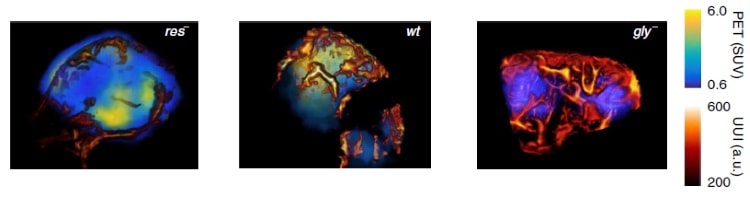
The experiment showed that the proposed modality could unambiguously differentiate three different metabolic statuses often found in tumours: an exclusively anaerobic metabolism (res–), and exclusively aerobic metabolism (gly–), and a mixed anaerobic and aerobic metabolism (wt).
Different metabolisms observed by the PET-CT-UUI setup
Finally, UUI can observe phenomena, such as beating hearts, more easily, and the addition of PET maps of FDG uptake makes delineation of the cardiac anatomy even more precise.
Weighting on the benefits
Combining imaging modalities usually comes with extra development complexity and cost. In this respect, the integration of a relatively inexpensive and portable ultrasound transducer probe in a PET-CT scanner is appealing. The fact that PET-UUI is simultaneous allows co-registration of the volume imaged and the establishment of a topographical relationship between multiple imaging parameters.
It is too early to know whether such an imaging combination will power new breakthroughs, but its potential for linking physiology and pathophysiology is promising. It could become a new standard for cancer imaging, where its ability to characterize both metabolic and vasculature can be particularly helpful.
Fermilab’s Don Lincoln is back with yet another entertaining video, this time about what people get wrong about time dilation. In particular, he asks whether the famous “twin paradox” is actually paradoxical. You can watch the video above, enjoy.
Have you taken a stunning photograph of the sky lately? If so, you still have a week to enter the Insight Astronomy Photographer of the Year, which is run by the Royal Observatory at Greenwich and sponsored by Insight Investment. This is the tenth year of the competition and to celebrate, the 2018 winners will have their work displayed at a new gallery at the National Maritime Museum in Greenwich – which will also show some of the best images from past contests.
Triumph of alliteration
Finally, in a triumph of alliteration there is a paper on the science of science in Science. According to the authors, he science of science (or SciSci) is “a transdisciplinary approach that uses large data sets to study the mechanisms underlying the doing of science – from the choice of a research problem to career trajectories and progress within a field”.
Among other things, the paper analyses the publication record of three physics Nobel laureates. This shows that these leading physicists have published high-quality work throughout their careers – and not just at moments of prize-winning brilliance.
Another interesting plot in the paper shows that the average number of authors on science and engineering papers has increased from just a shade more than one in 1900 to nearly five today. What’s more, today the average number of authors on papers judged to be of high quality is six – suggesting that bigger research collaborations may be better.
A dense, ultracold atomic gas has been created using blue-detuned laser light with a frequency that is higher than the atomic transition used to cool the atoms. This feat was achieved by Kyle Jarvis and colleagues at Imperial College London and their technique could offer a new way of trapping ultracold molecules – something that has proven very difficult to achieve.
Magneto-optical traps (MOTs) are particularly useful pieces of equipment for physicists wishing to trap samples of atoms at ultracold temperatures. MOTs use lasers with frequencies lower than certain atomic transitions (red-detuned frequencies) to cool the atoms. This “Doppler cooling” process involves atoms absorbing and emitting light in such way that their motion is reduced. It can be used to cool atomic gases to microkelvin temperatures – allowing the atoms to be used in a wide range of applications such as simulating quantum solids, measuring tiny changes in gravity and creating highly accurate clocks.
Avoiding rotation
Most MOTs achieve Doppler cooling through “type-I” atomic transitions, whereby the angular momentum of the excited state atomic state is higher than in the ground state. However, type-I transitions are of little use when trapping molecules because the trapping process must avoid exciting a molecule’s rotational and vibrational states. Instead, molecules need to undergo type-II transitions in which the excited-state angular momentum is lower than the ground state.
Attempts at using red-detuned lasers in MOTs to cool atoms and molecules using type-II transitions have resulted in gases that are too warm and too diffuse to be of any practical use. In their experiment, Jarvis and colleagues used blue-detuned lasers – with a frequency higher than that of the transition frequency. They describe this as a “counterintuitive” change in the cooling process because the absorption of red-detuned light by an atom is normally what causes the atom to slow down.
Despite this unconventional approach, the team could trap and cool rubidium-87 atoms using type-II transitions and achieved a density of 10¹¹ atoms per cubic centimetre – which is about one million times higher than achieved by red-detuned lasers. They also managed to cool the gas to below 30 μK.
When an ecosystem changes, those creatures most precisely adapted become the most vulnerable – and that is bad news for king penguins.
King penguins – one of the most charismatic species of the Southern Ocean – are under threat from climate change.
More than a million breeding pairs will either shift to new colonies or perish before the century’s end, as conditions in the Antarctic begin to change. The species Aptenodytes patagonicus could lose 70% of its population, according to a new study in Nature Climate Change.
The problem – increasingly familiar to conservationists and biologists – is one of mismatch engineered by climate change driven by human-induced global warming, itself a consequence of profligate combustion of fossil fuels that spill ever greater ratios of greenhouse gases into the atmosphere.
King penguins have adapted to a precise habitat range: they favour a scatter of islands in the Southern Ocean, away from the sea ice but close to an oceanic upwelling called the Antarctic Polar Front, which concentrates colossal quantities of fish into a small area.
And because of climate change, this front is in retreat. So penguin parents must swim ever further to find food for their chicks.
The new research predicts that – for most colonies – the distance to find fresh food will mean longer absences. At some point, the chick’s capacity to withstand starvation will be exceeded. The population will crash.
This is a reprise of an increasingly familiar story: human-induced climate change, along with other human bequests such as pollution and habitat destruction, have begun to threaten the wild things everywhere.
And even though the southern hemisphere is relatively less disturbed, and with a smaller human population, there have been signs of change. There have been separate cases of concern for Adélie and other penguins, for crested and rockhopper penguins, and even for the great survivor of the frozen south, the emperor penguin.
The entire region faces problems, in many cases driven by overfishing, and there has even been alarm about the condition of the albatross as it circles the southern ocean.
Repeated recoveries
The conclusion is based at least in part on evidence from the king penguin’s genome. The enormous string of DNA that encodes a creature’s machinery for survival is also a record of inheritance: it tells the story not just of the individual’s parentage but also of the entire species over many millennia.
And, so far at least, the king penguin DNA tells a tale of species survival: king penguin populations have crashed, and then recovered, more than once in the last 50,000 years.
But the bird faces new challenges. Humans have begun to alter the global climate, as well as to bring fishing on an industrial scale to a once isolated ocean. So hungry birds face high-technology competitors.
And faced with the choice of starve or migrate, the birds have only a limited range of potential breeding colonies. Around half of the population, on the Crozet and Prince Edward Islands, could lose their breeding colonies completely.
Poor prospects
Around a fifth of the population, based on the Kerguelen, Falkland and Tierra del Fuego Islands, will face ever greater foraging distances.
Climate change may create new opportunities for some, but overall, the outlook is bleak. “The main issue is that there is only a handful of islands in the Southern Ocean and not all of them are suitable to sustain large breeding colonies,” says Robin Cristofari, of the University of Strasbourg in France.
“There are still some islands further south where king penguins may retreat but the competition for breeding sites and for food will be harsh, especially with the other penguin species like the chinstrap, gentoo or Adélie penguins, even without the fisheries,” said his co-author Céline Le Bohec, also of the University of Strasbourg.
“It is difficult to predict the outcome, but there will surely be losses on the way. If we want to save anything, proactive and efficient conservation efforts but, above all, coordinated global action against global warming should start now.” – Climate News Network
Hadron therapy shows potential to improve the effectiveness of cancer radiotherapy. By exploiting the characteristic depth-dose distributions of hadrons in tissues (the Bragg peak), the technique offers precise delivery of radiation dose. The large gradients of the highly conformal dose distribution, however, make it critical to precisely and accurately plan the radiation field, align it with the target, and determine the stopping power of the ions. Current methods to do this have an uncertainty on the predicted range of 3–4%.
Advanced methods for absolute range verification are in development throughout the world. Researchers at Heidelberg University Hospital and the German Cancer Research Center (DKFZ) have developed a prototype detection system for helium-beam radiography (αRad) using silicon pixel detectors. The long-term goal of this research project is to develop a range verification method based on αRad.
The team has successfully demonstrated a proof-of-principle of αRAD, based on energy deposition measurements of single ions in thin layers, ion tracking and identification. In one key result, they showed that the rejection of secondary hydrogen ions originating from nuclear interactions distinctly improved the contrast-to-noise ratio (CNR) of the radiographs (Med Phys.45 817).
Lead author Tim Gehrke and colleagues created a prototype detection system consisting of three parallel silicon pixel detectors. The team selected pixel detectors (the CERN-developed Timepix chip) because they can measure the position of an ion in a single thin layer, and also provide unambiguous position determination in cases where multiple ions hit the detector in the same time window. These capabilities facilitated the construction of the ion track, and result in small multiple Coulomb scattering (MCS) in the tracking system.
The team selected helium ions instead of protons because they reasoned that helium ions would generate a better spatial resolution and undergo less pronounced MCS in the object being imaged. Moreover, they expected to achieve this resolution gain without any disadvantage in terms of CNR or applied radiation dose compared with proton radiography.
Detector verification
The authors used a phantom comprising a 160 mm thick block of acrylic glass, approximately the size of a human head. The phantom had a mean water-equivalent thickness (WET) of 192 mm and contained maximal WET-variations of ±6 mm. They imaged the phantom with a 173 MeV/u helium ion beam at the Heidelberg Ion-Beam Therapy Center.
The detection system was placed behind the phantom to register the ions leaving it. The system enabled detection of single particles, so that any with energy deposition higher than a user-defined threshold (in this case 5 keV) could be identified. Three detector layers were deployed: two to measure the arrival time of the ions for tracking and one to measure the energy deposition of the single ions.
When a heavy charged particle impacts the detector, the signal spreads over several adjacent pixels, forming a cluster. The so-called cluster volume, which is the sum of the pixel values in a cluster, was converted into the energy deposition of the incident particle by pixel-wise calibration. The authors note that desirable signals for image formation are clusters caused by single incident ions traversing all three detector layers, creating a matched event. They selected clusters corresponding to helium ions that did not have artefacts or degraded information.
The authors performed data processing, tracking and backprojection of the ions, calculated CNR, estimated the delivered dose and evaluated spatial resolution. They reported that this particular set-up achieved a spatial resolution of at least 1.15 lp/mm for, as well as a resolution of relative thickness differences of 1.2%, at a dose level typical for diagnostic radiography.
Range verification
Helium-beam radiography can be applied as an image-guidance tool for proton, helium and carbon-ion radiotherapy. Gehrke explained that a goal of αRad is to measure WET maps that might be used for in vivo range verification.
“Since the WET measured by αRad retains its validity for proton and carbon-ion beams, αRad is in this respect equally useful for proton, helium and carbon-ion therapy,” he said. “From a practical standpoint, αRad is especially interesting for helium-beam therapy, because this combination of imaging and treatment modality would not require any ion-type switching during the whole process. The applicability of αRad for intra-fractional imaging in proton or carbon-ion treatments will depend on the speed of the ion-type switching of a particular facility.”
The researchers have also recently performed an in-depth comparison of proton and helium-beam radiography, using the silicon pixel detectors and the data processing procedures that they developed. The detection system could be successfully applied to perform αRad, as well as proton radiography (pRad). This research showed theoretically and experimentally that helium ions provide a higher spatial resolution compared with to protons, retaining the same CNR at a comparable dose (Phys. Med. Biol.63 035037).
Gehrke says that the team is currently focusing on new ideas and concepts to overcome two major limitations of the method. They are working on the extension of the sensitive WET range (currently about 12 mm) in which a high CNR can be achieved. They are also developing methods to decrease the acquisition time of radiographs measured by their prototype detection system, therefore requiring silicon pixel detectors with a higher readout speed.
The history of physics is littered with people affected by mental-health conditions, and too often their stories have sad endings. Isaac Newton, Wolfgang Pauli and David Bohm, to name a few, are all thought to have suffered to some degree, and Ludwig Boltzmann took his own life after struggling with bipolar disorder for years. But mental illness does not just strike the elite. It is something that can affect anyone and you will undoubtedly have friends, family or colleagues facing such problems. Unfortunately, there is very little awareness of mental health in academia and few practical resources or material to draw on.
I suffer from bipolar disorder, which has affected me throughout the various stages of my academic career. Nowadays, I am working within my university to try and establish an effective support network and to create awareness around mental health. As part of this effort I have decided to share the story of how my own mental health has affected me as an academic in physics.
I hope that by sharing my experiences it might help start a dialogue in our community. People should not feel embarrassed to talk about these issues, and those suffering from mental illness need to know they are not alone and there is always help available – although more options on that front would be beneficial. We also need to improve the stigma around mental health. In the past, people have said some awful things in front of me, directly to me and behind my back, whether intentional or not. Others, meanwhile, tend to laugh things off, especially when they’re uncomfortable. But mental illness isn’t funny or a joke. By generating awareness of the issues, I hope people will think twice before making light of matters.
Before I start my story, one of the first things you will have noticed is that I have chosen to remain anonymous. While this decision runs counter to the ideal culture of openness, it is a necessity for me. Many of my friends, family and colleagues are incredibly supportive of me, but unfortunately, some people still have a bizarre and outdated view of mental illness. It’s sad that I must think this way – and it makes me angry sometimes too – but it’s hard to express the discomfort it could cause me if my mental-health problems were publicly known.
The beginning
Bipolar disorder, formerly known as manic depression, is mainly characterized by experiencing periods of depression, where you feel low and lethargic, and periods of mania – feeling very high and overactive, sometimes in an unpleasant and disorientating way (such as having thoughts that don’t stop racing). Bipolar disorder is a wide-ranging term, covering varying degrees of severity and symptoms, and I fall on the “schizoaffective” side. This means that on top of the typical bipolar symptoms, I have also suffered from those associated with schizophrenia, including audible and visual hallucinations and delusions.
I was not diagnosed with bipolar disorder until my early 20s, but my therapists and psychiatric team have looked back at my past, and we think the symptoms started when I was around 15 or 16. During sixth form (age 16–18), I began to experience severe mood swings that could last weeks or months, disrupting my attendance, focus and levels of motivation.
These symptoms worsened during my undergraduate degree in theoretical physics. Depression made it hard for me to do basic things – even getting out of the house was a challenge, let alone attending lectures. Yet, if I was heading towards a manic episode, I felt like the most confident person in the world. The mania meant I needed little sleep. I could plough easily through the learning material, and would do well in exams and assessments. Although experiencing such mania seemed “useful” at times as an undergraduate, it ultimately caused chaos – the feeling never lasted and was often followed by a crash into depression.
Depending on how intense the mania was, I could lose touch with reality, suffer from delusions and become uncharacteristically arrogant
As well as impacting my studies, such extreme highs and lows tested and strained my personal relationships, as friends and family would become concerned with my eccentric and erratic behaviour. Depending on how intense the mania was, I could lose touch with reality, suffer from delusions and become uncharacteristically arrogant. Sometimes I even experienced psychotic episodes, which were upsetting for all involved.
The mania could sometimes wreak havoc on my finances. I planned many unrealistic scientific projects, often involving expensive equipment and exotic locations, all of which never got done due to a crash in mood, because I was off to plan “more important” things, or because they were just plain nonsense. There were some seriously chaotic times.
This was all about 15–20 years ago, at a time when people were even less aware of mental-health issues than now. As far as I knew, there were very few support services available at my university – although, given they were so hard to discover, there may have been more. Meanwhile, my undergraduate peers and many of the academic staff appeared to be uncomfortable around me. I often felt ignored and saw a lack of empathy in the community towards people who were clearly suffering. I can understand this a bit though, as my behaviour, depending on the mood swings, could be difficult to deal with.
My undergraduate tutor did take notice, however, and was particularly concerned about me. He tried to get me to go to some of the limited available services but I did not listen. The problem with being manic is that you feel great at first and why would you want to stop that? However, when I felt depressed I couldn’t even think of talking to someone new, and unfortunately, I didn’t have much down time in-between. In hindsight, I wish I had listened to my tutor more.
A downward spiral
Although I faced problems during my undergraduate degree, my ambition to study physics remained strong, and I got a PhD studentship in theoretical physics at a different university. Unfortunately, despite all my enthusiasm for physics, my illness continued to worsen.
It’s hard to understand why. I’ve wondered if getting older meant my symptoms got worse, or if the open nature of research work lends itself to mood swings. There are big pressures during a PhD, such as managing your time, meeting deadlines and planning your future career, and I also had the legacies of my illness to carry, including friendship issues and financial debts. It did not help either that I had less direct supervision, leaving less chance for someone to intervene.
My illness continued to get worse and I had some severe bouts of mania during these times (I felt I was really going mad) and some serious depressive crashes. Being manic felt like it helped me do amazing research, but once things calmed down, I would re-read my notebook from the previous few days or weeks and often find utter nonsense in there despite me feeling I had done something amazing at the time.
Courtesy: iStock/agsandrew
In stark contrast, the depressive episodes were harder and darker than ever, and led to time off, disruption and, most distressingly, my first suicide attempt. Thankfully, the city I had travelled to to do this had some wonderful members of the public who prevented me from going through with it. Meanwhile, back at home the police had been called and had I think (I still don’t know fully what happened) been to my place of work. It felt humiliating at the time, but this forced me into my first proper treatment and I was put on some serious medication to try and lift my mood.
I hated taking medication – it made it hard to concentrate and I had difficulty performing the problem solving and logical thinking I needed to carry out research. I felt it was impacting my ability to work and ruining any chance I had of a career in research and academia. So, I would come off the medication – a disastrous decision. I usually ended up in a period of mania or hypomania – a milder version of the condition – that then resulted in a bigger crash, and ultimately, I would be forced to go back on the medication by friends and my medical team.
I felt at this point that the people around me, at work and at home, did not understand the illness or the effects of managing it. I was feeling very low and had a year remaining of my PhD. I needed to finish my doctorate and look for a job, but I also needed some time off to get my health under control. When I informed my department, I was told, however, that I would have to have my stipend suspended if I wanted to take time away from my PhD – essentially, I would be forced to take unpaid leave.
I still cannot believe this was how they handled someone who was suffering from severe depression. I was a good student – I had been awarded prizes in my first and second year and was otherwise on track to successfully get a PhD. Yet the university did not try and find a solution that would help get me through this horrific time. They had no protocols or systems in place to help students in bad situations, and they did not look for alternative funding. There was a total lack of effort from my department and supervisor, and I wasn’t even given details of support programmes that could help while I continued to work – I had to find them myself. It was worse than during my undergraduate degree – there was no sympathy and no empathy towards my case. I was shocked and hurt, but had no other choice than to plough on with the work.
New place, old problems
Fortunately, the National Health Service (NHS) was fantastic, and with its support I got through the final year of my PhD. I even managed to submit my thesis on time, which was pretty good considering everything that was going on. In spite of my troubles, my mental-health problems had once again not dampened my love of studying physics and doing research. Not wanting to leave academia, I amazingly found my dream job – a two-year postdoc in the US. Working abroad felt like it would be a fresh start and the institute I was going to be at was one of the best in the world for my chosen field.
I needed to have a good crack at this new job but, once again, I felt my medication was limiting my ability to work properly. So, I decided to stop taking it, which led me to some very scary and dark times in my life.
It’s often hard for people to understand why I would go on and off my tablets like this: surely controlling the bipolar disorder was the priority? Had I not learnt from past experiences? But all I wanted was a fair chance to do something I love, and I’ve always felt the medication was stopping my academic brain functioning to its full capacity, holding me back from succeeding and developing in the field.
This is when the schizoaffective element to my illness started to become very apparent. I was becoming delusional and having psychotic episodes. I thought I was being followed or attacked by creatures. I became scared to go out of my apartment, too frightened to even leave the bedroom. My colleagues started to worry as I became erratic around them.
The university offered no sympathy and no empathy towards my case. I was shocked and hurt
The medications I was then prescribed in the US were much stronger than my previous tablets and the impact was horrendous. I was sleepy all the time and it became impossible to function normally, but they kept me out of hospital. A real battle began and this period of work was a disaster for me as I couldn’t find a balance – I seemed to be either manic or too depressed to get to work or knocked out by medication.
Difficult decisions
At the end of the placement I returned to the UK and took up a two-year postdoc with my previous university. It was a very generous offer and this was due to my record of good performance – at times – as a PhD student. At this point my UK medical team changed my prescription again, as they were shocked by how many tablets the US doctors had put me on. Unfortunately, going off one type of medication and onto another was as bad as when I had stopped taking them completely. I started to become manic but was keen to hide it from people as it felt good – I felt like my old self again. But I began to hear voices, my behaviour became erratic, and it ended how it usually ends – in stronger medication and a lot of time off work.
I felt like I was failing. I really wanted to work in physics research but it was looking increasingly impossible – the bipolar disorder was ruining my career in academia. At this point, I started to become suicidal again. Thankfully, though, things calmed down, and towards the end of the postdoc I made the difficult decision to find a different career.
I felt like I was failing. I really wanted to work in physics research but it was looking increasingly impossible
I chose teaching – something I had always been interested in – but my heart was still in academia. I became very depressed again and found managing my illness through the teacher training and first year to be very tough. Thankfully, I had outstanding support from my mentors and lecturers. It was very different from my experience in academia – the education staff showed empathy and it was an unusual experience to feel supported. During this time, I was also incredibly lucky to meet the amazing person I would later marry. I suddenly had the support I never really had before, and I learnt to understand and manage the disorder much better.
I worked as a teacher for three years until a perfect opportunity came up to re-join my old university physics department on a permanent basis in a position involving both research and teaching. And this is where I am still – doing the research I love and enjoying teaching at a university level.
I am in a much better position with my mental health than I ever was, but the bipolar disorder will never truly go away. I have been on medication for about 13 years and still occasionally suffer from mania and depression, and the desire to reduce my medication. Fortunately, I have the support and love of my partner to keep me on the right track and, with the help of friends and learning from my experiences, I have managed to get through relapses without too much disruption.
Combating the stigma
My story highlights the struggles of dealing with mental illness while pursuing a career in academia – but whether this is a problem specifically within physics, or whether it is a wide-spread problem across the academic community, I cannot say. Without seeing reliable statistics, all I can offer is my own personal evidence, and what concerns me from that is the lack of awareness and understanding of such issues within the academic workplace.
I hasten to say that I don’t think this is a problem solely limited to academia – the stigma that surrounds mental health is rooted in our society’s attitude and culture. But this has been improving a lot in recent years, and there are many initiatives striving to improve awareness and provide support (see box opposite). Indeed, I have friends working for companies that have a supportive and open culture when it comes to mental health. I wish this was the case everywhere. Even my own time as a teacher highlighted the comparative lack of support in academia.
Again, I can only give my own anecdotal evidence, but there seems to be more stigma towards mental health in academia and improvements don’t seem to be keeping pace with the wider world. I know colleagues who have mental-health issues but refuse to come forward about them because they are worried about the stigma. Throughout my own career I have experienced some terrible attitudes from people, which I have found hurtful and sometimes cruel. It worries me greatly that our community lacks empathy towards individuals who are unwell.
I often sensed that people thought less of me and would not take a chance on me, or even did not trust my work
So why is academia worse? In my opinion, it partly comes down to the nature of academic work. The career paths are target-based, stressful and very competitive. There are limited pots of money and contracts are often short. It’s not surprising that working in such an environment can trigger mental illness. This backdrop means people who are unwell for a long period of time can be viewed as a liability, and working with them could be seen as detrimental to a project’s progress. I worried about this constantly when I was unwell – I felt I was wasting money and stopping a project from moving forward. I often sensed that people thought less of me and would not take a chance on me – at stages I even got the impression that my colleagues did not trust my work. I have seen this in how others suffering from mental illness have been treated too, and these attitudes mean you also begin to doubt your work and capability.
The reasoning behind these attitudes could be numerous – perhaps some people think that having a mental illness means you are not as intelligent, or maybe they think avoiding people with mental illness is simply logical and practical for the benefit of their project. Whatever the reason, I believe it comes down to ignorance and a lack of awareness, and this is something I would like to address. I think it is vital that we generate awareness of mental-health conditions and highlight the problems that some of us have to go through, ultimately improving the support offered in the academic workplace.
By making sure the community is informed and aware, you can also reach and educate those suffering from mental-health problems, ensuring they know they are not alone and that there are different support systems and actions available to them.
I’ve had people approach me with concerns about their own mental health and one of the first things they ask about is the side effects of medication. It’s not good that people are having to think about this before seeking medical help, but it is a genuine concern for my colleagues and friends in academia. As I’ve said, some of my biggest battles have concerned medications – I often felt the tablets were holding me back, suppressing my concentration and ability to do research. When your brain power, logic and problem solving are the most important tools of your job, it’s difficult to face tablets that might suppress that.
While I may not enjoy taking it, medication is the best way for me to stay well. That, however, doesn’t mean it’s the case for everyone – for others, cognitive behavioural therapy or counselling, for example, might be a better fit. It is therefore important to make sure people are aware that seeking help doesn’t necessarily mean tablets and, if it does, then there is nothing wrong with that. The most important thing is to get help and get well.
Unfortunately, mental-health conditions don’t simply go away, and often people don’t understand this. Like a physical injury or illness, they believe it will just pass or that medication will miraculously cure it forever. Personally, if I appear to be “normal” that does not mean there are no underlying issues. I manage this illness with medication and seeing professionals, and I will likely have to continue doing so for the rest of my life. It is important that employers and colleagues understand this is a long-term battle. They need to be able to make adjustments for the bad days or the side effects of medication, while also not penalizing those who are suffering.
A helping hand
Despite the steps that must still be taken, I must give credit where it’s due and point out that things have improved considerably in recent years. In general, mental-health awareness has increased ten-fold and there is more information readily available. Universities often have more visible counselling services that offer students a range of resources such as self-help guidance, drop-in sessions, workshops and one-to-one support. At the department level, I think undergraduate tutors and postgraduate supervisors are often more understanding nowadays and have greater empathy towards these issues because of society’s changing attitudes. Whether there are official systems in place to, for example, refer students to counselling or to help financially support them if they need a break from their studies, I cannot tell you – such information does not seem to be readily available.
At the staff level, a lot still needs to be done. For example, I recently approached occupational health at my current university. It initially looked promising, as they came up with a very good support mechanism for me. Knowing I had this, and therefore a better chance of success to pursue research, made me feel much more confident at work. Unfortunately, this did not last. When I had problems, the support network failed, and I felt alone and worried once more. We’re getting things sorted, and our new head of department has been very supportive and keen to do something, but the incident has highlighted for me that the mental health of staff and students is not a priority for the department.
It seems fashionable for employers to talk about mental-health support but they don’t necessarily follow-up on the discussion
I decided to see what I could do to stop this happening again, to me or other people at the university. Working with the human resources and occupational health teams, we discussed ways of improving the current support network with the heads of the university’s departments. We planned to introduce a mental-health first-aid initiative and a new departmental “listener” scheme, so there are known members of staff people can talk to about their problems. Unfortunately, things appear to have ground to a halt. It seems fashionable for employers to talk about mental-health support but they don’t necessarily follow-up on the discussion. This is incredibly frustrating as it could provide vital help for people.
The best support mechanisms I’ve found are with the NHS and its specialists. They have been amazing over the years and I am still lucky to meet them regularly – whether it be a nurse, a psychiatrist or a psychologist, they have always found time. I am very fortunate considering the stories we hear about long waiting times and delayed treatment. It would be great if universities also provided support systems for students and staff that could potentially take some of the pressures off the NHS.
I hope that my story helps raise the awareness of mental-health conditions in academia and the problems those suffering from them face every day. It is our job to make sure the bright minds around us now and in the future have the support they need to progress in academia. After all, their work could lead to the next big scientific breakthrough, but how could they achieve those feats if we let them slip through the cracks because we are ignorant of their battles?
Support services
If you need support, would like information about available services, or want to know more about mental health, here are some useful links and resources:
Cartilage – the connective tissue that provides a smooth, lubricated surface between joints in the body – is a structural marvel, but its limited capacity for self-repair complicates injury treatment. To boost the healing process, researchers have long been keen to find new cell-based therapies, and have identified cartilage as a promising candidate for tissue engineering.
“This idea was supported by the apparent morphological simplicity of cartilage – a tissue composed of a single cell type, namely chondrocytes,” explains Wojciech Święszkowski, a biomaterials expert based at Warsaw University of Technology.
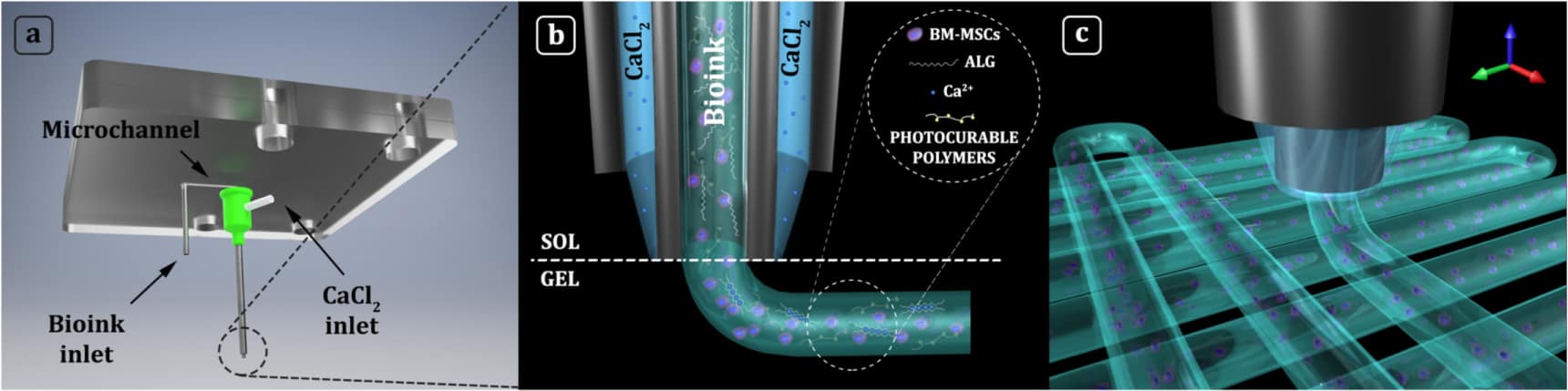
His team – which includes Andrea Barbetta and a group of chemists at Sapienza University of Rome, and specialists in stem-cell research at Oslo University Hospital directed by Jan Brinchmann – is helping to advance cartilage regeneration through the development of 3D-printed biomimetic hydrogel scaffolds. To fabricate these intricate matrix structures for supporting cell growth, the researchers have developed custom apparatus that provides microfluidic control over the dispensing of bioink through co-axial nozzles.
Microchannel control
According to Święszkowski, who has presented the work in the journal Biofabrication, the set-up unlocks a new level of printing accuracy for extrusion-based systems. “Using this apparatus, we can deposit cells with precision beyond the dimension of a single laid fibre,” he explains. “It means that extrusions can contain multiple cell types or biomaterials, which allows us to pattern 3D constructs that more closely mimic the body’s own tissue.”
The technique also makes advances in decoupling printing accuracy and precision from bioink rheology. “We can freely change bioink composition in terms of biopolymer content and/or cellular density, without changing printing conditions such as printing speed, layer thickness, or the distance between fibres,” Święszkowski comments.
This flexibility gives the team more freedom to tailor the structure and composition of the fibre. In the case of cartilage repair, the group has succeeded in bioprinting biomimetic extracellular matrices composed of methacrylated derivatives of gelatin, hyaluronic acid and chondroitin sulphate.
Święszkowski’s team also has projects running that focus on repairing bone, skeletal muscle, tendon and pancreatic tissue. Examining the performance of their fabricated designs, the researchers have shown that three-dimensional constructs bioprinted using the co-axial extrusion system exhibited functional features after culturing in the lab.
In related work, the researchers have formulated and bioprinted a series of biomimetic inks containing human-bone-marrow-derived mesenchymal stem cells (hBM-MSCs), with the aim of examining the influence that each component exerts on cell differentiation. “Interestingly, we found that the composition and the stiffness of the printed bioink plays a key role in the differentiation of hBM-MSCs. We obtain the best results for a bioink composed of gelatin methacrylate and chondroitin sulphate amino ethyl methacrylate,” says Święszkowski.
The group is looking to apply its knowledge to a range of different scenarios, which includes the regeneration of skeletal muscle tissue. Noteworthy preliminary results – attained in collaboration with the group of Cesare Gargioli from University of Rome Tor Vergata – include bioprinting aligned layers of highly-packed hydrogel fibres containing skeletal muscle precursor cells (myoblasts) to create functionally organized and fully differentiated myobundles. “In the future, this 3D bioprinting approach could be used to assemble macroscopic constructs for treating volumetric muscle loss, a severe condition that can arise after injuries, traumas and degenerative disease,” Święszkowski points out.
The results are promising, but there are more challenges to be addressed. “Without any doubt, the major step for me and my team is to bring our system to the next level by improving the current apparatus and building superior structures that can better and more efficiently recreate the complexity and functions of the human body,” Święszkowski comments.
He adds that future progress requires focus not just on the deposition systems, but also on bioink development to expand the choice of natural polymers available for designs. Święszkowski feels that performance gains can be found by focusing on the cellular benefits offered by new blends of matrix materials.
At the same time, he believes that advances in protocols for stem cell differentiation together with progress in understanding key growth-factors and their stimuli will play a major role in delivering further advances in organ healing and tissue repair. “There is still a lot to do in the field of biofabrication and 3D bioprinting,” said Święszkowski, as he looks forward to tackling more challenges in 2018.
Full details of the team’s work can be found in the journal Biofabrication.
This article is one of a series of reports reviewing progress on high-impact research originally published in the IOP Publishing journal Biofabrication.
A huge discrepancy between the observed hyperfine splitting in highly-ionized bismuth-209 atoms and the expected value could be a calculation error rather than evidence for new physics. That is the conclusion of Leonid Skripnikov at St Petersburg State University in Russia and colleagues, who have shown that the magnetic moment of the bismuth-209 nucleus – which is used to calculate the hyperfine splitting — is much smaller than the currently accepted value.
Hyperfine splitting is a small shift in electron energy levels that arises because of the interaction between the dipole magnetic moment of the atomic nucleus and the orbital motion of the electrons. Very precise spectroscopic measurements of hyperfine splitting offer a way of testing quantum electrodynamics (QED). Finding discrepancies between QED and experimental observations could point towards physics beyond the Standard Model of particle physics.
Sole electron
In 2017, Wilfried Nörtershäuser of the Technical University of Darmstadt and colleagues injected bismuth-209 atoms into the Experimental Storage Ring (ESR) at GSI Helmholtz Centre for Heavy Ion Research in Darmstadt. The atoms were stripped of all but one of their electrons. This remaining electron is tightly bound in hydrogen-like orbits that have very large overlaps with the bismuth nucleus. The bismuth-209 nucleus has a huge magnetic moment – and this combined with the close proximity of the electron makes the system ideal for testing QED.
There is an important snag, however, because quantum fluctuations make it extremely difficult to calculate the distribution of magnetization in the nucleus – something called the Bohr-Weisskopf effect. To get around this problem, the team also created lithium-like ions by stripping bismuth-209 atoms of all but three of their electrons. By comparing measurements of the hydrogen-like and lithium-like ions, the team could cancel-out the Bohr-Weisskopf effect and measure the difference between the hyperfine splitting of the hydrogen-like and lithium-like ions.
Whopping deviation
Much to their surprise, the team found that this difference had a whopping 7σ deviation from that predicted by theory, which could be indicative of new physics. But now, new measurements and calculations done by Skripnikov and colleagues (including Nörtershäuser) suggest a more mundane explanation.
Calculating the hyperfine splitting from the experimental data requires an accurate value for the nuclear magnetic moment of bismuth-209. Nörtershäuser along with Darmstadt’s Michael Vogel and colleagues used nuclear magnetic resonance spectroscopy to measure the magnetic moment of the nucleus. This was done by placing an aqueous solution of bismuth nitrate in a powerful superconducting magnet and measuring its radio-frequency spectrum.
An important challenge in making this measurement is accounting for the effect of the bismuth nitrate solution on the local magnetic field that is felt by the bismuth nuclei. This was worked-out by Skripnikov and colleagues, who did sophisticated quantum-mechanical calculations that revealed that the effect on the local field was much greater than expected.
Good agreement
When the new value of the magnetic moment was used to calculate the hyperfine splitting, the result was in good agreement with the original experiment.
“It would be too early to state that this represents the complete solution to the hyperfine puzzle,” says Nörtershäuser, adding “nevertheless, it is for sure a significant part of the solution”. “Further experiments are still needed to achieve complete clarity about the interplay between the atomic nucleus and the shell and, therefore, to verify the theoretical predictions of the nature of quantum mechanics in very strong fields”.
The inaugural Big Science Business Forum, which was held in Copenhagen this week, brought together 1000 scientists, engineers, business executives and government officials from 29 European nations to discuss the commercial opportunities for companies in big-science facilities across the continent. The European big-science market is big – it’s worth an estimated €12bn – but companies are often put off because each facility has its own complicated and time-consuming procurement rules and quality standards.
So the meeting was an attempt to create a more transparent and efficient big-science market in Europe by showing firms what opportunities are on offer and getting them talking to people form big-science facilities. But it left me wondering why the UK would want to quit the European Union (EU) when closer co-operation and freedom of movement of scientists are surely key to scientific and technological innovation in Europe of the kind espoused at the meeting.
My colleague Margaret Harris and I therefore put the following question to five of Europe’s top scientific leaders.
What are the threats to researchers and companies from Britain leaving the EU?
Carlos Moedas, EU commissioner for research, science and innovation
I think we will all be affected by that decision and that’s why we’re working so hard to find a solution for the future. I think the wish of all of us from the EU side and the UK side is that we find a solution for a future relationship. I cannot imagine that we will not find a solution so I am positive we are going through this phase of basically settling the accounts – what we call in our jargon the divorce bill. But then after that we will have to sit down and develop the relationship we want. And I hope that science and innovation will be part of that. But there’s nothing more I can tell you at the moment because there’s nothing more to tell.
John Womersley, director-general, European Spallation Source
There are two short-term issues. One concerns access to talent. A loss of freedom of movement, which until now has been a pre-requisite for membership of the EU’s Framework programmes, could make it harder for EU scientists to work in the UK and also for British researchers to study and work abroad.
The other concerns funding. The UK has been very good at winning grants, particularly from the European Research Council, and some universities have come to see it as a steady source of income that can make up for relatively flat funding from the research councils. If funding from the EU is cut off, that could damage UK research. The government has promised to more than make up for any potential shortfall from Europe by giving extra cast to UK Research and Innovation (UKRI) but much of that work is targeted at industrial and applied research so Brexit could mean less money for individual principal investigators doing basic research.
Longer term, Brexit could affect Britain’s ability to take part in decisions about future European projects and the overall direction of international projects. Many European scientific bodies, such as CERN, the ESS and the European Space Agency, are intergovernmental organisations and so in principle won’t be affected by Britain leaving the EU. But if the UK is “semi-detached” from international networks, science could suffer unless other networks are in place.
Brexit could affect Britain’s ability to take part in decisions about future European projects.
John Womersley, Director General, European Spallation Source
Many scientists in the rest of Europe are curious about the UK’s approach to Brexit because science has not been high on the agenda. Similarly, many UK scientists don’t look forward to the inevitable questions about Brexit because they don’t have any good answers. I’m really hoping we start to hear more from Mark Walport when he takes over as head of UKRI next month. This isn’t about lobbying for universities as a special interest group. Science and innovation are key to the future of everyone in Britain. It’s really important not to screw this up!
Xavier Barcons, director-general, European Southern Observatory
Brexit means no change for us. We are totally independent of the EU – I mean, we have close links, we try to work together with them and talk to each other and so on, but we are totally independent. So, I expect that there will be no changes in relation to UK companies and the government in terms of anything related to ESO.
At a fundamental level, Brexit is no issue for us, because the UK remains an ESA member state. There are some issues concerning, for instance, working arrangements and working permissions for UK nationals at ESA, but I am sure these will be solved within a couple of months, because they have to be. Of course, we would like the UK to be part of other activities as well, and I am fighting like hell to get all of these solutions, but for us it’s not that big an issue.
I agree it is an issue [for the wider research community and companies], though. If you apply for EU funding to do research, it is an issue. Also, at ESA we have the Galileo programme and the Copernicus programme that are financed by the EU, and whenever we have a UK company in to do work on those projects, it will be a special problem in the future, because the EU may forbid that money from going to British companies. It is the EU saying that, not us; we at ESA would be fine with it, but if it’s EU money we might be not allowed to give it to a UK company. I hope that this will be clarified very soon by the discussion between UK and Brussels.
I am a convinced European. I am very unhappy about the developments we are seeing right now.
Johann-Dietrich Wörner, Director General, European Space Agency
I am a convinced European. I am very unhappy about the developments we are seeing right now, and the UK is just one example. Having a “United States of Europe” would be still my dream, but what I am doing is the “United Space of Europe”, and that means I try to cover all the different actors and collect them under the roof of ESA to work together. And it’s working. In ESA, the European spirit is 100% there.
So far they [the UK] have communicated that they are still interested in participating in ITER. It’s fully under discussion but the first impression is that there won’t be a big change, let’s say closing down or not participating any more. They are willing to continue on this development. But again, discussions are ongoing. Initially it was some kind of a shock but people think the future looks reasonably stable and good so [the issue] has disappeared again. But nothing is decided yet but it does have an impact on British people working for us. It doesn’t have to have an impact but people are starting to wonder what does it mean for me.
The CERN-MEDICIS facility has produced its first radioisotopes for medical research, targeting novel diagnostic agents and treatments for diseases such as brain and pancreatic cancers.
The use of radioisotopes to treat cancer goes back to the late 19th century, with the first clinical trials taking place in France and the US at the beginning of the 20th century. Great strides have been made, and today radioisotopes are widely used by the medical community. Produced mostly in dedicated reactors, radioisotopes are used in precision medicine, both to diagnose cancers and other diseases, such as heart irregularities, as well as to deliver very small radiation doses exactly where they are needed to avoid destroying the surrounding healthy tissue.
However, many currently available isotopes do not combine the most appropriate physical and chemical properties and, in the case of certain tumours, a different type of radiation could be better suited. This is particularly true of the aggressive brain cancer glioblastoma multiforme and of pancreatic adenocarcinoma. Although external beam gamma radiation and chemotherapy can improve patient survival rates, there is a clear need for novel treatment modalities for these and other cancers.
On 12 December, a new facility at CERN called MEDICIS produced its first radioisotopes: a batch of terbium (155Tb), which is part of the 149/152/155/161Tb family considered a promising quadruplet suited for both diagnosis and treatment. MEDICIS is designed to produce unconventional radioisotopes with the right properties to enhance the precision of both patient imaging and treatment. It will expand the range of radioisotopes available – some of which can be produced only at CERN – and send them to hospitals and research centres in Switzerland and across Europe for further study.
Initiated in 2010 by CERN with contributions from the Knowledge Transfer Fund, private foundations and partner institutes, and also benefitting from a European Commission Marie Skłodowska-Curie training grant titled MEDICIS-Promed, MEDICIS is driven by CERN’s Isotope Mass Separator Online (ISOLDE) facility. ISOLDE has been running for 50 years, producing 1300 different isotopes from 73 chemicals for research in many areas including fundamental nuclear research, astrophysics and life sciences.
Although ISOLDE already produces isotopes for medical research, MEDICIS will more regularly produce isotopes with specific types of emission, tissue penetration and half-life – all purified based on expertise acquired at ISOLDE. This will allow CERN to provide radioisotopes meeting the requirements of the medical research community as a matter of course.
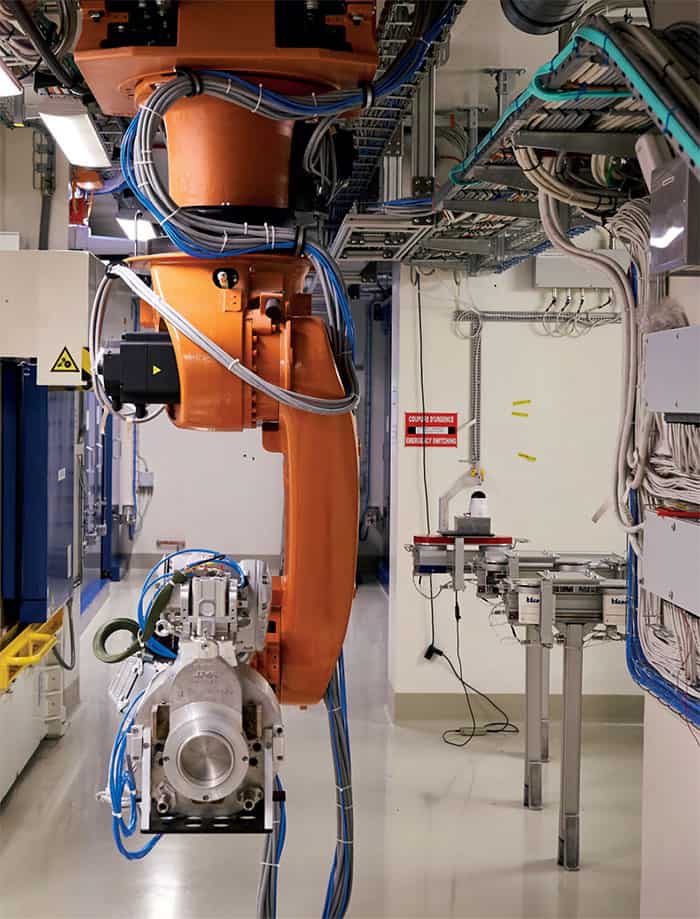
ISOLDE directs a high-intensity proton beam from the Proton Synchrotron Booster onto specially developed thick targets, yielding a large variety of atomic fragments. Different devices are used to ionise, extract and separate nuclei according to their masses, forming a low-energy beam that is delivered to various experimental stations. MEDICIS works by placing a second target behind ISOLDE’s: once the isotopes have been produced on the MEDICIS target, an automated conveyor belt carries them to a facility where the radioisotopes of interest are extracted via mass separation and implanted in a metallic foil. The final product is then delivered to local research facilities including the Paul Scherrer Institute, the University Hospital of Vaud and Geneva University Hospitals.
Clinical setting
Once in a medical-research environment, researchers dissolve the isotope and attach it to a molecule, such as a protein or sugar, which is chosen to target the tumour precisely. This makes the isotope injectable, and the molecule can then adhere to the tumour or organ that needs imaging or treating. Selected isotopes will first be tested in vitro, and in vivo by using mouse models of cancer. Researchers will test the isotopes for their direct effect on tumours and when they are coupled to peptides with tumour-homing capacities, and establish new delivery methods for brachytherapy using stereotactic or robotic-assisted surgery in large-animal models for their capacity to target glioblastoma or pancreatic adenocarcinoma or neuroendocrine tumour cells.
MEDICIS is not just a world-class facility for novel radioisotopes. It also marks the entrance of CERN into the growing field of theranostics, whereby physicians verify and quantify the presence of cellular and molecular targets in a given patient with a diagnostic radioisotope, before treating the disease with the therapeutic radioisotope. The prospect of a dedicated facility at CERN for the production of innovative isotopes, together with local leading institutes in life and medical sciences and a large network of laboratories, gives MEDICIS an exciting scientific programme in the years to come. It is also a prime example of the crossover between fundamental physics research and health applications, with accelerators set to play an increasing role in the production of life-changing medical isotopes.