A new multimodal hard X-ray scanning microscopy technique that can image features down to 10 nanometres could be used in materials-science studies. The technique, which works by focusing hard X-rays with two crossed multilayer Laue lenses and raster scanning a sample, is ready for use in routine measurements, say its inventors.
Scanning hard X-ray microscopy (SHXM) is used to image nanostructures because X-rays can resolve much finer details than visible light. Their penetrating power also allows access to deeper layers in a sample, which is useful for 3D tomographic imaging of structures such as biological cells, semiconducting chips, batteries and many other functional materials. But this high penetration also means that X-rays pass straight through conventional lenses without being bent or focused.
Apart from X-ray mirrors, which are limited in their convergence and that need to be mechanically polished, thus making them expensive, an alternative way to bend X-rays is to use crystals. To do this, researchers today make use of tailor-made artificial crystals consisting of different material layers to sharply focus X-rays. These crystals are known as multilayer Laue lenses (MLLs), named after the German physicist Max von Laue who discovered 100 years ago that crystal lattices diffract X-rays.
Two crossed MLLs
The new hard X-ray imaging technique developed by Hanfei Yan of the Brookhaven National Laboratory and colleagues has a spatial resolution of nearly 10 nm thanks to two crossed MLLs.
“We image the sample in multimode thanks to absorption-, phase- and fluorescence contrast,” explains Yan. “We raster scan the sample with respect to a nanobeam applied to its surface. While we do this, we record the excited fluorescence and transmitted signals using energy-dispersive and pixel-array 2D detectors, respectively, at each position on the sample. The former provides us with quantitative images of the constituent elements in the sample and the latter an electron density map of the sample.
The researchers characterized the focus size of the crossed MLLs using so-called ptychography reconstruction and conventional knife-edge scans. They determined the imaging resolution of the acquired fluorescence image using power spectrum density (PSD) analyses.
Imaging resolution is nearly as good as 10 nm
“With the knife-edge scans, we calculated a full-width-at-half-maximum (FWHM) focus size of 15.3 x 16.9 nm2 while the ptychography reconstruction produced a FWHM size of 13.9 x 12.3 nm2,” says Yan. “PSD analysis of a test pattern fluorescence image revealed the smallest detectable feature size down to 10.3 x 10.8 nm2.” These measurements all imply that the imaging resolution is nearly as good as 10 nm, he adds.
“We can use the technique to image a variety of samples,” he tells nanotechweb.org. “In our study, we imaged a test pattern fabricated by lithography, a nanoparticle array and an ionic ceramic-based membrane (used in solid oxide fuels cells) containing small grains. We could see the chemical composition of these materials as well as morphological variations. In the ionic membrane, we were also able to make out an emerging material phase.”
Towards sub-10 nm resolution
“The direct scanning image (that is, with no post-imaging processing and deconvolution) shows a resolution of around 12 nm,” he adds. “With ptychography, which is an inverse reconstruction technique that can then further enhance the resolution of an image, we found that we could clearly resolve a roughly 10 nm-sized gap between two nanocrystals. This indicates a resolution of better than even 10 nm in this special case.”
The technique can be used in situations in which electron microscopy is limited – for example to study local variations in 3D nanoparticle superlattices formed by self-assembly, he says. “We can also image trace metals present in extremely low concentrations in biological samples as well as investigate the connection between the physical and chemical properties of nanoparticle catalysts and their performance.
“We would like to emphasize that this technique is now ready for routine measurements and available to the scientific community in its present form. This represents a significant advance in itself, aside from a pure demonstration of resolution enhancement. In our view, it sets an important milestone in the development of high-resolution SHXM.”
The team, reporting its work in Nano Futures DOI: 10.1088/2399-1984/aab25d, says that it is now continuing to reduce the focus size in its technique and improve the nanofocusing optics.
Power engineers worry that, as more renewables are added to the grid, replacing old coal, gas and nuclear plants, we will lose lock-step AC synchronous system stability, since the latter had large heavy rotating turbo-generators that provided system inertia against frequency perturbations. The big plants’ rotational inertia acts as a buffer to grid frequency changes, and to varying supply and inductive loads. However, PV solar has no rotational inertia, and wind turbines not much, though direct drive machines can provide some. With more renewables on the grid it will become more of an issue.
So what can be done? Grid power is supplied at 50 Hz, but this frequency can be allowed to vary slightly, as can the voltage, compensating for some variations in supply and load/demand. However, as renewables like solar and, to a lesser extent, wind expand, more frequency support will be needed. There has been talk of adding “synthetic inertia” – i.e. frequency support provided by other means. But there are disagreements about whether batteries or other storage systems can be used to do this well, or at all. At the very least they will need some fancy electronics. Angular momentum is hard to beat. But big combined-heat-and-power plants do have that. So do big flywheels. Though not that much – they can’t be run for long without losing power. The turbines in tidal barrages and tidal lagoons would be more effective, smaller tidal stream turbines less so.
However, all that is some way off. As a stop gap, for rotational inertia, use is sometimes made of so-called “synchronous condensers“. Basically these are like the back end of the turbo-generator part of a power plant, spun using grid power, but not generating power. Old power station units can be used in this way. It is also possible to run live power plants with no power being produced by their generators just coupled to and freewheeling against the load, to provide some frequency stabilizing inertial load.
In theory then, we could leave some large old coal (or even nuclear) plant turbines on the grid just to provide rotational inertia in this way, without generating power. More likely, power output from smaller gas-fired plant will continue to be used for grid balancing and that ensures frequency stabilization – they have some rotational inertia.
Wind turbines provide less rotational inertia, and the way some operate makes them even worse in terms of grid frequency stabilization. Some are not directly coupled to the grid, but operate asynchronously, generating variable DC power which is then converted to AC in an inverter. That allows the turbines to rotate at optimum speed and maximum output, varying with the wind, but their output is not frequency stable, and that has to be dealt with by the inverter. Some newer wind turbines are however directly coupled and run synchronously at fixed grid-defined rotation speeds, so that there is better frequency stability, although less total energy output. So the grid matching problem can be dealt with to some degree, either by direct AC coupling or via synchronous inverter compensators/condensers. Evidently around 35% of all turbines installed recently had synchronous generators, 70% permanent-magnets such as Goldwind, 30% electrically excited such as Enercon. Interestingly, in Germany, new wind farms are now mandated to provide “synthetic inertia” to help with grid integration (see Pulse blog post).
As can be seen, there are a complex set of issues, with as yet uncertainties as to how best to deal with them. Batteries with invertors can provide some synthetic inertia, but for how long? Could PV systems with batteries present a synchronized load to the grid even when they are not generating ? There are lots of unknowns, but lots of possibilities being explored too, such as new synchronous invertor systems for use with solar projects.
How urgent is it? The UKERC study of renewable of integration said “analyses of the impact of reducing system inertia resulting from adding variable renewable generation (and so replacing some synchronous plant that would otherwise be providing inertia) have to date tended to focus on the technical challenges that this may pose”, but it says in terms of its impact and costs “of those studies that do address this issue, the typical conclusion is that it is likely to only become significant at high penetrations of variable renewables, i.e. greater than 50% on an instantaneous basis (although it should be recognized that some systems have already reached this level on occasion). Nevertheless, the analyses which consider penetration levels above 50% do generally conclude that even at these very high penetration levels, sufficient inertia-like resilience could be provided, typically through a combination of very fast response frequency control systems and synthetic inertia”.
So there should be time to sort it- although not too much. The UKERC is relatively sanguine. It points to the possible use of very fast-response assets like batteries and also say that “there is considerable inertia in the rotating mass of wind turbines”. It found studies suggesting that in concert they might provide as much inertia as a large fossil generator of the same rated power, albeit with additional control systems being needed. That might make it possible to go beyond a 50% contribution from wind without loss of frequency stability. Indeed, one study suggested that up to 80% might be possible. Well, we will see.
To round things off more speculatively, grid defectors may argue that, if we all went off grid, then we could avoid all these problems- no need then for synchronous matching. It is true that not all renewable generators need to feed their output into the grid. However, unless you have a lot of off-grid storage, grid linked systems are vital for top-up imports when local wind and/or sun power is not available, and to allow for exports of any surplus, thus helping to balance the variability of renewables. Nevertheless, some generators might opt out of the grid. For example, in what could be one of the most important new wind-application ideas to emerge recently, a container package-scale system has been developed for using wind-derived electricity to make fertilisers by extracting nitrogen from the the air, using the Birkeland-Eyde plasma arc process. It’s initially been thought of as using surplus wind electricity from the grid, but could also spread off-grid, to local centres in rural areas across the world, to meet local farm needs: a new “power to food” option.
However, there is still obviously value in grid linking, and a recent study suggests that, even with a small mostly isolated grid, as in the Republic of Ireland, high levels of useful output can be attained without major curtailment losses, if the synchronous constraints can be relaxed a bit. Though that may have its issues. Yes, grid frequency-run clocks can drift.
It can all get very complex for a non-expert. I’m certainly not one, so apologies to any electrical engineers if I’ve garbled some things. But if you want more technical details, here’s more than you may ever want to know, and on wind.
And, finally, if you include nuclear plants, then it’s not just complex: it can also get controversial. As noted above, their big turbo-generators clearly have a lot of rotational inertia to offer for frequency support. But that’s only part of the grid balancing problem. Can nuclear plants load-follow and help maintain overall grid reliability when there is a lot of variable renewables on the grid with potentially no output at times? See my next post.
Clinical applications using nanoparticles remain few and far between compared with the vast success of nanoparticle studies for medicine in the lab. The gap can be attributed to the many factors affecting interactions between cells and nanoparticles that are still little understood. A collaboration of researchers in the US, Canada and Iran have now demonstrated that the gender of different cells significantly affects how readily they uptake nanoparticles.
The function of a cell is largely considered its defining characteristic, suggesting that for example, one human amniotic stem cell (hAMSC) would behave on the whole much like another. However, as Joseph Matthew Kinsella, John Presley, Ke Xu, Phillip Chung-Ming Yang, and Morteza Mahmoudi and colleagues point out in their recent ACS NANO, there have been several reports over the past decade highlighting distinctions between the same cell type – in terms of functions such as cell secretions and signalling pathways – depending on the gender of the host the cell is taken from. The researchers suggest that the effects of gender may be a contributing factor preventing lab successes in nanomedicine translating effectively into clinical use.
Gender bias
By comparing how cells taken from males and females interact with commercial quantum dots using flow cytometry, confocal microscopy, and transmission electron microscopy, the researchers were able to demonstrate that gender can significantly affect quantum dots uptake. Further investigation of secretions revealed differences in the levels of 14 cytokines that may affect the protein corona that forms on the quantum dots, which influences interactions with the cell. Studies of actin filament structure also revealed differences for the different genders, suggesting further mechanisms involved in quantum dot uptake that may contribute to the bias in uptake.
A bias towards greater quantum dot uptake was found in hAMSCs taken from the amniotic sac of female foetuses compared with those from males. hAMSCs are some of the earliest sources of stemcells. The researchers also found gender-based differences in quantum dot uptake by somatic primary fibroblast cells from male and female adults, although here uptake was greater for male fibroblast cells.
The researchers also investigated gender-based differences in the uptake of the nanoscale Sendai virus, which researchers use to transfect cells like hAMSCs into “induced pluripotent stem cells” (ipSCs). There is a lot of interest in ipSCs because they can differentiate into any other type of cell, a useful trait for medical treatments to replace damaged or diseased cells. Despite differences in the uptake mechanism, Kinsella and colleagues found a significant increase in Sendai virus uptake of hAMSCs and resulting ipSCs in hAMSCs from females compared with those from male hosts.
“We suggest that cell sex is an overlooked factor in research relevant to the nanobio interface,” they conclude in their report. They add, “Our continuous reports of the overlooked factors and future progress in the field of nanobio interfaces might have the potential to facilitate successful clinical translation of nanoparticles.”
The sad death of Stephen Hawking has inspired us to look back into the archives of IOPscience to rediscover the breadth and depth of writing that we have published by and about Hawking.
“Is the end in sight for theoretical physics?” by Hawking appeared in 1981 in Physics Bulletin, which was the predecessor to Physics World. He investigated whether by 2000 “we might have a complete, consistent and unified theory of the physical interactions which would describe all possible observations”. His answer was “maybe”.
What did Physics Bulletin make of A Brief History of Time when the bestseller was published in 1988? Editor Kurt Paulus begins his review “A ‘popular’ book by Stephen Hawking is something to look forward to, and this one does not disappoint.” While Paulus describes the book as an “exciting” read, he laments “It is…a pity that not more of Hawking the person comes through explicitly.” Clearly, the celebrity status that the book subsequently brought to Hawking has allowed his personality to shine far and wide.
Incredibly, one of the most famous books about physics was given second billing in that issue of Physics Bulletin, with the lead review focusing on a tome called The Social Construction of Technological Systems.
The last time Physics World wrote about new research by Hawking was less than two years ago, when he published a paper along with Malcolm Perry and Andrew Strominger about a potential resolution of the black-hole information paradox. The paradox emerged in the 1970s after Hawking used quantum mechanics to describe events at the edge of a black hole. About 40 years on, and his solution involves soft hairs on a black hole.
Physics World has created a collection of articles and videos linked to the work of Stephen Hawking, including some of the research papers that he wrote.
Elusive and exotic quasiparticles called anyons could be detected in graphene using a scanning tunnelling microscope (STM) – according to physicists in the US and UK. If discovered, the anyons could prove useful for creating quantum computers.
An anyon is a hypothetical particle-like collective excitation (or quasiparticle) that is predicted to exist in some 2D materials. These are materials that are so thin that their electrons are effectively confined to move in only two directions.
When two anyons in a quantum system are interchanged, the wavefunction of the system can undergo a phase shift of any angle – hence the name anyon. This is unlike familiar particles like electrons and photons, whereby an interchange results in either no phase shift (for photons and other bosons) or a 180° shift (for electrons and other fermions).
Fractional charge
Anyons are expected to occur in the fractional quantum Hall phase, which occurs in 2D semiconductors that are subjected to strong magnetic fields. Electrical charge in this phase is quantized in fractional units of the electron’s charge, instead of the usual integer units.
In 1984, Dan Arovas, Robert Schrieffer and Frank Wilczek showed that the fractional quantum Hall phase could be explained in terms of anyons being the carriers of fractional charge. Since then, however, physicists have struggled to find direct evidence for the quasiparticles. This is because most 2D systems that could harbour anyons tend to be layers that are embedded deep within much thicker samples, making direct measurements very difficult.
Now, Zlatko Papić of the University of Leeds, Roger Mong at the University of Pittsburgh, and Ali Yazdani, and Michael Zaletel of Princeton University have done calculations and computer simulations that show that anyons should be visible to an STM in graphene.
Being a sheet of carbon just one atom thick, graphene is a quintessentially 2D material. Previous studies of graphene, which is also a semiconductor, have found that it has a fractional quantum Hall phase.
Lattice defects
Papić and colleagues have worked out that anyons should become trapped at small lattice defects in graphene. Writing in Physical Review X, the team shows that an STM can be used to detect the presence of ring-like structures in the electron density of states near such defects. These rings, say Papić and colleagues, would – if observed – be direct evidence for anyons.
The team also says that the STM technique can distinguish between “Abelian” and “non-Abelian” anyons. This could be useful for creating quantum computers because non-Abelian anyons should be able to store and transmit quantum information for relatively long periods of time.
At IOP Publishing, which publishes Physics World, we have been engaging with the Japanese scientific community for decades. A large proportion of the community we serve – including researchers, librarians, funders and society partners – are based in Japan. We set up our first office in Tokyo back in 2002. Today, the office is located on a quiet, sakura-tree-lined street in Nihonbashi. We are particularly proud to be the publishing partners for the Japan Society of Fluid Mechanics (JSFM) and the Japan Society of Applied Physics (JSAP) on their society publications. Articles from these prestigious Japanese journals, through our platform IOPscience, have been downloaded across the globe, with readers from across 140 countries and more than 4000 institutions.
IOP Publishing is proud to be the publishing partner for the Japan Society of Fluid Mechanics and the Japan Society of Applied Physics
Elaine Tham
The Japanese Journal of Applied Physics (JJAP) has a distinguished legacy dating back to 1962, and has published scientific papers from four Japanese Nobel laureates in physics to date. This year, JSAP’s letters journal Applied Physics Express (APEX) celebrates 10 successful years of publishing new findings of the highest scientific quality in applied physics, while JSFM’s journal Fluid Dynamics Research recently celebrated its 30th anniversary.
Beyond our work with partners, IOP Publishing is also continuously shaping its own portfolio of journals, books, conference series and journalism to meet the ever-changing needs of the global scientific community. Recent journal launches – such as Quantum Science and Technology, Nano Futures and Multifunctional Materials – aim to attract the highest-impact research from leading institutions, including many in Japan.
We are also constantly striving to deliver more impact, recognition and value to our customers through innovation in our publications. In the past 18 months, for example, we have initiated rapid publication of the accepted version of the author’s manuscript on our publishing platform, partnered with Altmetric and Digital Science to embed Altmetric badges into article pages, and also trialled “double-blind” peer review on two journals. And last July we joined the American Physical Society in signing the ORCID open letter, thereby committing to collecting ORCID IDs from authors submitting to journals following stated best practices.
We recognize that the success of our publications depends on contributions from the research community. In 2017 more than 1000 reviewers from Japan helped ensure the scientific rigour and quality of our publications through the peer-review process, with 54 receiving one of IOP’s prestigious “Outstanding reviewer” certificates.
IOP Publishing also has a new partnership with Publons, which enables our reviewers to receive recognition for their contributions to scholarly communication across journals and publishers. Reviewers can capture their review history and link to their ORCID profile with a click of a button. Since launching Publons, about 40% of peer reviewers have opted in to Publons.
Our newly launched Publishing Support site, meanwhile, provides free advice and guidance to help researchers navigate the publishing process. With step-by-step guides, videos and frequently asked questions on everything from submission to publication and beyond, Publishing Support will help researchers along every step of their journey as an author, reviewer or conference organizer.
Physics World has been covering the latest advancements in Japanese science and research facilities throughout its 30-year history. In November 2017 the Physics World editorial team gave a talk at Tokyo Institute of Technology, advising the audience on how to boost the visibility and impact of their research using today’s digital tools.
On behalf of all my colleagues at IOP Publishing, I would like to thank all members of the scientific community who support our publishing programme and our mission. We will be attending the 65th JSAP Spring Meeting (17–20 March, 2018) at Waseda University, Nishiwaseda campus as well as the 73rd JPS Annual Meeting (22–25 March, 2018) at Tokyo University of Science, Noda campus. Please visit our booths in the exhibition hall of these two conferences, and have a chat with our staff about publishing with IOP journals or books.
Physics World has created a collection of articles about physics in Japan, from the best recent research to career opportunities and the changing funding and policy landscape.
In his office on the fourth floor of the Department of Earth and Space Science at Osaka University, Hikaru Kawamura, president of the Physical Society of Japan (JPS), hands me a brochure. It lists all 13 Japanese physicists who have won a Nobel prize, starting with Hideki Yukawa in 1949 for his theory of the nuclear force, and ending with Takaaki Kajita in 2015 for detecting atmospheric neutrino oscillations at the Super-Kamiokande underground lab. (Two of the physicists – Kenichi Fukui and Hideki Shirakawa – were awarded the chemistry Nobel prize.)
It is an impressive roster, but Kawamura, who leads a society with 17,000 members, admits he is “not optimistic” that Japan will be as prolific in terms of Nobel prizes in the future. As he points out, most Nobel laureates win their awards for work done 20 or 30 years ago. But with Japanese physics being – in his view – “not so popular as it used to be”, Kawamura is not sure how long the country will have to wait before another Japanese physicist wins a Nobel prize.
The way forward
The situation was different when Japan saw science as a way for it to revitalize after the devastation of the Second World War. Indeed, Kawamura, 63, recalls one of his school teachers who “used to talk about Yukawa like he was a god”. The country’s post-war investment in science and technology helped to turn Japan into one of the wealthiest nations in the world – it is either the third or fourth biggest economy on the planet (depending on which criterion you use) and home to numerous hi-tech giants.
Kawamura still thinks Japanese physics is strong, picking elementary particle physics, solid-state physics, astronomy and materials as fields where the country is world-leading. But he is worried about the declining output of Japanese physics and falling numbers of people doing PhDs in the subject. He is also troubled by the government cutting back on funds for “unconstrained” research at the expense of projects earmarked for specific targets. “There is a general concern in the community for fundamental science in future,” he warns.
One reason for the tightened research cash is Japan’s demographics. Plummeting birth rates and a steady rise in the average age at which Japanese people die have not only led to Japan’s population falling by just over 1% since 2010 to 126 million, but has also left the government facing rising social-security costs to support an ageing population. And with the number of 18-year-olds as a fraction of the total population halving over the last 30 years, it has left science – and science funding – on a slow but steady downward slide.
Writing in a statement when he was elected president of the Japan Society for Applied Physics (JSAP) for a two-year term in 2014, Satoshi Kawata – a photonics physicist from Osaka University – said that the cuts were creating “cutthroat competition between scientists”, who were being worn out “at the cost of freewheeling thinking”. Coupled with increasing administrative duties, endless meetings, a pressure to publish, and the constant writing of grant applications, many Japanese researchers lack time to be truly creative.
RIKEN’s president Hiroshi Matsumoto has called Japan’s plummeting international competitiveness a “crisis”
The difficulties were also highlighted in a Nature Index supplement published in March 2017, which noted that while the total number of publications indexed in the Web of Science across the world rose in all fields in the 10 years to 2015, Japan has not kept pace. In every scientific field, except mathematics and astronomy, the country produced fewer papers in 2015 than a decade earlier, with physics dropping by more than 20% during that time. Hiroshi Matsumoto, president of the RIKEN research institute, went so far in a recent issue of RIKEN Research as to call the plummeting international competitiveness a “crisis”.
Cultural issues
One way Japan is trying to boost science is to lure more overseas researchers to the country. In many regards, Japan is an attractive place for outsiders, especially if you are young, adventurous and have no family ties. People are warm and welcoming, crime is low and the country’s culture is unique. The food is great – if you like fish, that is – and transport is incredibly efficient. One Japanese rail firm had to apologize last year because one of its trains departed 20 seconds early. And with Japan strong in so much of physics, there is bound to be a lab or institute that matches your expertise.
But other factors make moving to Japan tricky for outsiders. The language is hard to learn, although if you are based at a research institute, you will find English is widely spoken in the lab. But if you have a partner and they are not a scientist, it won’t be easy for them to find a job outside academia unless they can already speak Japanese, potentially leaving them feeling isolated. Foreign researchers with children will also find that the Japanese school system is tough above kindergarten level, forcing most overseas scientists to send their children to expensive private, international schools. Tuition fees at the American School in Japan, for example, stand at ¥2.6m (about $23,000) per year.
Another challenge facing foreign researchers is that Japan’s research system is strongly hierarchical, with a lot of power placed in certain hands. To succeed, you need a supportive boss who will mentor and guide you. If someone higher up in your institute does not like you or sees you as a rival, they can easily turn off funding or side-line your work. “Powerful bureaucrats and power-brokers can destroy the research activities of competitors in a merciless manner,” says one foreign physicist who works in Japan but wishes to remain anonymous.
Dubbed “power harassment”, this suffering at the hands of influential people is not confined to academia. The Japan Times last year reported that about one in three workers in Japan had experienced some form of it over the previous three years, up from one in four in a previous poll in 2012, according to a survey of 10,000 workers by the health, labour and welfare ministry. About 41% of those harassed failed to take action, with most saying that even if they did, nothing was likely to be done. Some did nothing because they feared speaking out would damage their career progression.
Power harassment is tolerated because the Japanese are by nature passive people who do not wish to rock the boat
Handling such difficulties is harder if you are not Japanese and the researcher who spoke to Physics World believes power harassment is tolerated because the Japanese are by nature passive people who do not wish to rock the boat. “They know that bosses here are very powerful and the employees do not have real protection. In the West, harassment is no longer tolerated the way it was decades ago. Such cases are openly discussed in the West, but they are hidden in Japan. The harassment that researchers receive in Japan is the elephant in the room. Power always corrupts. Huge power can be abused and it is often abused.”
Power imbalance
Most Japanese universities have few foreign scientists, who tend to be early-career postdocs or senior visitors who are either on sabbatical or retired. One exception is Oliver Wright, an applied physicist from the UK who has been a full professor at Hokkaido University for more than 20 years, having first moved to Japan in the 1980s. “I think power harassment is a problem, but not in my case,” he admits. “I was parachuted into a full professor position with lots of power, so I could fight my ground with impunity. But I hear stories from friends and acquaintances about their suffering under powerful people.”
However, Wright is wary of criticizing Japan out of context, pointing out that other countries and cultures have similar problems too. “I know professors in the UK who keep their PhD students or postdocs in limbo for years because of their perfectionist attitudes to finishing journal papers, so the researcher’s career is ruined,” he says. “That’s also power harassment.” Indeed, his university is trying to tackle the problem, with staff encouraged to report any problems, although Wright concedes that “hardly anyone usually will dare to complain”.
One initiative to make it easier for foreign scientists to forge long-term careers in Japan is the World Premier International Research Center Initiative (WPI), administered by the Japan Society for the Promotion of Science. It began in 2007 with the creation of five institutes, with each being required to have at least 30% foreign scientists. Perhaps the best known of the nine current centres is the Kavli Institute for the Physics and Mathematics of the Universe (Kavli IPMU), which aims to understand the origin, composition and fate of the cosmos. Located on the University of Tokyo’s Kashiwa campus, it marked its 10th anniversary last year.
Kavli IPMU has performed better than expected in terms of its international make-up, with about half of its 140 researchers coming from abroad. “I think that having an equal percentage of Japanese to non-Japanese also makes people from abroad feel more comfortable,” says its director Hitoshi Murayama. The strong international flavour at Kavli IPMU is reflected in the fact that 60% of the 450 papers its staff publish each year are written with international co-authors. Papers written by researchers at most other Japanese universities, in contrast, have barely 10% of foreign co-authors.
Another aim of the WPI centres, which include the Earth-Life Science Institute in Tokyo (see “Opening doors” box), is to shake up the Japanese university system by being less rigid and more innovative. Those efforts seem to be paying off at the IPMU, where Murayama, who spends around half his time at the University of California, Berkeley, was initially the only person at the University of Tokyo to hold such a joint position with a foreign institution. Now there are 72 staff at Tokyo with a joint appointment. “I am no longer an anomaly,” he says.
Opening doors
Earth-Life Science Institute (ELSI).
Another research centre under the World Premier International initiative (see main text) is the Earth-Life Science Institute (ELSI), located on the campus of the Tokyo Institute of Technology. Set up in 2012, it has around 100 staff – in everything from astrophysics to microbiology – who want to understand how life began on Earth and apply that knowledge to the search for life on other planets.
The ELSI has made quick progress in boosting the visibility of foreign researchers in Japan. When John Hernlund – ELSI’s vice director – joined the institute in 2013 he was the first permanent foreign researcher to work at Tokyo Tech. Now, there are 43 other international researchers at ELSI.
Yet Hernlund, who works in astrobiology, is well aware of some of the practical frustrations of working in Japan. When the ELSI was founded, for example, it sought to recruit scientists by placing job adverts in the media. But Hernlund and colleagues quickly discovered there was no process at the university to do this as conventional advertising was not how universities in Japan traditionally brought people in.
He and other staff members were therefore forced to dip into their own pockets to pay for the advertisements and, although they eventually got reimbursed, it took nearly a year to sort the problems out and put in place a system should anyone else at the university want to follow suit. “This is why reform is so important,” says Hernlund, who hopes that such changes will “propagate outside ELSI”.
Given the institute’s funding is guaranteed only for another five years, ELSI is now trying to diversify its income to guarantee its future. Hernlund notes the temptation to even turn away from the WPI programme itself to help the institute become self-sustaining and have more flexibility than it would do if it stayed in the system. One avenue being explored to do this is by attracting more private funding.
The 2018 Physics World Special Report: Japan is now out
The Physics Society of Iran (PSI) has voiced concern over a recent case of faked peer review by an Iranian researcher. In January, the research integrity blog Retraction Watch reported that academic publisher Elsevier had begun retracting 24 papers with the same corresponding author, Ahmad Salar Elahi, who is a physicist based at the Plasma Physics Research Center at Islamic Azad University (IAU) in Tehran. Writing in a letter to Ivan Oransky, a co-founder of Retraction Watch, the PSI president Mohammad Reza Ejtehadi condemned Elahi’s behaviour as “unethical”.
Rigged, faked or compromised peer review usually happens when authors submit a fake e-mail address for peer reviewers they suggest when submitting their work to a journal. Feedback on manuscripts is then generally favourable and provide little criticism, persuading journal editors to accept and publish the work in question.
Our image in the international scientific community is important for us
Mohammad Reza Ejtehadi
Mahmood Ghoranneviss, dean of the Plasma Physics Research Center at IAU, confirmed to Physics World that Elahi had been removed from all duties at the centre and referred to the institution’s disciplinary committee. “The report of the frauds by Ahmad Salar Elahi caused a very strong negative reaction among Iran’s scientific communities,” notes Ghoranneviss. “The news was received with consternation and triggered an angry backlash among Iranians scholars and scientists.”
Correcting distortions
In his letter to Retraction Watch, Ejtehadi wrote that the PSI “strongly condemns” such misconduct, believing that the majority of the Iranian physics community is free from such digressions. “Our image in the international scientific community is important for us and we are careful to correct any distortion of this image caused by misbehaviour of a few faculty members,” he told Physics World.
Journal papers by scholars in Iran have increased 20-fold since 1979 and this is not the first case of high-profile research misconduct in the country. In 2016, BioMed Central and Springer retracted 58 papers by 282 scientists in Iran after an investigation found “evidence of plagiarism, peer review and authorship manipulation, suggestive of attempts to subvert the peer review and publication system to inappropriately obtain or allocate authorship”. However, Behzad Ataie-Ashtiani, a civil engineer at Sharif University of Technology in Tehran who has written about academic misconduct in Iran, says the boost in the country’s research output is mostly due to increased investment in research and not fraud.
Elahi did not reply to a request for comment from Physics World.
Delivering radiation in comb-like arrays of beamlets rather than a solid beam, grid-based radiotherapy exploits the dose-volume effect to spare healthy tissue in the beam’s path. Successfully realised, the approach could enable repeat treatments and is a potential strategy for increasingly popular hypofractionated treatments that deliver larger, and potentially more harmful, doses per fraction.
While the bulk of grid therapy research has focused on X-rays, in new work, the tissue sparing potential of carbon ions has been demonstrated by a Japanese-Swedish collaboration, using simulations. In a methodological advance, first author Toshiro Tsubouchi of Osaka University and colleagues also devised “goodness” criteria, enabling quantitative comparisons of different grid setups (Med. Phys.45 1210).
The researchers had the particular goal of sparing tissue near deep-seated tumours. “It’s in these [organs] in which the most severe side effects appear after radiotherapy and radiosurgery … where the high dose volumes spread out from the target,” said Albert Siegbahn, senior author and physicist at Stockholm University.
Dosimetrically, carbon ions are a promising candidate, as a significantly lower beam divergence than photons or protons helps preserve the dose valleys between beamlets at depth. In the current study, for example, a nominal 3 mm wide beamlet was 3.3 mm wide at a depth of 9 cm.
Additionally, while beamlets less than a millimetre wide have dominated research to date, carbon ion beamlets of millimetres wide have two key advantages. They can be generated with existing clinical spot-scanning technology and are more robust to geometric uncertainties such as organ motion. A drawback, however, is a significant drop in normal tissue tolerance as beamlet width increases. Consequently, Tsubouchi and his collaborators examined grids using both a 0.5 mm wide beamlet and a 3 mm wide beamlet.
The researchers framed their investigation as an optimization problem, seeking the beamlet separation that minimized the valley-peak dose ratio (VPDR) 5 mm from the target. Simultaneously, two further criteria stipulated that the target dose should be uniform and higher than the entrance dose.
Grid arrangements
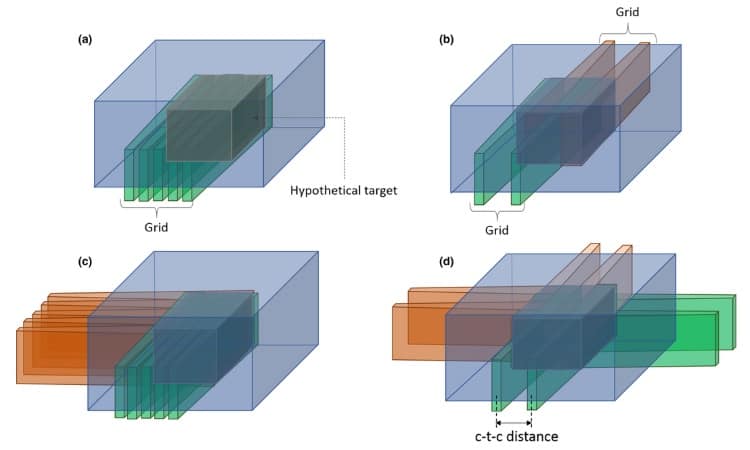
The team carried out Monte Carlo simulations for a 2-cm cubic target located in the centre of a 20-cm cubic water phantom. The target was irradiated with spread-out Bragg peaks with four different grid arrangements, ranging from a single grid to an orthogonal “crossfiring” of two pairs of opposed, interlaced grids.
The investigated grid arrangements
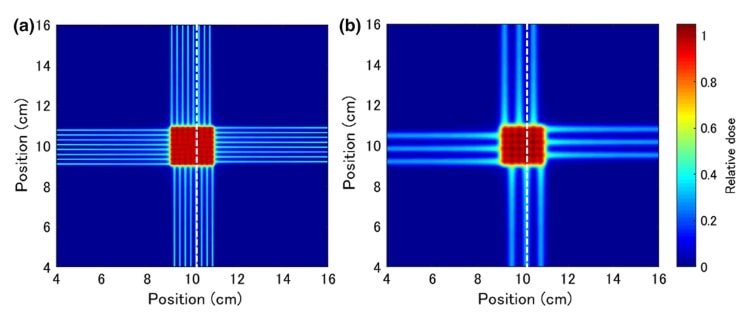
Using a single grid, the researchers found that spacings of 1.0 mm (0.5 mm beamlet) and 3.2 mm (3 mm beamlet) that achieved uniform target coverage provided minimal dose sparing close to the target. For example, 5 mm from the target, VPDR values exceeded 0.9.
In contrast, the four-grid arrangement resulted in significantly lower doses outside the target. Here, uniform target coverage was achievable using greater spacings of 2.4 and 6.4 mm, for the 0.5 and 3 mm beamlets respectively. They resulted in VPDR values of 0.22-0.24 near the target.
Simulated 2D-dose distributions
Based on their findings, Tsubouchi and his collaborators are developing the technique further. “From a theoretical point of view, we are pretty confident,” said Alexander Valdman, co-author and radiation oncologist at Karolinska University Hospital in Stockholm. “We know that we can deliver a safe dose to the target while maintaining the grid pattern down to the target and preserving the tissue.”
In the first instance, the authors see brain tumour cases not cured by conventional radiotherapy as the cohort most likely to benefit from a clinical trial. Here, critical structures in the brain are likely to have already received a significant dose, contra-indicating additional, conventional treatment. Fixed intracranial anatomy and immobilization that minimize geometric uncertainties would also make accurate grid placement less challenging. “This is where grid therapy could really shine,” said Siegbahn.
In ongoing work, the authors are investigating the physical implementation of carbon ion grid therapy in experiments. The researchers are also developing ways to evaluate and compare carbon ion grid therapy with conventional treatments.
Delay in slowing rising sea levels is dangerous. Each five-year delay in limiting global carbon emissions into the atmosphere now will increase sea level rise for the next three centuries.
This warning is based on computer models of global warming and sea level rise – but a second study based on very precise measurements over the last 25 years confirms that the models are reliable – and that sea level rise is already accelerating.
As sea levels rise, then so does the level of storm damage to coasts and coastal cities: a recent study of the coast of South Carolina warns that financial losses caused by hurricanes could rise by 70% by 2100.
And, for the doubters, a fourth piece of research delivers the ultimate in hard evidence: winter storms off the Irish coast have shifted boulders that weigh up to 620 tons (630 metric tonnes) and hurled smaller boulders of up to 100 tons far above the high tide mark.
German scientists report in the journal Nature Communications that they started from the premise that sea level rise must happen in decades to come because of fossil fuels already burned, to release ever greater proportions of greenhouse gases into the atmosphere.
In Paris in 2015, 195 nations vowed to contain climate change and reduce emissions. At some point, these emissions must peak and start to fall. The question then becomes: does it make a difference if this peak comes a little later in the century?
It does. Climate scientists can’t be sure how much sea level rise is in the pipeline – by 2300, sea levels could be 3 metres higher than today – but they can be sure that any delay will be expensive.
“Every delay in peaking emissions by five years between 2020 and 2035 could mean an additional 20 cm of sea level rise in the end,” said Matthias Mengel from the Potsdam Institute for Climate Impact Research.
And his co-author Carl-Friedrich Schleussner said: “The Paris Agreement calls for emissions to peak as soon as possible. This might sound like a hollow phrase to some, but our results show that there are quantifiable consequences of delaying action.”
Global sea level rise has not been steadily increasing: it has been accelerating. US researchers report in the Proceedings of the National Academy of Sciences that they examined 25 years of satellite data to find that the water lapping at the world’s coasts is rising, and the rate of rise is getting faster, as the ice caps in Greenland and Antarctica start to melt at a greater rate.
By 2100, on present evidence, the sea will have risen 65 cm. “That is almost certainly a conservative estimate,” said Steve Nerem, of the University of Colorado Boulder, and a member of the US space agency NASA’s sea level change team.
Conservative assumption
“Our extrapolation assumes that sea level continues to change in the future as it has over the last 25 years. Given the large changes we are seeing in the ice sheets today, that is unlikely.”
This is intellectual territory already well explored: researchers have repeatedly established that sea level rise is increasing; that the cost to human society will be enormous; and that with the combination of rising temperatures and higher tides, more destructive superstorms are all but inevitable.
Engineers in the US decided to try to put a more precise cost to come of these yet-to-happen superstorms. They report in the journal Sustainable and Resilient Infrastructure that they used climate models to simulate hurricane size, intensity, track and landfall locations for 13 coastal counties in South Carolina, under two scenarios.
One scenario presumed that ocean temperatures remained unchanged between 2005 and 2100. The other assumed that they would warm in line with climate predictions in a worst-case state, one in which humans went on burning fossil fuels at an ever-increasing rate.
They found that in the first scenario, a once-in-25-years hurricane would cause $7bn worth of damage in the area. But if oceans continue to warm, this damage rose to a notional $12bn.
These outcomes were based on computer models. But another research team in the US has delivered down-to-earth evidence of what storms really can do.
Boulder shunters
They report in the journal Earth-Science Reviews that they surveyed 100 sites in western Ireland, after the winter storms of 2013-2014, and documented the displacement of 1153 boulders.
They had been studying the coast for years and they knew where 374 of these boulders had come from, so they could also pace out the distance each was displaced.
One of these mobile masses was almost 240 cubic metres and weighed 620 tons. That is the equivalent of six blue whales. The second largest weighed 475 tons. Some smaller boulders had been shunted 222 metres inland, and 26 metres above high water.
Such scholarship is more than academic. Around 40% of the people on the planet live by the sea. Engineers, coastal scientists and city authorities need to know what storm waters can do.
“Now that we know what storm waves are capable of, we have much more information for policy makers who are responsible for preparing coastal communities for the impact of high energy storms,” said Rónadh Cox, a geoscientist at Williams College, Williamstown in Massachusetts.