An image of a single positively-charged strontium atom that is held in an ion trap by electric fields has won a national science photography competition organised by the UK’s Engineering and Physical Sciences Research Council (EPSRC).
Taken by PhD student David Nadlinger, from the University of Oxford, the image shows the light emitted from the atom when it absorbs the light from a laser tuned to a specific frequency. The picture was taken through a window of the ultra-high vacuum chamber that houses the ion trap.
“The idea of being able to see a single atom with the naked eye had struck me as a wonderfully direct and visceral bridge between the minuscule quantum world and our macroscopic reality,” says Nadlinger. “When I set off to the lab with camera and tripods one quiet Sunday afternoon, I was rewarded with this particular picture of a small, pale blue dot.”
Moving onto space, the successful launch of Space X‘s Falcon Heavy rocket last week resulted in a Tesla Roadster (formally owned by SpaceX boss Elon Musk) in orbit around the Sun. Used only as a test mass, the car featured a spacesuit-clad mannequin called “Starman” in the driver’s seat.
Physicists in Canada and the Czech Republic have now performed simulations to determine the fate of the Tesla and Starman. They estimate that the first close encounter with Earth will come in 2091 with the probability of a collision with either Earth or Venus in the next million years being 6% and 2.5%, respectively.
Courtesy: Ellie White
From space to climate change. At first sight the image on the right might look like a simple rug that could adorn your lounge. Yet the eagle-eyed among you might be able to spot a certain trend. That is because the stitching shows how warm the planet has become in recent years.
Each row in the cross stitch represents a year running from 1880 (top row) to 2017 at the other end. The colour signifies the average temperature for that year based on the deviation from the historical average (in white), which is the temperature from 1900 to 2000.
It was created by Ellie White, a graduate student in civil engineering at the University of California, Davis, who is now planning to release a kit with instructions.
And finally, make sure you have a go at this fun quiz by the Perimeter Institute – Are you a quantum mechanic? Avid readers of Physics World should be able to get Q9 correct.
Three new studies of how the world works show that seabird excrement plays an unexpected role, as do polar algae and rotting trees.
The world’s seabirds don’t just live off the land, they also nourish it: their excrement delivers 591,000 tons of nitrogen and 99,000 tons of phosphorus to feed plant communities in the soil and the water.
One polar plant community that happens to be flourishing is now to be found on the surface of Greenland’s icecap: green things are growing so well they are darkening the surface, which then reflects less light and absorbs more warmth. This algal darkening could be responsible for at least 5%, and possibly 10%, of the island’s total ice melt each summer.
And although the Arctic tundra wetlands are known to deliver between 16 and 27 million tons of methane to the atmosphere every year, they have unexpected competition in the natural greenhouse gas emission stakes.
New research reveals that the Amazon floodplain’s rainforest itself – most frequently thought of as a carbon sink for the planet – releases up to 21 million tons of methane to the atmosphere each year. This is more methane from one forest than from all the world’s oceans.
This catalogue of unexpected information has been made available by geographers, climate scientists and biologists involved in global warming research: each finding is confirmation that the planet must be considered as an intricate economic system, involving a continuous traffic between plants, animals, oceans, icecaps, atmosphere and the rocky surfaces of the continents. It also confirms that the accounting of these exchanges is still incomplete.
Ironic discovery
The irony is that in the process of trying to understand the climate change that poses a potential threat to human civilisations, humans now know their planet better than ever before.
But each individual bit of research confirms that there is still some way to go before the picture is complete. US scientists two years ago confirmed that ammonia from the guano left behind by breeding seabirds in the Arctic played a role in cloud droplet formation, which in turn reflected sunlight to keep the Arctic cool.
But Spanish and Mexican scientists wanted to know more. They report in Nature Communications that the 320 species of the world’s seabirds probably add up to 1,045 million individual birds, including 804 million breeding birds and their chicks.
Seabirds – gulls, penguins, puffins, guillemots, auks, albatrosses, shearwaters, fulmars, cormorants and so on – tend to nest in colonies, leaving over many millennia deposits of guano so rich and thick that in the 19th century nations fought over this agricultural resource.
Ten species, they found, contributed more than 60% of the nitrogen and phosphorus, two elements essential to all life. These contributors might not be the most numerous: the five penguin species and four albatrosses – big birds that spent long periods in their colonies – were the biggest contributors per individual.
The nitrogen gets from the colonies to coastal waters to increase primary plant life. So what the study’s authors daintily call “ornitheutrophication” has, they say, “geochemical and environmental relevance on a global scale.”
European and US scientists who looked at the mysterious darkening of the Greenland snows each summer were concerned with environmental relevance: Greenland is host to so much ice that, were it all to melt, sea levels would rise by seven metres, to drown most of the world’s coastal cities.
They report in Geophysical Research Letters that algae grow naturally on the ice surface, to darken the sheet, even more effectively than black carbon and dust linked to wildfires further south.
They used instruments every day over a 56-day period to confirm that the ice sheet reflected significantly less light as the algae grew. They also concluded that algal growth was responsible for 70% of the variance in the ice sheet’s albedo (the climate scientist’s term for the capacity of land, ice or water to reflect solar radiation).
More growth
“As the climate warms, the area that the algae can grow in will expand, so they’ll colonise more of the ice sheet,” said Marek Stibal, an ecologist at Charles University in Prague, who led the research.
“Additionally, the growing season will lengthen, so the contribution of algae to melting of the ice will probably increase over time.”
British, Brazilian, Canadian and US scientists report in the journal Nature that they monitored methane flow from the stems of 2,357 individual trees at 13 locations on the Amazon floodplain.
Methane – sometimes called marsh gas – is a natural greenhouse gas linked to decomposing vegetation, and is around 34 times more powerful than carbon dioxide at trapping atmospheric heat.
Mosaic of measurement
The scientists found that methane release from the Amazon trees was 200 times that from temperate wet forests and tropical peat swamp woodlands.
This finding, like the evidence from sea bird nutrients and glacial algae, represented yet another piece in the mosaic of meticulous measurements that provide the basis for a better understanding of how climate works.
“We are not, in any way, saying that trees are bad for the environment – this is how natural forests function. We now have a fuller picture of the sources of greenhouse gas emissions and this could help to inform how environmental change can have a knock-on effect on the tropical wetland methane source,” said Sunitha Pangala, then at the Open University but now at the University of Lancaster in the UK, who carried out the study.
“Emissions from these Amazon trees are still only half as much as those created by humans in the form of landfill and waste, so we should be targeting reductions in human emissions.”– Climate News Network
Atomically thin graphene drumheads can vibrate at very high temperatures of over 900°C, which is the highest operating temperature ever reported for such electromechanical resonators. The structures could be used to make nanoelectromechanical systems (NEMS) for a variety of sensing, signal processing and communications applications that would work in harsh or extreme environments.
Graphene drums are made of 2D sheets of carbon that resonate at a certain frequency. In this new work, by Philip Feng and colleagues at Case Western University in Cleveland, Ohio, they are only one to three atomic layers thick with a diameter of between 3 and 5 microns.
The researchers made their devices using a simple dry-transfer technique to align and deposit these atomic layers onto pre-patterned microcavities on semiconductor chips. They also dry-transferred thick and highly conductive graphite flakes to act as bridging interconnects between the atomic-layer graphene and lithographically patterned metal electrodes on the chips. These electrodes make for high-quality electrical contacts, important for subsequently electrothermally tuning the devices.
Operating temperature as high as silicon carbide devices
Feng’s team made the graphene membranes resonate by applying an AC voltage and heated them up by applying a DC bias voltage. This electrothermal technique increases the temperature of the membranes via Joule heating.
“The membranes can vibrate at temperatures of over 900°C (which is the temperature at which graphene can be synthesised in a furnace by chemical vapour deposition),” explains Feng. “This is the highest operating temperature ever reported for an electromechanical resonator and is comparable to that recorded for silicon carbide electronic devices (800–900°), made by researchers at NASA’s Glenn Research Center.”
Negative thermal expansion coefficient
According to the researchers, such high-temperature resonance comes from the fact that graphene has a negative thermal expansion coefficient. This means that the material shrinks when heated, unlike conventional materials that expand.
“As well as this unusual property, it also has an exceptionally high thermal conductivity (comparable to that of diamond, which is the best thermally conductive solid known),” Feng tells nanotechweb.org. “The material can be strained by up to 25% of its original surface area too before it fractures, which also helps.”
And that is not all: the resonator’s quality factors also significantly increase with temperature.
“Our work shows that graphene resonators could be used to make electrically tuneable, voltage-controlled nanoscale electromechanical oscillators,” says Feng. “Applications include sensors and transducers that would work at very high temperatures and in harsh or extreme environments.”
Researchers from Canada have developed a new augmented reality software that uses a motion-tracking device to display patients’ medical images – such as from CT or MRI exams – directly onto their body, even as they move.
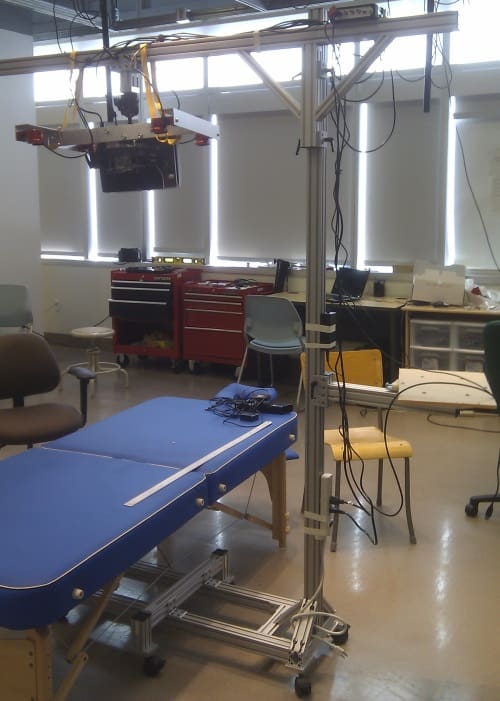
Referred to as ProjectDR, the working prototype of the motion-tracking device consists of infrared cameras, a projector and markers placed on fixed areas of the patient’s body. Once images are obtained and the device is set up, the software automatically tracks the patient’s position and projects the images accordingly.
“People naturally have anatomical variations, so having a means of viewing the patients’ data directly on their body gives the clinician a lot more context to work with,” Ian Watts, who developed the software, told AuntMinnie.com. Watts is a computing science graduate student at the University of Alberta in Edmonton.
“The difference with this technology is that, whereas projectors typically project images on a flat surface, ProjectDR is able to do so on curved surfaces using a laser that keeps the image always in focus,” said Pierre Boulanger, co-supervisor of the project at the university. “And when the patient moves, the device will compensate automatically.”
‘Realistic projection’
The concept for ProjectDR arose when project co-supervisor Greg Kawchuk, noticed the frequency with which medical clinicians needed to press and palpate on the body of patients during physical rehabilitation. Chiropractors, in particular, regularly pushed and prodded select areas on patients while attempting to define exact locations for treatment.
The device set-up
To facilitate chiropractic training, the researchers began developing software to help guide finger movement via projections onto the patient’s body. While working on this project, they realized that their idea could also be beneficial in the operating room – especially for laparoscopic surgeries.
“We understood how difficult it could be in the operating room even for clinicians to know the precise location of parts underneath the skin,” Boulanger said. “We believed that a realistic projection of images onto the patient could help the entire surgical team be able to see what’s going on.”
The main components of ProjectDR are a projector, infrared cameras (OptiTrack, NaturalPoint) and round markers (0.2 cm to 1.0 cm in size) that are covered with paint capable of reflecting infrared light. The projector and cameras are situated around the area the patient would be, such as an examination table, and the markers are attached to easily identifiable anatomical landmarks on the patient.
Once the device is set up and the markers placed, the researchers’ proprietary software is able to automatically track the patient’s movements and project his or her internal anatomy onto the appropriate part of the body for 3D visualization.
For proper calibration of the augmented reality images, the patient needs to have a few markers affixed to predetermined anatomical landmarks on the body during image acquisition. The location of the markers is recorded on the images, and the software is thus able to align the images with markers on the patient’s body during projection.
Furthermore, ProjectDR can display any type of image that is saved in DICOM format and then loaded into the computer software, Watts said. Once uploaded, the images undergo volume rendering for 3D volume reconstruction, as well as transfer-function editing for opacity enhancement and colour application.
“ProjectDR also has the capacity to present segmented images – for example, only the lungs or only the blood vessels – depending on what a clinician is interested in seeing,” he said.
Boundless applications
“This projected augmented reality provides a common perspective that is not tied to an individual point of view, which can be used by others such as a surgical team,” Boulanger said. “The software can easily function with other display technology and has many potential applications including in education, surgical planning, laparoscopic surgery and entertainment.”
Surgical planning is currently the most practical application due to its interactive nature and because planning doesn’t need to be quite as precise as actual surgery, he said. A prime example is preparing for breast reconstruction surgery; surgeons can use the augmented reality projection to compare possible changes to the breast before deciding how they would like to modify it.
For minimally invasive or image-guided surgeries, using ProjectDR could allow clinicians to look straight at a point of interest with a kind of “X-ray vision,” instead of having to refer to a screen, he noted. They could also track the entry point of an endoscopic tool and see it as a graphic as it enters the patient’s body.
Watts and colleagues have been working on improving various technical aspects of ProjectDR to make it suitable for testing with these types of procedures as well as for eventual commercialization. Their first priority is fine-tuning the device’s ability to automatically calibrate the augmented reality images to the patient’s body. They hope to move toward depth-based registration for alignment, as opposed to the anatomical landmark-based method currently in use.
“After completing necessary adjustments [to ProjectDR], we will conduct a pilot study later this year to test the viability of ProjectDR for teaching chiropractic and physical therapy procedures, as well as evaluate several of its real-life surgical applications in a surgical simulation laboratory,” Boulanger said. “Testing has been limited to a mannequin so far.”
We’re often told that with age comes wisdom. Unfortunately, this virtue also comes hand-in-hand with various downsides, notably our bodies no longer functioning as they used to (as much as we may not want to admit it). And as we reach middle age and lose count of the grey hairs, there is the inevitable prospect of having to put on a pair of glasses.
Over the course of your life, it becomes ever harder to focus on objects closer to you because the crystalline lens in the human eye becomes more rigid. This means the lens can no longer change shape as readily as it used to, so cannot focus on nearby objects – to use the technical term, the lens can’t “accommodate”. This condition, known formally as presbyopia and informally as not-having-arms-long-enough-to-hold-text-far-enough-away-to-see-properly, affects everybody over the age of 50. A few people don’t think it has affected them, but in truth their distance vision was already imperfect and presbyopia just makes everything a little bit better.
But imagine if we could magically get rid of these vision problems and you never had to wear glasses again? Is there a way to restore the vision of your youth so it is no longer a thing of the past?
Imperfect solutions
There are several existing solutions for presbyopia, but all are compromises and none fully restores youthful vision. The most common approach is to use spectacles with different focal regions, known as bifocals or varifocals. The spectacle lenses are shaped differently in the regions associated with distance compared to those linked with reading, thereby forming different focal lengths.
Bifocal contact lenses also exist and, as with glasses, these work by having different focal regions in different parts of the lens. Selecting the right part of the contact lens relies on the brain distinguishing between in-focus and out-of-focus images, together with the pupil generally being smaller in conditions where we read. This clever solution works well for some people, but it is, again, a compromise.
In particular, reading in the dark is a problem with bifocal contact lenses. That’s because when it’s dark, your pupil is wide open to try and let in as much light as possible. But the dilation of the pupil exposes the outer edges of the contact lenses – the parts usually associated with focusing on distant objects. There’s also a lack of contrast as not all of the light passing through the lens is focused on a single image, making it difficult to distinguish small text.
Another common solution is so-called “monovision”. This corrects one eye for good distance vision and the other for good near vision and can be done via contact lenses or laser surgery. Once again, however, this solution doesn’t work for everyone as some people feel disoriented by having different foci associated with each eye and the approach falls short of restoring our vision to that of our youth.
We’re working on another possible solution. The aim is to develop liquid-crystal contact lenses with variable focus. Our team, which we set up a few years ago with staff at the UK-based firm Ultravision, brings together optometrists and experts in optics and liquid crystals. We wanted to see if liquid crystals could be used to make “switchable” contact lenses by virtue of them having a refractive index that varies with applied voltage. At first glance, our approach may seem more rooted in science fiction than reality, but we believe it could offer the eyesight of youth to older generations.
From TVs to eyes
Nowadays, liquid crystals are a massive part of everyday life, as they are used in the flat-panel liquid-crystal displays (LCDs) of billions of mobile phones, televisions and laptops. These fascinating “soft” materials are characterized by the fact they are ordered fluids. There are many variants of liquid crystal because there are many ways of achieving order in a fluid, but it’s the so-called “nematic phase” used in LCDs that is of interest to us.
The molecules that form nematic liquid crystals are usually rod-like and orientated such that their long axes point, on average, in the same direction – this is defined by a unit vector called the “director”. Liquid crystals have long-range orientational order, so many of a nematic liquid crystal’s physical properties, such as its refractive index, are anisotropic, which means that the value of those properties varies from one region to another, depending on the local value of the director.
But because liquid crystals are fluids, the director is extremely responsive to external stimuli, such as electric and magnetic fields, temperature and pressure. Applying a voltage above a particular value, for example, orients the director either parallel or perpendicular to the electric field’s direction, depending on whether the dielectric anisotropy is positive or negative respectively. As the system’s optic axis (i.e. the direction of optical symmetry) is defined by the director, it also reacts to the applied voltage. These are the properties any LCD devices rely upon.
Eye on the challenge
Based on the voltage-dependent refractive index, researchers have been suggesting liquid-crystal lenses since the 1970s. But making a liquid-crystal contact lens that can be placed on the eye is not easy. The overall device must be curved and less than 300 µm thick – anything chunkier would not be comfortable to wear. The change in focus must be around +2.0 dioptres, which is the measure of focus in optometry; most people with presbyopia need an additional +1.5 or +2.0 dioptres. The lens needs to change focus faster than the eye can blink, meaning less than a second in practice. Ideally, it shouldn’t be too expensive either, which means that a simple manufacturing process is important. And, somehow, the lens needs to have a source of power so it can change focus. Indeed, to make a device that stands a chance of being used in the eye, it’s important that the lens can stay powered for at least a day.
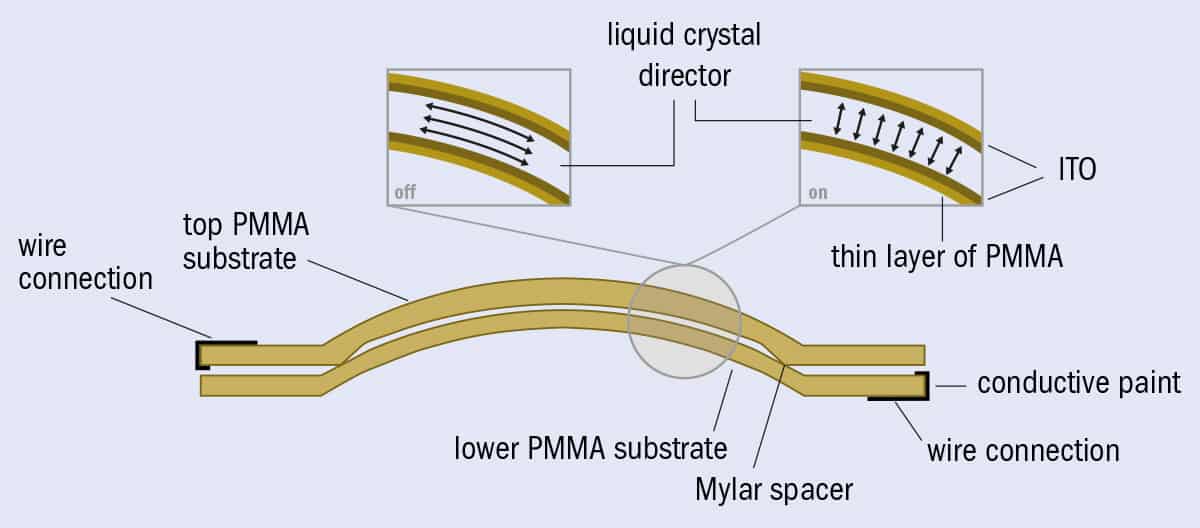
We decided to use polymethylmethacrylate (PMMA) as the base for the lens as this is a material commonly used for contact lenses. We then came up with a simple – and in our view elegant – solution based around “balanced optics”. It involved forming a contact lens with three layers (figure 1), each of which is a lens in its own right. The bottom layer, a substrate of PMMA, follows the curvature of the eye and is coated on the surface adjacent to the liquid crystal with a transparent indium-tin-oxide (ITO) electrode and a polymer that aligns the liquid crystal when in the “off” state. Next comes the liquid-crystal layer, topped with another layer of ITO-coated PMMA. Together, these three lenses are balanced. Their curvature, the PMMA refractive index and the “off”-state refractive index of the liquid crystal are designed to provide either no vision correction or distance vision correction, depending on what is needed by the individual. When a voltage is applied, producing an electric field across the electrodes, the refractive index of the liquid-crystal layer changes (by an amount that depends on the voltage, the lens geometry and the liquid-crystal material). As a result, the focal power of the lens changes too.
1. Layered lenses
We have now demonstrated several geometries with different kinds of liquid-crystal alignment, all of which rely on the liquid-crystal refractive index changing between ~1.5 and ~1.7. This switching starts at voltages as low as ~0.7 Vrms, which at the moment is simply applied with wires attached to the electrodes. The response time is well under 1 s. Our design allows us to do better than mimic putting on reading glasses that give a change of ~2.0 dioptres, while also variably changing the focus so that we can correct for intermediate vision too (e.g. for viewing a computer screen).
One potential drawback of using a liquid crystal is related to its anisotropy. We need the property of having two refractive indices (birefringence) to achieve a voltage-dependent refractive index – but unless we design our lens carefully, the focusing power would depend on the polarization of the light and so would suffer from similar drawbacks as some of the other technologies. The problem is that the refractive index experienced is also polarization-dependent (remember it is polarized light that interacts with the liquid-crystal layer in an LCD). Our solution has been to develop a lens with two chambers for the liquid crystal, oriented orthogonally with respect to each other, to ensure that the whole lens operation is polarization-independent.
Ever closer future
Although a switchable spectacle lens is far easier to make and power, using liquid-crystal contact lenses has many advantages. First, we can ignore any chromatic aberration in the contact lens, which is caused by the fact that the refractive index in any material is wavelength-dependent and leads to different wavelengths being focused at slightly different points. That’s because the aberration in the lens is less than the aberration of the cornea and the brain just sorts it out. Second, we don’t need to be concerned about off-axis rays that would experience a different focus because of the liquid-crystal geometry. Again, the contact-lens geometry helps as it restricts vision to mostly the axis of the lens.
There are still some challenges to be overcome before we get close to a commercial switchable contact lens. The first is to determine how the lens will be powered. One reason LCDs are so successful is that they are inherently low-power devices, meaning they can run for a long time on a small battery. This helps us, as there are several possible solutions to powering the lens. Indeed, we have a strong patent in the area of liquid-crystal contact lenses and our first investment will allow us to make an eye-ready wireless lens that has the power source on the lens itself.
Another major challenge is how the lens will know when to change the refractive index. The simplest way to do this is to have the lenses communicating with, say, a smart watch. However, many other possible control mechanisms have been proposed, for example blinking. Of course, in such a case, a longer than normal blink would be needed, or perhaps a specific sequence of blinks.
It might still seem like science fiction to have batteries or other power technologies mounted on a contact lens, but a contact lens containing a light-emitting diode powered from an induction coil was demonstrated a few years ago (J. Micromech. Microeng.21 125014). There are several other examples of “smart contact lenses” including ones containing glucose sensors for monitoring diabetes, such as that announced by Google in 2014. The challenge of powering such devices is a hot topic, with wide-ranging suggestions including one where the lenses might be powered by tears. There is also increasingly simple technology that could be used to trigger the change in focus – something that users would want to be simple and, if possible, automatic.
As all of these technologies come together, contact lenses that have variable and controllable focus are no longer science fiction – but could become reality within the next five years.
Inside an LCD
Liquid-crystal displays (LCDs) contain a thin film of a nematic liquid crystal roughly 5 µm thick, held between two transparent electrodes, which are themselves sandwiched between two polarizers. The liquid crystal molecules have a specific geometry depending on the type of device, but in the most common arrangement, known as a “twisted nematic” device, the “director” – the average direction in which the nematic liquid-crystal molecules point – is aligned to the polarizers, which are at 90° to each other. This means the director rotates through an angle of 90° across the layer. In the absence of an electric field (E), unpolarized light becomes polarized as it enters the LCD. Its axis of polarization gets rotated 90° by the liquid crystal and the light then passes through the second polarizer, causing a bright state. When a sufficiently large electric field is applied across the electrodes, however, the liquid-crystal molecules align perpendicular to the plane of the device, changing its effective refractive index and suppressing the twisted arrangement. The light therefore gets completely absorbed by the second (crossed) polarizer, creating a dark state.
An optical imaging system developed by researchers at Columbia University can identify breast cancer patients who are responding to neoadjuvant chemotherapy. The team found that analysing the increase and decrease in blood concentrations inside a tumour could help determine which patients would respond, as early as two weeks after starting treatment (Radiology 10.1148/radiol.2018161041).
Neoadjuvant chemotherapy is used to treat some women with invasive, but operable, breast cancer. The treatment is given for five to six months before surgery to eliminate active cancer cells. Patients who achieve a complete response have a lower risk of cancer recurrence than those who do not; however, this occurs in fewer than half of women treated. Knowing early on that a patient is not going to respond could allow changes in their treatment regime, thereby avoiding unnecessary side effects.
Breast tumours have a denser blood vessel network than found in healthy breast tissue. Chemotherapy drugs kill cancer cells, but they also affect the vasculature inside the tumour. As blood is a strong absorber of light, the researchers designed a diffuse optical tomography (DOT) system that uses near-infrared light to visualize blood flow in the breasts and observe how the vasculature changes.
In a first pilot study, the researchers used the dynamic DOT system to image patients with invasive breast cancer, before and two weeks into chemotherapy. The system captured a series of 3D images of both breasts simultaneously, without requiring breast compression. They recorded images during a breath hold of at least 15 seconds, which inhibited the backflow of blood through the veins but not the inflow through the arteries. Additional images were captured after the breath was released, allowing blood to flow out of the veins in the breasts.
The researchers analysed images from 34 patients, and compared the imaging data with patient outcomes after five months of chemotherapy. They found various blood flow parameters that could be used to distinguish between responders and non-responders. For example, the rate of blood outflow could correctly identify responders in 92.3% of patients, while the initial increase of blood concentration inside the tumour could identify non-responders in 90.5% of patients.
“There is currently no method that can predict treatment outcome of chemotherapy early on in treatment, so this is a major advance,” explained Andreas Hielscher, co-leader of the study. “This helps us distinguish malignant from healthy tissue and tells us how the tumour is responding to chemotherapy earlier than other imaging techniques can.”
The researchers are currently refining and optimizing the imaging system and planning a larger, multicentre clinical trial. They hope to commercialize their technology in the next three to five years. “If we can confirm these results in the larger study that we are planning to begin soon, this imaging system may allow us to personalize breast cancer treatment and offer the treatment that is most likely to benefit individual patients,” said Dawn Hershman, co-leader of the study.
The extracellular matrix is an organized network of fibres that acts as a support structure to cells and directly influences their behaviour. The interaction between a cell and the extracellular matrix is crucial to tissue-specific cell behaviour. Indeed, scientists have manipulated this cell-matrix relationship by using biomaterials to create environments that can facilitate cell growth, to create tissue for research or transplantation purposes.
The use of human stem cells presents exciting opportunities for tissue engineering. Pluripotent stem cells enable the growth of multiple different cell types, which contain the same genetic code as the person from whom the cells were originally extracted. Stem cells can be directed to grow into a certain cell type by selecting an appropriate extracellular environment – through specialized materials – to provide physical cues that direct growth. Hydrogels are commonly used due to their biocompatibility and tuneable physical properties.
Researchers from the University of Akron have studied the effect of different extracellular environments on promoting differentiation of neural stem cells into neurons (Biomed. Mater.13 024102). They performed the investigation by using hydrogels with different physical properties, i.e. stiffness and cell binding domains.
The researchers found that neuronal differentiation was promoted when cells were grown on soft surfaces, with a stiffness of 0.1–0.8 kPa being favourable over 4.2–7.9 kPa. In addition, they observed an increased expression of a key neuron protein marker (β-III tubulin), as well as significantly increased neurite growth, in the softer hydrogels (0.1 and 0.8 kPa). The stiffer hydrogels, on the other hand, promoted glial cell differentiation instead of neuronal.
On top of investigating the effect of stiffness on neural stem cell differentiation, the researchers also studied the impact of physical binding of cells to their surrounding environment on differentiation. They established that the amount of binding sites available to cells is important – with differing levels affecting neural differentiation – but not as important as the physical stiffness of the extracellular environment.
To investigate binding, the researchers introduced a specific peptide sequence, Arg-Gly-Asp (RGD), to the synthetic hydrogel used in this study. RGD is a peptide sequence present in multiple biopolymers of the extracellular matrix – fibronectin and collagen, for example. It enables cell binding through multiple integrin receptors at the surface of cells.
This study echoes seminal papers exhibiting that a physical stiffness of below 1 kPa is favourable for neuronal differentiation from stem cells, while stiffness above1 kPa promotes glial cell formation. It builds on previous work by establishing that a small difference in stiffness can switch the lineage of neural stem cells from neuronal to glial, with previous investigations having only tested 1 and 10 kPa hydrogels for neuronal and glial growth.
This research presents a general guideline for differentiating neural stem cells to neuronal cells, which will aid engineering of brain tissue in future. This information could be manipulated to create multicellular brain constructs from patient stem cells, potentially creating translational and stratified models for medical research in the lab. The authors suggest that an interesting progression from their study would be to investigate the cell-to-cell communication and interactions within the neural stem cell niche, as opposed to the cell-to-extracellular interactions exhibited here.
One of America’s leading research-funding agencies has announced new steps to eliminate sexual harassment and similar transgressions in science and engineering. Responding to increasing reports of sexual misconduct by individual grantees and in institutions that employ them, the National Science Foundation (NSF) will now require that every grantee organization report cases of sexual harassment. The agency will also update its web resources on harassment policies and has clarified how NSF employees should report and handle complaints of sexual harassment.
France Córdova, NSF director, outlined the steps in a letter to presidents of universities and colleges, and the heads of other grant-receiving organizations. “NSF is committed to promoting safe, productive research and education environments for current and future scientists and engineers,” Córdova wrote. “The Principal investigator (PI) and co-PI and all grant personnel must comport themselves in a responsible and accountable manner, including during the performance of award activities conducted outside the organizations, such as field sites or facilities, or during conferences and workshops.”
Community effort
The NSF policy comes at a time of increased concern about sexual harassment, which has also hit the scientific community. Dartmouth University, for example, recently put three psychology professors – and recipients of NSF grants – on paid leave pending the results of a criminal probe into sexual misconduct. In February, the NSF removed Boston University geologist David Marchant as a PI of a grant following charges – which Marchant denies – that he had sexually harassed graduate students during field studies in Antarctica two decades ago.
The upgraded NSF policy now requires that grantee organization’s report findings of sexual harassment, or any other kind of harassment regarding a PI, co-PI or any other grant personnel. It also expects all grant-receiving organizations to establish and maintain clear and unambiguous standards of behaviour to ensure harassment-free workplaces. Finally, the policy requires NSF’s Office of Diversity and Inclusion to ensure that NSF-funded programmes and projects are free of discrimination.
“NSF is working to make certain that awardee organizations respond promptly and appropriately to instances of sexual and other forms of harassment,” says Córdova. “A community effort is essential to eliminate sexual and other harassment in science and to build scientific workspaces where people learn, grow and thrive.”
Rapid expansion of coal power plants in Turkey, Indonesia and Vietnam – climate targets need active policy.
While fewer new coal-fired power plants are now being built in China and India, the planned expansion in the use of coal in fast-growing emerging economies, such as Turkey, Indonesia and Vietnam, will in part cancel out the reduction. Only if the countries of the world actively counteract this trend, they can achieve the climate goals agreed in the Paris Agreement.
These are the results of the study “Reports of coal’s terminal decline may be exaggerated,” by researchers from the Mercator Research Institute on Global Commons and Climate Change (MCC) and the Potsdam Institute on Climate Impact Research (PIK), published in the journal Environmental Research Letters.
“The coal problem is by no means self-defeating, despite all the advances in renewable energy. If the international community wants to achieve its greenhouse gas emission reduction goals to avoid the greatest climate risks, then it must act decisively,” said MCC Director Ottmar Edenhofer, who is also Chief Economist at PIK.
“It would take a coal exit, worldwide. The best way to do this is, from an economic point of view, a substantial carbon pricing. It may look different from one country to another, but a coalition of pioneers should do the first step – this very decade. ”
In 2016, China and India have each cancelled more than 50 percent of their plans to build new coal-fired power plants, according to the study. However, globally coal investments are further increasing. Turkey, Indonesia and Vietnam, for example, plan to increase their capacity altogether by about 160 gigawatts altogether. This is about as much as the output of all existing coal-fired plants in the 28 EU countries.
In addition, other countries’ planned future investments in coal have been massively extended in 2016. Investment plans in Egypt, for example, have increased almost eightfold, while they have nearly doubled in Pakistan. These developments jeopardize countries’ ability to meet their Nationally Determined Contributions (NDCs), as CO2 emissions from coal-fired power plants would increase almost tenfold from 2012 to 2030 in Vietnam, for example, and almost quadruple in Turkey.
“It is true that China has recently invested less in coal and has perhaps even passed its peak in carbon emissions,” said Edenhofer. “This has rightly received a lot of attention – but to speak of the end of coal is premature. Recent data also show that China is increasingly investing in coal-fired power plants abroad.”
If current plans are implemented, emissions from coal would nearly exhaust the remaining global carbon budget, which is determined by the Paris Agreement’s target to limit global warming to less than two degrees Celsius. According to the International Panel on Climate Change (IPCC), if the world wants to likely stay below the two-degree threshold, it may only release another estimated 700 to 800 gigatons (Gt) of CO2 into the atmosphere.
However, the existing infrastructure including, for example, power plants and buildings, is expected to emit about 500 Gt already if used to the end of its lifecycle. The coal-fired power plants currently under construction and those additionally planned would amount to another 150 Gt.
Under these circumstances, additional emission growth, e.g., resulting from growth within the transport sector or agriculture would then exceed the total budget. The newly published study is based on data of the US-based organisation CoalSwarm and the International Energy Agency (IEA), as well as on subsequent research by the authors.
“Although the costs of renewables have recently fallen, they still can’t compete with cheap coal in many parts of the world,” said Jan Steckel, head of the MCC working group Climate and Development.
“The financial costs for renewable energy in these countries are stagnating at a relatively high level. In order to incentivize investments in renewables, capital costs would have to be reduced by means of intelligent policies, such as the use of credit default swaps.”
The researchers advocate politically feasible solutions for a global coal exit. For example, coal could be pushed out of the energy markets by means of a roadmap to shut down coal mines, stricter power plant regulations and higher carbon prices worldwide. This could be combined with using the revenues from carbon pricing for a socially just transition of tax systems or the expansion of socially necessary infrastructure.
A new two-qubit quantum processor that is fully programmable and single electron spins that can be coherently coupled to individual microwave-frequency photons are two of the latest advances in the world of solid-state spin-based quantum computing. The breakthroughs could help in the development of large-scale spin-based processors in the future.
While classical computers store and process information as “bits” that can have one of two logic states – “0” or “1” – a quantum computer exploits the ability of quantum particles or bits (qubits) to be in a “superposition” of two or more states at the same time. Such a device could, in principle, outperform a classical computer on certain tasks, such as factoring large prime numbers and sorting large random lists, thanks to it being massively parallel.
In recent years, researchers have succeeded in making qubits from a number of solid-state materials, including semiconducting quantum dots and superconductors. Semiconductor spin qubits appear to be better for a number of reasons. For one, they last for a relatively long time before decohering (interacting with their environment). They can also be controlled electrically and can be integrated with high density on a chip.
The problem, however, is that it is still difficult to control the state of individual spin qubits and intertwine multiple qubits in a controlled way.
A complete set of operations in arbitrary combinations
A team at QuTech and the Kavli Institute of Nanoscience Delft led by Lieven Vandersypen and another led by Jason Petta at Princeton Universty have now succeeded in overcoming these problems.
Vandersypen and colleagues have made a new two-qubit device based on silicon that they can program to perform a complete set of operations in arbitrary combinations. “Such programmability means that the processor can run any algorithm the user designs and this is the idea people have in their minds of what a useful future quantum computer would look like,” explains team member and lead author of the study Thomas Watson.
A naturally “quiet” environment for qubits
The new device looks very much like a transistor, he says. “We apply control signals to metallic electrodes on a silicon chip to isolate, measure and manipulate the two electron spin qubits on the chip. As a proof of principle, we show that we can use these (electrical) control signals to run two different algorithms – the Deutsch-Jozsa algorithm (which tests whether a function is odd or even) and the Grover-search algorithm (which searches for the right answer in an unsorted set of data).”
The processor has the added advantage of being made from silicon, which provides a naturally “quiet” environment for qubits, he adds. Silicon is also the most widely used material in the semiconducting industry, so there is a great opportunity here to be able to scale up the number of qubits in our device, which would allow it to run more complex algorithms still.
Transferring information
Meanwhile, Petta’s team, which includes researchers from the University of Konstanz, has succeeded in coherently coupling a single electron spin with a single microwave-frequency photon. This has been difficult to achieve until now since spin qubits only weakly interact with their environment (a property that allows them to have a long lifetime, as mentioned).
“Such coupling is important because it allows us to transfer information from the spin qubit (which is stuck on a wafer) to a photon (which can be routed over relatively long distances on a chip),” explains Petta. “In the future, we should be able to couple any spin qubit on a processor to any other spin qubit on a processor using the photons as an information ‘link’.”
Faster than “bad” processes
The key here is for the spin to communicate with the photon in an extremely clean material system that allows for long spin coherence times, he says. “What happens naturally in most systems is that the photon leaks from its cavity, and the qubit quantum state collapses. We need to be able to couple the spin to the photon faster than the rate at which these ‘bad’ processes occur.
“In our work, we coupled silicon and superconducting niobium to couple semiconducting spin qubits to superconducting circuitry, a set up that allows us to trap the photon for a relatively long period.”
Fast spin-photon coupling rates
The operation time of such a device is slow, however, at around 0.1 seconds (which is like having a computer with a 10 Hz clock speed), explains Petta, so we sped up the interaction using a two-step process that couples the charge of the spin electron to the electric field of the photon cavity. “The spin of that same electron is coupled to its position due to a magnetic field gradient, which generates a spin-orbit interaction,” he says. “Combining the electric field coupling and spin-orbit coupling is what allows us to achieve the fast spin-photon coupling rates (of more than 10 MHz) we observed in our experiments.”
And that is not all. As well as demonstrating this spin-photon coupling, the Princeton-Konstanz researchers also found they could use light to measure the orientation of a single electron spin. “In the short term, we believe that the technology might be useful for high-fidelity readout of single quantum states,” Petta tells nanotechweb.org. “As mentioned, spin-photon coupling should also allow us to couple spins separated by large distances, and possibly even allow for chip-to-chip coupling.”
So, where next? Watson and colleagues say they will now be increasing the number of qubits in their devices and Petta’s team will couple one spin to another across a chip roughly 1 cm in size using a single microwave-frequency photon.
The research from both groups is published in Nature. Their papers are here and here.