

Quantum simulators shed new light on magnetic phase transitions

Quantum simulators that provide individual control over more than 50 interacting quantum bits (qubits) have been developed by two independent research groups in the US. The teams used their newfound computing power to discover new information about quantum phase transitions in materials. The simulators are a step towards a fully programmable quantum computer.

The quest to build quantum computers has captured the imagination of physicists worldwide. A complete set of quantum gates – the quantum equivalents of the logic gates necessary to build the processors in classical computers – has been demonstrated in several different qubit technologies including trapped ions. In principle, therefore, it should be possible to combine qubits to build a “universal quantum computer” that could be programmed to execute any quantum algorithm. However, the fidelity (reliability) of qubits and quantum gates remains too low to reliably carry out the long sequences of operations that would be necessary to create a practical quantum computer.

Quantum simulators are not universal, but instead are special-purpose machines containing arrays of quantum objects designed to simulate specific systems and provide insight into their behaviour. These are a bit like the forerunners of classical computers, which were designed to perform specific tasks such as addition and subtraction. Renato Renner of ETH Zurich in Switzerland explains that fidelity is less crucial in such machines: “In a calculation, one bit that is flipped makes the calculation completely wrong and useless,” he says, “Whereas in a simulation, a small deviation is tolerable because what I’m simulating is normally a system that is subject to noise.”

Hard to control

Several research groups have produced quantum simulators containing fewer than 20 individually controlled qubits. Other research groups have created systems with more than 100 qubits but have been unable to fully control and read them out individually. In the new research, the two teams have used different physical mediums to implement quantum simulations of magnetism in more than 50 individually controllable qubits.

Christopher Monroe and colleagues at the University of Maryland, College Park, used 53 electromagnetically trapped ions whose spins could be manipulated by a laser. This is a well-established quantum information protocol valued for the long coherence times of the qubits – where coherence time is a measure of how long quantum information will endure in a qubit before it is destroyed by external noise.

Meanwhile in Massachusetts, Mikhail Lukin and colleagues at Harvard University and the Massachusetts Institute of Technology (MIT) used 51 neutral atoms confined by sets of optical tweezers. A laser was used to excite an individual atom to a Rydberg state, which makes that atom interact strongly with other Rydberg atoms in the simulator. This is a much newer protocol developed independently by the Harvard–MIT group and researchers at l’Institut d’Optique in Paris in 2016. While the coherence times of the qubits are much shorter, interactions between qubits are much easier to control.

Phase transitions

Both groups used their systems to simulate magnetic phase transitions within ensembles of spins: Monroe’s group looked at how the spins switch from being aligned with each other to being aligned with an external field as the strength of the external field changes. “We could not predict ahead of time where’s the magic value at which the transition occurs,” says Monroe. “The problem was too hard for us to calculate on any classical computer.”

Lukin and colleagues looked at their system’s change from random ordering of the spins to various types of antiferromagnetic ordering as the distance between the atoms changed. The researchers discovered a new, stable, non-equilibrium quantum state: “If you want to discover it from scratch on a classical computer it’s very difficult to impossible,” says Lukin. “That’s why it hadn’t been discovered.”

Lukin says that, although their system can run only a limited set of algorithms, many parameters can still be programmed: “We explored several different types of quantum phase transitions,” he says, “where by programming the interactions we could change the type of phase transition, and we also explored how a system evolves if you go across a phase transition rapidly and create some non-equilibrium states of matter.” Picking up the analogy to the history of computing with a reference to the British computing genius who first conceived of a reprogrammable computer, he says, “We are now really entering the Alan Turing kind of era”.

Quantum power

Renner, who was not involved in the research, is excited: “If I remember what people said a few years ago about quantum computing, this would have been deemed completely unrealistic,” he says. “I’m really happy to see that these things are now experimentally proved.” He says that surmounting the figure of 50 individually controlled qubits is crucial: “The best classical algorithms can simulate something on the order of almost 50 qubits but then it stops…The fact that there are now 50 or a bit more than 50, really shows that the quantum technology is more powerful than the classical one.”

Christine Muschik of the University of Waterloo in Canada says that the simulators do not encode a complete set of quantum logical operations so she would consider them “textbook examples of not being quantum computers”. Nevertheless, she says, “they can still be incredibly useful”. Muschik says that researchers are working in parallel, with some focusing on absolute quantum control and others concentrating on increasing the numbers of bits. “In the future, probably, the two tracks will meet somewhere.”

The simulators are described in separate papers in Nature.
Magnesium-containing hydrogel supports bone regeneration

Alkaline metal ions like calcium (Ca2+) and magnesium (Mg2+) play a critical role during the process of bone healing. For this reason, Mg2+ and Ca2+ ions are gaining interest in tissue engineering as compounds to be delivered directly at the injury site to support bone regeneration. To meet this need, a team of researchers from The Chinese University of Hong Kong have proposed a novel hydrogel nanocomposite, which incorporates and releases Mg2+ ions with a precise degradation rate, along with a designed intake of Ca2+ ions, for local bone formation and calcification (Acta Biomaterialia 64 389).

A hydrogel design challenge

Researchers have tested different biomaterials to deliver ions at specific injury sites. Among them, hydrogels seem the most appealing for bone healing therapies. This is due to their ability to constitute bone-mimicking, three-dimensional structures that can be loaded with other fillers and injected or shaped in specific geometries.

Magnesium and calcium ions, for example, may be loaded in hydrogels, due to their active role in calcification and bone healing. Calcium intake and deposition, in fact, are fundamental mechanisms during growth and skeletal development, while Mg2+ ions have been shown to enhance cell adhesion and differentiation, along with local bone formation.

However, depending on the interaction between hydrogels and their fillers, some mixtures may be poorly stable, leading to quick degradation and uncontrolled release of fillers. This instability can be detrimental, especially if the retention and release of nanoparticles needs to meet specific requirements for clinical applications. High levels of magnesium in blood, for example, can induce muscular paralysis and hypotension, while an excessive local concentration of Mg2+ ions can cause local bone loss.

A novel design

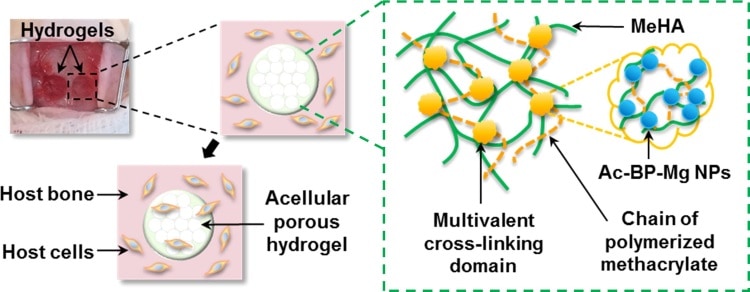
A Chinese team of researchers, led by Liming Bian, has solved this issue of instability by proposing a nanocomposite in which Mg2+ ions are linked to bisphosphonate nanoparticles (Ac-BP-Mg NPs), which in turn behave as cross-linkers between the polymer chains of a hyaluronic acid-based hydrogel (MeHA, see the zoomed region in the figure).

The proposed hydrogel design

With the aid of this design, the chemical bonds between Mg-containing nanoparticles and the hydrogel network allow nanoparticles to be physically and chemically immobilized, extending the storage time of Mg2+ ions within the network and slowing down their release over time.

Moreover, since bisphosphonates are known to prefer binding to calcium more than magnesium ions, when these hydrogels are implanted in calcium-rich environments – like a bone defect – Mg2+ ions are forced to leave the nanoparticles to be substituted by Ca2+. This creates a magnesium release/calcium deposition cascade, which stimulates bone healing and calcification, simultaneously.

Design in action

The researchers tested the novel hydrogels as two- and three-dimensional substrates for culture of human mesenchymal stem cells. They observed enhanced cell adhesion and spreading on Mg-containing hydrogels, along with osteogenic differentiation when compared with Mg-free controls.

Interestingly, they also tested Mg-containing nanocomposites as acellular implants – i.e. without containing any cells – in rat models presenting skull bone defects. The authors reported colonization by bone cells from the surrounding tissue and new bone formation eight weeks after the implantation. Considering the results, this nanocomposite offers a reliable and appealing proof-of-concept study to engineer future ion-containing hydrogels for tissue engineering applications.

Rising stars: Reggie Bain and Shannon Bayliss

Yesterday, we published interviews with materials scientist Grayson Doucette and molecular biologist Khady Sall. First up today is Reggie Bain, who recently completed his PhD in theoretical physics at Duke University. With a keen interest in science education, Reggie has recently started a teaching position at the University of Houston where he is investigating new teaching methods based on active learning techniques. He also believes that there is a growing realization among physics undergraduates that their degree can prepare them for a range of careers beyond academia.

Our second interview today is with Shannon Bayliss who is studying for a PhD in ecology and evolutionary biology at the University of Tennessee, Knoxville. Like many ecologists, Shannon developed an interest in natural science through her love of the outdoors and she is now researching the genetics underpinning drought tolerance in trees. In addition to her research, Shannon is involved in science outreach and she speaks about her experiences volunteering with a women-in-science group.

To hear more voices on the state of science in the US, take a look at the free-to-read Physics World special report on physics in the US. Share your thoughts on the current state of physics in the US by posting a comment below or joining the conversation on Twitter including our handle @PhysicsWorld.

Simple swimmer could drive tiny robots

Physicists in France have come up with a new and simple way of propelling objects through a viscous fluid. They say that the technique could someday be used to create tiny swimming robots for biological applications such as drug delivery.

Swimming micro-organisms and similarly sized micro-swimmer robots operate in a low-Reynolds number environment, in which viscous forces dominate. This puts significant limits on how a micro-organism or robot can propel itself. Swimming is a cyclical process that involves a body changing its shape in a propulsion stroke and then going back to its initial shape in a return stroke. In a high-viscosity environment, drag can cause the propulsion and return strokes to cancel each other out – the result being little or no motion.

Micro-organisms get around this problem by changing their shapes in at least two different directions. However, building micro-swimmer robots capable of such complicated motions can be challenging.

One direction

Now, Gwennou Coupier and colleagues at the University of Grenoble Alpes in France, have built a robot that can swim in a high-viscosity environment using a simple, unidirectional shape change.

Their system comprises a balloon-like sphere that is inflated and deflated by pumped air delivered through a small hose. The sphere has a diameter of 5 cm and was tested in a fluid that is 10,000-times more viscous than water. This ensures that it experiences the same low-Reynolds number environment as does a 50 µm sphere in water.

Motion occurs when the sphere is deflated, creating a dimple. Friction between the surface of the dimple and the liquid pulls the sphere in the direction of the dimple. The sphere is then inflated, which causes a force in the opposite direction. Crucially, the way in which the shape changes during reflation is not simply the reverse of how it changes when deflating – and this asymmetry results in the net motion of the sphere.

Drug delivery

Coupier and colleagues suggest that ultrasound could be used to deflate and inflate micrometre-sized shells, causing them to move at a speed of about 1 cm/s through water. This, they write in Physical Review Letters, could be used to create remote-controlled micro-robots for applications such as drug delivery.

European physicists call for ‘urgent’ completion of nuclear facility

A committee of European nuclear physicists have called for a major facility currently under construction in Germany to be “urgently” completed without further delays. In its fifth five-year plan, released yesterday, the Nuclear Physics European Collaboration Committee (NuPECC) says that the €1.6bn Facility for Anti-Proton and Ion Research (FAIR), at the GSI heavy-ion lab in Darmstadt, will “reinforce” European leadership in nuclear physics once online in 2025.

FAIR will consist of two synchrotrons with a circumference of 1100 m built on top of one another in an underground tunnel. Ions from the GSI’s existing 200 m circumference synchrotron will be fed into the new double-ring facility, which will multiply the intensity of the ion beams by a factor of 100, and provide up to 1011 ions per second.

It will provide scientists with a selection of very intense and energetic particle beams. There will be a total of 15 experiments at FAIR in the four “experiment complexes”. Nuclear physicists will, for example, use the accelerated ions to generate beams of novel, unstable nuclei by firing them at a target made of a light element such as beryllium, as well as colliding heavy ions at high energies to generate a quark–gluon plasma. Atomic physicists, meanwhile, will use the facility to explore the properties of antihydrogen, which consists of an antiproton and a positron.

Protecting amphibians

FAIR is funded 75% by Germany and 25% by nine other collaborating countries, including Russia and India, as well as other European states such as France and Finland. However, it has been beset by delays since its conception more than a decade ago. After being hit by planning issues, which included the need to protect amphibians from a nearby road, a ground-breaking ceremony for the facility was only held earlier this year.

“We want this to be built as soon as possible – it is a priority for the community,” Rolf-Dietmar Herzberg from the University of Liverpool, who sits on NuPECC’s committee, told Physics World. “When delivered within the timescale it will be a fantastic facility.”

The NuPECC report also calls for the “urgent” completion of the Spiral2 facility being built at the French Heavy Ion National Accelerator in Caen as well as the continued support of the heavy-ion programme at CERN’s Large Hadron Collider, and theory groups working in nuclear physics.

Biggest success

Yet Herzberg says that perhaps the “biggest success” of the report is to highlight the “wide applications” of nuclear physics from healthcare to security. “I think that it is important to highlight how much physics can contribute to all walks of life,” he says. “What this report shows is the reach and range of nuclear physics from applications to theoretical efforts, to fundamental research at world-leading facilities.”

NuPECC, which is a committee of the European Science Foundation, previously released long-range plans in nuclear physics in 1991, 1997, 2004 and 2010. NuPECC chair Angela Bracco, from Italy’s National Institute for Nuclear Physics, now hopes that the recommendations will be taken up by European funding agencies, “in particular those that go beyond the capabilities of an individual country”.

How much self-promotion is enough?

Tooting your horn can be good at times. For academics, it comes in the form of citing your own prior work in new studies. Citing yourself is not necessarily a bad thing: researchers mostly report incremental advances in their niche area of expertise, so citing oneself alerts other colleagues to your work that they might otherwise have missed. But since self-citations contribute to long-established metrics such as the h-index — a measure of a researcher’s productivity and impact of their publications — abusing them may boost one’s own citation record.

For Justin Flatt of the University of Helsinki in Finland, the answer may be using another metric. In a manuscript he co-authored in the journal Publications this August (10.3390/publications5030020), he and colleagues who are now based at the Swiss Federal Institute of Technology in Zurich, Switzerland, propose the self-citation index — or s-index. It is similar to the h-index, which was developed in 2005 by Jorge Hirsch, a condensed-matter physicist at the University of California in San Diego, to quantify the impact and productivity of individual scientists’ research output. The measure is simple: a scientist with an h-index of, say, 10 has published 10 articles that have each attracted at least 10 citations (papers with fewer than 10 citations therefore do not count).

One drawback of the h-index is that you can artificially inflate your score by simply citing your past papers a lot. The s-index would serve to shed light on this practice. To have an s-index of 10, for example, a researcher will have authored 10 papers with at least 10 or more self-citations each. The higher your s-index, the more you’ve been self-citing. An author’s s-index should appear alongside their h-index, according to Flatt and colleagues, as this would offer insights into researchers’ self-citation behaviours. In their paper, the researchers also calculate adjusted h-indices, which don’t count self-citations.

Unfair advantage

Superfluous self-citations can be a “slippery slope to abuse for personal gratification and self-promotion”, Flatt and colleagues warn. What’s more, a 2007 study by James Fowler from the University of California, San Diego, and Dag Aksnes from the Nordic Institute for Studies in Innovation, Research and Education, Oslo, found that the more a researcher cites themselves, the more other scholars cite them. This means those abusing the system may have even more of an unfair advantage. Excessive self-citations within a journal – where papers in a journal excessively cite other previously published papers by the same journal – is also a problem. Last year, for instance, the intellectual-property division of Thomson Reuters (now an independent company, Clarivate Analytics) delisted several journals for excessive self-citations from its annual list of journal rankings.

Yet another issue emerges in light of a 2016 study that found that men cite themselves on average 56% more than women. That number rises to 70% when only considering papers published in the last two decades. The analysis, carried out by Molly King at Stanford University in the US and colleagues, looked at more than 1.5 million papers published between 1779 and 2011. Referring to this study, Flatt and his team point out that self-citations can exacerbate the existing disadvantage female scientists face in terms of visibility and recognition. King, on the other hand, says that the s-index’s simplicity and similarity to the h-index are its assets, although she adds that a potential drawback is that “it will be difficult to use the metric to tell if an author’s self-citations have had a noticeable impact on his/her overall citation profile”.

But not citing your own closely related work can be problematic too, notes Matt Hodgkinson, head of research integrity at open-access publisher Hindawi. This, he adds, is particularly apparent when authors split their work into several smaller publishable units – a practice known as “salami slicing”.

Flatt and colleagues hope the s-index doesn’t come across as a “crude measure of bad behaviour”, as a high s-index can also indicate a consistent and illustrious career. After all, you can only cite yourself a lot if you’ve already published a lot – so to some extent a high s-index can be a sign of high productivity. “If self-citations are scientifically warranted, there is nothing wrong in having a high s-index,” the authors explain, but “the best arbiter to spot whether self-citations are unnecessary or excessive is another expert in the same field”.

No metric to rule them all

As for Hirsch, he likes the idea of an adjusted h-index, which, he says, has been proposed before. However, he finds the s-index to be uninformative at best and misleading at worst. Hirsch believes that peer-reviewers should be responsible for spotting and pointing out any relevant missing citations or irrelevant self-citations. Hirsch believes that, with context, the h-index and related metrics are still a useful evaluation tool.

But Sidney Redner, a statistical physicist at the Santa Fe Institute in New Mexico who has previously written about metrics and the h-index (arXiv:1002.0878), notes that a publication may be cited because researchers disagree with its conclusions (or for other hard-to-quantify reasons), meaning that it can be misleading to use citations as an indicator for quality. For example, a 2005 paper (Science 307 426) about a protein that allegedly mimicked the effects of the hormone insulin was retracted in 2007 but nevertheless has been cited more than 1100 times, with many of the citations occurring after the paper was pulled. This article is at the top of the “10 most highly cited retracted papers” list published by the research-integrity blog Retraction Watch, where I used to work full-time as a reporter.

Citation indices might seem arbitrary, but some funding agencies and institutions use them extensively to evaluate grants and even decide on who to recruit or promote to a new job. One organization that avoids any kind of metrics when evaluating what research to fund is the Laura and John Arnold Foundation, which is based in Houston, Texas. One reason for this, explains vice-president of research Stuart Buck, is publication bias – a long-standing problem in scientific publishing where positive results are favourably published over negative ones. As Buck points out, flooding literature with positive findings means these are more likely to be cited, leading to a skewed picture of exaggerated and biased claims. Instead, he tends to examine factors that determine robustness, such as statistical power and sample sizes, when judging grant applications.

Hodgkinson also discourages the use of simple metrics to judge research. Adjusting for self-citations, however, won’t necessarily stop the h-index from being manipulated, he says, since scholars may do deals to exchange citations with each other – a problem known as “citation stacking”. At Hindawi, the staff actively monitor “citation concentrations” towards certain researchers and journals, Hodgkinson says, and then works with authors to reduce that. Indeed, a case of citation-boosting earlier this year led to resignations at the European Geosciences Union. Hindawi also discourages peer-reviewers from suggesting authors should cite their work, which Hodgkinson notes is also mentioned in the reviewers’ guidelines of the Committee on Publication Ethics.

Ultimately, “the s-index should prompt people to think differently about how to assess scientific qualities”, Flatt and colleagues say. “Numbers are extremely useful, but we must always take them with a pinch of salt.”

Superhero science: from fiction to fact

Much like superheroes, scientists tend to assemble…at conferences or science festivals. At one such event, the 2016 Manchester Science Festival to be precise, a team of like-minded scientists came together to try to suss out the real-world science behind everything from Wonder Woman’s lasso to the Hulk’s gigantic transformation. The result is The Secret Science of Superheroes – an eclectic collection of essays by 15 scientists and science communicators, edited by Mark Lorch and Andy Miah. While not explicitly a sequel to James Kakalios’s The Physics of Superheroes, this book is greater than the sum of its parts and fills many of the gaps when it comes to other sciences including biology and chemistry. It is clear from the preface that the book does not aim to debunk the science (which is easy) – instead, it considers how science might make the superheroes plausible.

Each section is concise and faster-paced than similar books, as the authors each had to fit their contributions into 15 or so pages. Laced with gentle humour, every chapter ends with a list of references for the interested reader. In biology, the book covers key issues such as evolution, epidemiology and cancer. Louise Gentle, from Nottingham Trent University, writes about the evolution of superpowers but starts with an excellent explanation of natural selection, before suggesting that X-Men mutants could originate from a founder population. Embryos develop structures reminiscent of gills, a testament to life evolving in the oceans. It is conceivable that an environmental trigger might lead to the expression of this ancestral characteristic and the appearance of Aquaman.

Gentle shows that many living creatures possess the superpowers claimed by our superheroes and this refrain echoes throughout the book. For example, shape-shifting comes as naturally to the mimic octopus (Thaumoctopus mimicus) as X-Men’s Mystique. By using muscular hydrostatics to squeeze through an aperture the size of a pound coin, a 273 kg octopus outdoes Elastigirl. Although she can stretch any part of her body by 30 m, Elastigirl gets undone by the effect of turning forces – the further she stretches, the smaller the force she can apply – one of the few places in the book where we are confronted with the limits of superheroes.

To a greater or lesser extent, all of the writers strayed from their superhero brief. For example, Isabel Pires, a life scientist at the University of Hull, uses the Hulk as a metaphor for how cancers develop. Paul Coxon, a materials scientist at the University of Cambridge, talks about lithium, though he cleverly weaves it into the superhero world by suggesting that we should not overlook the super elements we already have at our disposal. Felicity Heathcote-Márcz, at the University of Manchester, tells us that Wonder Woman’s Lasso of Truth was most likely a comic-book manifestation of the lie-detector test. After all, William Moulton Marston, who dreamt up and wrote the first Wonder Woman comics, also developed the systolic blood pressure test, an integral part of the polygraph.

Rob Miles, from the University of Hull’s school of engineering and computer science, writes about big data, computers and artificial intelligence, but he starts by talking about Tony Stark’s (aka Iron Man) home computing system “Jarvis” (Just A Rather Very Intelligent System). Miles then turns his back on superheroes, veering to “homicidal HAL” in Stanley Kubrick’s 2001: a Space Odyssey, before going into the Turing test, personal assistants such as Apple’s Siri, and even Isaac Asimov’s Three Laws of Robotics. Miles closes by talking about recent, possibly state-sponsored, cyber-attacks and the dangers of big data.

While Spider-Man is arguably the best superhero vehicle for explaining physics, the University of Surrey’s Suze Kundu makes a persuasive case for using Batman and his costume to showcase composite materials. Kevlar would be a good choice for his suit, as it is bulletproof. This is because it spreads the force of an impact over a wide area, and this effect could be enhanced by incorporating a non-Newtonian material such as D3O. Already used in beanie hats worn by snowboarders, it stiffens on impact, turning the hat into a crash helmet and deforms slightly to absorb kinetic energy. Weaving in carbon nanotubes would enhance its tensile strength and provide a figure-hugging Faraday cage. Carbon is a conductor so Batman would be insulated from electric shocks, while heat would be channelled along the tubes. His cape could be made from “memory cloth” and the desired shape could be activated by an electrical current. If it were made of something like Nitinol, it could pop back into shape. Shape-memory materials are already in use as arterial stents and underwiring for bras. Of course, all these superheroes really need crumple zones or an airbag to avoid injury but this would compromise the visual spectacle and we are prepared to suspend disbelief for the sake of the story. Meanwhile, scientists are developing supersuits for soldiers and people with disabilities, inspired by science fiction.

Brian Mackenwells, of the Wellcome Trust Centre for Human Genetics, tries to trip up the Flash, who can run at a maximum speed of 140,000 mph (or just shy of 63 km/s) – an ideal pretext to talk about the physics of re-entry from space. Mackenwells uses the “isentropic gas equation” to work out that the temperature of someone running at Mach 182 would rise by 3.4 million °C. Three strategies are used for space re-entry vehicles to minimize heating: ablation, where some material absorbs thermal energy and changes state; emission, where thermal energy is absorbed and then emitted as electromagnetic radiation; or using heat sink material with a high specific heat capacity, which is the only option open to the Flash. Mackenwells works out the Flash’s specific heat capacity to be around 7 billion J kg–1 K–1, making him an amazing human heat-sink. Very few typographical errors sneaked in, though the book could have benefited from a few tables of data rather than some of the infographics used. Despite these small niggles, The Secret Science of Superheroes is quite possibly the best book I have read that uses science fiction as a vehicle for science fact.

  • Ed. Mark Lorch and Andy Miah The Secret Science of Superheroes 2017 Royal Society of Chemistry £19.99hb 220pp

Rising stars: Grayson Doucette and Khady Sall

Each day this week, we will be publishing a couple of new video interviews from that series. The first interview is with Grayson Doucette, a PhD student in materials science at Pennsylvania State University. Grayson is particularly interested in building bridges between science and public policy. He believes that scientists have a responsibility to ensure that their science reaches the public and he has practical advice on how scientists can influence policy-makers.

Our second interview is with Khady Sall, a PhD student in molecular biology at Oregon State University. Originally from Senegal, Khady is keen to return to Africa in the future to apply her work to some of the most pressing environmental challenges relating to climate change, such as developing drought-resistant crops. She also speaks about her experiences in the US, where she loves the level of independence given to postgraduate researchers, but she has faced challenges along the way.

To hear more voices on the state of science in the US, take a look at the free-to-read Physics World special report on physics in the US. Share your thoughts on the current state of physics in the US by posting a comment below or joining the conversation on Twitter including our handle @PhysicsWorld.


Open-access quantum computer goes live in Japan

An optical system for solving combinatorial optimization problems has been made available for use online, say its creators in Japan. Called the Quantum Neural Network (QNN), the system has been developed by Nippon Telegraph and Telephone (NTT), Japan’s National Institute of Informatics, and the University of Tokyo.

Combinatorial optimization problems involve evaluating large numbers of possible solutions to a problem and identifying the best one. A familiar example is the “travelling salesman problem” whereby a person wishes to visit several different destinations by the shortest possible route. Such problems can be found in a wide range of human endeavour from scheduling medical procedures in a hospital to maximizing the performance of a complex system like an aircraft.

Round and round

The QNN comprises a 1 km loop of optical fibre that incorporates a phase-sensitive amplifier (PSA) and a field-programmable gate array (FPGA). Information is encoded in 2000 optical parametric oscillators (OPOs), which are light pulses that are each in a superposition of two polarization states (0 and π). These OPOs act as quantum bits (or qubits), which are injected into the loop. The FPGA makes measurements on sequential pairs of OPOs and can then modify the OPOs to solve the desired combinatorial optimization problem. The process is repeated as the OPOs make as many as 1000 trips around the loop, amplified at each pass by the PSA. This process transforms the OPOs into a specific configuration of 0 and π states, which is then read off as the solution to the problem.

Rather than being a universal quantum computer that can address a wide range of problems, QNN is designed to optimize systems that can be described by Ising models. These have constituents that can take one of two values (0 or π) and only interact with their neighbours. While this puts a limit on the usefulness of the QNN, Ising models can be used to describe a wide range of phenomena in physics and beyond.

Access to the system is via QNNcloud, where new users are invited to create an account.

Microwaves in metamaterial perform quantum search

Microwaves propagating back and forth through a metamaterial have been used to implement a quantum algorithm. The efficiency of the technique was shown to match that of Grover’s search algorithm, with each round-trip of the wavefront corresponding to one iteration of the calculation.

The last place you look

Grover’s search algorithm is an approach to interrogating a database for an output that matches a certain input value. Using classical computation, searching a database of size N would take N iterations, since the correct result could be the Nth entry in the list. Quantum techniques can cut the computation time dramatically, with Grover’s algorithm requiring a number of iterations equal to the square root of N.

Optical, nuclear magnetic resonance, and trapped-ion systems have been used before to implement the algorithm, proving that classical approaches can achieve the same search efficiency without the need for quantum effects like entanglement. Now, writing in Advanced Materials, Weixuan Zhang and colleagues at Beijing Institute of Technology and Tongji University in China claim the first implementation in an electromagnetic metamaterial, with potential applications in wave-based signal processors.

Shaped beam

The researchers’ setup consists of a 3D-printed, perforated dielectric structure into which a Gaussian microwave beam is directed. The searched-for term is defined by the oracle sub-block at one end of the structure. A specific arrangement of air holes at a location along the width of this component makes the beam adopt a spatially dependent phase profile, representing the input to the algorithm.

From the oracle sub-block, the wavefront propagates through two Fourier-transform sub-blocks separated by a phase plate. The purpose of the phase plate is to convert the oracle-imprinted phase pattern into an amplitude signal.

A ceramic reflector at each end of the structure causes the beam to pass back and forth through the metamaterial block, with the electric field amplitude pattern of the wavefront evolving each time. Since Zhang and his team designed the system to implement the simplest quantum algorithm that they could, the search process takes just one-and-a-half iterations (round-trips) to complete, after which the result can be read in the amplitude profile of the beam.

Shorter wavelengths

For this proof of principle, the researchers employed a small searchable database using a macroscopic physical device – the metamaterial block is some tens of centimetres across. Using infrared or visible beams instead could allow more complex search problems to be implemented with chip-scale architectures.

Copyright © 2026 by IOP Publishing Ltd and individual contributors