physicsworld.com Blog
July 24, 2008
Cut the SLAC

By Jon Cartwright
The US Department of Energy (DOE), it would seem, is getting a minor headache trying to come up with a new name for SLAC.
What's wrong with SLAC, you ask. Well, last year the DOE tried to copyright the description of the acronym, the Stanford Linear Accelerator Centre, but was stopped in its tracks by Stanford University, which runs the lab. Apparently the university wanted to hold onto the rights to the word "Stanford", thus forcing the lab to rename itself.
SLAC isn't finding it that easy. To help matters, director Persis Drell is pointing imaginative types to a website to suggest acronyms anonymously. Preferably the name should reflect the change in the lab's mission, she notes.
It is of course customary on these occasions to have an open discussion, so we've been racking our brains for ideas. If "Stanford" is out of the question, perhaps just replace the first letter? We could have the Big Linear Accelerator Centre (BLAC), for instance. Or, if synonymy with the original acronym is your game, there's the Linearly Organised Optimum Science Establishment (LOOSE). (Okay, so that one's a little contrived.)
As some employees at SLAC have suggested, they could keep the original acronym but change the meaning. How about the Science Lab And Café? (I've never been, but I assume there's somewhere to get a bite to eat.)
Still, the prize for the most cynical must surely go to the author of the blog an American Physics Student in England. He or she has put forward the Fundamental Understanding-of-Nature Discovery MachinE (FUNDMe).
I await your suggestions...
July 22, 2008
Racing with the sun

By Hamish Johnston
UPDATE: The race was won by the Michigan solar car (pictured above), which travelled from Dallas to Calgary in a little under 52 hours. The final results can be found here.
This morning 15 solar-powered cars will leave Medicine Hat, Alberta in a final dash to Calgary, a distance of about 300 km. If the fastest vehicle could maintain its top speed all the way, it could get there in less than two hours.
Unfortunately, the cars competing in the 2008 North American Solar Challenge must obey the speed limit — which I'm guessing on that stretch of the Trans Canada Highway is 110 km/h, much slower that the 160 km/h that some solar cars have been known to reach.
The race began on July 13 in Plano, Texas (near Dallas) and the cars travelled due north for about 2100 km before crossing the Canadian border just south of Winnipeg. Then it was a left turn for the remaining 1400 km to Calgary.
As of yesterday, the leading car was from the University of Michigan, which travelled from Plano to Medicine Hat in 47 hours of driving time. That's an average speed of nearly 75 km/h (about 45 mph).
Not bad when you consider that the winner of the first such long distance race — held in Australia in 1982 — averaged just 23 km/h.
The race looks wide open this morning because the fastest five cars arrived in Medicine Hat separated by about 13 minutes. The other four challengers with a chance are Principia College in Illinois, Germany's FH Bochum, the University of Waterloo in Ontario, and the University of Minnesota.
The weather forecast for southern Alberta calls for sunny skies...so the race could be over sooner rather than later.
There is (of course) lots of interesting physics related to solar cells and you can read all about it in this feature article (Bright outlook for solar cells) in Physics World.
July 21, 2008
'What a long strange trip it's been'
By Hamish Johnston
'What a long strange trip it's been'...The Grateful Dead's famous lyric describes exactly how I feel after reading a paper on the arXiv preprint server about correlations between the band's live performances and how many times its most popular songs are listened to online.
The paper is called "A Grateful Dead Analysis: The Relationship Between Concert and Listening Behavior".
Marko Rodriguez at the Los Alamos National Laboratory in the US and colleagues have gone through over 1500 "set lists" — the names of songs played at a particular gig — from Dead concerts between 1972 and 1995 to work out the total number of times the group played individual tunes. This was possible because the band's fans (Deadheads) are a fanatical bunch who have documented the group's every performance and all this information is available on the Internet.
The team then compared the frequency of live performances with the frequency at which the same songs are downloaded from the website last.fm.
Their conclusion — the songs most played by the band also tend to be the most downloaded tunes, with some important exceptions the significance of which is not obvious from the paper.
You are probably wondering "what possible use is this information"?
All I can think of is this: in a strange way the Dead were ahead of their time in terms of their "business model". They did 30 years ago what some bands are starting to do today — they gave their music away for free (by allowing fans to tape-record concerts) and made their money from touring.
I suppose it's possible that by analysing the data lovingly archived by Deadheads, a band could come up with clever strategy to give their music away on the Internet and cash in at the box office.
Or, it could just be a joke!
July 18, 2008
ISS looks to the future

By Belle Dumé
The Heads of the International Space Station (ISS) agencies from Canada, Europe, Japan, Russia and the US met at European Space Agency (ESA) Headquarters in Paris yesterday as part of the ongoing meetings to celebrate the Space Station's 10th anniversary, which is this year. I went along to find out what they have planned for ISS from now until 2015, and perhaps beyond.
Emphasis was clearly on collaboration with a capital "C". ISS Partners seem to be very happy with what is the world's biggest peacetime scientific cooperation to date, which is something that they can be proud of.
The Heads said ISS will continue in its role as "test-bed" for future space exploration and research and development in space.
New modules, including Japan's H-2 Transfer Vehicle, US Commercial Orbital Transportation Services and US Orion Crew Exploration Vehicle, together with current vehicles, US Shuttle (up to 2010), Russian Soyuz and Progress, and ESA Automated Transfer Vehicle (ATV) were discussed.
The Heads then spoke about new initiatives, such as ESA's plan for an ATV-Advanced Return Vehicle system for down-mass from ISS and Russia-ESA joint preparatory activities on an advanced Crew Space Transportation System.
They are also considering how best to take advantage of an increased six-man crew in 2009.
ISS should be complete by 2010 but the Heads are already looking to post-ISS times -- and mentioned a possible international lunar colony.
And to round off the press conference, a surprise for us journalists: a live audio link with astronauts onboard the ESA Jules Vernes ATV, which is cargo carrier, storage facility and "tug" vehicle that raises the Space Station's orbit every so often. The astronauts had taken original manuscripts from the pioneering 19th century science fiction writer, after whom the spacecraft is named, with them into space and proudly showed these to us in a separate video.
The audio link with ESA headquarters and the Jules Verne was also a link between the past and future, and dreams and reality, said ESA Director General Jean-Jacques Dordain as he referred to Verne's extraordinary vision in books like From the Earth to the Moon (1865) and Around the Moon (1870).
A pawn in the string wars?
By Hamish Johnston
The July 21 issue of The New Yorker landed on my doormat this morning and I tore open the wrapper knowing that it contained a profile of the controversial theoretical physicist Garrett Lisi. The profile is by the journalist Benjamin Wallace-Wells.
Lisi, who works independently and is not affiliated with a university or research institute, burst on the scene last year when he published "An Exceptionally Simple Theory of Everything" on the arXiv preprint server.
As the title suggests the paper tackles one of the big questions of physics — how to unify the Standard Model of particle physics with gravitation. However, it is anything but simple. Lisi's paper is 31 dense pages of equations, diagrams and tables and is concerned with an 8D lattice called "E8".
Stephen Maxfield of the University of Liverpool has just written an article on E8 in the July issue of Physics World and Matin Durrani touches on the Lisi controversy in his editorial.
Those with the mathematical expertise (and patience) to get to the bottom of Lisi's theory have expressed very mixed views on its merit — and the work has yet to pass muster with any peer-review process.
According to The New Yorker, Lee Smolin of the Perimeter Institute described it as "one of the most compelling unification models I've seen in years".
On the other hand, Jacques Distler of the University of Texas is quoted as saying "Not only can one never hope to get 3 generations out of this 'Theory of Everything', it appears that one can't even get one". By "generations", Distler is referring to the various particles that Lisi claims can be described by his model.
However, it is not the content of Lisi's paper that has generated the most controversy, but rather how certain factions within the physics community have latched-on to it.
Some critics of string theory — a leading contender for a theory of everything — have been accused of talking up Lisi's work because it draws on similar mathematics as "loop quantum gravity", an alternative theory of everything.
Also, instead of beavering away at a reputable institute, Lisi has spent the last few years snowboarding in the Rockies and surfing in Hawaii. "One can't deny that the particular romance of this surfer dude played a part," Distler is quoted as saying.
So is Lisi's story one of "a surfer in search of credibility and a movement in search of a poster boy," as The New Yorker suggests?
NB: I'm afraid you will have to buy The New Yorker to read this particular article because it is not available online.
July 17, 2008
Putting the 'Warp' into Warp Drive
By Hamish Johnston
My favourite episode of The Simpsons begins with Homer returning to college to retake the course "Nuclear Physics 101". He manages to get three fellow physics students expelled and they all move into the Simpson home. They proceed to drive Marge crazy with their geeky ways, including tieing up the telephone line by downloading "Top ten reasons why Captain Kirk is better than Captain Picard".
Funny as it may be, portraying physicists as Trekies is a stereotype that does the physics community no good — which is why someone should have a quiet word with Richard Obousy and Gerald Cleaver at Baylor University, who have posted a paper on the arXiv preprint server called "Putting the 'Warp' into Warp Drive".
The paper describes how to create a "warp bubble", which would surround a spacecraft and allow it to "effectively travel faster than the speed of light". Instead of being powered by a cantankerous engineer with a bad Scottish accent, this warp drive harnesses the Casimir effect.
However, Cleaver and Obousy calculate that the total mass/energy contained in the planet Jupiter would be needed to propel a starship the size of the Enterprise to beyond the speed of light.
That's a lot of dilithium crystals, and the inevitable tabloid headlines like "Physicists want to annihilate Jupiter to reach Rigel 7" will do the physics community no good.
Indeed, many readers will recall Lawrence Krauss's 1996 book The Physics of Star Trek, which set relations between physicists and the wider community back 20 of your Earth years.
Even Physics World has been guilty of promulgating this stereotype — type "star trek" into our search facility and no less than 20 articles will come up.
A plea to the physics community — no more Star Trek!
Oh, just to set the record straight — Captain Kirk is light years better than Captain Picard.
July 14, 2008
WIMPs and DAMA: The debate continues
By Hamish Johnston
Did they see WIMPS, or didn't they?
The question of whether the DAMA and DAMA/LIBRA experiments in Italy have seen evidence of dark matter in the form of "weakly interacting massive particles" (WIMPs) has hung over the dark matter community for the past eight years.
The DAMA team has measured a very strong annual modulation in the signal from their detectors — which they ascribe to the motion of the Earth through our galaxy's halo of dark matter.
However, other dark-matter searches have failed to confirm their result. The latest, being posted on the arXiv preprint server by researchers using a new detector buried somewhere under Chicago.
Physics World's Italy correspondent Edwin Cartlidge will be delving deep into the controversy surrounding the DAMA result in the next issue of the magazine. Stay tuned for much more.
July 11, 2008
Happy birthday ISS!

By Belle Dumé
The International Space Station celebrates its 10th anniversary later this year as its first module was launched in November 1998.
To commemorate the historic event, a symposium was held at UNESCO Headquarters in Paris this week — and in my capacity as physicsworld.com's Paris correspondent, I was there rubbing shoulders with space industry and agency leaders from around the world.
The symposium, organized by the International Astronautical Federation (IAF) and the European Space Agency (ESA), began by looking at history of the cooperation between 16 nations and how it all began in the 1980s — at the height of the cold war. Agreements were signed and collaborations forged thanks to the efforts of early ISS negotiators, including Mac Evans of the Canadian Space Agency, Margaret Finarelli of NASA and Fredrik Engstrom of the ESA (pictured above left to right), all now retired. The symposium also described the present, difficult, construction period and future ISS plans.
ISS crew members, Jean-Francois Clervoy, Leopold Eyharts, Satoshi Furukawa, Sergei Krikalev and Michael Lopez-Alegria also explained what it is like to actually live in space for long periods of time. Such experience will be invaluable for future human space travel.
ISS is first and foremost a giant space laboratory, with experiments being carried out in areas as diverse as medicine and life sciences, microgravity, materials science and physics, and Earth observation. An amazing technical achievement, the ISS is the world's biggest scientific collaboration to date.
Construction of the $60 billion space station (it weighs over 500 tons) began at the end of 1998 (with Zarya, the Russian control module). It has been successively built over the last decade by over 80 spaceflights, carrying different modules up to the orbiting outpost. This year, the Columbus research module from ESA, the Kibo Laboratory from Japan and the Dextre Robot of Canada were installed. This also means that all of the ISS partners now have their major elements assembled in orbit.
ISS assembly should be complete by 2010, by which time it should be the size of a football field from "port" to "starboard".
The ISS is crucial in our quest to expand the boundaries of space exploration and research, and will be a real "stepping stone" to other planets in our solar system, like Mars, and beyond. It is also a magnificent testament to what can be achieved when nations collaborate for the advancement of humankind.
July 10, 2008
Social networking for physicists
By Hamish Johnston
Yesterday I was at a conference in London put on by the Specialised Information Publishers Association, or SIPA.
Although SIPA members publish both print and electronic products, old-fashioned paper was barely ever mentioned and the focus was on the Internet.
A great deal of discussion was devoted to building social networking sites for professionals — and we were treated to several success stories.
Some speakers argued that social networking is the next big thing for professionals, and instead of happening on massive public sites like Facebook or Bebo, professionals will interact on much smaller and much more exclusive "niche" sites.
An example cited by several speakers is SERMO, which claims to have over 65,000 doctors as members.
But what about physicists?
In September, the Institute of Physics (which owns the company that publishes physicsworld.com) plans to launch a social networking site for its members. The network has the working title MyIOP and according to the IOP's Karen Bayless, "The network will enhance members' ability to interact with each other more widely".
Do you use social networking sites as a physicist?
July 9, 2008
The final outcome
By Michael Banks
Many physicists in the UK have spent the past six months fuming after the Science and Technology Facilities Council (STFC) announced an £80m shortfall in its budget late last year. The STFC said it would deal with the shortfall by pulling out of plans for the International Linear Collider and withdrawing from the Gemini telescopes in Hawaii and Chile. Numerous experiments in particle physics and astronomy also faced the axe or severe cuts.
Stunned by the reaction from the community, the STFC quickly set up a consultation with physicists, the final outcome of which was due to be announced at a meeting with physicists and the media at the Royal Society in London yesterday. In fact, the STFC told the media of its plans last week, although I still decided to attend the meeting as I knew that STFC chief executive Keith Mason, science-board chair Peter Knight and John Womersley director of science programmes at the STFC would all be there.
But what could have turned out to be a lively debate into how the £80m black hole in the budget of the STFC occurred ended up as a rather drab affair. Generally, members of the physics community were pleased with how the consultation process went and had even accepted that some projects would sadly have to face the axe. Indeed, almost all physicists who asked a question began by praising the STFC into how it conducted the consultation period.
Any chance of a surprise announcement at the meeting had of course vanished due to last week's unveiling of the final programmatic outcome. The STFC had decided that some projects that had faced the funding axe would now be saved, including the e-MERLIN project - containing the Jodrell Bank observatory. In other words, the community and media already knew what projects were going to be funded.
What was bizarre for me and other members of the media is that we were prevented from asking any questions in the open session because there was going to be time to do so afterwards in a separate session for journalists. However, this session never materialised, and when I went and asked an STFC spokesperson what happened to the media session I was told that as the outcome had been made public last week, there was no need for one!
It was a shame that the media were not given the chance to ask questions with the community present. Instead we had to approach Mason, Knight and Womersley to quiz them at the end of the meeting as they were preparing to leave.
I myself had wanted to ask Mason about the Gemini project. I am still intrigued to know how and by whom that decision was made early in March to pull UK involvement in the project completely. Not only would this have been a scientific loss, but also would have meant a financial loss as the UK has put around £35m into the 8m class telescopes based in Hawaii and Chile. Additionally, the UK would also have induced a financial penalty for pulling out.
Both these points must have been known to the management of STFC. In the final outcome, the UK has now been reinstated as a full member in the Gemini consortium, but will sell 50% of its observing time to other members.
There was a change of tune within the community from the hostilities earlier in the year. Both parties are probably thinking that damage is now being done to the image of physics not only in the UK but internationally as well.
Possibly one of the most outspoken critics of STFC, Michael Rowan Robinson from Imperial College London, former president of the Royal Astronomical Society, was pleased at how the STFC have listened to the community.
But, he added, "I am still saddened that we had to go through all that in the last eight months and damaged our international reputation. I still don't understand why we went through it."
The first words that came from Mason in response were, rather discouragingly, "I don't either."
July 7, 2008
Reliving the 'Victorian Internet'

By Matin Durrani
In this age of e-mails, satellite navigation and mobile phones, which allows scientists and everyone else of course to communicate pretty much instantly, sending messages around the world by telegram down underwater cables seems very much old hat.
But for the pioneers of cable telegraphy in the 1860s, the ability to communicate globally in seconds was a huge advance over the standard method of giving a handwritten letter to a ship's captain. There was no guarantee the letter would arrive and, even if it did, it could take months to get a reply.
A network of undersea cables was soon formed, now dubbed the "Victorian internet" by science popularizers. Sending telegrams was a bit of a faff — and very expensive to the average punter — but soon thousands of messages were being sent and received every day by governments, military officials and even journalists.
As I discovered while on holiday in rain-soaked Cornwall last week, for Britain many of these cables arrived at a remote, secluded beach at Porthcurno in Cornwall in the south-west of the country, almost near Land's End.
Porthcurno soon became established as the centre of international telecommunications for the UK. The first cable, laid in 1870, stretched from Cornwall to Gibraltar, before linking up with other cables that continued to Malta, Alexandria and Aden before finally reaching Bombay in India.
At each site, the signal — weakened as it travelled down copper fibres coated with a natural rubber-like material called gutta percha — would be amplified and sent back along its way.
I haven't got space to go into all the details of how the technology worked, but if you're in Cornwall, as I was, you can get a first-rate understanding by visiting the Porthcurno Museum.
Celebrating its 10th birthday this year, it includes fascinating details of how, in the early 1900s, scientists at Porthcurno grew more and more anxious about the work of the future Nobel-prize-winning physicist Guglielmo Marconi, who was experimenting with trans-Atlantic radio-wave transmissions from a nearby station at Poldhu on the Lizard.
Fearing that Marconi's wireless transmission could put cable companies out of business, they set up a clandestine operation to check out what he was up to.
Of course the snag with wireless transmissions is that they can be intercepted by anyone with a suitable receiver. Cable telegraphy is much more secure.
In the end, firms using the rival technology merged to form Imperial and International Communications Limited, which later rebranded itself as...Cable and Wireless.
So important was the Porthcurno station deemed to be to the fortunes of the British Empire, that during the Second World War it was hidden in a maze of tunnels to protect it from enemy attack.
Sadly submarine telegraphy was eclipsed by telephone cables and later fibre-optics. Porthcurno role as a telegraph station ended in 1970 after exactly a century as a working station. A Cable and Wireless college at the site continued for some years, but it too shut in 1993 and transferred to Coventry.
Thankfully the story of Porthcurno can be relived in the museum. Partly housed in the war-time tunnels, it of course makes a great break from the rain.
July 2, 2008
On a lake in southern Germany

(Photograph courtesy of Edda Praefcke)
By João Medeiros
Part of my job as Features Editor on Physics World is to dig up great ideas for possible feature articles. That's one reason why I am spending this week on an island in Lake Constance in southern Germany at the 58th meeting of Nobel Laureates at Lindau.
The meeting, which is held every year, gives top young students the chance to hear, talk to and debate with leading researchers from a particular field of endeavour. This year's meeting is dedicated to physics and there are some 25 Nobel-prize-winning physicists here as well as over 550 students.
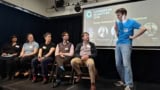
Yesterday we were treated to a fascinating debate about the Large Hadron Collider (LHC) at CERN, featuring Nobel laureates David Gross, Martinus Veltman, George Smoot, Gerhard 't Hooft and Carlo Rubbia, along with LHC accelerator supremo Lyn Evans and CERN chief scientific officer Jos Engelen.
Chairing the session was my predecessor in the Physics World features hot-seat Matthew Chalmers, who is now forging a career as a freelance science journalist.
Some speakers, like Smoot and Gross, preferred to talk about the hope that the LHC will yield a cornucopia of new physics , prominently of Higgs bosons and supersymmetric particles. Others, like Veltman and Rubbia, took a more cautious stance as to what might be discovered.
The experiment itself is a complex beast and will take years before the experimentalists understand it completely. The computing challenge is also gargantuan: the proton-proton collisions will yield some 109 events per second, of which only 200 can be saved into a disk.
This means there is a huge responsibility on the shoulders of the thousands of young researchers working in the bowels of the LHC to make sure that the interesting events are the ones that get saved into the computing grid.
As Rubbia told the meeting: "The discussion about the Higgs is not the right discussion at the moment. This is a very complex machine, and presumably, it will take years before we understand it properly. One should let the physicists do their work instead of pressuring the scientists for results."
I hope to tell you more about what's been happening here on Lake Constance later this week. Meanwhile, back to those Nobel laureates...
June 30, 2008
Where are all the physics teachers?
By Hamish Johnston
The British media were talking about physics today, and I'm afraid the news wasn't good.
The BBC was reporting on a study on the state of physics teaching in England by Alan Smithers and Pamela Robinson of the Centre for Education and Employment Research at the University Of Buckingham.
Robinson and Smithers found that in 2007 just 12% of scientists accepted on teacher training programmes were trained as physicists -- down from 30% in 1983. If this trend continues, it could be very difficult for the government to hit its target of having 25% of all science teachers specialising in physics by 2014.
The decline in physics teachers has meant that many education authorities have opted for "general science" teachers who cover biology and chemistry as well as physics. Indeed, the researchers found that half the schools in inner London have no teachers specialising in physics.
However, all is not gloom and doom for teaching physics in England. Last week we had our summer company meeting and Bob Kirby-Harris, chief executive, the Institute of Physics (which owns the company that publishes physicsworld.com) told us about how the organization was tackling the problem. The IOP has set up the Physics Enhancement Project, which aims to boost the physics expertise of trainee science teachers who don't have formal qualifications in physics.
Most of our readers are outside of the England, so please let us know about the state of physics teaching where you are.
June 26, 2008
Dark energy at The Science Cafe
By Hamish Johnston
There's nothing more annoying than the sound of your own voice...
I have come to this conclusion after spending many painful hours transcribing hundreds of taped interviews that I have done with scientists, industrialists and other luminaries.
But today, the shoe was on the other foot (or ear). At noon I was in a radio studio speaking to the host of the BBC Radio Wales programme The Science Cafe about dark energy.
2008 marks the tenth anniversary of the discovery of dark energy and Adam Walton wanted an update on the stuff from Physics World.
I'll be the first to admit that cosmology is not one of my strengths and I know that I don't have a voice for radio — but no-one else on the editorial team seemed to be available, so I agreed.
I spent the last few days reading up on dark energy — indeed, Physics World recently published three articles to mark the 10th anniversary, all of which were very helpful.
I did my best to answer Adam's questions and I hope that after some skillful editing, his listeners will learn something about dark energy.
One thing I learned from the experience is that many of the things that I find interesting about dark energy — the huge discrepancy between the cosmological constant invoked to explain dark energy and the "cosmological constant" that can be derived from quantum field theory, for example — are very difficult to explain in sound bites.
If you live in Wales, you can listen to the show on Sunday, 29 June at 5pm. The rest of us can listen online.
I was pretty nervous during the interview, so I can't really remember half of what I said. It will be interesting to hear what they use and what ends up on the cutting room floor.
June 20, 2008
US: question your congressional candidates
By Jon Cartwright
Reports of rumour-mongering, pettiness and mud-slinging may still be rife, but I think it's safe to say that the fever surrounding the US primaries has at least partly subsided. Among those who have not been taking time to convalesce, however, are the folks at ScienceDebate 2008. According to an email they dropped into my inbox this morning, they've been busy working with a dozen national science organizations to prepare a list of 14 questions related to science policy for the presidential candidates. Get ready, they'll be announcing it shortly.
Until then, check out this page on the Scientists and Engineers for America (SEA) website. Together with ScienceDebate 2008, the American Association for the Advancement of Science, the American Institute of Physics, the American Physical Society and 11 other organizations, the SEA has drawn up a list of seven questions on science policy for the 2008 congressional candidates.
Two candidates have already posted some responses. If you want to pester your local candidate, SEA gives you the option to send him or her an email.
June 19, 2008
'Abundant health from radioactive waste'
By Hamish Johnston
Earlier this week I received a press release about a paper entitled 'Abundant health from radioactive waste', which was published today in the International Journal of Low Radiation.
Not surprisingly, this set the alarm bells ringing, but I couldn't resist following it up.
The paper is by Don Luckey who is Emeritus Professor of Biochemistry at the University of Missouri. Luckey is a proponent of "radiation hormesis" — the idea that small doses of radiation can actually be good for you, even if much larger doses will kill you.
In his paper, Luckey goes so far as to suggest that schools be built "in used nuclear power plants", and children be given sculptures that are impregnated with nuclear waste to boost their exposure to radiation (and their health). He does caution, "However, children should not ride [sculptures of] radioactive ponies for more than a few minutes every day".
I had never heard of radiation hormesis, so I got in touch with several health physicists in the UK and I was genuinely surprised to get a mixed verdict on the theory. Although they all agreed that hormesis was at the fringes of health physics, some did say that there could be something to it.
Indeed, I was told that the theory has a small but very vocal group of supporters, particularly in France, Japan and the US, who have been lobbying the International Commission on Radiological Protection to look into revising its Linear No-Threshold (LNT) principle. The LNT maintains that there is no exposure level below which radiation has no harmful effects (although these effects are extremely small at very low levels).
The reality is that it is very difficult to understand the effects — good or bad — of very low levels of radiation. As a result, the literature is full of seemingly conflicting reports and scientists who have a passionate belief in radiation hormesis can pick and choose studies that support the theory, while dismissing those that don't.
A case in point is the controversial 1995 study by Bernard Cohen, which suggested that people living in parts of the US with high levels of the radioactive gas radon tend to be less likely to die from lung cancer — strong evidence for radiation hormesis, according to Luckey. However, in 2003, Jerry Puskin showed that this could be explained by considering the different rates of smoking in these regions — something that Luckey seems to have ignored in his latest paper.
So, will my children be playing on a radioactive pony? I don't think so!
June 18, 2008
Renaissance man

By Matin Durrani
I was up in London yesterday at the headquarters of the Institute of Physics to listen to a talk by top quantum-information scientist Anton Zeilinger from the University of Vienna.
Zeilinger was giving the inaugural Isaac Newton lecture after being named the first recipient of the Institute's Newton medal.
Unlike the Institute's other medals, the Newton medal is awarded to "any physicist, regardless of subject area, background or nationality", rather than to a physicist with specific links to the UK.
I'd say there were about 200 physicists in the audience to listen to Zeilinger whizz through topics like entanglement and decoherence — and how these have applications in quantum communication, quantum cryptography and quantum teleportation, some of which are being commercialized.
His basic message is that, thanks to various technological advances, we can now examine some of the fundamental questions in quantum mechanics that the likes of Heisenberg, Schrödinger, Bohr and Einstein posed as mere "thought experiments", such as whether measurements on one particle can instantly affect an entangled partner a finite distance away. We are in fact living through a "quantum rennaissance".
Zeilinger and his colleague Markus Aspelmeyer are fleshing out these themes in an article to appear in the next issue of Physics World. I was delighted that he referred several times to the article, even flashing up a couple of figures from the article that our art studio has redrawn from Zeilinger's hand sketches.
After the lecture, I caught up with Zeilinger over champagne and quizzed him on the fact that he had put his neck firmly on the line when it comes to decoherence — the fact that fragile quantum states can be lost when they interact with the environment.
Having described how molecules as large as buckyballs can demonstrate quantum behaviour, Zeilinger had told the audience that he thinks "there is no limit" to how heavy, complex or warm a molecule can be while still showing quantum phenomena. "Decoherence won't be a problem for molecules as large as viruses even at room temperature," he speculated. "The limit is only one of money."
After the lecture, delegates were treated to a concert by the Abram Wilson Jazz Quartet. Zeilinger is, apparently, something of a jazz buff.
June 17, 2008
Two new reactors for Canada

By Hamish Johnston
Summer can be a miserable time in Toronto. It can get very hot and humid, causing folks to turn up their air conditioning, which in turn puts the region's coal-fired generating plants into overdrive blanketing the city in a sickly yellow smog that can harm those with breathing difficulties.
As a result, local utilities have begun to shut down aging coal-fired plants in an attempt to improve air quality — but leaving some wondering where the city and surrounding province of Ontario will get its electricity.
Now, Ontario's Minister for Energy Gerry Phillips has given the go ahead for two new nuclear reactors to be built at the Darlington generating plant just east of the city, which is already home to four reactors. These are the first power reactors to be built in Canada in over 15 years.
According to the Toronto Star, the reactors will come online in 2018 and the design will be chosen in November from a short list of three firms: Atomic Energy of Canada; US-based Westinghouse; and Areva of France.
The reactors are expected to generate about 3200 MW of power, which will double Darlington's current capacity.
The move is part of Ontario's CDN$26 billion plan to maintain its current nuclear capacity of 14,000 MW through a series of upgrades over the next 20 years.
Darlington is located in a part of Ontario that has been hard hit by lay-offs in the automotive industry, so Phillips may be hoping that the promise of 3500 new jobs will offset the concerns of environmentalists.
June 16, 2008
A real gem on arXiv
By Hamish Johnston
I spent an hour or so this morning trawling through the arXiv preprint server, where many physicists post their research results before they are published formally. It's a great way to keep up with the latest breakthroughs — and a good source of more controversial or off-beat stories.
That's where I spotted this gem: "Growth of Diamond Films from Tequila" by Javier Morales, Miguel Apátiga and Victor M Castaño, who are physicists based in (you guessed it) Mexico.
It seems that the three physicists have used the famous spirit in their chemical vapour deposition (CVD) machine to create tiny diamonds.
Although the paper notes that diamonds have already been made by CVD using a number of other precursors, the trio suggest that tequila provides "an excellent alternative to produce industrial-scale diamond thin films for practical applications using low-cost precursors".
It's not clear from the paper why tequila was used rather than vodka, gin or whisky — and of course, if this paper was entitled "Growth of Diamond Films from Water and Ethanol", I wouldn't have given it a second thought.
Cold-fusion demonstration: an update
By Jon Cartwright
Several of you have asked when I'm going to give you an update on Yoshiaki Arata's cold-fusion demonstration that took place at Osaka University, Japan, three weeks ago. I have not yet come across any other first-hand accounts, and the videos, which I believe were taken by people at the university, have still not surfaced.
However, you may have noticed that Jed Rothwell of the LENR library website has put some figures with explanations relating to Arata's recent work online. I've decided to go over them and some others here briefly to give you an idea of how Arata's cold-fusion experiments work. It's a bit more technical than usual, so get your thinking hats on.

Above is a diagram of his apparatus. It comprises a stainless-steel cell (2) containing a sample, which for the case of the demonstration was palladium dispersed in zirconium oxide (ZrO2–Pd). Arata measures the temperature of the sample (Tin) using a thermocouple mounted through its centre, and the temperature of the cell wall (Ts) using a thermocouple attached on the outside.
Let's have a look at how these two temperatures, Tin and Ts, change over the course of Arata's experiments. The first graph below is one of the control experiments (performed in July last year) in which hydrogen, rather than deuterium, is injected into the cell via the controller- (8) operated valve (5):

At 50 minutes — after the cell has been baked and cooled to remove gas contamination — Arata begins injecting hydrogen into the cell. This generates heat, which Arata says is due to a chemical reaction, and the temperature of the sample, Tin (green line), rises to 61 °C. After 15 minutes the sample can apparently take no more hydrogen, and the sample temperature begins to drop.
Now let's look at the next graph below, which is essentially the same experiment but with deuterium gas (performed in October last year):

As before, Arata injects the gas after 50 minutes, although it takes a little longer for the sample to become saturated, around 18 minutes. This time the sample temperature Tin (red line) rises to 71 °C.
At a quick glance the temperatures in both graphs, after saturation, appear to peter out as one would expect if heat escapes to the environment. However, in the case of deuterium there is always a significant temperature difference between Tin and Ts, indicating that the sample and cell are not reaching equilibrium. Moreover, after 300 minutes the Tin of the deuterium experiment is about 28 °C (4 °C warmer than ambient), while Tin/Ts of the hydrogen experiment is at about 25 °C (1 °C warmer than ambient).
These results imply there must be a source of heat from inside the cell. Arata claims that, given the large amount of power involved, this must be some form of fusion — what he prefers to call "solid fusion". This can be described, he says, by the following equation:
D + D = 4He + heat
(According to this equation, there should be no neutrons produced as by-products — thanks to those of you who pointed this out on the last post.)
If any of you are still reading, this graph below is also worth a look:

Here, Arata also displays data from deuterium and hydrogen experiments, but starts recording temperatures after the previous graphs finished, at 300 minutes. There are four plots: (A) is a deuterium and ZrO2–Pd experiment, like the one just described; (B) is another deuterium experiment, this time with a different sample; (C) is a control experiment with hydrogen, again similar to the one just described; and (D) is ambient temperature.
You can see here that the hydrogen experiment (C) reaches ambient temperature quite soon, after around 500 minutes. However, both the deuterium experiments remain 1 °C or more than ambient for at least 3000 minutes while still exhibiting the temperature difference between the sample and the cell, Tin and Ts.
Could this apparently lasting power output be used as a energy source? Arata believes it is potentially more important to us than hot or "thermonuclear" fusion and notes that, unlike the latter, it does not emit any pollution at all.