Skip to the content

Sign up

To enjoy free access to all high-quality "In depth" content, including topical features, reviews and opinion sign up

Michael Banks: November 2009 Archives

PWcer1_11-07.jpg
Now where did I put my sandwich? (credit: CERN)

By Michael Banks

The mystery surrounding the electrical fault last week at the Large Hadron Collider (LHC) at CERN has taken a new twist today.

Last week, a piece of baguette was found to be lying on an electrical connection in one of the eight above-ground cryoplants - used to cool the LHC to 1.9 K - that caused two of the eight sectors around the LHC’s 27 km ring to heat up to 10 K.

But in the latest issue of the CERN Bulletin, James Gillies, head of communication at CERN, claims that a bird carrying a baguette did not stall the world’s most powerful particle-physics experiment from starting up on schedule.

“Of course, no such thing happened,” says Gillies. But he did admit that engineers at CERN do not fully understand how the heating occurred in the two sectors. “To this day, we do not know what caused the power cut,” he says.

However, Gillies, who was not at CERN when the incident happened, says it is true that “feathers and bread” were actually found at the site of the mystery electrical fault.

Could it be that someone intent on sabotaging the LHC has cleverly laid a decoy of feathers and bread?

Whatever the reason, Gillies is keen for the media to now focus on the LHC and the science it will produce once low-energy collisions begin early next month.

“Soon, the headlines should be turning from birds to b-quarks, and from baguettes to bosons,” he says. Well there is hope.

By Michael Banks

merkel.jpg
German Chancellor Angela Merkel addresses delegates at the Falling Walls conference

“The fall of the Wall changed my life, but it didn’t put a dampener on my passion for science,” said German chancellor Angela Merkel at yesterday’s Falling Walls conference held in Berlin.

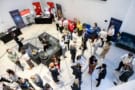
I was in Berlin to attend the one-day event, which was organized by the Einstein Foundation. It was held in a former water pumping station in the east of the city to celebrate 20 years of the fall of the Berlin Wall on 9 November 1989.

Top researchers from different backgrounds gave 15 minute talks about what they believe are modern walls in their disciplines.

Merkel, a former physicist, delighted scientists by attending the conference to talk to researchers about her background and about breaking the walls of the 21st century.

Speaking for 25 minutes, Merkel outlined tackling climate change as a wall that needs to be overcome. She said this was a challenge that cannot be done alone and needs international cooperation — something that scientists excel at and could teach politicians a lesson or two about.

P1000764.JPG
Rolf-Dieter Heuer discusses walls of the hidden universe

The list of speakers was quite impressive from Nobel Peace laureate Muhammad Yunus from the Yunus Centre, who talked about how to break the wall of introducing “social business” into today’s corporate giants to Alain Aspect from the Écoles Polytechnique who talked about breaking down the wall of quantum weirdness and his experiments on single photon diffraction.

In the third session, entitled “walls around our universe”, Rolf-Dieter Heuer, director-general of the CERN particle-physics lab, told the 500 strong audience about the Large Hadron Collider and how it could break the wall of the hidden universe by possibly explaining what makes up dark matter and gives particles their mass.

Also speaking was Norbert Holtkamp, deputy director general of the ITER fusion experiment, who talked about breaking the wall of limitless energy via fusion.

P1000771.JPG
Using the desert to power the world

Perhaps the most amusing part of the conference was provided by an actor, who, when the speaker went over the 15 minute allowance, came on stage to do an act like pretend to sweep the floor or starts blowing balloons up.

Perhaps Gerhard Knies from the Desertec foundation, which is planning to build large solar energy plant in North Africa, gave members of the audience most food for thought when he talked about breaking the wall of the fossil age. “The whole desert gets in six hours what mankind needs for a year,” he said.

baguette.jpg
Crusty problems for the LHC

By Michael Banks

Oh crumbs.

After talk of the Higgs boson travelling back in time and sabotaging the Large Hadron Collider (LHC) at the CERN particle-physics lab, a more mundane object temporarily stopped the machine from operating on Tuesday night.

According to a note posted today on the CERN users’ pages, a piece of baguette placed in a cooling station caused a sector in the LHC to heat up by a few degrees to the bemusement of engineers.

The 27 km circumference LHC has eight sectors, each 3.3 km long. Each sector has a cooling station, or “cryoplant”, which helps the machine get down to the chilly temperature of 4.2 K.

The crusty piece of bread was found in one of the cryoplants and happened to be lying on a busbar — an electrical connection made of copper that are generally wide and flat to allow heat to dissipate more easily.

The well placed baguette then caused a short circuit in the cryogenic equipment that heated one of the sectors to around 10 K.

“The best guess is that it was dropped by a bird, either that or it was thrown out of a passing aeroplane,” a spokeswoman from CERN told the Times.

But it seems the best guess was right after all. The note on the CERN users page said that the culprit was a “bird carrying a baguette bread” and that the “bird escaped unharmed but lost its bread”.

The statement read: “The standard failsafe systems came into operation and after the cause was identified, re-cooling of the machine began and the sectors were back at operating temperature last night. The incident was similar in effect to a standard power cut, for which the machine protection systems are very well prepared.”

At least the note didn’t say that it was a bird travelling back in time with a piece of bread hellbent on sabotaging the LHC from finding the Higgs.