The HALHF collaboration is developing a disruptive platform technology that could slash the size, cost and carbon footprint of future large-scale particle-accelerator facilities. Joe McEntee checks out progress
Big science is all about big-money bets. What’s more, payback on those research investments – sometimes running to billions of euros in capital spend – will usually only be realized decades down the line. With the stakes so high, funding agencies and governments are understandably keen to shorten the odds in their favour and ensure every bet’s a winner.
Take the long-running debate within the international particle-physics community regarding a “next energy frontier” particle collider. The end-game: to build on the fundamental physics discoveries made by CERN’s Large Hadron Collider (LHC) and the anticipated breakthroughs resulting from its imminent upgrade – the High-Luminosity LHC – which is due to enter operation in 2030.
The collective conversation here is a case study in consensus meets divergence. On the one hand, there’s general agreement that any post-LHC big-science facility should be an electron–positron “Higgs factory”, in which electrons and positrons are smashed together at high energies to deepen our understanding of the Higgs boson. Discovered in 2012, the Higgs boson is the newest addition to the family of elementary particles that make up the Standard Model of particle physics.
“It’s widely accepted that an electron–positron Higgs factory, with its ‘exceptionally clean’ experimental conditions, will reveal the new physics that we know must exist beyond the Standard Model,” explains Richard D’Arcy, associate professor of particle-accelerator physics in the John Adams Institute at the University of Oxford, UK.
Collision course
In contrast, there are several mature and competing concepts for the implementation and operation of such a Higgs factory. Chief among them: the International Linear Collider (ILC) and the Compact Linear Collider (CLIC); also the Circular Electron–Positron Collider (CEPC) and the Future Circular Collider (FCC-ee).
All these proposals exploit existing accelerator technologies based on superconducting and/or normal-conducting RF cavities (metallic chambers in which charged particles injected into an electromagnetic field receive an electrical impulse to accelerate them).
However, each blueprint comes with downsides, whether that’s prohibitive construction costs, sprawling land use and facility footprint, or eye-watering operational costs and energy budgets (or a combination thereof).
Opportunity knocks, it seems, for disruptive accelerator innovation that could unlock the door to a cut-price Higgs factory. One candidate technology that has seen significant advances over the past decade is plasma-wakefield acceleration (PWFA), which exploits laser- or particle-beam-driven intense “plasma waves” as the accelerating medium, yielding electric fields up to three orders of magnitude greater than in classical accelerators. Those ultra-high accelerating gradients, in turn, promise a significant reduction in the size, cost and carbon footprint of next-generation accelerator facilities.
New thinking, new physics
The Hybrid Asymmetric Linear Higgs Factory (HALHF) project is one of several international initiatives seeking to turn the game-changing potential of PWFA into a mainstream platform technology for future particle accelerators. HALHF researchers, for their part, are developing a linear-collider concept based on proven RF cavities and novel PWFA modules – a hybrid acceleration scheme that, they hope, will leverage the benefits of both.
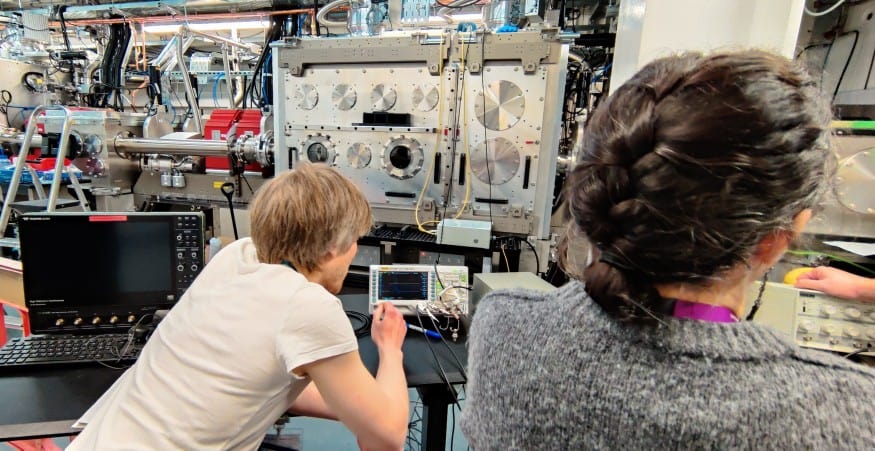
Their concept is now taking form. Earlier in the spring, the HALHF project notched up a significant experimental milestone with the introduction of PWFA infrastructure into a test facility called CLARA (Compact Linear Accelerator for Research and Applications) at STFC Daresbury Laboratory in the UK. For context, CLARA hosts one of the world’s brightest medium-energy electron beams and is designed specifically to support the development of next-generation accelerator technologies.

Initial HALHF@CLARA experiments were carried out over a five-week period by a team of scientists from the universities of Oxford, Oslo and Manchester working with colleagues from the German accelerator laboratory DESY and Daresbury’s Accelerator Science and Technology Centre (ASTeC). Along the way, the researchers successfully integrated PWFA modules into CLARA and subsequently used them to drive plasma wakes with >GV/m gradients and then focus CLARA electron beams with >100 T/m fields.
“These results are foundational for future HALHF@CLARA experiments,” claims D’Arcy, who also leads the PWFA group at Oxford and is one of the principal investigators on the HALHF project. “They are also impressive in their own right, representing the first time beam-driven plasma acceleration has taken place in the UK.”
During this Phase 0 experimental run at CLARA, the HALHF team prioritized three key performance metrics: very high field strengths (orders of magnitude higher than what is possible with traditional accelerator technology); maintaining beam quality as the electrons pass through those very high field gradients; and, finally, minimizing (or even reducing) the energy spread of the electron bunches (which also maintains beam quality and ensures the PWFA set-up remains super-compact).
“By ticking off those three boxes,” says D’Arcy, “we have established a solid platform on which to build the next level of experiments. That’s when things will start to get really exciting.”
Progressions of power
Follow-on experimental runs, which are scheduled to get under way at CLARA later this year, will inevitably begin to tackle two outstanding challenges in plasma acceleration: pushing on to very high energies (which require the staging of PWFA modules in series) and attaining competitive luminosity (by operating the plasma modules thousands of times per second). “CLARA offers a unique opportunity to make substantial advances in both areas owing to its novel architecture and modular environment,” D’Arcy adds.
In the meantime, the HALHF collaboration has submitted its contribution to the European Particle Physics Strategy Update 2026 – part of a concerted push to raise the profile of the research community working on plasma acceleration. The priorities for that community are clear: to increase resources and funding, coordinate development activity on an international level, and take the next steps to further the PWFA concept towards practical and at-scale realization.
“We want to show particle physicists that PWFA isn’t some flash in the pan,” concludes D’Arcy. “This is an enabling technology that really has legs.”