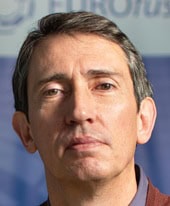
Experimental physicist Stefano Coda from the Swiss Federal Technology Institute of Lausanne (EPFL) and colleagues have been awarded the 2026 Plasma Physics and Controlled Fusion (PPCF) Outstanding Paper Prize for their research on magnetic confinement fusion.
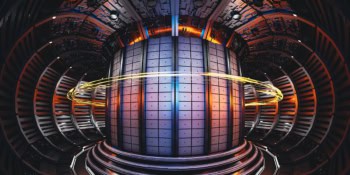
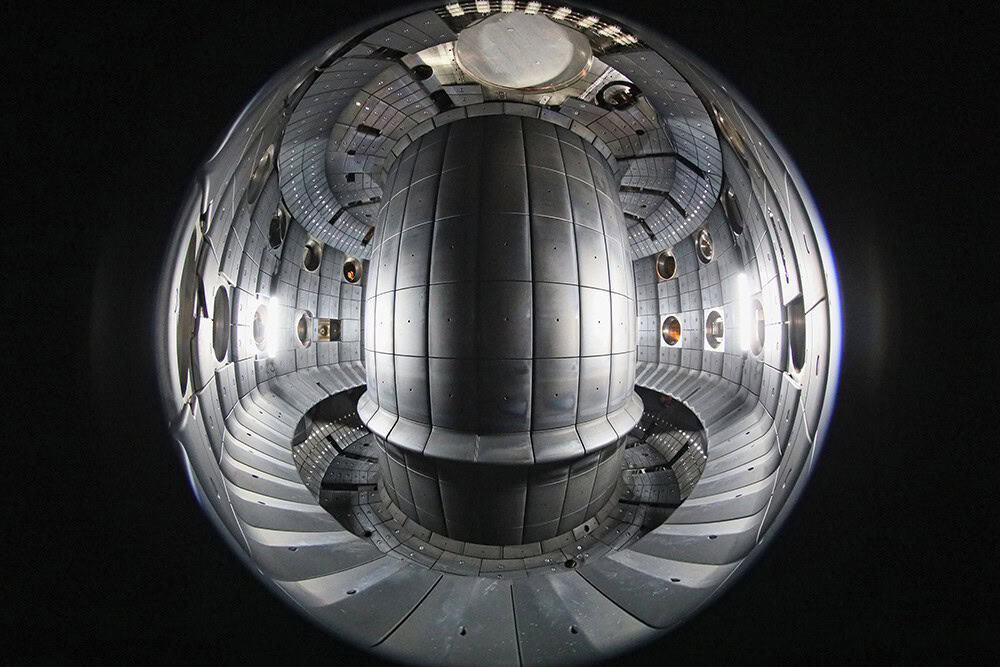
The work – Enhanced confinement in diverted negative-triangularity L-mode plasmas in TCV – is based on simulations and experiments on the TCV tokamak based at the EPFL.
Fusion is usually performed via two types of plasma confinement. Magnetic involves using magnetic fields to hold stable a hydrogen plasma, while inertial confinement uses rapid compression, usually by lasers, to create a confined plasma for a short period of time.
In the late 1990s, scientists working on the TCV tokamak found that a certain plasma shape — dubbed negative triangularity – can help to keep the hot plasma stable and better contained.
The award-winning work build on the progress made in the decades since to show that such a configuration can lead to enhanced plasma confinement.
Indeed, the findings highlight how negative‑triangularity plasmas are no longer a niche idea but can work reliably, at high performance, and in reactor‑relevant conditions making them promising for real fusion power.
Awarded each year, the PPCF prize aims to highlight work of the highest quality and impact published in the journal. The award was judged on originality, scientific quality and impact as well as being based on community nominations and publication metrics.
The prize will be presented at the 52nd European Physical Society Conference on Plasma Physics to be held in Edinburgh from 29 June to 3 July.
The journal is now seeking nominations for next year’s prize, which will focus on papers in the following areas: foundational and discovery plasma physics; astrophysical, space and ionospheric plasmas; laboratory astrophysics, high energy density physics; low temperature, dusty and industrial plasmas, and inertial fusion.
Below, Coda talks to Physics World about prize, the importance of recognition and what advice he has for early-career researchers.
What does winning the 2026 PPCF Outstanding Paper Prize mean to you?
This prize is especially meaningful as it recognizes a line of research that has long been associated with our facility TCV but has taken decades to enter the mainstream. Negative triangularity is now considered a realistic option for a fusion power plant. The success of this paper confirms our group’s longstanding and continuing leadership in this effort.
How important is it that researchers receive recognition for their work?
Recognition takes several different forms. It begins with the simple act of acceptance of a publication through the peer-review process. The broader recognition that comes from downloads, citations, and ultimately the propagation of a scientific idea – the replication of an experiment, the application of a theory, a practical implementation of a conceptual notion – is the engine that keeps propelling science forward by giving it visibility and credibility. Researchers are driven primarily by curiosity and the desire to contribute new knowledge, so recognition is most meaningful when it reflects genuine scientific impact. Prizes and awards are then the cherry on the cake!
What advice would you give to early-career researchers looking to pursue a career in plasma physics?
Do not lose sight of the beauty of the science. Plasma physics is enormously complex, full of unsolved mysteries, and yet still rooted largely in classical physics. It is an exceptionally exciting time for the field with applications ranging from manufacturing to biology, and above all nuclear fusion, whose tantalising promise of abundant clean energy is driving tremendous momentum in both the public and private sectors. But whatever direction you choose, it will be rewarding if you keep your eye on the beauty of the science.