Researchers at the Polytechnic University of Hauts-de-France have used fractal mathematics to create a new non-invasive method that can distinguish genuine artworks from forgeries (Surf. Topogr.: Metrol. Prop. 14 025016).
Art forgery is a growing problem worldwide and traditional authentication of an artwork relies on expert opinion, historical research, pigment analysis and digital techniques.
While these approaches can be effective, they are also resource‑intensive and can sometimes still be inconclusive.
The new technique works by capturing the subtle patterns created by an artist’s brushwork – patterns so consistent that they act like a morphological signature unique to that particular artist.
By converting high-resolution images of the artwork into 3D‑like topological maps the researchers created a microscopic “texture” of a painting, measuring how rough or detailed the surface is using fractal dimensions – a mathematical ratio that measures how densely a fractal shape occupies space as it scales.
The fractal dimensions are calculated for the whole artwork as well as for selected homogeneous areas that are representative of brushwork.
“Fractal analysis gives us a measurable fingerprint of an artist’s brushwork without needing to sample or disturb the painting,” notes lead researcher Francois Berkmans. Hidden pictures
The researchers tested the fractal method on works attributed to the Dutch painter Vincent van Gogh finding that the well‑documented fake The Plowmen was a strong outlier compared to other works while the recently authenticated Sunset at Montmajour aligned closely with Van Gogh’s known painting.
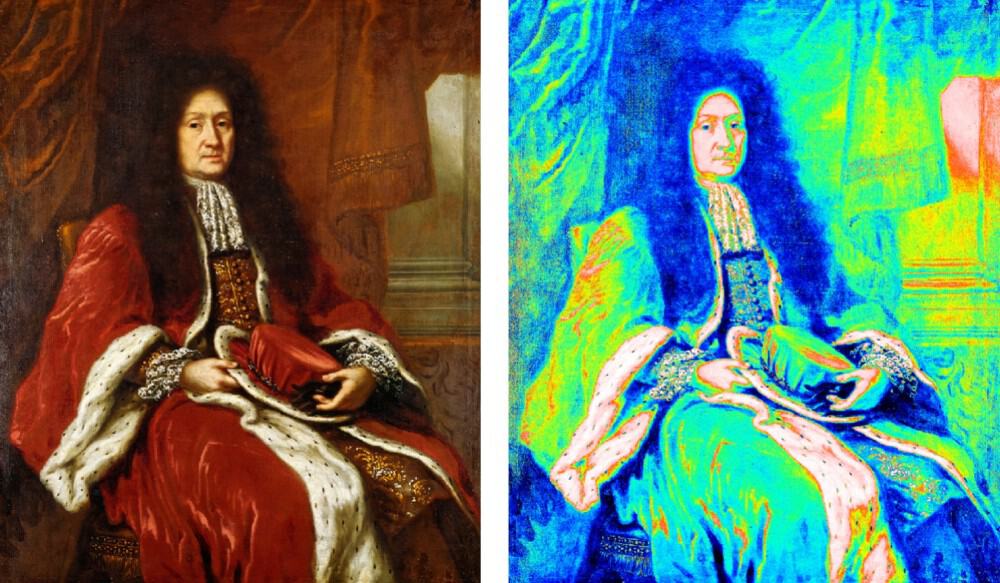
Using eight works for each artist, the approach also successfully separated the stylistic signatures of Van Gogh with that of the 17th‑century painter David Klöcker Ehrenstrah.
The researchers say that the technology can improve authentication, especially when combined with other techniques such as chemical analysis.
“This approach won’t replace traditional expertise, but it significantly strengthens it,” adds Berkmans. “Our results show that our technique can clearly point out genuine artists and reliable detect known forgeries.”