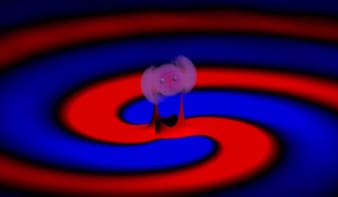
An international team of astronomers called the MACHO collaboration claim to have found fifty percent of the 'dark matter' hidden in our galaxy. They claim it could possibly be primordial black holes. However, other researchers are calling the group's interpretation of the data 'extremely controversial'. Approximately ninety percent of the mass of our Milky Way galaxy must be invisible or 'dark' to explain its rotation. Charles Alcock of the MACHO collaboration reported the findings at the "The Galactic Halo: Bright Stars and Dark Matter" meeting in Canberra, Australia, this week.
Alcock and co-workers have been searching for MACHOs – massive compact halo objects – with a technique known as gravitational lensing. In this the gravitational field of a heavy object acts like a lens when it passes in front of a background star, magnifying the star’s light. Researchers have so far found 15 such events using background stars in a small neighbouring galaxy called the Large Magellanic Cloud (LMC). However, some astronomers claim that the heavy objects are actually stars in the LMC rather than MACHOs in our galaxy. They point out the unless the microlensing event occurs in a binary star system, it is impossible to determine how far the object is from Earth. Alcock’s team claims that the objects they discovered have masses at least half the mass of the Sun, which is heavier than expected – suggesting, according to Gerry Gilmore of Cambridge University in the UK, that they are in fact stars in the LMC. Gilmore also points out that objects cannot be normal stars in the Milky Way, otherwise the Hubble Space Telescope would have seen them. However, he agrees that more events have been seen than would be expected if there were no MACHOs in the Milky Way, but adds that there are still problems associated with some of the candidates. This view is shared by Alcock: “The favoured candidates are dim shrunken stars called ‘white dwarfs’, but there are problems with those.” A white dwarf is an earth-sized remnant of a star after it has ended its hydrogen-burning life. For the galaxy to be made mainly of white dwarfs in the past, there would have had to have been a large population of stars in a narrow mass range and astronomers see no evidence of this. Moreover, as Alcock points out: “When white dwarfs form there’s a lot of associated chemical ‘pollution’ in space, and we’re not seeing that.” Another favourite dark matter candidate – failed stars called brown dwarfs with masses between those of Jupiter and the Sun – have turned out to be unexpectedly scarce. In the past it was thought that brown dwarfs were too faint to be detected. Improvements in astronomical technology now mean that this is no longer the case, but only a small number have been detected. “We expected dozens and dozens, ” says Chris Tinney of the Anglo-Australian Observatory, “but only twenty have been found in four years.” Another possibility is that the lensing events are due to black holes that formed microseconds after the big bang. However, Michael Rowan-Robinson of Imperial College, London, thinks that this interpretation is unlikely and that it has been driven by the difficulty of explaining how white dwarfs can account for a large fraction of the halo. There is also a dispute about what fraction of the Galaxy’s dark matter can be accounted for by MACHOs. Rowan-Robinson, points out that estimates range from 0 to 100%, and that other teams have used the same data as that presented by the MACHO collaboration to derive a figure of 20%, rather than 50%. According to Gilmore, the microlensing events suggest two possibilities: “Does this imply that 90 percent of the mass of the Universe is in a population of primordial black holes, which for some coincidental reason happen to weigh roughly as much as the Sun? Or does it mean that the Large Magellanic Cloud is somewhat thicker along the line of sight than was assumed? The first of these ‘explains’ the dark matter problem. The second does not, but favours a particle physics answer.” And Ken Freeman of Mount Stromlo Observatory cautions that even if we solve the dark matter problem for our Galaxy, there is a separate problem for the Universe. Indeed, as much as 99 percent of the universe could be ‘dark’. “There is a great deal of dark matter out there”, says Freeman, “and conventional cosmology still tells us that most of it is not ordinary matter.”