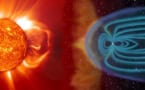
Stars and solar physics Research update Can we create a shield to protect Earth from solar storms? A space-based system could help deflect potentially catastrophic interplanetary weather Read article: Can we create a shield to protect Earth from solar storms?
Stars and solar physics Research update Evidence for a ‘forbidden range’ of black hole masses emerges in gravitational wave observations Stars in this range may form a long-predicted type of supernova instead Read article: Evidence for a ‘forbidden range’ of black hole masses emerges in gravitational wave observations
Stars and solar physics Research update Solar storms could be forecast by monitoring cosmic rays Forbush decrease effect is tracked between the Sun and Earth Read article: Solar storms could be forecast by monitoring cosmic rays
Stars and solar physics Research update Astronomers observe a coronal mass ejection from a distant star Burst from M-dwarf star could be powerful enough to strip the atmosphere of any planets that orbit it, with implications for the search for extraterrestrial life Read article: Astronomers observe a coronal mass ejection from a distant star
Stars and solar physics Research update Plasma bursts from young stars could shed light on the early life of the Sun New multi-temperature coronal mass ejection observations might help us better understand how life emerged and evolved on Earth Read article: Plasma bursts from young stars could shed light on the early life of the Sun
Planetary science Research update Young rogue planet grows like a star Telescope observations reveal material accreting onto the planet Cha1107-7626 in a way that resembles the infancy of stars Read article: Young rogue planet grows like a star
Modelling and simulation Research update Laser-driven implosion could produce megatesla magnetic fields Simulations of improved technique generate fields as strong as those found near neutron stars Read article: Laser-driven implosion could produce megatesla magnetic fields
Stars and solar physics Research update Too-close exoplanet triggers flares from host star New observations are the first direct evidence of planets influencing their stars rather than just passively orbiting them Read article: Too-close exoplanet triggers flares from host star
Stars and solar physics Research update Astronomers observe the biggest booms since the Big Bang "Extreme nuclear transients" from tidally disrupted heavy stars release more energy than 100 supernovae Read article: Astronomers observe the biggest booms since the Big Bang
Stars and solar physics Research update Short-lived eclipsing binary pulsar spotted in Milky Way Rare sighting could allow astronomers to test theories of binary star systems Read article: Short-lived eclipsing binary pulsar spotted in Milky Way