A manmade molecular machine that can drive a system away from equilibrium is the first to do so using an “information ratchet”, claim researchers in Scotland. The machine, in which a light-powered gate controls the transport of molecules, uses a similar principle to Maxwell’s demon, a famous thought experiment devised to challenge the second law of thermodynamics (Nature 445 523).
Nature uses molecular machines to drive chemical systems away from thermodynamic equilibrium in virtually every major biological process. But while scientists have been eager to create similar machines to perform nanoscale tasks, they have so far only had success with simple switches that proceed towards equilibrium.
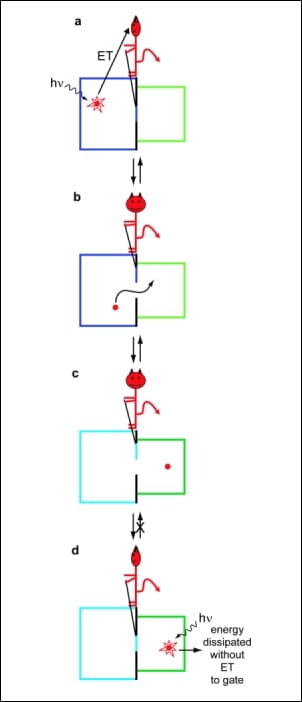
David Leigh and fellow researchers at the University of Edinburgh, however, have proved that particles can be driven away from equilibrium using a molecular “information ratchet”. To perform the feat, they use “rotaxane”, an assembly of molecules comprising a dumbbell-shaped axle on which a ring can slide, hindered only by a gate located part way along. By shining light on rotaxane, the ring absorbs photons and transfers energy to the gate, which then temporarily changes shape to let the ring pass. Once the ring has passed, however, it cannot transmit energy back to the gate, and is therefore stuck – or ratcheted – in place.
A comparable ratcheting process was famously conjured 140 years ago by James Clerk Maxwell in a thought experiment that was later nicknamed “Maxwell’s demon”. Maxwell supposed that some kind of entity (a “demon”) could be invented to act as a gatekeeper between two isolated chambers of gas, letting only fast molecules into one chamber and only slow molecules into the other. In doing so, he proposed, the difference in temperature between the two chambers would progressively increase, thus violating the second law of thermodynamics.
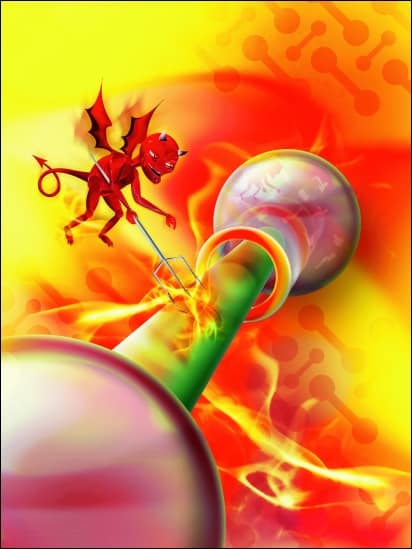
The flaw in Maxwell’s thinking, however, was that the demon itself would expend energy when controlling the gate. In the Edinburgh team’s system, the demon’s appetite is satisfied by light energy, and hence the second law remains undisputed. According to Leigh, the two gas chambers are analogous to the opposing sides of the rotaxane molecule, and the demon – perhaps less tangibly – is analogous to a double bond within the gate that receives energy from the ring.
Nevertheless, the researchers have still proved it is possible to force an ensemble of rotaxane particles away from equilibrium, which Leigh says could result in molecular machines that are as functional as the ones seen in biology. For example, ions could be attached to the rings and pumped against a concentration gradient. “Because we understand exactly how this molecule behaves from a chemical standpoint, it allows us to appreciate exactly why the information ratchet requires an input of energy to work,” he said.