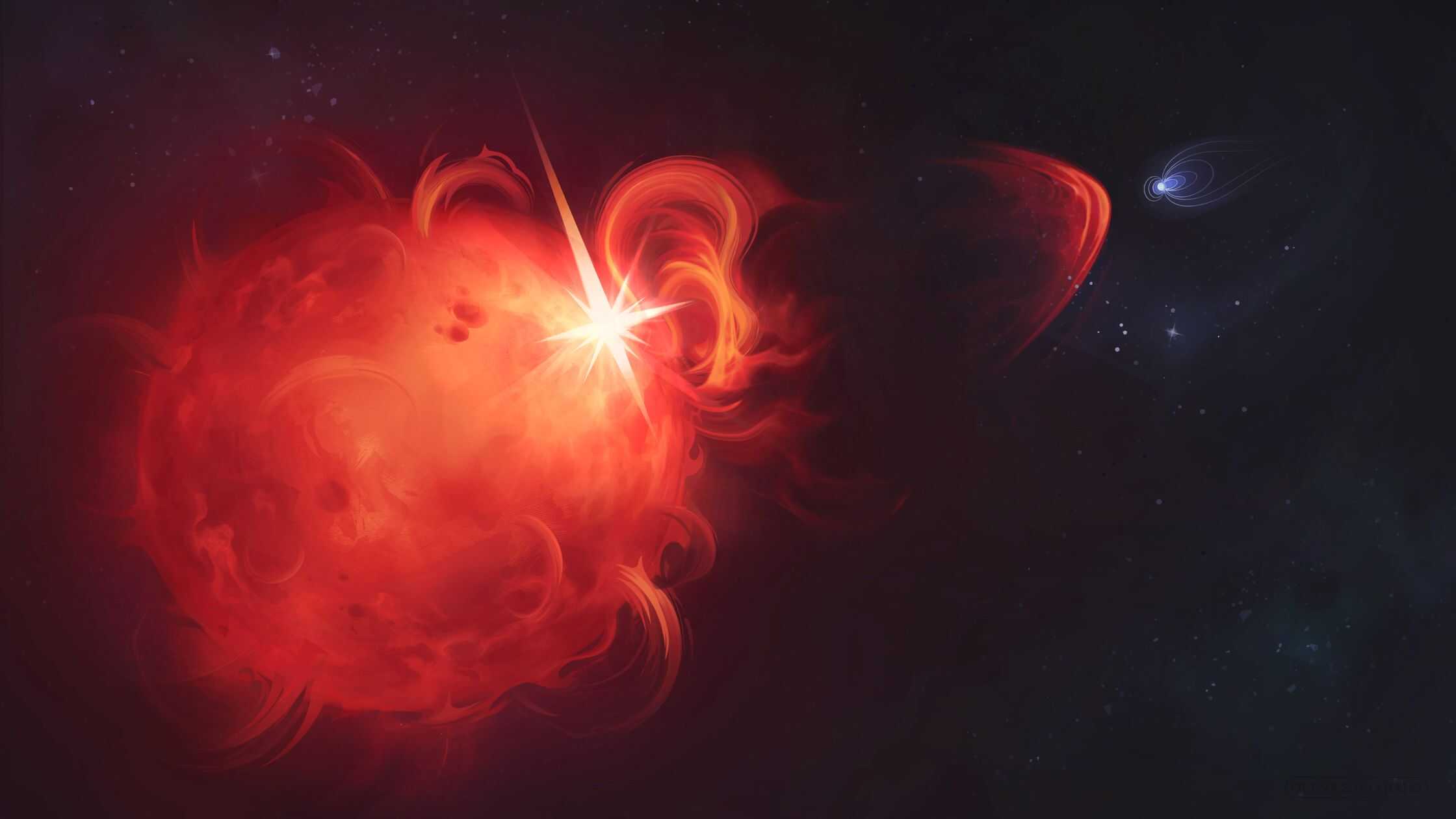
The Sun regularly produces energetic outbursts of electromagnetic radiation called solar flares. When these flares are accompanied by flows of plasma, they are known as coronal mass ejections (CMEs). Now, astronomers at the Netherlands Institute for Radio Astronomy (ASTRON) have spotted a similar event occurring on a star other than our Sun – the first unambiguous detection of a CME outside our solar system.
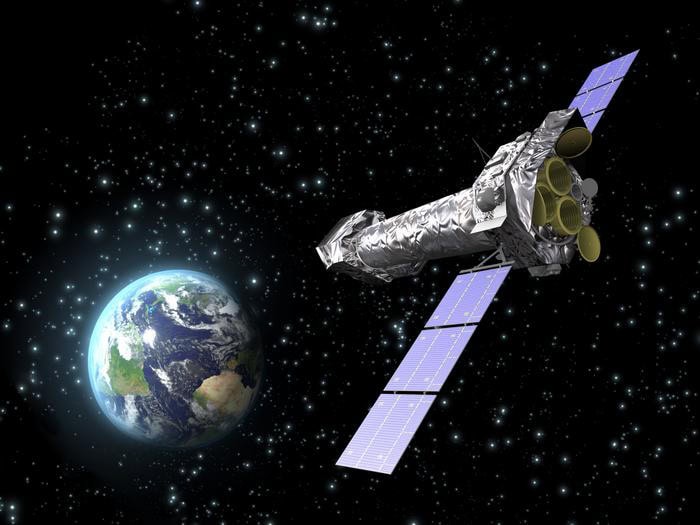
Astronomers have long predicted that the radio emissions associated with CMEs from other stars should be detectable. However, Joseph Callingham, who led the ASTRON study, says that he and his colleagues needed the highly sensitive low-frequency radio telescope LOFAR – plus ESA’s XMM-Newton space observatory and “some smart software” developed by Cyril Tasse and Philippe Zarka at the Observatoire de Paris-PSL, France – to find one.
A short, intense radio signal from StKM 1-1262
Using these tools, the team detected short, intense radio signals from a star located around 40 light-years away from Earth. This star, called StKM 1-1262, is very different from our Sun. At only around half of the Sun’s mass, it is classed as an M-dwarf star. It also rotates 20 times faster and boasts a magnetic field 300 times stronger. Nevertheless, the burst it produced had the same frequency, time and polarization properties as the plasma emission from an event called a solar type II burst that astronomers identify as a fast CME when it comes from the Sun.
“This work opens up a new observational frontier for studying and understanding eruptions and space weather around other stars,” says Henrik Eklund, an ESA research fellow working at the European Space Research and Technology Centre (ESTEC) in Noordwijk, Netherlands, who was not involved in the study. “We’re no longer limited to extrapolating our understanding of the Sun’s CMEs to other stars.”
Implications for life on exoplanets
The high speed of this burst – around 2400 km/s – would be atypical for our own Sun, with only around 1 in every 20 solar CMEs reaching that level. However, the ASTRON team says that M-dwarfs like StKM 1-1262 could emit CMEs of this type as often as once a day.
According to Eklund, this has implications for extraterrestrial life, as most of the known planets in the Milky Way are thought to orbit stars of this type, and such bursts could be powerful enough to strip their atmospheres. “It seems that intense space weather may be even more extreme around smaller stars – the primary hosts of potentially habitable exoplanets,” he says. “This has important implications for how these planets keep hold of their atmospheres and possibly remain habitable over time.”
Erik Kuulkers, a project scientist at XMM-Newton who was also not directly involved in the study, suggests that this atmosphere-stripping ability could modify the way we hunt for life in stellar systems akin to our Solar System. “A planet’s habitability for life as we know it is defined by its distance from its parent star – whether or not it sits within the star’s ‘habitable zone’, a region where liquid water can exist on the surface of planets with suitable atmospheres,” Kuulkers says. “What if that star was especially active, regularly producing CMEs, however? A planet regularly bombarded by these ejections might lose its atmosphere entirely, leaving behind a barren uninhabitable world, despite its orbit being ‘just right’.
Plasma bursts from young stars could shed light on the early life of the Sun
Kuulkers adds that the study’s results also contain lessons for our own Solar System. “Why is there still life on Earth despite the violent material being thrown at us?” he asks. “It is because we are safeguarded by our atmosphere.”
Seeking more data
The ASTRON team’s next step will be to look for more stars like StKM 1-1262, which Kuulkers agrees is a good idea. “The more events we can find, the more we learn about CMEs and their impact on a star’s environment,” he says. Additional observations at other wavelengths “would help”, he adds, “but we have to admit that events like the strong one reported on in this work don’t happen too often, so we also need to be lucky enough to be looking at the right star at the right time.”
For now, the ASTRON researchers, who report their work in Nature, say they have reached the limit of what they can detect with LOFAR. “The next step is to use the next generation Square Kilometre Array, which will let us find many more such stars since it is so much more sensitive,” Callingham tells Physics World.