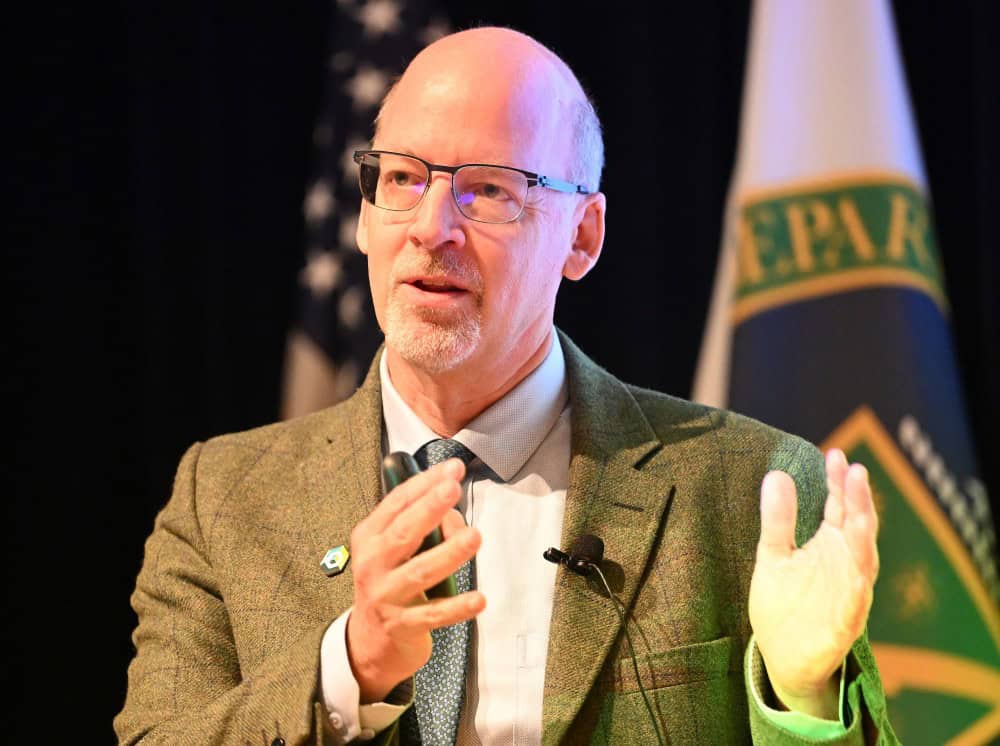
John Hill has become director of the Brookhaven National Laboratory in Long Island, New York, after serving as interim lab director since September. Hill will now oversee Brookhaven’s 3000-strong team of scientists, engineers and technicians as well as manage the lab’s annual $900m budget.
Brookhaven opened in 1947 as one of the first three US national labs, the others being Argonne and Oak Ridge. Brookhaven carries out a wide range of research in the physical, biomedical and environmental sciences and is home to seven Nobel-prize-winning discoveries.
Brookhaven operated the Relativistic Heavy Ion Collider (RHIC) until it shut down in February. RHIC collided heavy nuclei such as gold and copper to produce a quark-gluon plasma – a state of matter thought to have been present in the very early universe.
In 2020, Brookhaven was chosen to host the next-generation Electron-Ion Collider (EIC). Costing about $2bn, the EIC will smash together electrons and protons to probe the strong nuclear force and the role of gluons in nucleons and nuclei.
Building the EIC involves revamping the RHIC accelerator as well as adding an electron ring and other components with the first experiments starting the 2030s.
As well as RHIC and the EIC, Brookhaven is also home to other big-science projects including the National Synchrotron Light Source II, which opened in 2015 at a cost of $912m.
A Brookhaven career
With a PhD in physics from the Massachusetts Institute of Technology, Hill joined Brookhaven as a postdoc in 1992 before leading the lab’s X-ray scattering group from 2001 to 2013.
He then became deputy associate laboratory director for energy and photon sciences until becoming the lab’s deputy director for science and technology from 2023 to 2025.
In September 2025 he became interim director following the resignation of the theoretical physicist JoAnne Hewitt.
In the role, Hill will also become president of Brookhaven Science Associates – a partnership between Stony Brook University and the science and tech firm Battelle – that manage and operate Brookhaven on behalf of the US Department of Energy.
Hill notes that he is “very excited” to lead the lab in the coming years. “Brookhaven is entering a defining decade, and I’m honoured to take on this role at this time,” he says. “The vision we have for our future is a powerful one, including delivering the nation’s next particle collider and advancing science across a range of critical areas.”