New insights into the “reverse sprinkler” problem popularized by Richard Feynman have been provided by US researchers using modified rotary sprinklers. The results, which indicate that the reverse sprinkler is driven by the angular momentum induced at its centre by water being drawn in, could shed light on the fluid dynamics of open systems.
Rotary lawn sprinklers are ubiquitous devices that eject water at an angle to the head, thereby generating the torque to rotate and water a 360° area. The puzzle is how – or whether – sprinklers rotate if the problem is inverted and they suck the fluid in rather than blowing it out. A lawn sprinkler will, of course, draw in air, but Feynman conducted experiments with a submerged sprinkler that sucked water in and arrived at conflicting results.
Applied mathematician Leif Ristroph of New York University says that the asymmetry of the problem is not in itself surprising. “You can blow out a candle but you can’t suck it out,” he points out. “When you blow out a fluid through an orifice at a high enough flow rate, it forms a concentrated jet…When you reverse the system and pull in fluid at the same flow rate, the flow does not reverse – it pulls in fluid from all directions. That comes from the irreversibility of the Navier-Stokes equation.”
The correct way to model the system, however, is less clear. Some researchers have argued that the problem should be best solved by considering the total angular momentum of the system. Others focused on the torque exerted on the outside of the structure as fluid enters the nozzles, or the angular momentum that builds up at the centre due to the fluid that flows in from the outside of the arms.
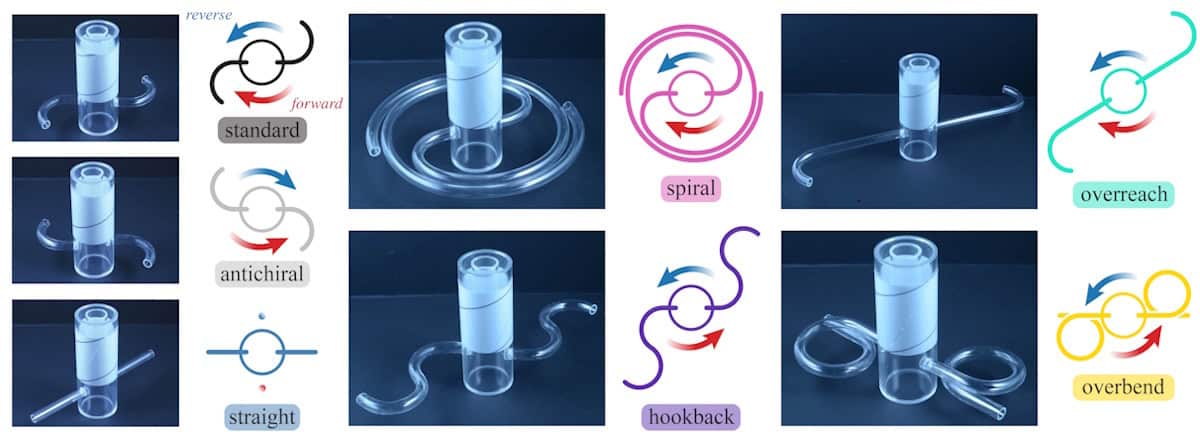
Attempting to disentangle these explanations, Ristroph and colleagues constructed a set of specially designed sprinklers. They submerged the devices before either drawing water out of the centre of each one or feeding it in. Each device’s geometry was designed either to amplify or nullify one of the effects previously proposed to determine the torque and thereby the rotation rate. For example, they tested the impact of the overall angular momentum by comparing devices with “spiral” arms (in which water travelled 360° before escaping) to those with S-shaped “hookback” arms (in which it doubled back). This did not explain the observed results.
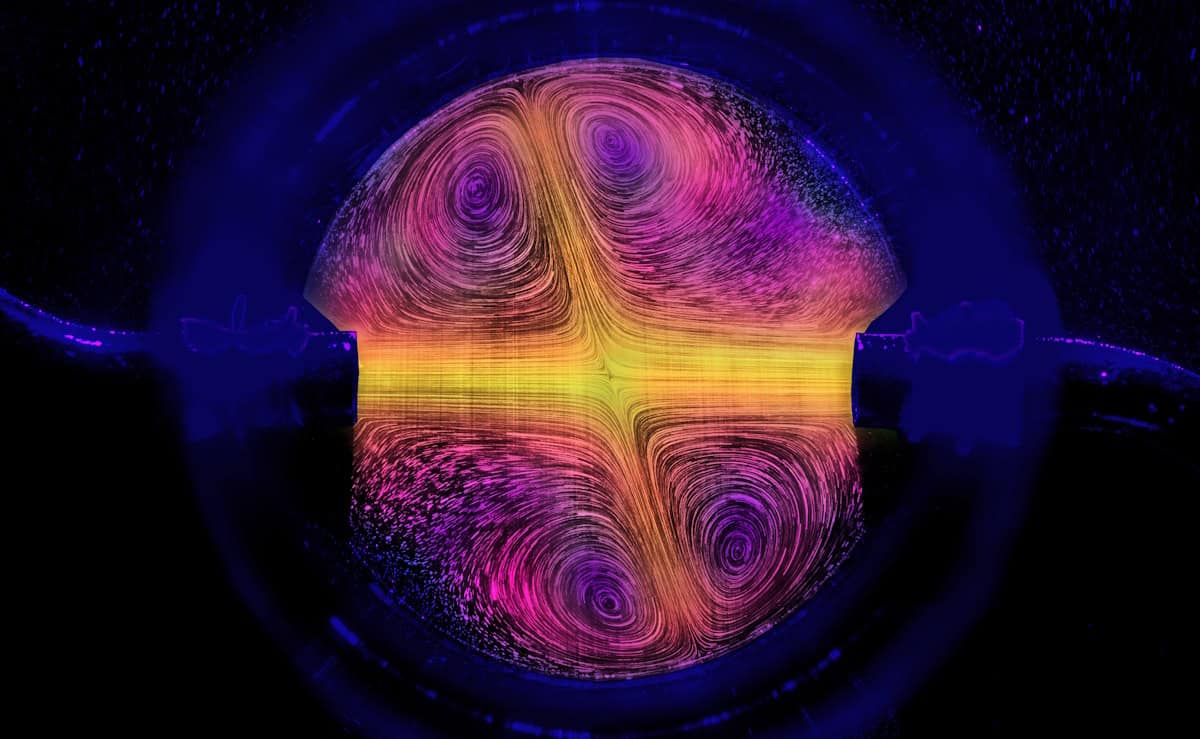
There was one factor, however, that correlated with torque and rotation rate irrespective of the geometry of the arms. “If you measure the angular momentum flux from any one of these designs it’s quantitatively one-to-one with the torque on the solid [in the forward case],” says Ristroph. “The beautiful thing is the same thing works in the reverse case, except now you should look at the centre where these arms begin, and there are very subtle asymmetries that inject angular momentum to the core of the device…That’s the common unifying principle: in all cases there are jets generated, but in the reverse case those jets are pointing in.” The lower torque at the centre makes the sprinkler much slower in reverse.
Mechanical engineer Earl Dowell of Duke University says that “the study in the paper is largely experimental,” although he acknowledges that “the experiments appear to have been carried out competently and the results presented in a well-organized manner”.
“What the authors call theories are notional ideas based upon highly simplified concepts that tend to be favoured by some physicists,” Dowell adds. “An expert in fluid mechanics…would attack this problem with well-established computational models for the flow field and rigid body dynamics for the sprinkler per se.” He believes that this is not, to his knowledge, being done because neither experiments nor computational simulations are expected to reveal any fundamental new concepts in fluid mechanics.
Fluid gears make their debut

“I have a hard time thinking this going to generate a practical device,” concedes Ristroph. However, he says that entirely new methods were needed to conduct these experiments and the researchers are now developing new computer simulations of fluid dynamics, in which fluids enter and escape from the system, to apply to it. “This is a beautiful problem to test your experimental methods, your computational methods, modelling, theory…This is a place to give it the best test it can possibly have.”
The research is published in Proceedings of the National Academy of Sciences.