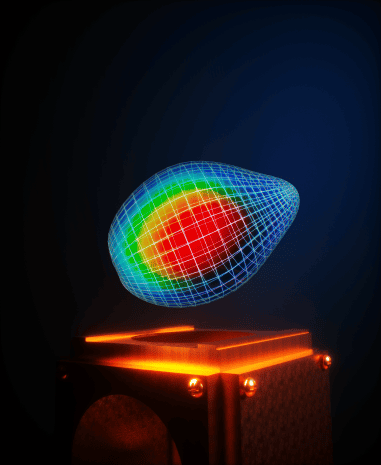
A new method of stabilizing radioactive molecules could open the door to sensitive searches for physics beyond the Standard Model. The approach, which involves cooling radium-bearing molecules to just above absolute zero, offers a tabletop alternative to experiments that use particle accelerators to look for violations of fundamental symmetries. According to lead researcher Nick Hutzler, a physicist at the California Institute of Technology (Caltech), US, it also shows that university laboratories can safely handle these radioactive materials, paving the way for similar studies at other institutions.
One of the greatest puzzles in physics is the fact that the early universe created more matter than antimatter. For decades, physicists have tried to solve this mystery (and others) by using particle accelerators to search for violations of nuclear symmetry at ever-higher energies. However, molecules that contain heavy radioactive nuclei could also act as super-sensitive sensors for symmetry violations – with the advantage that the equipment required to manipulate them generally fits in a single room, rather than an entire building.
Pear review
The basic idea is this: when electron orbitals overlap with a nucleus, the system’s atomic or molecular energy levels shift by tiny amounts that depend on the nucleus’ size and shape. Variations in nuclear structure due to symmetry-violating effects would therefore produce changes in the electron orbitals, and these changes could be measured with high-precision spectroscopy.
Asymmetric nuclei are ideal for this purpose because their lopsided shape makes small changes easier to detect. Radium, for example, has a pear-shaped nucleus, and radium-containing molecules offer additional advantages because the repulsion and attraction of neighbouring atoms further distorts the electron orbitals.
The downside is that radium is both radioactive and highly reactive, making it dangerous to handle without specialized equipment that is not present in standard university laboratories. It is also only available in extremely small quantities.
Sweet as candy
In the latest study, which is published in Science, physicists at Caltech and chemists at Johns Hopkins University and Michigan State University (all in the US) found a possible way around these obstacles. Their first step was to make radium stable and transportable. For this, they developed a process that resembles candy-making, though they do not recommend eating the results. By “caramelizing” small amounts of radium-226 in a solution of xylitol sweetener, they created a material they could transport in small quantities, keeping radioactivity levels low enough to comply with standard radiation-safety frameworks.
Next, they added their sticky radium “goo” to gold foil; installed it in a copper cryogenic cell; and cooled it to 4K using helium gas. They then used a laser to excite the radium into a chemically reactive state, allowing it to bond with targets such as hydroxide, deuteroxide and fluoride. Collisions with surrounding helium atoms further cooled these radium-bearing molecules into a mixture of only a few rotational and vibrational states. At this point, the team was finally able to perform the first-ever high-precision spectroscopic analysis of such molecules.
Opening doors
Hutzler acknowledges that several challenges remain before precision searches for symmetry violation can begin in earnest. Though theory predicts that these radium-bearing molecular species will be amenable to standard laser cooling and trapping techniques, no one has yet cooled them to ultracold temperatures. Another challenge will be to extend the process to other isotopes. Radium-225, for example, has a better nuclear shape for high-precision searches for symmetry violation, but it is also much more radioactive than radium-226, with a half-life of 15 days rather than 1600 years.
The team is also interested in studying the spectra of other radioactive species, with the aim of better understanding nuclear structure and chemistry at the extremes of the periodic table. A final possibility, Hutzler adds, would be to study other radium-containing molecules, as this would enable different precision measurements.
Exotic radioactive molecules could reveal physics beyond the Standard Model

David DeMille, a physicist at Johns Hopkins who studies symmetry violations in atomic and molecular systems but was not involved in this research, calls it an “extremely promising way” to search for interactions that violate charge-parity (CP) symmetry. The efficiency with which the team converts solid-phase radium atoms into gas-phase molecules is a good sign, he adds, and extending the process to other radioactive molecules could help scientists understand species that have been observed astronomically.
However, DeMille points out that achieving ultracold temperatures poses additional challenges, including finding a way to release the confined molecules into a larger, much more complex experimental setup, without helium, while maintaining safe conditions. That said, he notes that the spectroscopic results are, in themselves, an important step towards reaching this ultracold regime.