Physicists at CERN have recreated the collisions that trigger cosmic-ray air showers in Earth’s atmosphere. Results from the ATLAS experiment on the Large Hadron Collider (LHC) show that none of the computer models used to simulate showers gets every detail right. Their measurements of particle production in proton–oxygen collisions are more than ten times more precise than the differences between the models – which could be improved by these latest results. This will be a step toward understanding the most energetic particles in the universe.
Cosmic rays are energetic particles (mostly protons) from outer space. They strike Earth’s atmosphere at nearly the speed of light, setting off cascades of secondary particles.
“Cosmic-ray air showers are sprays of particles raining down from high in the sky,” explains Jesse Liu of New York University, the lead author of a paper that describes the study. He adds that cosmic rays come from “extreme corners of our universe,” with exploding stars and supermassive black holes in distant galaxies as likely sources.
Still, the origin of the most energetic cosmic rays remains “one of the biggest mysteries in astrophysics,” says Karl-Heinz Kampert of the University of Wuppertal in Germany, who was not involved in the study. Such particles carry a hundred billion-billion electron volts or more – compared to the million-million electron volts achieved by the LHC. At the highest energies, only about one such particle hits each square kilometer of Earth’s surface per century. “The only way to measure them in sufficient numbers is to detect the extensive air showers they produce,” he says.
Difficult calculations
Interpreting these showers relies on computer simulations. But, the role of the strong nuclear force, which governs the underlying collisions, is notoriously difficult to calculate. The simulations therefore use models informed by accelerator data, yet “existing models widely disagree with one another on how these showers form,” says Liu.
The most energetic cosmic rays collide at energies far beyond the reach of the LHC, so “we must extrapolate the known properties of particle interactions at man-made accelerators to those occurring in the upper atmosphere,” Kampert explains. Moreover, the LHC’s beams had previously consisted only of protons or heavy nuclei such as lead, rather than the light nitrogen and oxygen nuclei found in air. “For more than a decade, the cosmic-ray community has been working to convince the CERN and particle physics communities of the importance of such measurements,” he says.
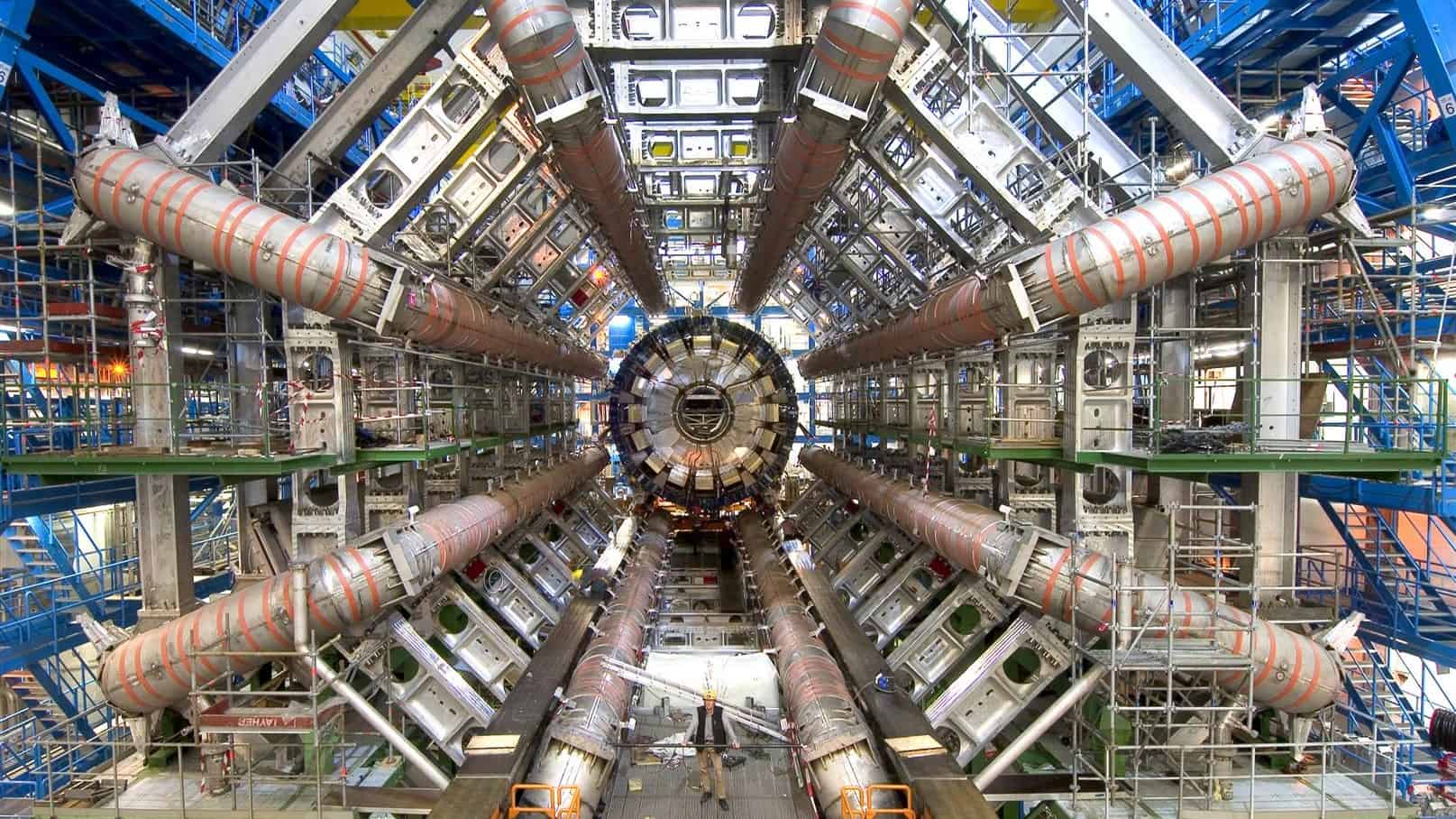
That changed in July 2025, when the LHC was reconfigured “to make protons acting as cosmic rays collide with oxygen nuclei playing the role of Earth’s atmosphere,” says Liu. The ATLAS detector recorded the charged particles these collisions produced.
Key parameter
ATLAS physicists studied “how many particles are created during collisions of protons and oxygen nuclei, alongside what energies and angles these particles fly out at,” Liu explains. They also determined the cross section, which “tells us how often these collisions occur,” he adds. Kampert calls it “a key parameter,” because it determines the average depth at which cosmic rays first interact in the atmosphere. This depth affects “essentially all air-shower measurements that are needed to infer the mass” of the incoming particle.
The measured cross section lies at the low end of model predictions, agreeing with only two of the seven models tested. The team also used it to infer the cross section for protons colliding with air, a quantity previously measured at such high energies only by cosmic-ray observatories. The result agrees with earlier air-shower measurements at similar energies.
“Our measurements are more than ten times more precise than the differences between the existing computer models,” says Liu. “Our data show that no model correctly describes the number of particles created in these collisions.” Some models misjudge the frequency of rare, particle-rich collisions by a factor of ten. A model called Angantyr best reproduces the particles’ energies and directions, but no model describes all the results consistently.
Blind spots and next steps
Kampert points out that the measurement has a blind spot because multipurpose detectors like CERN’s ATLAS and CMS are optimized to track particles flying out at relatively large angles to the beam. He explains, “most of the collision energy remains unseen by ATLAS and CMS and escapes close to the beam pipe, at very small angles. This unseen region most strongly influences the features of the air showers.” Specialized experiments, such as LHCf at CERN, are designed to fill this gap.
The next step, says Liu, is “to apply our data to improve the computer models of cosmic-ray showers.” Physicists will then check whether this eases the “muon puzzle” — facilities such as the Pierre Auger Observatory in Argentina see more muons, heavier cousins of electrons, in air showers than simulations predict. “Our proton–oxygen data are an important step toward resolving these puzzles and help decipher cosmic mysteries, namely what high-energy cosmic rays are made of and where they come from,” Liu adds.
Cosmic gamma-ray energy record shattered by high-altitude observatory

“Model builders have been eagerly awaiting this data and have started improving their models based on it and earlier accelerator data,” says Kampert. Because Auger results suggest that the most energetic cosmic rays are mostly heavier nuclei such as carbon, nitrogen, oxygen and silicon, he calls data from oxygen–oxygen or nitrogen–nitrogen collisions “another important step forward.”
Earlier this year, he and colleagues outlined in Nature Reviews Physics how such data could feed into a common tuning of the models, an undertaking he calls “a great community effort involving researchers from different fields of science.”
“I hope [our work] strengthens the cross-disciplinary connections between particle physics and high-energy astrophysics, with much to learn from each other,” says Liu.
The research is described in Physical Review Letters.