Remote uncrewed aerial vehicles (UAVs), or drones, equipped with solar cells could be wirelessly charged using laser beams directed at them from the ground, rather than relying on traditional onboard batteries. The problem until now, however, has been keeping the drones cool – since laser light heats them up, so reducing the efficiency of the photovoltaic cells they carry on their wings. A team of researchers at the Civil Aviation University of China has now overcome this problem by incorporating a heat blocking technology based on antimony selenide (Sb2Se3) nanorods into these solar cells.
As drones take on longer missions, battery life has become one of the biggest barriers, explains Jianhua Han, who led this new research study. “Our team has been looking into laser wireless power transmission, which is a leading approach for long-distance wireless energy transfer, to replace these batteries.”
Laser wireless power transmission is particularly suited to aerospace applications such as UAVs equipped with photovoltaic cells. Perovskite solar cells show much promise in this context because they are cheap to manufacture, absorb light strongly in the visible part of the electromagnetic spectrum and have long charge-carrier diffusion lengths.
A perovskite laser cell-thermoelectric tandem device
In the new work, detailed in Matter & Light, Han and colleagues studied a type of solar cell known as a perovskite laser cell-thermoelectric (PLC-TE) tandem device, which consists of a carbon-based CsPbBr3 perovskite as the PLC and bismuth telluride (Bi2Te3) as the TE material. The TE module is directly fixed beneath the laser cell and a carbon electrode is attached to its negative terminal to create a series connection. When laser light is shone onto the device, the carbon electrode converts a portion of the incident laser energy into heat. The TE then harvests this heat, converting it into electricity through the thermoelectric effect.
And that’s not all: since one side of the device ends up being warmer than the other, this temperature gradient also helps convert the thermal energy into electricity. The larger the temperature gradient, the more electricity the TE layer can generate.
There is a problem though: while the carbon in the hybrid structure dissipates some of the heat produced by the laser, the structure can still heat up – reaching temperatures of up to 90°C, says Han. “That was much higher than we expected and made us realize that heat buildup was a far more serious problem than we had imagined.”
Sb2Se3 behaves like a thermal barrier
To overcome this problem, the researchers turned to Sb2Se3, which is a promising photovoltaic material. As well as its good optoelectronic properties, this semiconductor also has a low thermal conductivity, which allows it to behave like a thermal barrier when embedded in a device.
Han’s team synthesized nanorods from the Sb2Se3 and incorporated them into the upper portion of the CsPbBr3 layer. The Sb2Se3 reduces heat dissipation in the carbon electrode and so helps maintain a significant temperature gradient in the TE device, thereby improving its overall energy conversion efficiency. Its thermal barrier properties also help decrease the PLC’s overall operating temperature during prolonged laser exposure.
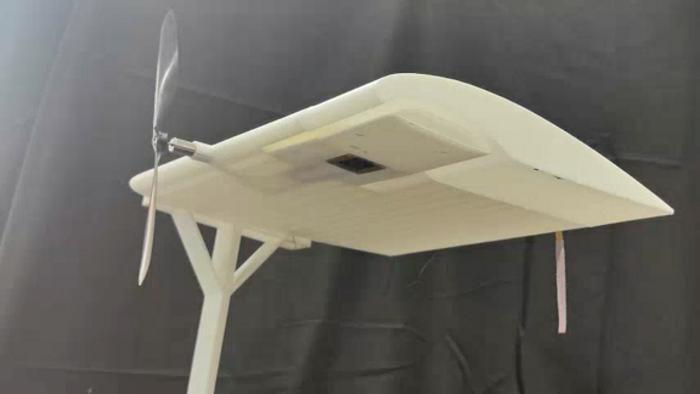
The team then inserted the tandem device containing the Sb2Se3 nanorods beneath the wing of a stationary drone and carved out air channels through the wing to simulate real-world airflow conditions. When illuminated with high-power green laser light with a wavelength of 520 nm, they found that the device converted 38.49% of the incoming laser energy into electricity and successfully powered the drone’s propellor blade. This power conversion efficiency, says Han, is among the highest reported for this class of technology operating under similar conditions.
Device could help UAVs stay airborne for longer
“In terms of concept, this is the first time that a system-level scheme of the devices has been applied to a UAV power supply, expanding the work from pure materials research to application-oriented system design,” Han tells Physics World. “It demonstrates that powering UAVs with light is not just a theoretical concept, but an engineering pathway that can be practically implemented.”
A route to more efficient wireless charging?

The device could help UAVs stay airborne for longer, something that will be useful for applications like forest patrol, disaster monitoring and delivering packages, he says. But there is still much work to do before such applications become a reality. For one, the researchers will need to integrate the PLC-TE device into a lightweight drone for flight testing outdoors and to assess the safety of their technology. They will also need to find a way of accurately tracking moving drones with laser beams.
“Going from the ground-based proof stage to the real flight validation stage will require solving many engineering challenges,” says Han, “but our technology is a good starting point and verifying its viability is the core objective for the next phase in our study”.