By analysing the signals from extragalactic fast radio bursts, astronomers at the Massachusetts Institute of Technology (MIT) say that the “missing matter” in the universe is distributed further away from galaxies than most theoretical simulations predict. Their finding – which is counterintuitive since the gravity from galaxies tends to pull everything closer to them – could help us better understand how highly energetic galactic activities, such as jets from supermassive black holes and explosions from old dying stars, impact the formation of cosmological structures.
“Ordinary” matter, which is built from atoms and their protons and neutrons (collectively known as baryons), makes up stars and galaxies and everything we see around us. However, the best models of the universe we have today suggest that close to 90% of this baryonic matter is “missing”.
The radio signals of FRBs are stretched
As their name implies, fast radio bursts (FRBs) are brief, intense bursts of radio waves spanning multiple wavelengths. They were first detected in 2007 and since then, astronomers have spotted thousands of others, including some within our own galaxy. They are thought to originate from cataclysmic processes involving compact celestial objects such as neutron stars and typically last a few milliseconds or even less. And these FRBs can be used to probe the missing baryonic matter.
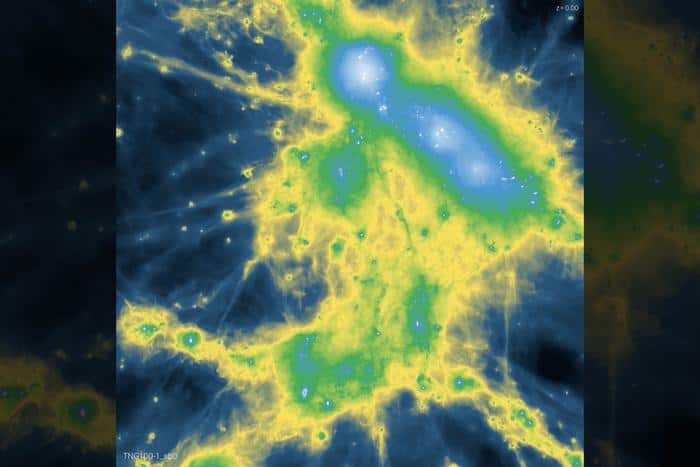
As they pass through the missing matter, the radio signals of FRBs are stretched (or “dispersed”) over time – that is, their overall duration becomes longer. The more missing matter they pass through, the more the signals are dispersed. The missing matter has an extremely low density – of just a single proton per cubic metre – so it is extremely difficult to identify, but researchers recently found that they could use the dispersion effect to detect it. In that previous study, they confirmed that intergalactic space, which contains most of the universe’s baryons, is home to tenuous clouds or filaments of diffuse plasma that make up the missing matter.
Data from CHIME and DESI
In the new work, a team led by astrophysicists Haochen Wang and Kiyoshi Masui has now gone a step further and mapped the extent to which this plasma extends. They did this by cross correlating the locations of millions of galaxies with the dispersion of nearly 3000 background FRBs on length scales of 0.1 to 50 Mpc.
The researchers used data from the Canadian Hydrogen Intensity Mapping Experiment (CHIME) catalogue and the Dark Energy Spectroscopic Instrument (DESI) survey. CHIME, a large radio telescope located in British Columbia, scans the entire northern sky for incoming radio waves and it can detect ultrashort, ultrabright radio signals. Indeed, it has detected about 4000 FRBs since it became operational. DESI, for its part, is an instrument mounted on the Mayall Telescope at Kitt Peak National Observatory, near Tucson, Arizona. It makes detailed measurements of the light coming from over 30 million galaxies – originally to provide estimates of dark energy, the mysterious force that is driving our universe’s expansion.
In all, the researchers detected 2870 FRB signals with CHIME and correlated these with the locations of around six million galaxies with DESI.
Missing baryonic matter scattered across a large radius
Their analyses revealed that on scales smaller than about 1 Mpc, the missing baryonic matter was indeed found around galaxies and galaxy clusters, but rather than being close to galaxies in a dense ball as expected, it was scattered across a large radius. “A galaxy is maybe a few 100,000 light years across, and we found missing matter out to about four million light years,” Masui says. “That’s further than the simulations predict.”
The new result backs up the idea that missing matter is projected out from a galaxy through highly energetic events, such as jets from supermassive black holes and explosions from old dying stars. These processes could be much more energetic than we think, note Wang and Masui, and they are stronger and much more violent.
The work, which is detailed in Physical Review Letters, proves that FRBs are a good way to study large-scale structures in the universe – in a similar way to how cosmologists have been using galaxies and the cosmic microwave background for decades, says Wang. “It has helped to establish FRBs as a new cosmological probe, especially for detecting the missing matter.”
Astronomers announce haul of the shortest fast radio bursts ever discovered
FRBs will only become a more popular tool in this context, he adds, especially given that several new radio telescopes, with upcoming surveys such as CHORD, DSA-2000 and the SKA, are being constructed around the world to offer much better FRB data in the coming years. “Indeed, we have already received more FRB data from our telescopes and are working on expanding our study,” Wang tells Physics World.
And that is not all: the researchers say they are also busy improving their analysis technique. “Until now, we have mostly examined the dispersion of FRBs but we are now working on extracting information from FRBs’ spatial positions relative to galaxies. This will reveal more details on how the missing matter is distributed in the universe.”