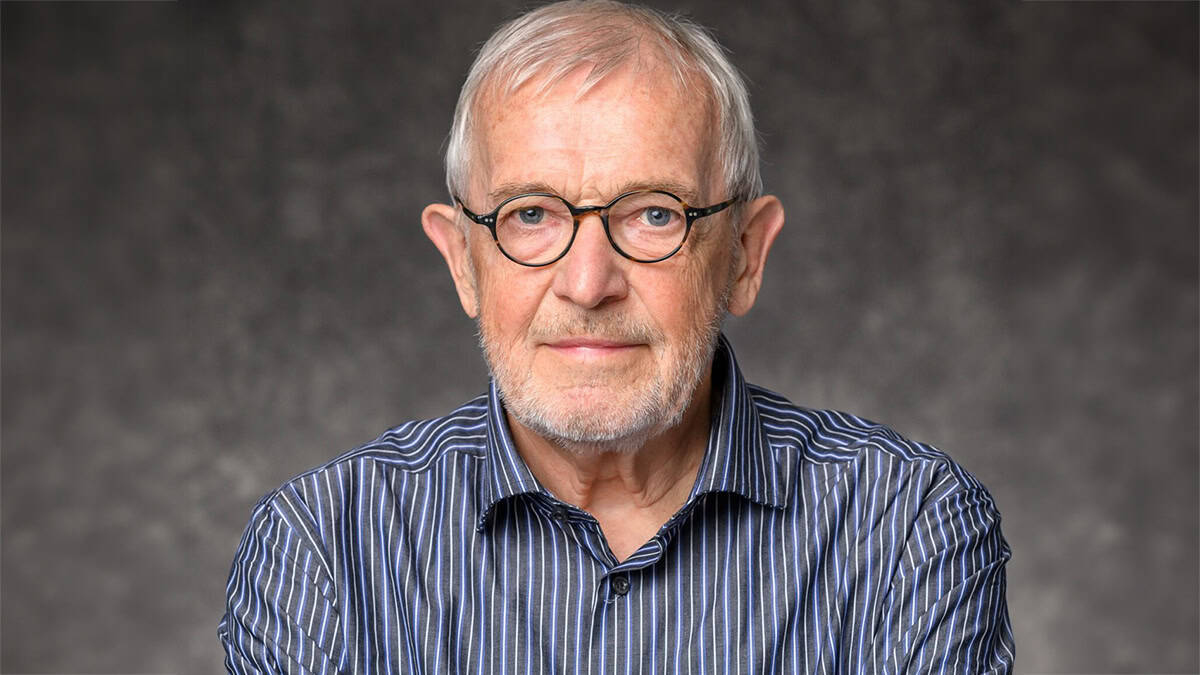
Francis Halzen wins the 2026 Nobel Prize in Physics “for decisive contributions to the IceCube Neutrino Observatory and the discovery of high-energy neutrinos of astrophysical origin”.
Born in Belgium, Halzen is based at the University of Wisconsin-Madison. In 1988 Halzen realized that the ice at the South Pole could be used to detect cosmic neutrinos. Two decades later IceCube began operation. It comprises many light detectors in a cubic kilometre of ice. Occasionally a neutrino will interact with the ice and create particles that are tracked through the ice – allowing Halzen and colleagues to determine where in the sky the neutrino came from.
The prize will be awarded in Stockholm on 10 December and is worth SEK 12 million (about $1.2 million).
Speaking on the telephone shortly after the announcement Halzen said, “It was a great surprise and I didn’t expect it. It’s a great pleasure to hear about this prize.”
He added, “When I reflect on this moment, I have to say how lucky I am. This was an adventure where success was not guaranteed, but we overcame many challenges. It was a long journey. I want to emphasize again how lucky I was to take contributions from collaborators. It feels strange. I hope it reflects on the courageous people who joined me on this project. Many talented people joined me on this journey.”
He was also thankful for the support of his university, “I was lucky to be in the right place [Wisconsin] when this idea [to build IceCube] came up.”
When asked what he will do for the rest of today, Halzen replied “I’m working on a proposal. I hope this prize will help get it approved.”
“Halzen had the idea together with a colleague in 1988 to use the ice at the South Pole as a medium to detect neutrinos,” said Mark Pearce, chair of the Nobel Committee for Physics, who is also an astroparticle physicist at KTH Royal Institute of Technology in Stockholm, Sweden.
Pearce adds, “Halzen has spearheaded an international collaboration of more than 450 people from 58 institutions in 14 countries around the world to realize this enormous neutrino detector.”
Halzen is the first sole winner of the Nobel Prize in Physics since Pierre-Gilles de Gennes in 1991.
Halzen was born in Belgium in 1944. He graduated with a MSc in physics from the University of Louvain in 1966 and then a PhD from the same university in 1969.
After a stint at the CERN particle-physics lab, he moved to the University of Wisconsin-Madison in 1972 where he also became the principal investigator on the AMANDA neutrino observatory in Antarctica and the IceCube project.
More to come