The 2026 Nobel Prize in Physiology or Medicine has been awarded to Karl Deisseroth, Peter Hegemann and Georg Nagel for “their discoveries concerning light-gated ion channels and optogenetics”.
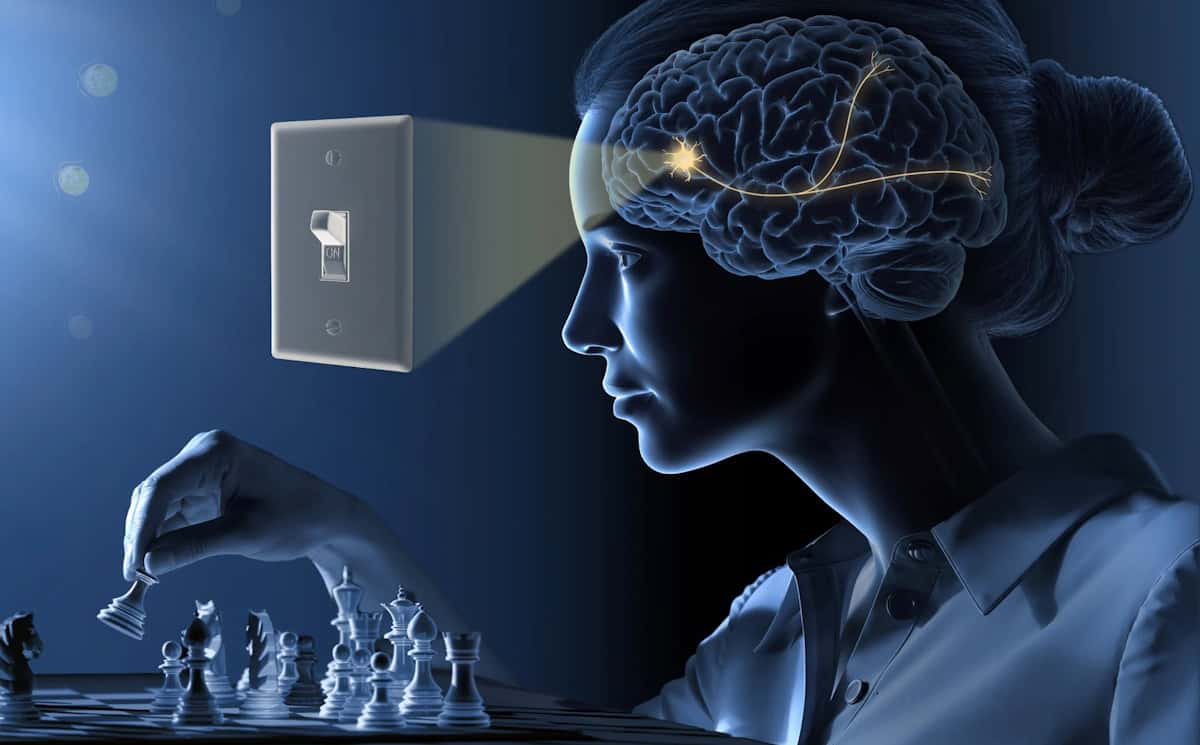
Optogenetics is a method that uses light to characterize and manipulate the activity of neurons in a living brain. Hegemann and Nagel discovered the light-sensitive protein channelrhodopsin, while Deisseroth transformed the protein into a light-controlled switch for nerve cells.
“Optogenetics provides opportunities for mapping the brain in a way that we could once only dream of,” says Per Svenningsson, chair of the Nobel Committee for Physiology or Medicine.
From the pond to the brain
Speaking in the press conference following the announcement, neuroscientist Abdel El Manira from the Karolinska Institute described how the breakthrough began with the study of a single-celled green alga, Chlamydomonas, known for its ability to swim towards light using a tiny “eyespot” on its surface as a sensor. Hegemann was intrigued as to how this simple organism could transform light into action.
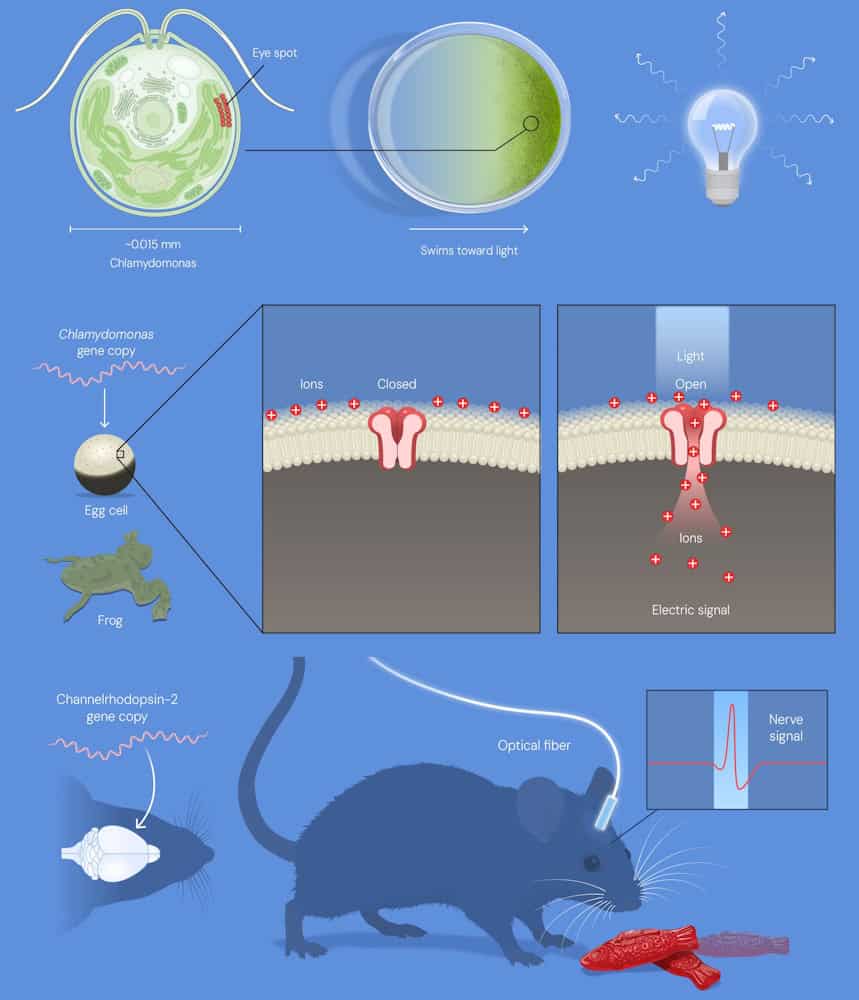
Using electrical measurements to solve this mystery, Hegemann discovered that the eyespot contains a light-sensitive protein that almost instantly converts light into an electrical signal, enabling the alga to move. Hegemann next teamed up with Nagel, who used the gene for Chlamydomona to produce the protein in frog egg cells. They discovered that the protein itself was a light-gated ion channel that opens when exposed to light, allowing positively charged ions to flow into the cell and rapidly generate an electrical signal.
“Nagel and Hegemann realised exactly what they had found. They had just discovered the switch neuroscientists had long dreamed of – a light-gated ion channel they named channelrhodopsin,” says El Manira.
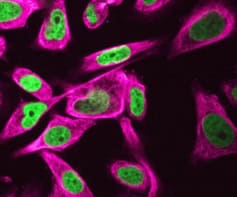
Appreciating the potential of this discovery, Deisseroth – at the time studying ways to establish causal links between specific brain circuits and behaviour – decided to test whether channelrhodopsin could be used as a switch to control the activity of neurons with light. By introducing the DNA encoding the protein (supplied by Nagel) into mammalian neurons and illuminating them with light, he observed a remarkable response: the neurons reacted on command, instantaneously and with millisecond precision.
The real test was whether channelrhodopsin could control neurons in living animals. Deisseroth and colleagues demonstrated that this was possible. By introducing the gene for channelrhodopsin into specific nerve cells in the brains of living mice and illuminating these cells via a thin optic fibre, they activated selected group of neurons and elicited a distinct behaviour.
“For the first time, causal links between specific brain circuits and behaviour had been achieved. The technology, which soon became known as optogenetics, transformed neuroscience,” notes El Manira. “Optogenetics was rapidly and widely adopted all over the world.”
Future medical potential
The field of optogenetics has now enabled researchers to establish causal links between neural activity and behaviour, identifying, for instance, neural circuits associated with pain, social behaviours, thirst, food consumption, reward and attention. Beyond the healthy brain, the technique also sheds light on how specific brain circuits can be disrupted and how this impacts psychiatric and neurological conditions.
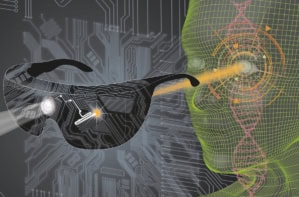
And while optogenetics is primarily a tool for basic research and understanding of disease, optogenetic therapy is also showing early promise as a medical treatment. In particular, a landmark study has demonstrated partial recovery of visual function in a blind patient with retinitis pigmentosa, by insertion of a channelrhodopsin-like protein in their retina.
“In this disorder, retinitis pigmentosa, patients lose their photoreceptors, the rods and cones in the retina,” explains Svenningsson. “But there are still healthy cells in the retina and researchers have used optogenetics to stimulate these healthy cells and thereby activate the optic nerve and generate vision perception in the brain. This has been done and there are several clinical trials ongoing with this approach.”
Elsewhere, optogenetics is also under investigation for applications including control of spinal cord activity and bladder activity in small animals, inhibition of nerve pain and guidance of morphogenesis in a living embryo.
Friends together
Karl Deisseroth was born in 1971 and received his PhD and MD from Stanford University in the US, where he performed the work for which he was awarded the prize. He is currently an investigator at the Howard Hughes Medical Institute and professor at Stanford University.
Peter Hegemann was born in 1954 and received his PhD at the Max-Planck-Institute for Biochemistry in Martinsried, Germany, where he made his prize-awarded discoveries. He is now a senior professor of neuroscience at Humboldt University of Berlin, Germany.
Georg Nagel was born in 1953 and received his PhD at the University of Frankfurt, Germany. His prize awarded discoveries were made at Max Planck Institute for Biophysics in Frankfurt. He is currently professor of molecular plant physiology at the University of Würzburg, Germany.
Plug me in: the physics of brain–computer interfaces

Thomas Perlmann, secretary-general of the Nobel Assembly, described his call to the laureates earlier this morning: “All three were very surprised and all three said the same thing, that it was absolutely wonderful to receive the prize with the other two, called them ‘my friends’, and that it was such an honour to receive them together”.
- Read about the use of organic dyes in optogenetics, in a book chapter co-authored by Peter Hegemann, now free to read on IOP Science.

SmarAct proudly supports Physics World‘s Nobel Prize coverage, advancing breakthroughs in science and technology through high-precision positioning, metrology and automation. Discover how SmarAct shapes the future of innovation at smaract.com.