Flocks of birds, schools of fish, colonies of swimming bacteria and even crowds of humans have something important in common. Although the details of how they move and interact are very different, they are all examples of what physicists call “active matter” – collections of particles that propel themselves through their environments, consuming energy as they go.
Because real-world active matter systems can be complex and hard to model mathematically, physicists working in this field sometimes study simpler “toy” systems instead. In a study published in EPL, Timo Wagner, Michael Himpel, Thomas Ihle and Horst-Holger Boltz took this principle a step further by building an active matter system made from literal toys.
Working at the University of Greifswald, Germany, they developed a model active matter system based on bristlebots, which use the friction and the elasticity of their asymmetric legs (the bristles) to turn vibrations from their small onboard motors into directed motion. The overall effect is similar to a smartphone moving across a table as it vibrates, with one important difference: the Greifswald team’s bristlebots incorporate a bias, or chirality, into their movement. Physics World spoke to Boltz about the group’s work.
Why did you decide to use bristlebots as your model active matter system?
Our research group is developing kinetic theory for active matter systems, and we aim to derive statistical descriptions that start from the equations of motion of individual particles. In active matter, the effective dynamics are more general than truly microscopic equations of motion, which means one can write down a great variety of models. However, not all these models are physically realizable, so we needed an experimental system that would allow us to determine which dynamics actually occur and to infer realistic parameter values.
It turns out that this is surprisingly hard to do in most active matter experiments. In colloidal or biological systems, for example, you typically observe the collective behaviour, but you have limited access to the microscopic parameters that enter the theory. We wanted a model realization of an active gas that we have full control of and insight into.
Bristlebots are an attractive option because they are cheap and operate on length scales that are easy to work with. Although there are limits to how analogous they are to real physical systems (among other shortcomings, bristlebots are dry, frictional, macroscopic objects with no hydrodynamics, no thermal noise in the usual sense, and interactions that depend purely on spatial arrangement), they do allow us to isolate and study specific aspects of the dynamics. In this study, we chose to focus on the interplay of chirality and self-alignment with structured environments, in a setting where we have full experimental access to all the relevant parameters.
Why were you interested in chirality?
From a theoretical perspective, adding chirality is a logical step because it is the simplest form of free dynamics in a system’s internal degrees of freedom. Whereas a non-chiral particle will only change its direction due to noise or interactions with other particles, a chiral particle constantly turns on its own with a deterministic drift.
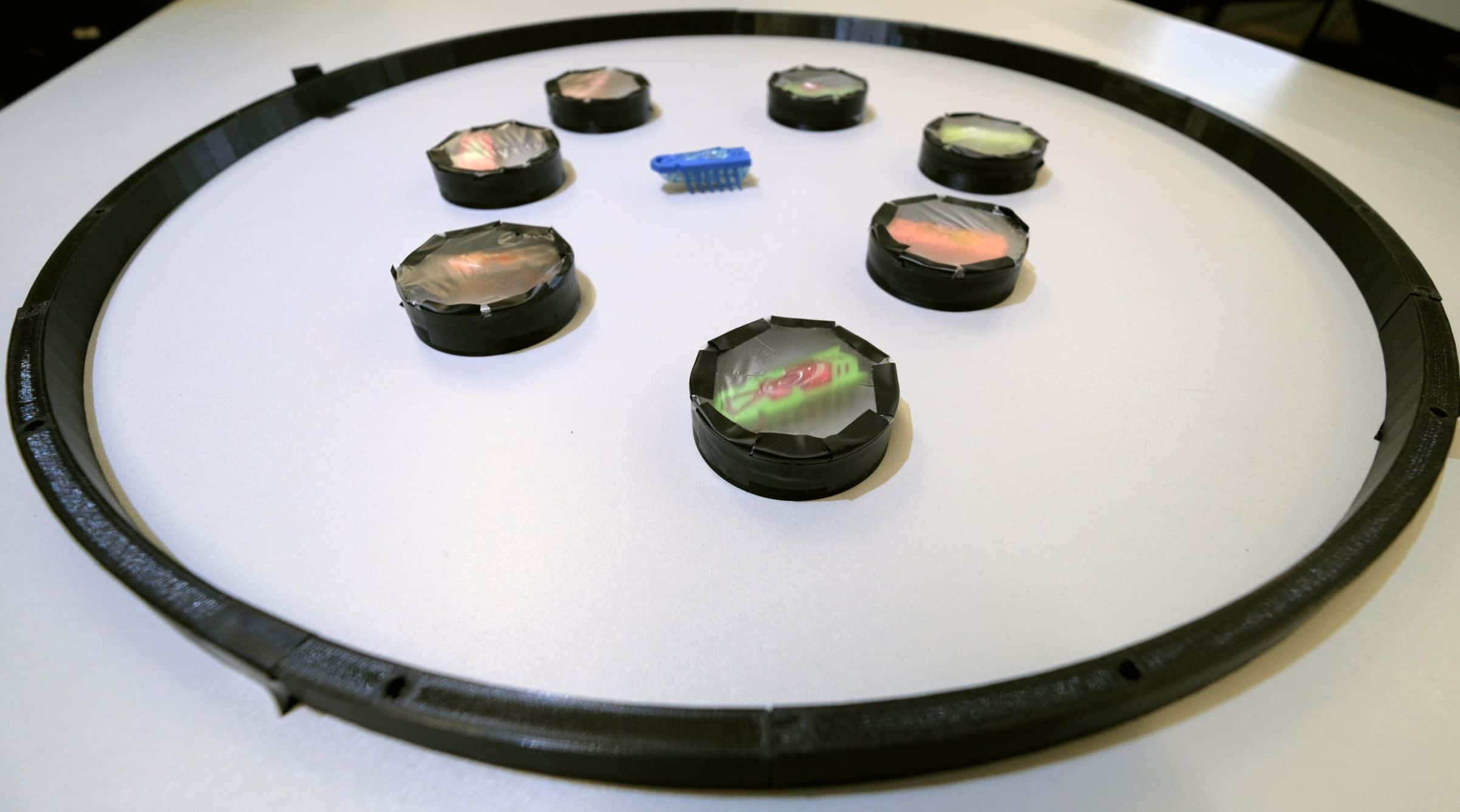
Our chiral bristlebot system is based on a commercial toy bot called a Hexbug nano with a motor that is placed off-axis, such that a single bristlebot will always move in a circular pattern. Many previous bristlebot experiments have sought to control this chirality, or to suppress it by adding counterweights, but we leaned into it.
We found that if you design the system to have pronounced chirality, qualitatively new phenomena become accessible. In particular, you start to see interplay between the chirality of the particle and the chirality of the environment, which gives you a form of passive control over collective transport. That was not something we set out to find: it came out of the design process for the particle housings.
What is the most important advance in the paper?
There are several layers to this. On the most practical level, we show how to turn a cheap commercial toy into a self-aligning chiral active particle by enclosing it in a 3D-printed housing with an elastic cover. This is an experimental platform that high school students could use: it requires little investment yet still allows for relevant research.
Our central physics result is about how chirality interacts with geometry to control transport. In a circular arena, our “particles” – the chiral bristlebots – form edge currents along the boundary. We show that the stability of these currents depends on the relative handedness: if the chirality of the particle and the direction of the current are mismatched, the particles are constantly pushed into the wall and the current is very stable. In the opposite case, they tend to leave the wall and the current is volatile. This asymmetry is a direct consequence of the self-alignment and would not be present in a standard active particle model based on Brownian motion.
We then exploit this behaviour by placing a chiral obstacle shaped like a nautilus shell in the arena. This creates a bottleneck with effects that depend simultaneously on three different chiralities: the particle’s own chirality, the direction of the collective motion, and the handedness of the obstacle. In the best case, transport is essentially unimpeded. In the worst case, you get pronounced jamming. This is a chirality-sensitive ratchet effect, a genuinely non-equilibrium phenomenon that could not occur in a passive system.
If I had to pick just one highlight, though, it would be the demonstration that passive geometric control of active transport is possible and that chirality is the relevant control parameter. This is not an abstract theoretical observation: we show it working in a real system with real particles. I am rather fond of the Nautilus-like geometry that we found to rectify (or at least bias) transport based on handedness. It’s somewhat like a diode or a valve, where transport in one direction is strongly favoured over the other direction.
What was the most challenging aspect of this work?
The commercial bristlebots we use tend to jam at walls, so they accumulate into immobile clusters. Enclosing each bot in a circular ring solves this because the particle can now rotate within its housing and reverse direction on the spot; however, we also needed the particles to be fast and to retain their chirality. Many design choices that helped with one aspect hurt the other, and we went through 11 iterations before arriving at a design that uses a thin elastic foil as a cover.
That foil introduced a coupling between propulsion direction and actual velocity, which we had not planned for. So during the design phase, the scope of the project shifted from studying a chiral active gas to studying a chiral self-aligning active gas, which is a richer system but also one for which less theory exists.
A separate challenge is that the data you can get from our system is inherently limited. The bots run on small batteries, so each measurement lasts at most a few minutes before ageing effects become relevant, and we have a finite number of bots. We cannot simply run for longer or add more particles. This meant the analysis had to be designed to extract as much information as possible from relatively short trajectories, which is part of why we developed the adjusted velocity autocorrelation that factors out the deterministic chirality and isolates the noise contribution. There are many ideas that improve on this, but we are primarily a theoretical group and operated on limited resources.
What are your next steps?
We now have a well-characterized experimental system with known parameters, which is exactly the input that kinetic theory needs. We are working on deriving transport coefficients, diffusion constants and flow profiles from the microscopic equations of motion for chiral self-aligning particles. The goal is a quantitative, first-principles prediction that we can then compare to experimental data. That cycle of prediction and experimental test is what we want this platform to enable.
Active matter goes chaotic

On the experimental side, one natural direction would be to vary the geometry of the rigid constraints, for example changing the shape or size of the linked structures to see how the effective energy landscape and the mode-switching behaviour respond. Another is to implement non-reciprocal interactions, meaning that particles respond differently to a neighbour depending on some internal state. That would be a significant step up in complexity and would connect to a very active theoretical debate.