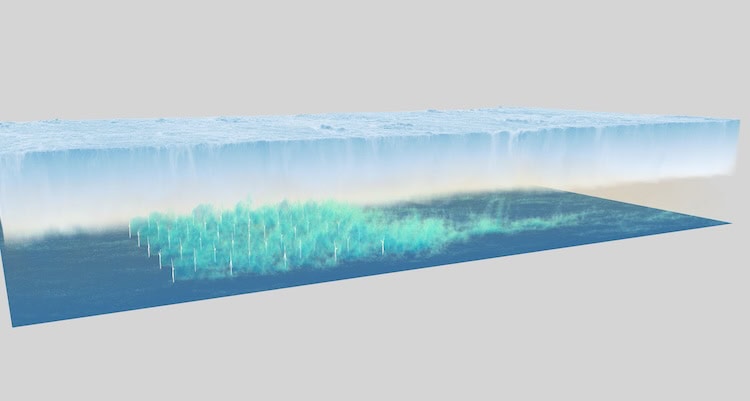
Low-level sea clouds can make offshore wind farms more efficient, say researchers at the University of Twente in the Netherlands. This increase in efficiency is due to atmospheric mixing effects that shrink the wake of slower air behind nearby turbines, and the team say it could help wind farm designers make the most of ambient conditions.
Scientists have known for decades that multiple wind farms can be significantly less efficient than a single, isolated one. This is because air slows down as it moves through turbine blades, creating a wake that impairs the performance of wind farms downstream. This slow-air wake may extend for tens of kilometres, and in extreme cases it can even stretch beyond 100 km. “How quickly the wake recovers depends on how effectively atmospheric mixing pulls air from the stronger wind above and on the sides,” explains Davide Selvatici, a physicist who co-led the research with his colleague Richard Stevens.
In their latest study, which appears in PRX Energy, Selvatici and Stevens show that the presence of low-level stratocumulus clouds can enhance this mixing via a process called radiative cooling. This occurs when air at the top of a cloud radiates heat into space and becomes cooler, much like the ground does on a clear night. Because cooler air is denser than the surrounding air, it sinks, generating an enhanced downward motion that intensifies atmospheric turbulence. This ongoing mixing helps sustain the cloud by drawing moisture up from the surface below.
Fully three-dimensional simulations
To piece together this picture, Selvatici and Stevens needed to accurately model the turbulence in cloud tops and the way that air flows through a wind farm. They used large-eddy simulations to study how low-lying clouds impact the length of a wind farm’s wake. They also performed high-resolution simulations of stratocumulus-topped boundary layers across a range of atmospheric conditions: clear skies, cloudy skies without radiative cooling; and cloudy skies with radiative cooling.
These simulations are fully three-dimensional, and Selvatici explains that creating them meant solving equations within the model to determine how wind moves in all three directions, while also incorporating changes in temperature, water vapour and liquid water suspended within the cloud. For this, they relied on the Navier-Stokes equations (the standard equations used to describe the movement of fluids such as air) with some modifications. “We use an extended set of equations to include the effects of heat and moisture and to represent the energy and momentum extracted by the wind turbines under local wind conditions,” Selvatici explains.
“Effects can be significant”
The pair’s results indicate that the effects of cloud-top cooling can be significant. When these effects are present, the mean wind speed within a wake returns to approximately 90% of the incoming wind speed about 17 km beyond the end of the wind farm. In simulations without cloud-top cooling, however, the mean wind speed remained below 90% even 32 km beyond the end of the farm.
“Clouds are inherently coupled to the atmosphere, making it difficult to isolate their effects, but by comparing simulations with and without cloud-top cooling, we identified cloud-top cooling as an important process for wind farm wake recovery,” Selvatici explains.
So you want to install a wind turbine? Here’s what you need to know

Since wind farm power production increases with the cube of wind speed, even a modest reduction in wind speed can have a considerable effect, he adds. The problem is that most existing wind-farm models either simplify cloud-related processes or exclude them altogether. “Our results demonstrate that these should be taken into account,” says Stevens, “particularly in regions with frequent low-level clouds as over the North Sea, where many wind farms are found and where the annual cloud coverage is higher than 30%.”
Stevens adds that a better understanding of these effects could improve wind farm design and inform how far individual wind farms should be placed from each other. However, Selvatici notes that they’re not yet able to offer definite practical advice. “We cannot conclude whether wind farms should indeed be placed closer together in cloudy regions because our simulations represented idealized conditions,” he says.