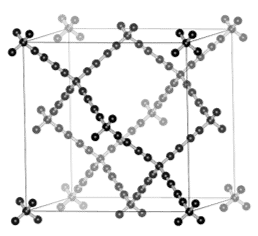
Researchers in Sweden have synthesized a new allotrope of carbon which, like diamond, forms covalent bonds in 3D. Unlike in diamond, however, carbon atoms in the new “diamondiyne” material form these bonds at relatively low pressure, producing a more porous crystal with properties that are still under investigation.
Carbon is among the most versatile elements in the periodic table. Because it can bond with other elements in one, two or three dimensions, it is a building block for a wide range of structures with varying electronic properties. This versatility also appears when carbon bonds with itself to form allotropes such as fullerene (which is considered zero-dimensional, as its internal structure plays little role in its properties); one-dimensional carbon nanotubes; and two-dimensional graphite and graphene.
The search for more carbon allotropes took off in 2004 after graphene was isolated for the first time. The number of theoretically predicted structures now stands at 1635, though most have never been created in the laboratory. Among those that have is an expanded version of graphene known as graphdiyne, which is composed of carbon atoms with different kinds of hybridized electronic orbitals (sp2 and sp).
Although researchers took the first steps towards making diamondiyne more than 30 years ago, getting to the final product proved challenging. The reasons are two-fold. First, one of the material’s building blocks, tetraethynylmethane, is unstable. Second, the carbon atoms in diamondiyne are covalently connected by robust single carbon–carbon bonds and even stronger triple carbon–carbon bonds. Such strong connections make it difficult to form a version of the material that is crystalline in all three dimensions.
A cascade reaction on a liquid–liquid interface
In the new work, which is described in Angewandt Chemie, physical chemist Karl Börjesson and colleagues at the University of Gothenburg succeeded in producing the desired crystalline state using a so-called cascade reaction with kinetics they could control. This reaction takes place on a liquid–liquid interface, ensuring that monomers bind to a formed crystallite one by one. The result is an expanded crystal structure featuring a “carbo-mer” of diamond in which sp3-hybridized carbons are connected by four sp-hybridized carbons to form two triple bonds – a structure commonly known as a ─diyne group.
“To our knowledge, diamondiyne is the first allotrope besides diamond in which the carbon atoms form covalent bonds in all three dimensions,” Börjesson says.
Liquid-liquid interfaces had previously been used to make graphdiyne and other 2D materials. In this work, the liquid–liquid system consisted of tetra(triethylsilylethynyl)methane and CuF2. When the F− ions in the latter molecule react with tetra(triethylsilylethynyl)methane, they produce tetraethynylmethane, which has exposed terminal alkyne groups – that is, structures containing at least one carbon-carbon triple bond. The Cu2+ ions then catalyse coupling between pairs of terminal alkynes.
As the reaction proceeded, Börjesson and colleagues observed a film containing diamondiyne crystallites growing perpendicularly out of the interface between the two liquids. “We have previously shown that under such circumstances, the growth of covalent crystals is favoured kinetically,” Börjesson explains. To further encourage the emergence of the crystals via the molecule-by-molecule addition of tetraethynylmethane to the carbon film at the interface, Börjesson adds that the team kept the concentration of tetra(triethylsilylethynyl)methane relatively low.
Characterization and applications
The finished films have an area of around 5 cm2 and are between several nanometres and tens of nanometres thick depending on the reaction time. Images obtained using transmission electron microscopy (TEM) confirmed that the crystal structure of the diamondiyne persists over volumes of 10 nm3, the team says.
Liquid carbon reveals its secrets
The researchers have been working with similar covalent organic frameworks (COFs) for several years now, mainly focusing on making COFs using carbon-carbon coupling reactions. “We then realized that we could use a similar synthetic methodology to make this new carbon allotrope,” says Börjesson.
He and his colleagues now hope to make larger crystallites of diamondiyne so that they can measure its properties as accurately as possible. “We will need to do this to find out what we can use the material for,” Börjesson tells Physics World.