Giannis Zacharakis is a biophotonics and biomedical imaging researcher and CEO of the precision photonics spin-off Kymatonics
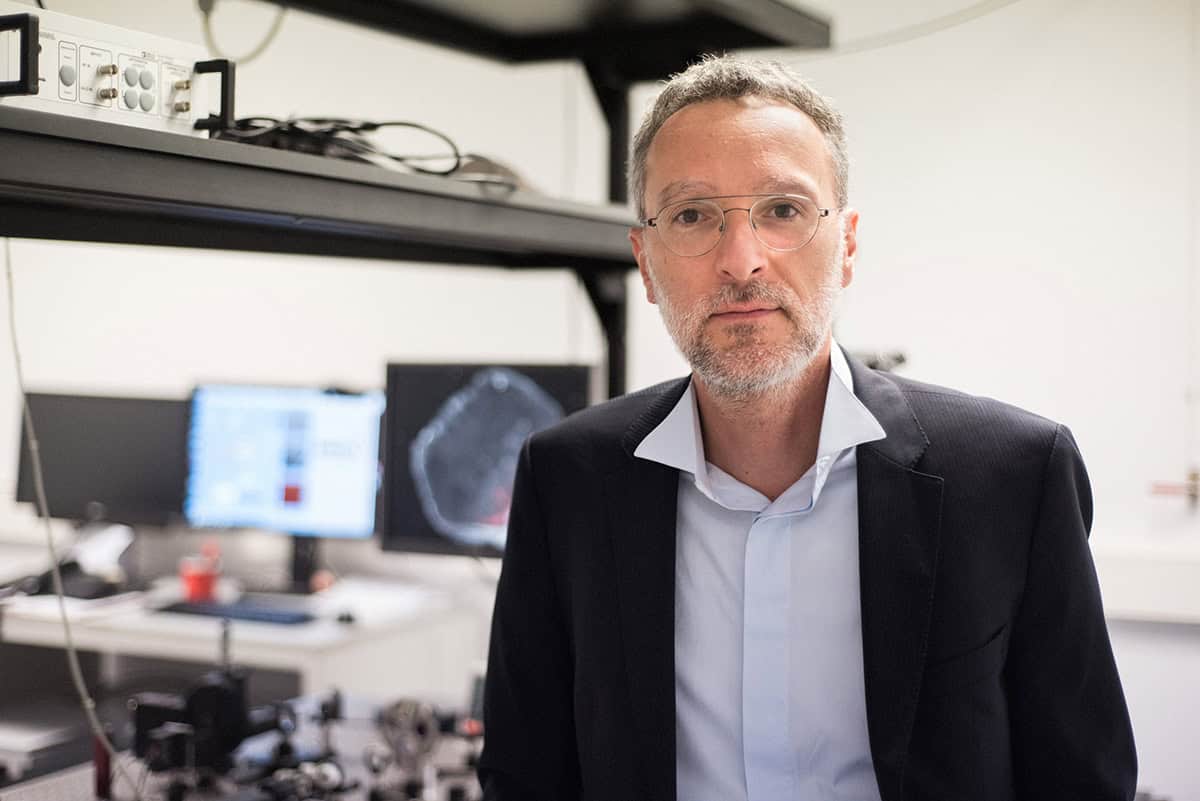
Giannis Zacharakis is a research director at the Institute of Electronic Structure and Laser (FORTH) in Greece, where he leads the Laboratory for Biophotonics and Molecular Imaging. Zacharakis has served as president and vice-president of the European Society for Molecular Imaging. His main focus is on developing key enabling technologies for imaging biological processes in living systems.
Zacharakis is also the CEO of the precision photonics spin-off Kymatonics. The company recently secured a highly competitive €2.1M European Innovation Council (EIC) Transition Open grant, to advance the development and commercialization of their innovative wavefront-shaping objective lens.
What skills do you use every day in your job?
My everyday work involves both hard and soft skills, which are equally important for a successful career.
At its core, my work is about asking questions and defining the path to discovery, through scientific knowledge and rigour. This requires being able to break down complex physical and biological problems into manageable and measurable components under certain hypotheses. Much of my day therefore involves analytical thinking and judgement: evaluating whether an observed effect is physically meaningful or an artefact of instrumentation or data processing. That defines the path forward.
Problem solving constantly requires creativity and thinking out of the box, because experiments rarely behave exactly as planned. You need patience, persistence and the ability to stay calm when instruments misbehave or data contradict expectations.
Communication is another central skill. I regularly explain technical concepts to students, collaborators from other disciplines, and biologists or clinicians who may not share the same vocabulary. Translating physics into accessible language, without oversimplifying the science, is something I consciously practise and it takes time and effort to achieve.
Project management also plays a surprisingly large role. Co-ordinating experiments, supervising students, meeting deadlines for proposals or manuscripts, and balancing long-term research goals with short-term deliverables requires structured planning.
Finally, mentoring is an important part of my routine. Guiding students and young scientists through experimental design, encouraging independent thinking, and helping them develop scientific confidence is both a responsibility and an integral component of academic work.
Essentially, while physics provides the foundation, my job relies on a blend of analytical rigour, practical problem-solving, communication and leadership.
What do you like best and least about your job?
What I value most is intellectual freedom: the ability to pursue questions that genuinely interest you is a privilege. There is something deeply satisfying about seeing a concept move from hypothesis to experimental evidence. Even incremental progress can feel meaningful when it clarifies a mechanism or resolves ambiguity.
I also appreciate the interdisciplinary environment. Working at the interface of physics, biology and biomedicine forces me to continuously learn and think beyond boundaries. It prevents intellectual stagnation and keeps curiosity alive.
Mentoring students is another highlight. Watching someone gain confidence, moving from following instructions to proposing their own ideas, is deeply rewarding. Research training is not only about technical knowledge; it is also about developing judgement and rigour.
On the more challenging side, uncertainty is a constant companion. Funding cycles; competitive grant applications and proposal rejections; and the unpredictability of research outcomes can be demanding. Not every idea works, and not every effort translates into immediate output. Maintaining momentum despite setbacks requires persistence and resilience.
Administrative responsibilities can also fragment time and reduce deep focus. Balancing research, supervision and institutional duties often requires careful prioritization.
What do you know today that you wish you knew when you were starting out in your career?
I wish I had understood earlier that uncertainty is not a sign of inadequacy but is the natural state of research. Early in my career, I expected clarity to come quickly if I worked hard enough. In reality, meaningful progress often requires extended periods of ambiguity. Learning earlier to tolerate that and even see it as productive would have reduced unnecessary self-doubt.
I also underestimated the importance of communication. Being technically correct is not enough; ideas need structure, clarity and narrative. Writing well and presenting clearly are not secondary skill; they are core scientific tools.
Another lesson is that collaboration is essential. Scientific progress increasingly happens at disciplinary boundaries with impactful discoveries emerging at interfaces. Engaging with people who think differently challenges assumptions and strengthens work.
Finally, remember that career paths are less rigid than they appear. There is rarely a single “correct” trajectory. Developing transferable skills, analytical thinking, adaptability, mentoring and project management provides resilience across different opportunities.
I would tell my younger self to focus less on short-term milestones and more on building depth, clarity of thought and professional relationships. Those foundations endure longer than any single milestone.