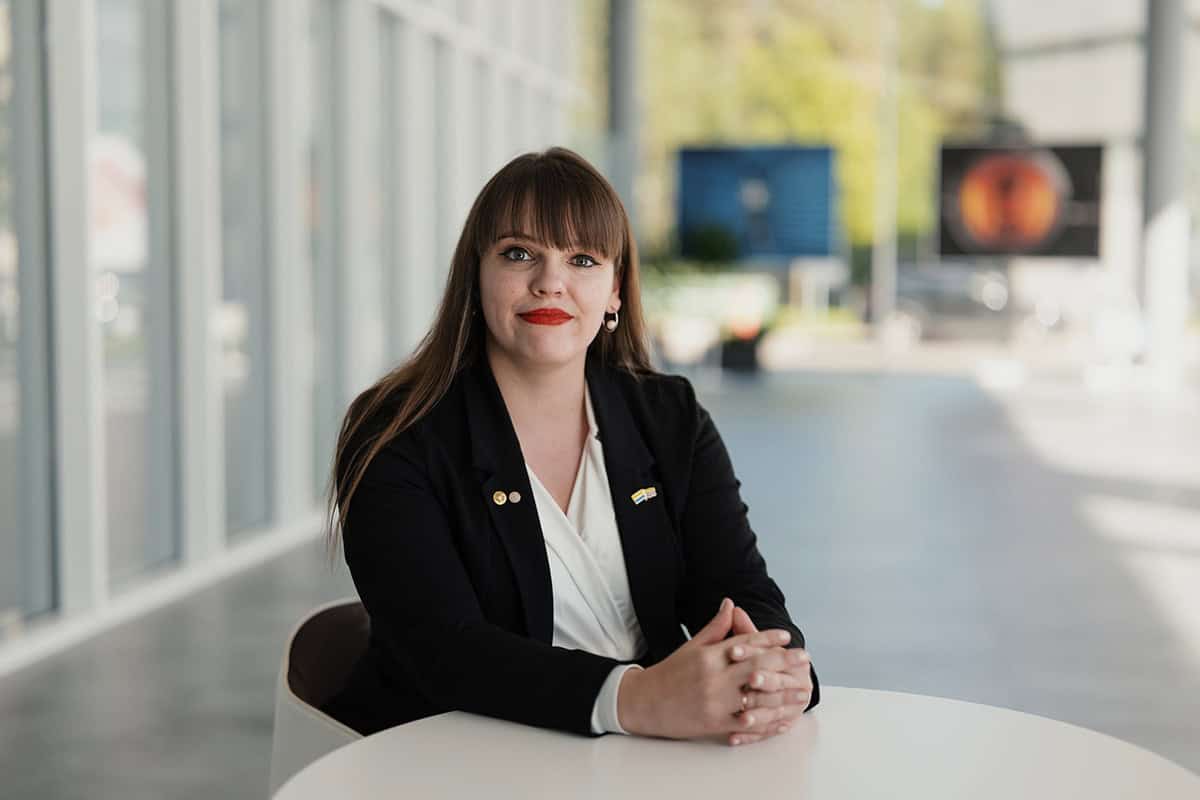
Mažena Mackoit-Sinkevičienė is a researcher at the Institute of Theoretical Physics and Astronomy, Vilnius University, Lithuania. Working in quantum optics and technology, with a focus on quantum emission from point defects in solid-state platforms, and non-classical spin states in ultracold atomic gases, she is a co-author of Lithuania’s National Quantum Guidelines and vice-president of the Lithuanian Physical Society. Mackoit-Sinkevičienė has received several awards, including the Lindau Nobel Laureate Meeting Alumnus distinction and the Lithuanian Government Award. Most recently, she won the 2025 Baltic Women in Science Fellowship awarded by the Baltic National Academies of Sciences and UNESCO National Commissions.
What skills do you use every day in your job?
Much of my time is spent trying to build and refine models in quantum optics, usually with just a pencil, paper and a computer. This requires an ability to sit with difficult concepts for a long time, sometimes far longer than is comfortable, until they finally reveal their structure.
Good communication is equally essential – I teach students; collaborate with colleagues from different subfields; and translate complex ideas into accessible language for the broader public. Modern physics connects with many different fields, so being flexible and open-minded matters as much as knowing the technical details. Above all, curiosity drives everything. When I don’t understand something, that uncertainty becomes my strongest motivation to keep going.
What do you like best and least about your job?
What I like the best is the sense of discovery – the moment when a problem that has evaded understanding for weeks suddenly becomes clear. Those flashes of insight feel like hearing the quiet whisper of nature itself. They are rare, but they bring along a joy that is hard to find elsewhere.
I also value the opportunity to guide the next generation of physicists, whether in the university classroom or through public science communication. Teaching brings a different kind of fulfilment: witnessing students develop confidence, curiosity and a genuine love for physics.
What I like the least is the inherent uncertainty of research. Questions do not promise favourable answers, and progress is rarely linear. Fortunately, I have come to see this lack of balance not as a weakness but as a source of power that forces growth, new perspectives, and ultimately deeper understanding.
What do you know today that you wish you knew when you were starting out in your career?
I wish I had known that feeling lost is not a sign of inadequacy but a natural part of doing physics at a high level. Not understanding something can be the greatest motivator, provided one is willing to invest time and effort. Passion and curiosity matter far more than innate brilliance. If I had realized earlier that steady dedication can carry you farther than talent alone, I would have embraced uncertainty with much more confidence.