Light forms the backbone of many of today’s advanced technologies, offering the ability to transmit data and information much quicker than electrons. Within optical networks, optical amplifiers are used to increase the intensity of light and enable its transmission over long distances. Without this ability to amplify optical signals, satellite technology, long-distance fibre-optic communications and quantum information processing would not be possible. But many optical amplifiers use a lot of power, limiting their deployment.
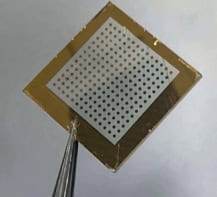
Modern-day photonics are continually getting smaller and more efficient, and researchers from Stanford University have now developed an optical amplifier that uses a low amount of energy on a fingertip-sized device – achieved by recycling the energy used to power it.
The low-power optical amplifier operates across the optical spectrum and is small and efficient enough to be integrated on a chip. The device achieved more than 17 dB gain using less than 200 mW of input power – an order of magnitude improvement over previous optical amplifiers of a similar size.
“We wanted to store up optical energy and release it in intense bursts, kind of like how a Q-switched laser works, but now with an optical resonator being the store of energy that fills up,” explains senior author Amir Safavi-Naeini. “After a few months we started to see that it could address other challenges we had in the lab, like building a broadband low-power amplifier for squeezing light in a chip-scale device.”
Optical parametric amplifiers
There are many types of optical amplifiers. Erbium-doped amplifiers are common in telecommunications but only work within specific wavelength bands, while semiconductor amplifiers function over a larger range of wavelengths but are limited by high noise. Optical parametric amplifiers (OPAs) are seen as the bridge between the two. OPAs, which use nonlinear interactions to transfer energy from a pump beam into signal photons, offer high gain, wide bandwidth and low noise.
A high gain boosts signals above noise levels, while the broad bandwidth enables amplification of ultrafast or wavelength-division-multiplexed optical signals. However, as they typically require watt-level power, OPAs have been difficult to miniaturize and integrate onto tiny photonic chips. For most amplifiers, achieving a high gain requires a high power input, which is counterproductive to miniaturization.
Integrating lasers into the photonic chip is not ideal and an external optical pump is now seen as an alternative option, but usually requires a pump at the second harmonic (twice the wavelength frequency being amplified). In the new design, the researchers use an external pump laser at the fundamental wavelength, coupled by lensed fibre onto the chip, where it generates the resonant second-harmonic pump – using a new loop design to reduce power requirements.
“The trick is that we trap and recirculate the shorter-wavelength pump light in a loop, not the signal,” Safavi-Naeini explains. “This gives you the efficiency boost of a resonator without narrowing the amplification bandwidth.”
A low-power optical amplifier
The team built the low-power OPA using thin-film lithium niobate, which offers large second-order nonlinearity and tight optical confinement. The big advantage, however, lies in its second-harmonic resonant design, in which the optical pump is doubled into a second harmonic inside a cavity. The pump light travels in a circular loop, increasing its intensity until the desired power is met. Once this amplification is complete, the signal is output with a near-quantum-limited noise performance over a broad amplification bandwidth of 110 nm.
Performing the amplification inside the cavity reduces the required power because the OPA is powered by energy stored inside the light beam. “The pump light is generated inside the pump resonator, not coupled in. This means we can efficiently fill up this resonator without dealing with impedance matching constraints that limit other nonlinear devices,” explains Safavi-Naeini. “The pump field is therefore larger than what we can even couple into the chip, so we get a boost that otherwise wouldn’t be possible.”
Single silicon chip processes optical and microwave signals

The small-scale and low-power architecture could be used to build on-chip OPAs across a range of applications, including data communications technology, biosensors and novel light sources. The amplifier is also small and efficient enough to be powered by a battery, making it suitable for use in laptops and smartphones.
Looking ahead, Safavi-Naeini says that the goal is “to combine this amplifier with a small on-chip laser, so the whole thing is self-contained without bulky external equipment, and use it to generate large amounts of quantum squeezing in an integrated device”. In the short-term, he suggests that fabrication improvements could cut the power requirements by another factor of ten. “We’re looking to push the sensitivity beyond what’s currently possible with classical technologies.”
The research is reported in Nature.