Using a specially designed setup to levitate particles with sound, researchers in the UK have revealed that the electrical charge built up through repeated collisions between two particles follows a clear, predictable pattern. Led by Tom O’Hara at the University of Bristol, the team found that although each collision transfers a seemingly random amount of charge, the overall build-up follows similar rules to a charging capacitor. The result offers new insight into the long-standing question of how charge accumulates in clouds of colliding particles.
Triboelectric charging – which generates static electricity – is one of the most familiar effects in physics. As simple classroom experiments can demonstrate, electrical charge can be exchanged whenever two objects touch and then separate, with the polarity and strength of the charging depending on the materials involved. All the same, physicists’ understanding of the process is still far from complete.
“Triboelectric charging has been known since the time of Plato, but the fundamental mechanisms governing charge transfer remain incompletely understood,” O’Hara explains. “This is especially important for insulating powders, where the large surface area allows for large amounts of surface charging.”
This type of charging occurs in natural phenomena such as volcanic ash, dust storms, and thunderstorm clouds – generating charge buildups which eventually give way to lightning strikes. It can also lead to significant risks in industrial processes, where triboelectric charge can ignite flammable dust or vapour clouds. Because these systems involve vast numbers of collisions under widely varying conditions, it is incredibly challenging to isolate what happens in any single collision.
Tight control
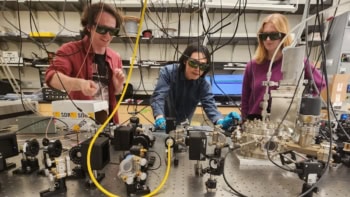
In 2017, a team at the University of Bristol developed an apparatus that offers much tighter control over the motion of individual particles using acoustic levitation. Dubbed TinyLev, the levitator can be built from low-cost, off-the-shelf components. It can trap objects including silica spheres, water droplets, and even small insects and electrical components.
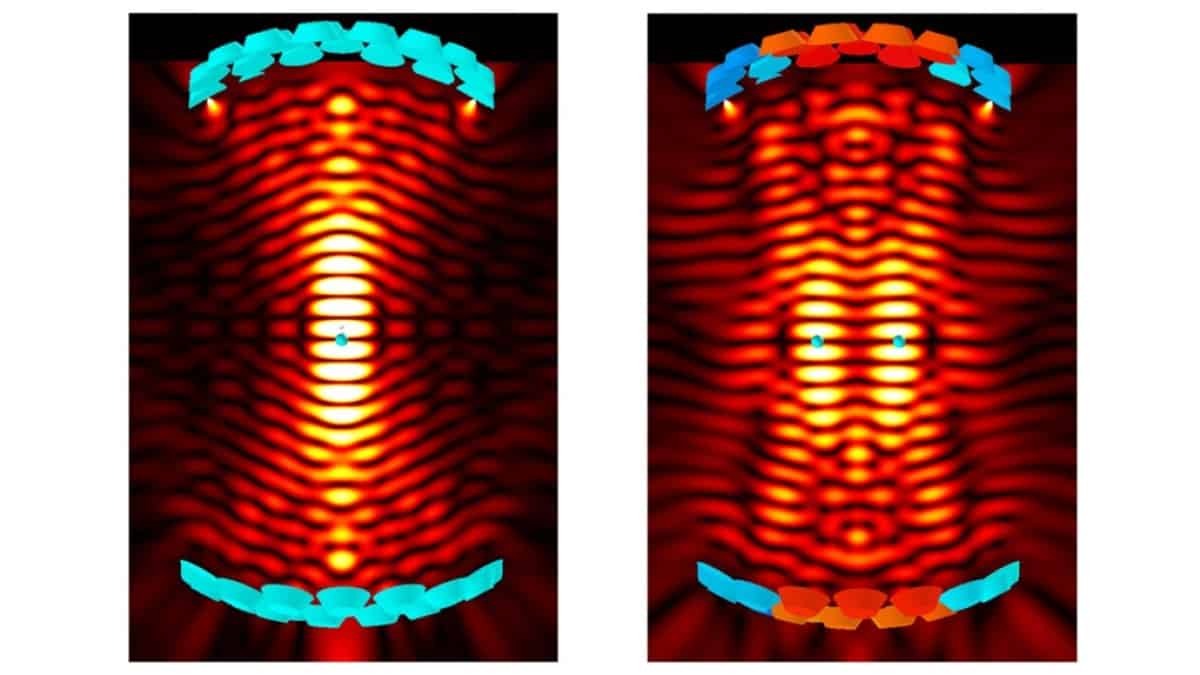
Building on these capabilities, O’Hara’s team has unveiled MultiLev, which is a more controllable version of TinyLev. The new device allows them to trap two particles of polystyrene and make them collide repeatedly. Their setup included a pair of opposite-facing Faraday cups, which measure the charge on a particle placed inside them by detecting the current it induces, using a sensitive picoammeter.
The cups are made from a wire mesh with carefully chosen spacing, making them transparent to the sound waves used for levitation. This meant they could levitate each particle inside its own cup, adjust the acoustic field to bring the particles together in the space between the cups, and then return each particle to its own cup, where the charge transferred during the collision could be measured.
Skewed normal distribution
At first, the charge transferred in individual collisions appeared random, with values following a skewed normal distribution. But as the team induced more and more collisions, a clear cumulative pattern emerged: each particle’s charge rose steadily at first, before levelling off towards a maximum saturation value. “This is consistent with the previously proposed condenser model, which treats the particles’ charging like that of a capacitor,” O’Hara says.
Static electricity: mysteries lurk within this everyday phenomenon

While individual collisions can vary widely in the amount of charge they transfer, the team’s results show that many such events together can produce predictable behaviour over time. “By establishing a clear relationship between repeated particle collisions and charge saturation in a controlled system, we provide a useful foundation for investigating triboelectric charging in more complex environments,” O’Hara adds.
Ultimately, the approach could help researchers to better understand the build-up of charge in real-world settings. In turn, it could lead to advances ranging from better predictions of extreme weather events, to more informed safety regulations for manufacturing industries.
The research is described in Physical Review E.