Mechanically rigid materials that are also poor conductors of heat could be employed in a host of applications, from thermal insulation to waste heat recovery in electronics devices. However, combining these two properties in a single structure is not easy. Researchers at North Carolina State University in the US have now succeeded in doing just this thanks to a layered hybrid organic–inorganic perovskite. The material boasts an ultralow thermal conductivity of just 0.04 W/m/K at room temperature and an elastic modulus as high as 7.7 GPa. These exceptional properties come from specially engineered organic cations in the layered structure.
“The thermal conductivity of this material is one of the lowest for a fully dense solid film and its modulus is higher than that of most plastics, foams and aerogels,” says mechanical and aerospace engineer Jun Liu, who led this new study together with his physicist colleague Dali Sun. “Our finding highlights the potential of molecular engineering to push the extreme of thermal insulation in dense coatings.”
In general, hard materials, like diamond, conduct heat well while softer ones, like foams and aerogels, are good insulators. For example, the thermal conductivities of most crystalline and ceramic solids lie between 1000 and 2000 W/m/K at room temperature and those of plastics between 0.1 and 0.5 W/m/K. Only a few dense solids have thermal conductivities even lower than 0.1 W/m/K.
A solid’s thermal conductivity stems from the behaviour of its phonons, which are quantized vibrations of its crystal lattice. There are two main ways to reduce heat transport via phonons: reduce the distance they travel between scattering events (their mean free path); or reduce the speed at which they travel as a group.
The first of these metrics depends on the scattering between phonons themselves and the scattering of phonons by defects or boundaries within the material. The phonon group velocity, on the other hand, depends on the structure and composition of a material. Researchers have previously tried to reduce the phonon mean free path by engineering defects in materials and producing materials with nanostructures specially designed to have a low thermal conductivity. Other techniques include changing the layers between crystals to alter phonon interactions at the interface between the layers.
Pushing the limits of heat conduction
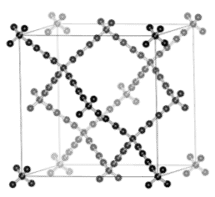
In the new work, reported in Science Advances, Liu and colleagues studied spin-coated azobenzene ethyl ammonium lead iodides. In such hybrid organic–inorganic perovskites, the periodic stacking of organic and inorganic layers produces a superlattice-like structure that naturally suppresses phonon group velocities.
The researchers also introduced organic cations featuring two aromatic rings connected by a double-bond linkage. These cations not only increase the material’s mechanical rigidity but also increase the random stacking disorder between the inorganic layers, thereby further suppressing thermal transport. Indeed, they measured the perovskite’s thermal conductivity (using ultrafast-laser-based pump-probe time-domain thermoreflectance) to be just 0.04 W/m/K and its elastic modulus (using contact resonance atomic force microscopy) as 7.7 GPa.
Polymer-tuned perovskite creates high-efficiency underwater solar cells
“Pushing the limits of heat conduction has always been one of the fundamental challenges in thermal transport,” explains Liu, “and we wanted to explore how far we could push this limit through molecular and materials design. A five-year National Science Foundation (NSF) award provided us with the opportunity to pursue this question systematically and in depth, while collaboration with colleagues across different disciplines gave us the expertise needed to tackle a problem that spans materials synthesis, thermal measurements, mechanics and molecular-level modelling.”
The central challenge, he tells Physics World, was to determine whether a molecular design strategy could actually produce extremely low thermal conductivity in a dense, mechanically rigid material, rather than relying on pores, voids or other forms of structural softness – as was previously the case in such studies.
The NCSU team is now busy testing its thin film as a coating for various practical applications. “We will also work on replacing the lead metal with other, non-toxic, metals in the composition,” reveals Liu.