Through fresh analysis of supernovae data, a team of astronomers has discredited a recent study that suggested that dark energy has weakened since the early universe.
Led by Phil Wiseman at the UK’s University of Southampton, the team showed that the apparent weakening almost disappears after accounting for a known correlation between supernova brightness and galaxy mass. This latest work confirms that the universe’s expansion is accelerating – a discovery that bagged three astronomers the 2011 Nobel Prize for Physics.
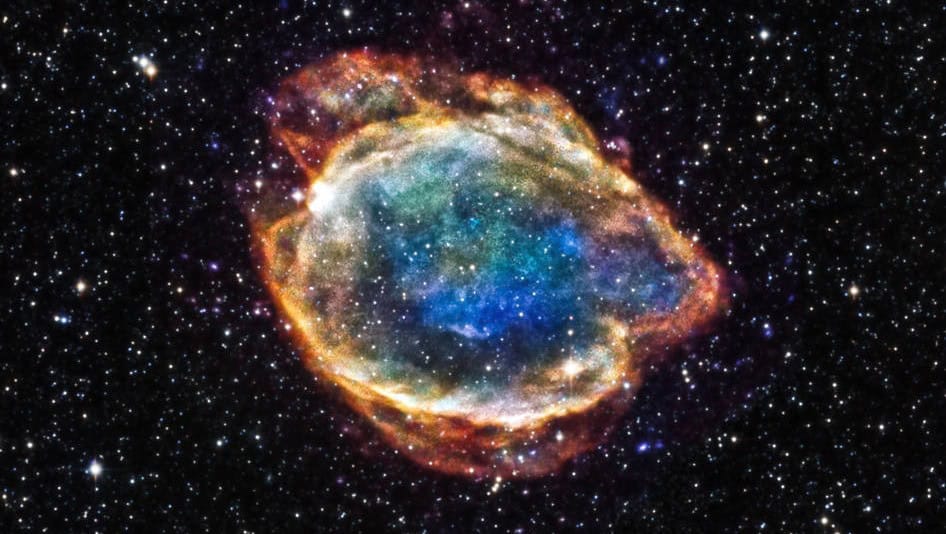
Type 1a supernovae occur when a white dwarf accretes mass from a binary companion star. Eventually, it reaches a critical mass where the crushing weight of its gravity can no longer be supported by electron degeneracy pressure, triggering an explosion that can briefly outshine entire galaxies.
These events are especially valuable to cosmologists because white dwarfs always explode at the same critical mass – meaning type 1a supernovae always reach around the same peak brightness. As a result they are “standard candles”, whereby their distances from Earth is inferred by their apparently brightness. The rate at which a type 1A is moving away from us is given by the redshift of its light. By measuring the distance and motion of these objects, the rate of the universe’s expansion can be determined as a function of time.
Driving acceleration
Since the 1990s, researchers have observed thousands of type 1a supernovae. Contrary to expectations for a matter-dominated universe, these measurements revealed that the universe’s expansion is speeding up. This lead to the concept of dark energy – a hypothetical entity that is driving this acceleration.
But in 2025, a team of astronomers in South Korea, led by Junhyuk Son at Yonsei University, Seoul, made an observation that appeared to turn this long-standing picture on its head. “They claimed that a subtle correlation between the brightness of the supernova and the age of the galaxy it exploded in could, if left uncorrected, means that the overall measurements actually now indicate that the expansion is now slowing,” Wiseman explains. “In other words, that dark energy was strong billions of years in the past, but has subsequently weakened.”
In their study, Wiseman and his colleagues revisited the data used by Son’s team – accounting for a correction that the previous astronomers hadn’t applied. Regardless of redshift, the peak brightness of type 1a supernovae in lower-mass galaxies is known to be slightly fainter than those in higher-mass galaxies. Although the reasons for this correlation remain unclear, astronomers have routinely been correcting for it over the past 15 years.
Wiseman’s team applied the same correction – ensuring their calculated distances were unaffected by differences in galaxy mass. “We also used simulations, where we traced how the age of the exploding stars and the galaxies they explode in evolve with cosmic time,” Wiseman says.
Similar ages
With this correction applied, the claimed correlation between supernova brightness and host galaxy age became almost undetectable. “Even if we account for the prediction that the relationship between the supernova and the galaxy should change as we look further back in time, we end up with almost identical measurements of dark energy,” Wiseman continues. Their simulations also showed that supernova progenitor stars have exploded at consistently similar ages throughout cosmic history.
DESI delivers a cosmological bombshell
The results will likely come as a relief to many cosmologists, averting the dark energy crisis some had feared. All the same, the team says Son’s study provides a valuable test of existing approaches to measuring the universe’s expansion rate, given the limitations of current observational capabilities.
“In an ideal world, we think a correction based on the age of the galaxy would be slightly more accurate than using the galaxy mass, but these measurements are currently not available for more than a handful of supernova host galaxies in the distant universe,” Wiseman says. “Until then, a mass correction is adequate and the implication is that the universe is still accelerating due to dark energy.”
The research is described in Monthly Notices of the Royal Astronomical Society.