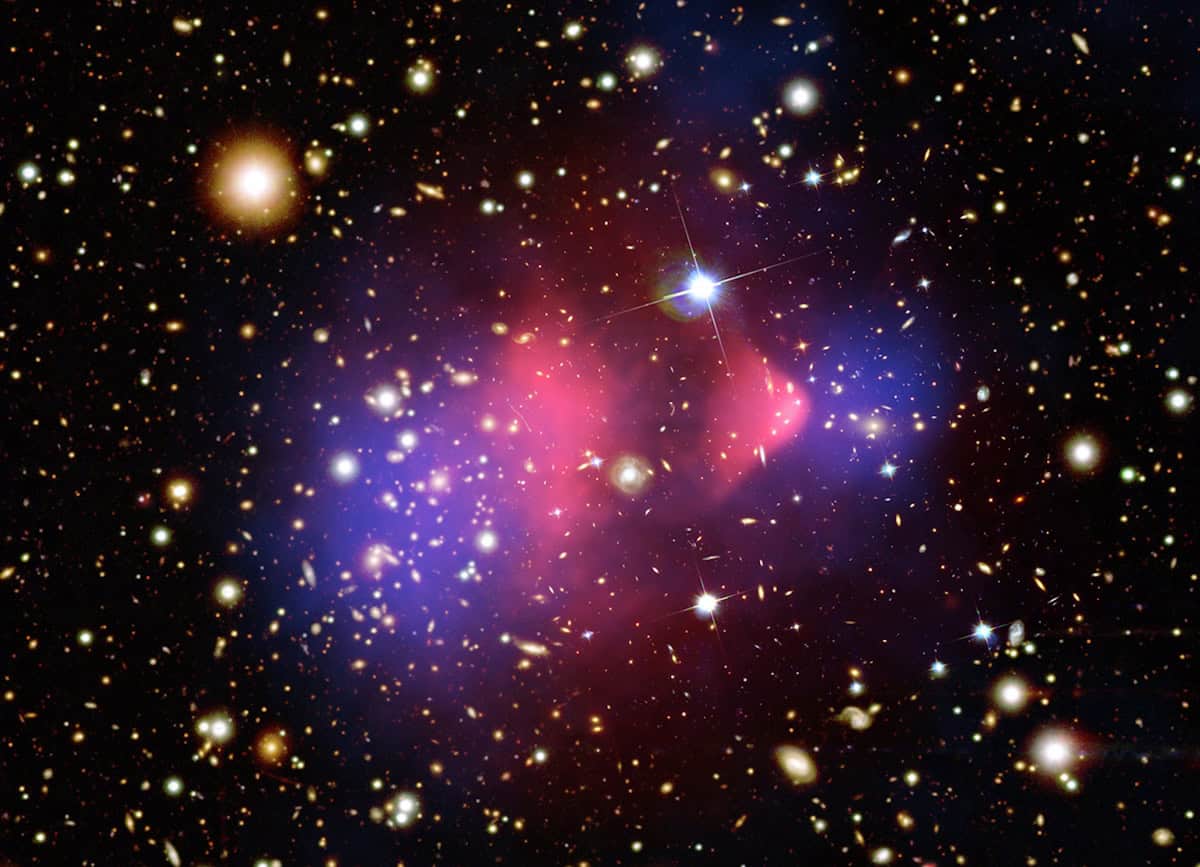
The Bullet Cluster of galaxies might only have half as much dark matter than scientists thought, or perhaps even none at all, according to a new look at observations of this immense collision of galaxies from the James Webb Space Telescope (JWST).
“Our results indicate that the required amount of additional unseen mass – dark matter – is reduced,” astrophysicist Dong Zhang of the University of Bonn, who led the study, tells Physics World.
The Bullet Cluster is a central battleground for proponents of alternative models of gravity seeking to usurp dark-matter theory. The cluster itself is actually two clusters of hundreds of galaxies that have collided head-on. In 2006 the Hubble Space Telescope mapped how the Bullet Cluster’s mass was warping space and creating gravitational lensing, and from this it was possible to infer where the dark matter in the cluster was relative to the galaxies themselves and the hot, X-ray emitting gas. While the galaxies and hot gas remained in the middle, the dark matter from both colliding clusters had passed through unhindered and is now on opposite sides – exactly as dark-matter theory predicted.
In 2025 the JWST observed the Bullet Cluster and the initial analysis, led by Sangjun Cha of Yonsei University, found that while the distribution of mass in the cluster is more complex than expected, it still supports the dark-matter model.
“Those JWST observations of the Bullet Cluster have sparked a lot of interest,” says astrophysicist Richard Massey of Durham University, who was not involved in the new study.
Counting stellar remnants
Astrophysicists led by Zhang have now made their own analysis of the JWST data and arrived at a very different conclusion, as they report in Physical Review D.
Zhang’s team aimed to precisely measure the total mass of not just the stars, but also of dark stellar remnants – white dwarfs, neutron stars and black holes formed when stars die – to see if these objects could account for the extra gravity attributed to dark matter. They found that there would be enough stellar remnants to reduce the amount of dark matter required by half, at least. Furthermore, applying MOND (modified Newtonian dynamics) to the cluster potentially removes the need for dark matter entirely.
They utilized a model called the integrated galaxy-wide initial mass function (IGIMF), which is a variation on the standard IMF that describes how a collapsing molecular cloud fragments into clumps that produce stars. The standard IMF favours low-mass over high-mass stars.
However, variations in chemical compositions, stellar radiation fields and the rate at which gas cools in a given environment mean that the IMF varies from galaxy to galaxy. The IGIMF is designed to get around this by integrating over the full stellar population of a galaxy, or in this case, an entire cluster of galaxies.
“The IGIMF framework was developed independently of MOND and is motivated by observational constraints related to star formation and stellar populations,” says Zhang.
One of the quirks of the IGIMF is that it predicts that in the early universe, more massive stars formed in giant elliptical galaxies than form in galaxies today, consequently producing more stellar remnants than what the standard IMF predicts. Such giant galaxies exist in the core of clusters such as the Bullet. Since massive stars leave behind massive remnants when they go supernova, the gravity of these remnants could account for a large amount of the dark matter. This is supported, says Zhang, by the abundance of heavy elements in some galaxies that’s hard to explain without invoking an early population of very massive stars.
When the quantity of stellar remnants predicted by the IGIMF is applied to the standard model of cosmology “it does not appear sufficient to account for the strong lensing mass in the central regions of the Bullet Cluster,” says Zhang. It is only when applying MOND that things begin to align, he adds.
Questioning the mass function
However, not everyone is convinced by the choice to use the IGIMF over the standard IMF.
“It’s kind of a neat theoretical framework, in which aspects that could produce a total IMF are broken down into separate mathematical terms that can be modelled individually,” says Massey. “But it’s also kind of irrelevant for this sort of empirical analysis, since mainstream analyses already assume that the IMF varies between galaxies, and even in different regions of a galaxy.”
Traditionally, estimating the total stellar mass of a galaxy is accomplished by taking spectra or multi-band photometry and employing a technique called “stellar population synthesis” that best-fits a galaxy’s light to a particular distribution of stellar masses, Massey explains.
“However, the emitted light can be dominated by the brightest, most massive stars,” he says, meaning that the far greater number of less massive stars has to be extrapolated from a galaxy’s stellar mass function, which is derived from the IMF while factoring in the galaxy’s age.
Stellar remnants are even more difficult to detect directly, hence the dependency on the IMF or IGIMF.
“Stellar remnants cannot generally be detected in external galaxies beyond the Milky Way and its satellites,” says Kathy Romer, an astrophysicist at the University of Sussex who studies galaxy clusters. “Exceptions would be via gravitational-wave events or ultra-luminous X-ray binaries, but those are only the tip of the iceberg, so estimates of the total contribution of stellar remnants will always be an extrapolation of what we measure in the Milky Way and Magellanic Clouds.”
MOND versus dark matter: the clash for cosmology’s soul
Like Massey, who describes IGIMF as being “less mainstream”, Romer is also sceptical about the new results, but acknowledges that “there are some strong aspects to their paper” and that “bringing fresh perspectives and challenging the orthodoxy is essential to keep science moving forward”.
Massey also highlights recent work from a team led by Gregor Rihtarŝiĉ and including Douglas Clowe of Ohio University who led the original Hubble observations of the Bullet Cluster, and who are running simulations to try and refine their maps of dark matter in the cluster.