Radiation therapy is usually delivered by prescribing the same radiation dose for each particular type of tumour. But this “one-size-fits-all” approach does not account for a tumour’s intrinsic radiosensitivity and heterogeneity and can lead to recurrence and treatment failure. Researchers in Sweden and Germany are now investigating whether biologically individualized radiotherapy plans, created using PET images of a patient’s tumour biology, can improve treatment outcomes.
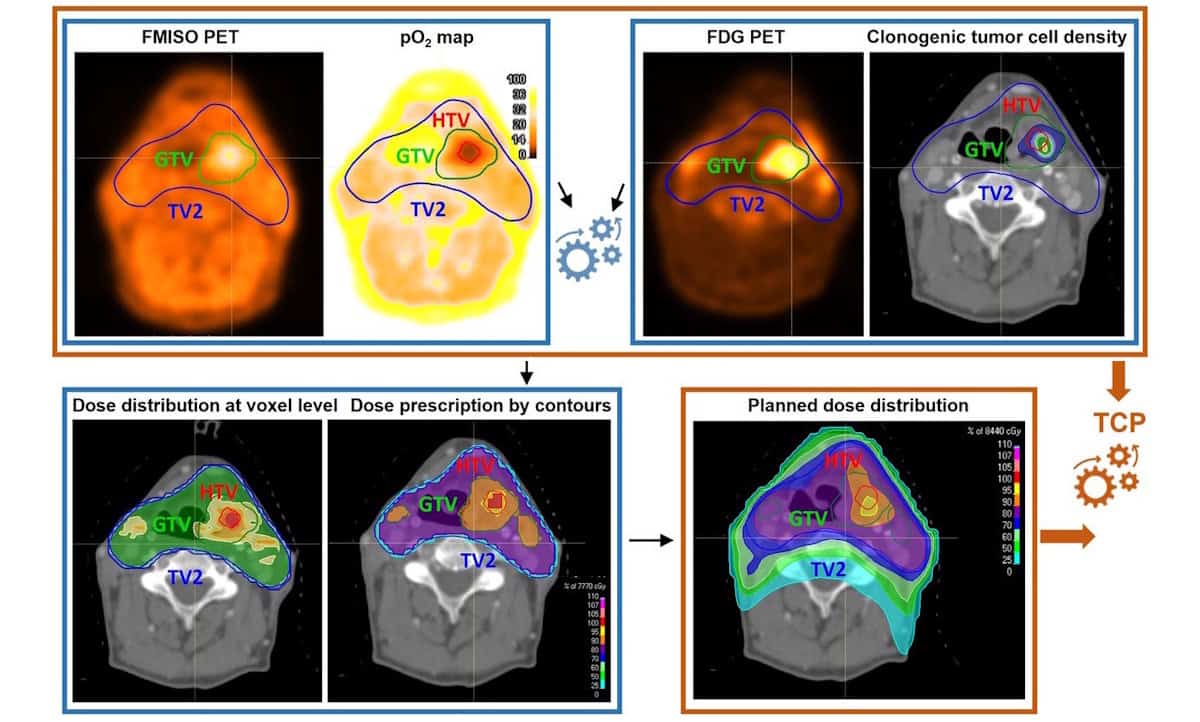
The research team – headed up by Marta Lazzeroni from Stockholm University – studied 28 patients with advanced head-and-neck squamous cell carcinoma (HNSCC). All patients underwent two pre-treatment PET/CT scans, using 18F-fluoromisonidazole (FMISO) and 18F-FDG as tracers to respectively quantify radioresistance and tumour cellularity (the percentage of clonogenic cells) – both critical factors that influence treatment response.
“FMISO provides information on hypoxia-related radioresistance, but tumour control also strongly depends on the number of clonogenic cells, which is not captured by hypoxia imaging alone,” Lazzeroni explains. “To our knowledge, this is the first study to combine FMISO and FDG PET within a unified radiobiological framework to guide biologically individualized dose escalation.”
For each patient, the researchers used FMISO uptake to derive voxel-level maps of oxygen partial pressure (pO2) in the tumour and define a hypoxic target volume (HTV). The FDG scans were used to estimate spatial variations in clonogenic tumour cell density, which directly influence the dose required to realise a given tumour control probability (TCP).
Based on individual tumour profiles, the team used automated planning to create volumetric-modulated arc therapy plans comprising 35 fractions with an integrated boost. The plans delivered escalated dose to radioresistant subvolumes (the HTV), while maintaining clinically acceptable sparing of organs-at-risk. The PET datasets were used to calculate the prescribed dose required to achieve a TCP of 95%.
Meeting clinical feasibility
The automated planning pipeline achieved high-quality treatment plans for all patients without manual intervention. The average EQD2 (the dose delivered in 2 Gy fractions that’s biologically equivalent to the total dose) to the HTV was boosted to 81±3.2 Gy, and all 28 plans met the clinical constraints for protecting the brainstem, spinal cord and mandible. Parotid glands were spared in 75% of cases, with the remainder being glands that overlapped the target.
Lazzeroni and colleagues suggest that these results confirm the overall clinical feasibility of their personalized dose-escalation strategy and demonstrate how biology-guided prescriptions could be integrated into existing treatment planning workflows.
The researchers also performed a radiobiologic evaluation of the treatment plans to see whether the optimized dose distribution achieved the desired target control. For this, they calculated the TCP based on the planned dose distribution, the PET-derived radioresistance data and clonogenic cell density maps. For all patients, the plans achieved model-predicted TCP values exceeding 90%, a notable improvement on tumour control rates reported in the clinical literature for HNSCC, which are typically around 60%.
The proposed strategy is based on pre-treatment PET images, but biological changes during treatment – including temporal and spatial variations in tumour hypoxia – could impact its effectiveness. In future, the researchers suggest that longitudinal imaging, such as PET/CT scans at weeks 3 and 5, could be used to monitor evolving tumour biology and inform adaptive replanning. This is particularly relevant in HNSCC, where tumour shrinkage and reoxygenation are common, and where updated imaging is required to determine whether dose escalation or de-escalation is appropriate to maintain tumour control and optimize normal tissue sparing.
First-in-human study reveals potential of biology-guided radiotherapy
The researchers point out that as the biology-guided dose prescriptions were planned but not delivered, prospective trials will be required to assess whether the observed dosimetric and biologic gains translate to improved patient outcomes.
“This study was designed as a feasibility and modelling investigation, and the next step is prospective clinical validation,” Lazzeroni tells Physics World. “Based on the promising results of this approach, prospective clinical trials are currently in the planning phase within the group led by Anca-L Grosu in Germany. These trials will focus on integrating longitudinal PET imaging during treatment to enable biologically adaptive radiotherapy.”
The results are published in the Journal of Nuclear Medicine.