Analysis by physicists in China suggest that if dark matter carries even a tiny electric charge, it will generate a magnetic “hum” in Earth’s geomagnetic field. And what is more, data from existing magnetometer networks can already constrain this effect.
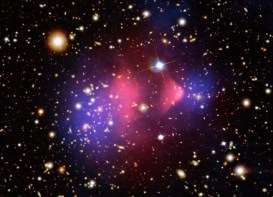
Dark matter is one of the biggest open questions in modern physics. Astronomers infer the existence of hypothetical dark-matter particles from their gravitational influence. The invisible presence of dark matter explains why galaxies rotate too rapidly for their visible mass, for example. Also, the gravitational lensing of starlight suggests a similar invisible mass in galaxy clusters. Yet the exact nature of dark matter particles remains unknown.
Ariel Arza at Nanjing Normal University and colleagues have explored what happens if dark matter carries a tiny electric charge, far smaller than that of an electron. The charge would be so small that dark matter would still be effectively “invisible” to most particle-physics experiments. However, the researchers argue that Earth’s own magnetic environment could turn our planet into a huge dark-matter detector.
Millicharged dark matter
This idea of millicharged dark matter (mDM) appears in several extensions of the Standard Model of particle physics, especially where the visible sector and a hidden dark sector mix slightly. In such models, dark matter can acquire a minuscule effective coupling to electromagnetism. Not enough to behave like ordinary charged matter, but enough to open new detection channels.
In a recent study described in Physical Review Letters , Arza and colleagues focused on bosonic mDM in the ultralight regime. This regime is particularly interesting because ultralight dark matter would behave collectively like a coherent wave, which makes its signal easier to model and search for in frequency space. This wave picture predicts a nearly monochromatic signal at a frequency tied directly to the dark-matter mass.
Earth as a dark matter detector
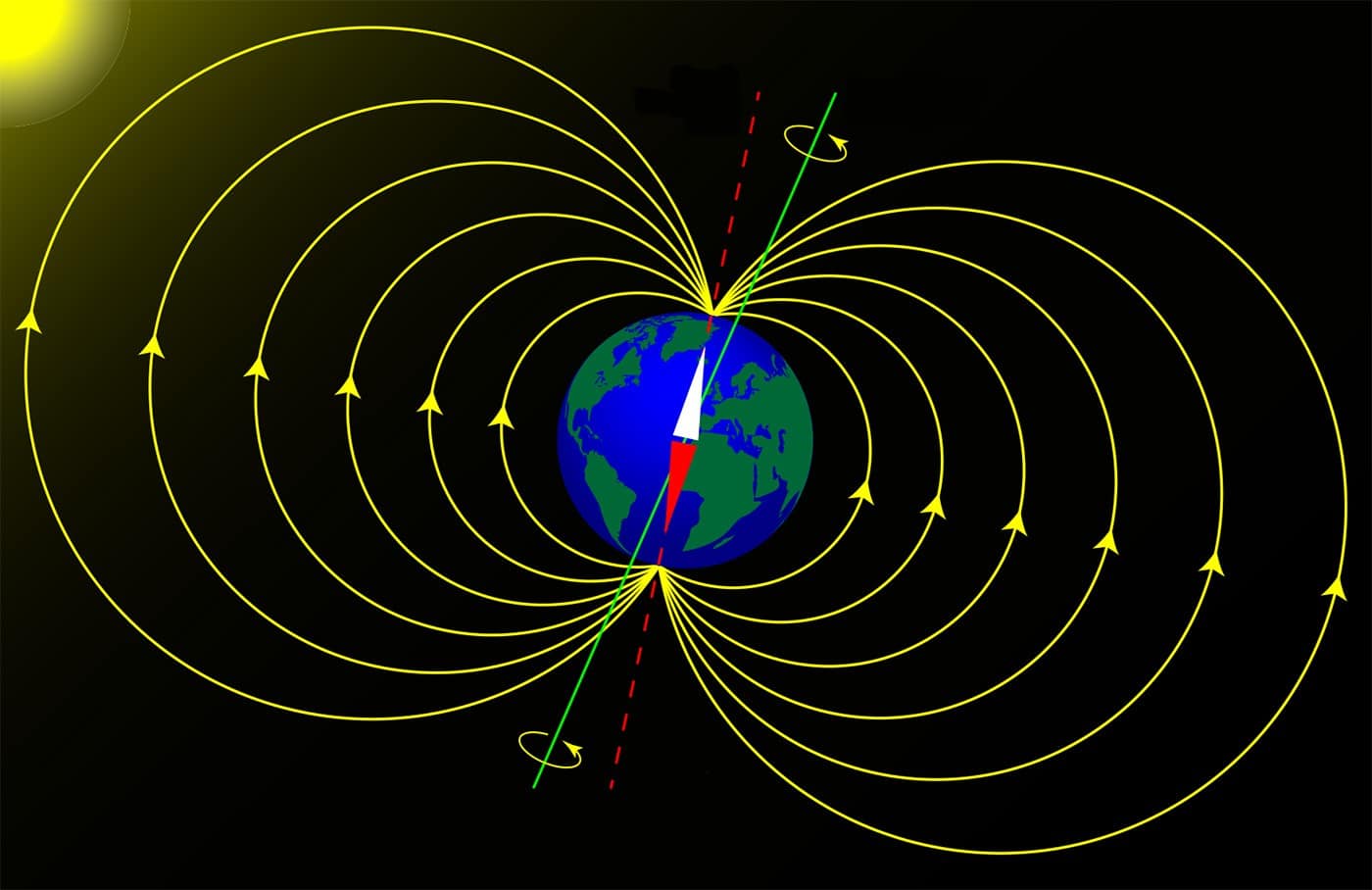
If dark matter has an extremely tiny electric charge and behaves like an oscillating field, it can act like a weak source that drives a small alternating current. In Earth’s magnetic field, that current would create an extra magnetic signal, a faint, repeating “hum” added to the usual geomagnetic field. This hum should appear at a specific, well-defined frequency set by the dark-matter mass, rather than being spread across many frequencies like most natural magnetic noise. In the mass range for this study, the signal is predicted to get stronger for lighter dark matter (roughly scaling like 1/m2, where m is the dark-matter particle mass).
At the very low frequencies expected for ultralight millicharged dark matter, the electromagnetic fields change slowly, almost like steady magnetic fields with a small repeating wobble added on top. The ground acts like a conducting boundary below and the ionosphere acts like another conducting boundary above, so together they shape how these low-frequency magnetic signals travel and spread. Instead of needing to build a special resonant chamber in a lab, the “detector” is the space around Earth itself.
Testing with real data
The researchers predict that mDM would result in a narrow, single-frequency signal in Earth’s magnetic field. The frequency of the signal is determined by the dark-matter mass and the signal’s amplitude defined by dark matter’s tiny electric charge.
Azra and colleagues looked for this signal in real magnetometer data. They used null (no-signal) results from two major efforts: SuperMAG, which combines geomagnetic measurements from stations around the world, and SNIPE Hunt, which searches magnetometer data for narrow, single-frequency signals that could indicate new physics. Since neither dataset shows the persistent monochromatic oscillation expected from ultralight mDM, they used this absence of a signal to set upper limits on how large the dark matter’s tiny electric charge could be, for particle masses roughly in the range 10−18–10−14 eV/c2.
Constraining mDM has already been done using astrophysical observations – for example, looking for the effect of mDM on how stars lose energy. However, these bounds often rely on complex environments and modelling assumptions. This latest study demonstrates that Earth-based magnetometer data can be just as powerful. Indeed, the ultralight mass range the researchers find limits that exceed stellar-cooling constraints by more than 13 orders of magnitude in some cases.
Modelling choices
Because the team’s argument relies on modelling choices (like boundary conditions and simplifying limits), one might question how sensitive the results are to these choices. Team member Jing Shu at Peking University in China, tells Physics World that the final calculation is not limited to the small-parameter approximation. “Our calculation is valid across the full parameter space of ε and κ, not only in the ε, κ ≪ 1 regime.” Here, ε is the dark matter charge, and κ is its electromagnetic coupling. He explains that the small-ε, small-κ discussion is mainly there to give a clearer physical picture.
Long-distance quantum sensor network advances the search for dark matter

The researchers also note an important limitation: if the dark matter’s tiny charge is still “too large,” Earth’s magnetic field can deflect it enough that the signal no longer keeps increasing and instead levels off. Related to this, Shu explains that the result does depend on ionospheric conductivity because it helps set the boundary conditions of the Earth’s ionosphere cavity. “Variations in conductivity, for example due to solar activity effectively modify this boundary and therefore change the geometric factors that determine the signal amplitude. In practice, this leads to variations that can be on the order of unity in the predicted signal.”
Finally, Shu says the next step is to make the search more targeted and coordinated. “A natural next step is to carry out dedicated measurements in electromagnetically quiet environments, for example in remote field sites across different locations in China, and to build a coordinated network of magnetometers.” This would help distinguish a global, coherent signal from local noise and improve sensitivity to weak oscillations.