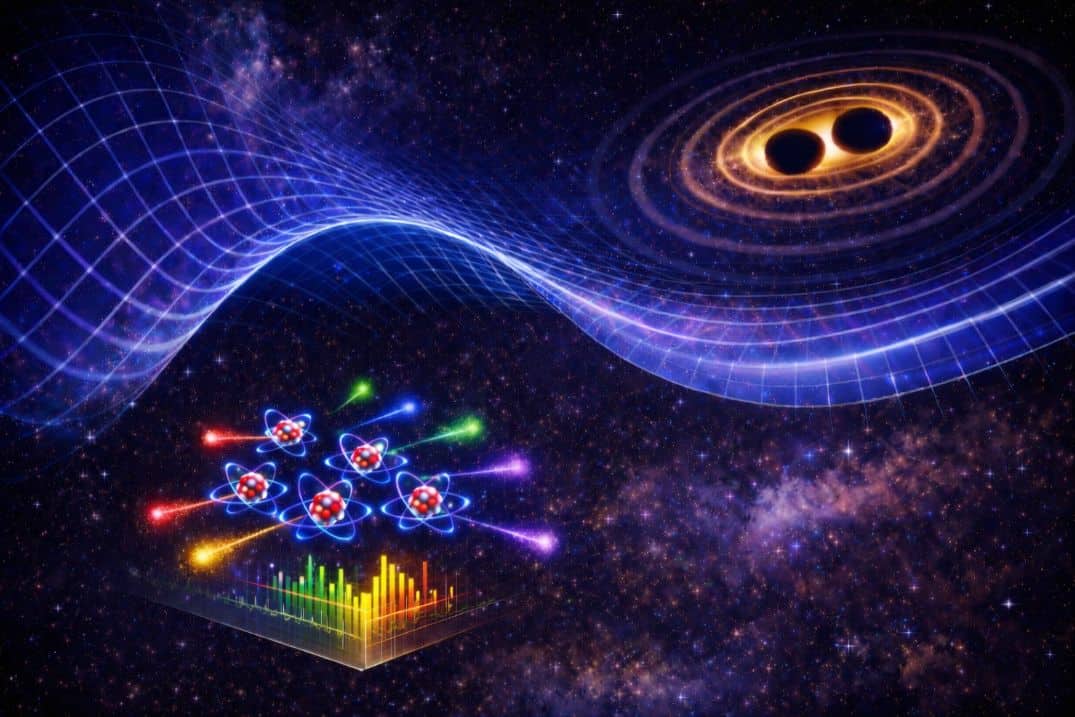
A single atom is one of the last places one would expect to find a gravitational wave. These ripples in spacetime are caused by movements of massive objects such as black holes, and they are typically detected using instruments that measure tiny changes in the distance between mirrors separated by kilometres. Their home territory is on large scales, not the microscopic scale of an atom.
Despite this, physicists have questioned for decades whether gravitational waves might affect how often atoms spontaneously emit photons. Previous theoretical studies suggested that the answer was no: the total spontaneous emission rate of a single atom remains unchanged, so the atom appears unaffected by the wave.
This null result is not surprising. Gravitational waves stretch space in one direction while squeezing it in a perpendicular direction. Detectors such as LIGO measure this effect by sending light between mirrors in perpendicular “arms” and comparing how long the light takes to travel along each arm. For a single atom, there is no comparable separation to measure, so scientists did not expect that passing gravitational waves could be detected this way.
A hidden signal
In a new study, published in Physical Review Letters, Navdeep Arya and collaborators at Stockholm University in Sweden and Eberhard Karls Universität Tübingen in Germany identified a loophole in this argument. Although gravitational waves do not leave an imprint in the number of photons emitted, Arya and colleagues calculated that they do affect how those photons are distributed in angle and frequency.
This distinction is crucial. Because a gravitational wave does not make the atom emit more or fewer photons overall, its effects will cancel out if one only measures the total number of photons. However, if the photons are sorted by their direction and frequency, a characteristic pattern emerges that reflects the wave’s stretch-and-squeeze geometry. Depending on the wave’s frequency, this pattern can manifest either as a small shift in the emitted photon frequencies or as additional sidebands in the spectrum.
The reason this is possible, Arya explains, is that the atom isn’t the only thing the gravitational wave interacts with. “It’s actually the atom and the [quantum] field,” he says. Because the field is a global object, he adds, it can carry information about the gravitational wave even when the atom itself does not.
Beyond counting photons
The existence of these effects opens a new way of thinking about gravitational-wave detection. Instead of watching how spacetime changes the distance between mirrors, a next-generation detector might look for how a passing wave changes the light emitted by atoms. This approach would make it possible to detect lower-frequency gravitational waves, which are difficult to reach with ground-based detectors such as LIGO.
A system that could detect these effects experimentally would look very different from a traditional gravitational-wave detector. Instead of measuring how a passing wave changes the distance between mirrors, one would need to excite a large cloud of atoms, collect the photons they emit through spontaneous emission, and resolve the angles and frequencies of those photons.
Though this is not a standard experiment, parts of the required technology already exist. Cold-atom experiments, for example, routinely trap and control millions of atoms. The challenge is to combine these capabilities with sufficiently precise measurements of the directions and frequencies of the emitted photons, while also controlling technical noise.
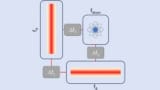
Phase shift in optical cavities could detect low-frequency gravitational waves
The researchers say their next step is to understand whether the signal will survive under realistic experimental conditions. According to Jerzy Paczos, the Stockholm PhD student who led the study, the most important task will be to consider the full range of technical noise that would appear in a real experiment, determine which noise sources matter most, and conclude from that whether their proposal is truly feasible. The researchers are also interested in whether cavities or collective effects in atomic arrays could amplify the signal.
For now, the work suggests that gravitational waves may leave traces in a place that physicists have not fully looked before: not in how fast an atom emits light, but in the detailed pattern of the light it gives off. In doing so, it points to a new way of using quantum systems to probe spacetime itself.