With the effects of climate change on plant life a growing concern, researchers are examining threatened Arctic ecosystems to help predict the fate of the species in cold habitats. Liz Kalaugher travels to Finland to investigate
As I walk across the curving slopes of the valley to the north of Saana – a fell in the far north-west of Finland – I’m greeted by an unexpected sight. Dotted against the blanket of low-lying shrubs are heaps of rusting metal. Despite its remote location – roughly 300 km north of the Arctic circle – this area was the scene of the last battle during the German army’s retreat northwards in 1945. Now protected as a memorial, the twisted panels from the German defences are surprisingly well preserved; no doubt the winter temperatures here, which sink to an average of –13.4 °C in January, slow corrosion.
The German bunkers have left their mark in other ways too. Even a small change to the landscape, such as a hole or ridge, can affect its vegetation, as physical geographer and ecologist Miska Luoto from the University of Helsinki explained to me in August when I visited the village of Kilpisjärvi, now home to a university research station. Of course, it’s not just war-time excavations that have moulded this area; the terrain is continually disturbed by processes such as frost, wind, late-lying snow and water flow.
The concern is that as temperatures rise, cold-tolerant plant species that are found only at high elevations could become extinct
The concern driving Luoto and his eight colleagues is that as temperatures rise, cold-tolerant plant species that are found only at high elevations or at Arctic latitudes could become extinct. These “Arctic–alpine” plants include species such as mountain avens and white Arctic mountain heather. “Where only the peak of a mountain is suitable for these alpine species, there’s a lot of worry that as conditions warm and lowland species move up, they will essentially be squeezed off the top and lost,” says Peter le Roux, Luoto’s former colleague who is now at the University of Pretoria, South Africa.
Luoto and his team have spent the last three summers intensively studying the vegetation on and around Saana, with the aim of working out the factors, including disturbance, that affect which plants grow where. They intend to use this data to predict the vegetation mix over larger areas than they can study – both now, and in the future, based on projections of temperature and precipitation from climate models (see box).
The project is unusual not only for looking at landscape processes as well as plant ecology, but also in the sheer amount of data it is collecting. By the time the researchers have finished, they will have around 500 different measurements of factors such as topography, geomorphological and hydrological disturbance, species presence, soil temperature and soil moisture, from each 1 m grid square in their study. With a grand total of 3360 grid squares, that’s pretty impressive. What’s more, Luoto has discovered that by including disturbance, such as frost churning the ground, or water flow, the models’ predictive powers are improved.
The physics of climate change
Back in 1896, Swedish physicist Svante Arrhenius, who was interested in ice ages, was the first to calculate how carbon dioxide – or carbonic acid as it was known at the time – in the Earth’s atmosphere affects temperatures on the ground. To do this he used measurements of infrared radiation from the full Moon. When the Moon was near the horizon, the radiation had to travel through more of the Earth’s atmosphere than when the Moon was directly above. These different atmospheric path lengths meant greater or lesser contact with carbon dioxide and water vapour along the way. “A simple calculation shows that the temperature in the Arctic regions would rise about 8° to 9 °C if the carbonic acid increased to 2.5 or 3 times its present value,” he wrote in the London, Edinburgh and Dublin Philosophical Magazine and Journal of Science.
Nowadays, instead of the Moon, physicists use sophisticated climate models that run on supercomputers. Put simply, the models, such as the UK Met Office’s HadGEM3, split the Earth’s atmosphere and ocean into small cubes. The contents of each cube obey the basic laws of physics and chemistry, including the rules of thermodynamics and the fluid dynamics principles that govern flow of air and water as the Earth rotates. The conditions in each cube affect the next.
To start the process rolling, modellers tend to use initial conditions such as observations of temperature at the Earth’s surface as well as in the oceans and the atmosphere. They then let the model run as the clock ticks forward, projecting temperatures for many years into the future under the different conditions, such as increasing greenhouse-gas concentrations, that they impose. It is temperature and precipitation outputs from models like these, fed into regional climate models, that Miska Luoto and his team of geographers and ecologists are using to project the effects of climate change on vegetation such as Arctic–alpine species.
Trek to the top
On a typical morning during my visit to this remote region I’d wake up with my fleece hat pulled down over my eyes in an attempt to stave off an early alarm call from the Sun, which became much brighter at about 3 a.m. after nominally “setting” at midnight. After breakfast, I’d head off with two or three members of the team and hike to the area they planned to study that day.
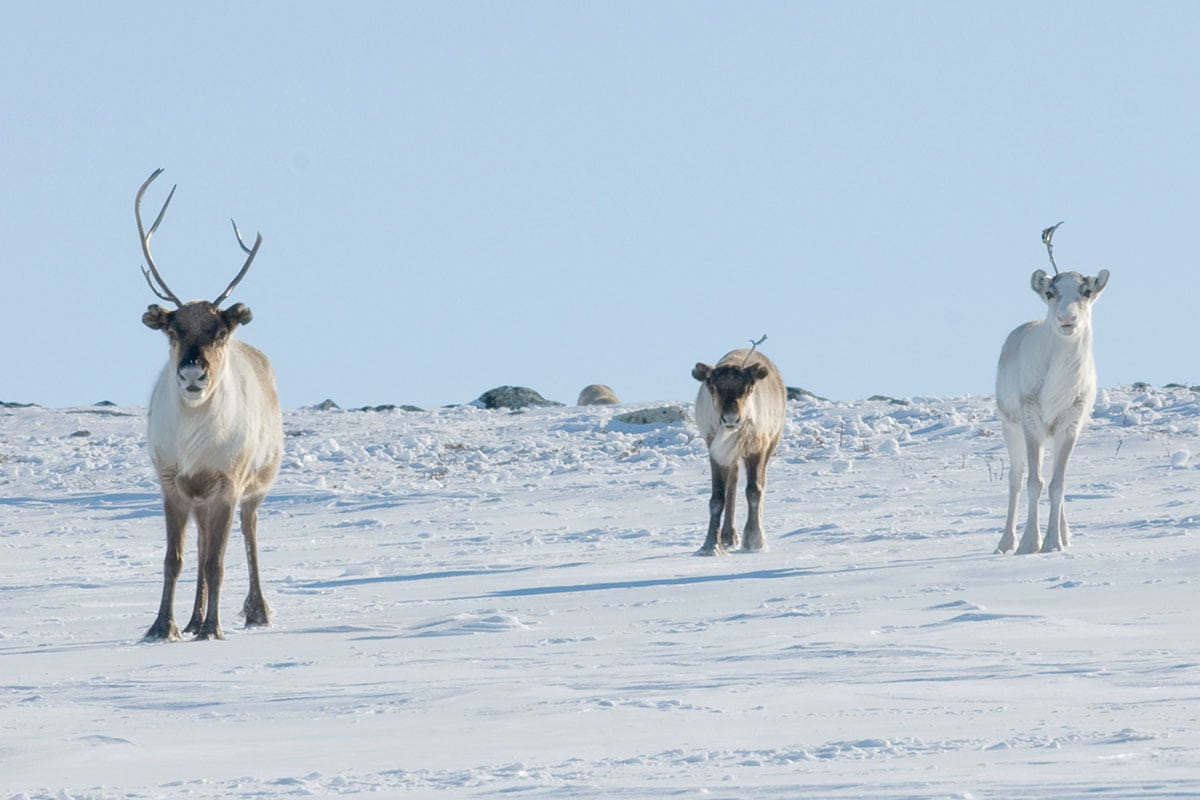
From our base at the Kilpisjärvi Biological Research Station, which had views across to Sweden on the other side of Lake Kilpisjärvi, we’d cross the main road – where reindeer like to stop traffic – and walk up through the mountain birch woods that hug Saana’s lowest slopes. Occasionally we had to wave away from our faces one of the autumnal moths that were experiencing a population boom and stripping the birch trees of their leaves.
As we emerged from the forest and onto the mid-level slopes, a mix of low-growing perennial shrubs such as crowberry, dwarf birch and juniper took over. The juniper serves as a measuring device in its own right as it reveals the level of snow here in winter – branches sticking out above the snow blanket suffer repeated freezing and thawing and so do not thrive, limiting the height of the shrub to that of the snow. The crowberry, meanwhile, provided a tasty snack for the researchers, who took care, of course, only to sample berries from outside their survey areas.
To make sense of the mix of species on these mid-level slopes, it’s essential to understand the effects of running water – indeed, a stream in the valley to the north of Saana demonstrated how much difference it can make. Grasses, sedges and herb species – plants that would normally only occur at lower altitudes – clustered in the boggy ground surrounding the stream. While it is standard for the mid-level slopes to have 8–15 plant species per square metre of ground, near water that figure can rise to 40. A few trees were even creeping up the river; their presence can shelter other plants and increase snow accumulation in winter, providing extra protection from the cold.
Grid by grid
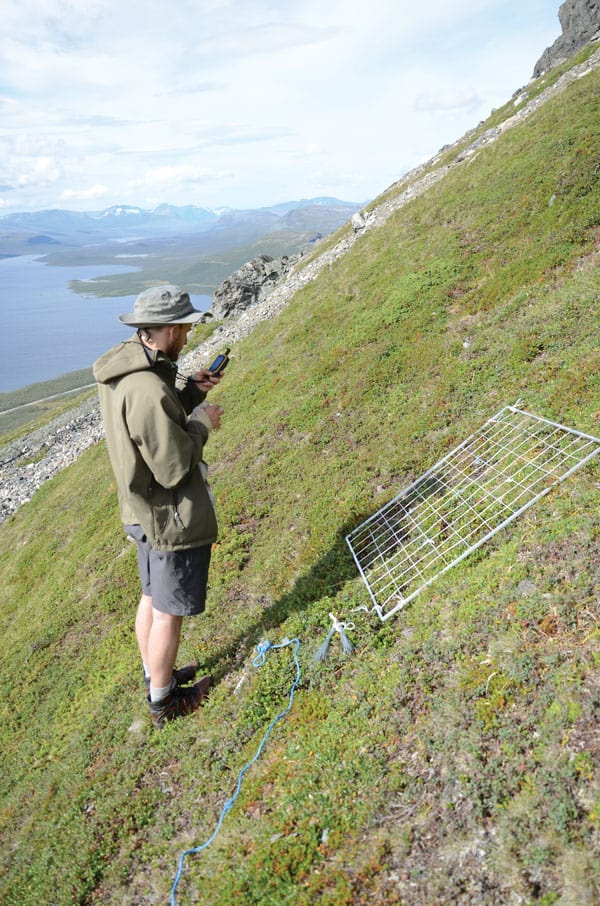
Species per square metre is just one of the measurements made by the Helsinki team. So far they’ve surveyed 21 grids, each 8 m wide and 20 m long – about the size of a singles tennis court – and divided them up into 1 m squares. The grids are marked out using wooden barbecue skewers that, by happy accident, have the brand name Saana, which is also a Finnish girl’s name. It’s low-tech but the sticks do a good job – until inquisitive reindeer knock them over.
The sites are chosen to represent a range of aspects, elevations and topographies: there are six each on Saana’s northern and southern slopes; and three each on the western slopes, near the top of the fell and in the valley to the north. Aspect is important because solar radiation can be as much as eight times higher on south-facing sites than on northern slopes.
This year the researchers also ventured further away from Saana and surveyed 1 m squares at points along transects (lines of measurement), enabling them to assess how vegetation changes, for example, on a path that climbs straight up the hill or is parallel to the slopes.
For each square, whether it’s in a grid or on a transect, the team has analysed the vegetation, noting all plant species present and the percentage of the ground that each type of plant covers. Luoto himself assessed the landscape topography and disturbance – those extra factors that he has found improve the predictive power of vegetation models. At several points across each grid, the team also sampled soil temperature, pH and biomass, while factors such as slope angle, altitude and aspect come from digital elevation models.
I spent two days with Luoto visiting a selection of transects near and on the fells of Korkea (High) Jehkas and Iso (Big) Jehkas. Luoto was the only person responsible for topography and disturbance assessments throughout the project, in order to keep the method consistent. He and other team members surveyed the vegetation independently from landscape factors to avoid biasing their results. At each transect point we reached – marked by coloured forestry tape that was hard to spot, making the GPS kit a godsend – Luoto assessed the surface shape of each of four 1 m squares by assigning a slope rating relative to the surrounding area, on a scale of one to 10.
Evaluating disturbance, meanwhile, required Luoto’s keen eye for identifying the physical processes that have affected the ground. Much of the disturbance here is related to frost activity. The top couple of metres of soil freezes every winter, creating seasonal frost, while high up in the mountains – above 800 m – there is permafrost. Soil and bedrock is frozen all year round at depths of more than 5 m or so below the surface. Repeated freezing and thawing of the soil gradually squeezes stones to the surface as the ground contracts and expands – a process known as cryoturbation. Meanwhile, recurrently frozen ground can creep gradually downhill, creating characteristic “solifluction terraces”.
Wind can play a role too – on the edges of small ridges, it blows away the fine soil particles leaving only gravel and rock behind. And then there’s snow. Although it was gone by the time of my visit in August, signs of its presence remained. When the snow starts to melt in late May, new streams break out around the hills. These can wash nutrients into an area and play a direct role in vegetation growth, as well as disturbing the soil. Some resilient snow patches, generally in high-altitude hollows and dips shielded from the Sun, remain later into the year and create their own disturbance.
Troubled sanctuary?
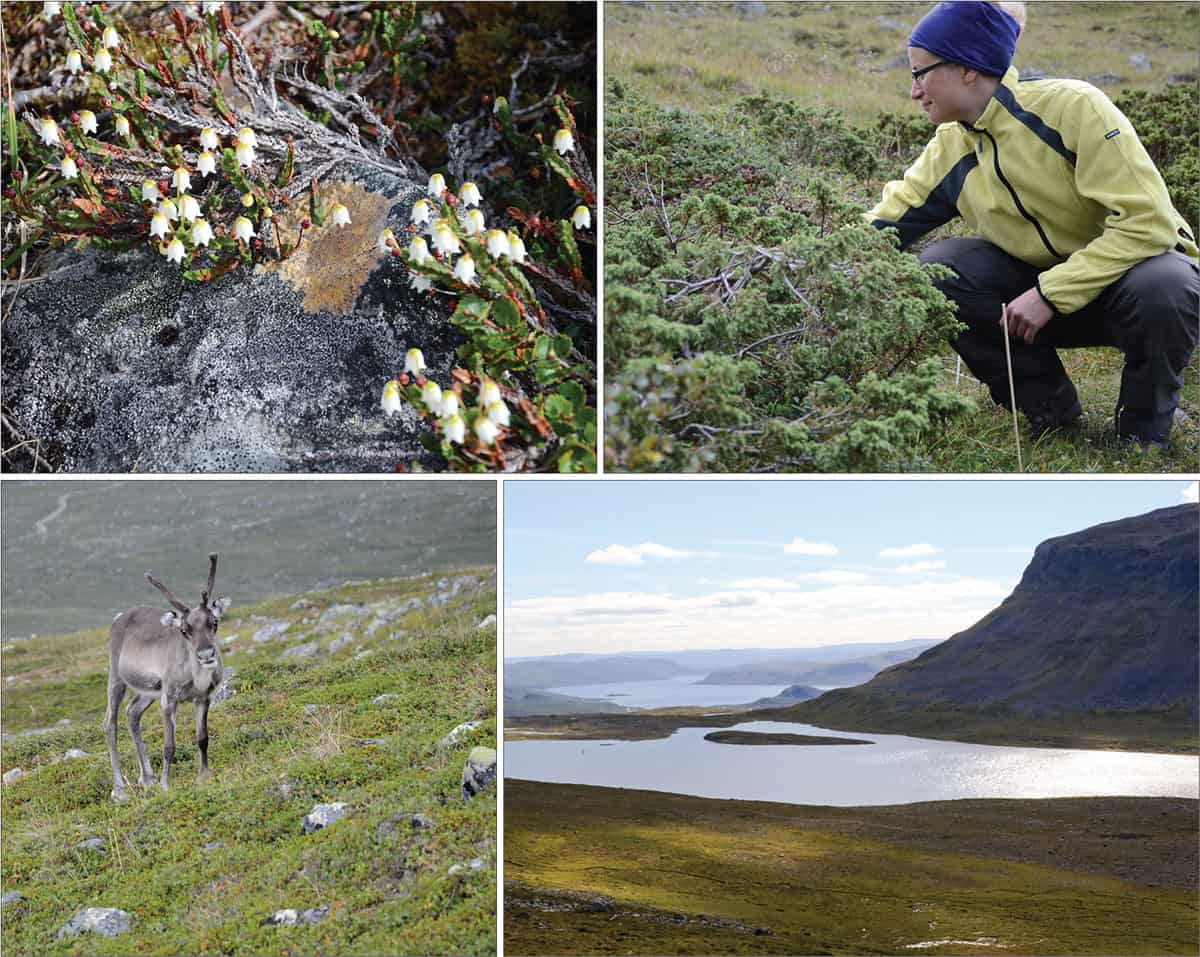
While disturbance might sound undesirable, for Arctic–alpine plants it is a blessing. On those wind-swept edges, for example, the poor soil prevents the alpines’ more vigorous lowland cousins, such as crowberry and dwarf birch, from taking hold. This means that species such as white Arctic mountain heather, mountain avens and Diapensia lapponica are able to thrive. Luoto and colleagues’ analysis shows that the disturbances that affect plant growth the most, giving Arctic–alpines a greater advantage, are solifluction, water flow and late-lying snow.
Of course, the disturbance here is not just physical – there are biological influences too. The impact of humans is relatively low but reindeer, lemming and willow ptarmigan graze on the vegetation. The lemming population is cyclical; in a good year the animals can be bigger grazers of herbs than reindeer, which normally hog the number one spot. Two years ago there were so many of the rodents in this area that their corpses littered the roadside and you could stand on them by mistake. Now only their burrows are visible – small holes among the rocks with droppings by the entrance – and the occasional lemming track in grassy areas, presumably made in the winter when the animals tunnelled beneath the snow.
Onto the plateau
As we climbed up onto a plateau on Korkea Jehkas, the vegetation changed dramatically. The ground was almost barren, except for a few hardy specialists. The perennial shrubs that grow lower down don’t do well at these higher altitudes, where colder temperatures mean a shorter growing season and strong winds blow away the winter snow, leaving plants less protected. It is here that Arctic–alpine species finally come into their own, along with lichens and mosses, as well as some grasses where it’s wet. The white Arctic mountain heather was flowering; in a boulder field Luoto pointed out a glacier buttercup, the most northerly vascular (veined) plant in the world and the highest-growing in Europe, reaching altitudes of more than 4000 m in the Alps.
It’s this type of habitat that is under threat of being forced off the top of the mountain as temperatures warm and perennial shrubs become able to survive higher up. There are glimmers of hope, in the form of small patches of land that happen to be relatively cold and disturbed – these could act as refuges for the Arctic–alpine species that would otherwise lose their homes. But it’s not a great prognosis. “The outlook for these species is maybe not as bad as forecast, but it doesn’t change the fact that the populations would be seriously affected by climate change,” says Le Roux. For example, plants might end up less connected to other populations of the same species; that’s bad news for their genetic diversity.
As I stand in the sunshine I can’t imagine what Saana will look like in just a couple of months, when snow and darkness cloak the landscape once again, let alone what conditions will be like by the end of the century. Society’s climate negotiations are arguably much harder to predict than the climate itself – ultimately it is likely to be the decisions we make about our greenhouse-gas emissions that will most drastically affect this area in years to come.