How did a classroom science demonstration lead to a job using quantum optics to improve the energy efficiency of deep learning? Ryan Hamerly talks to Tim Wogan about his career path
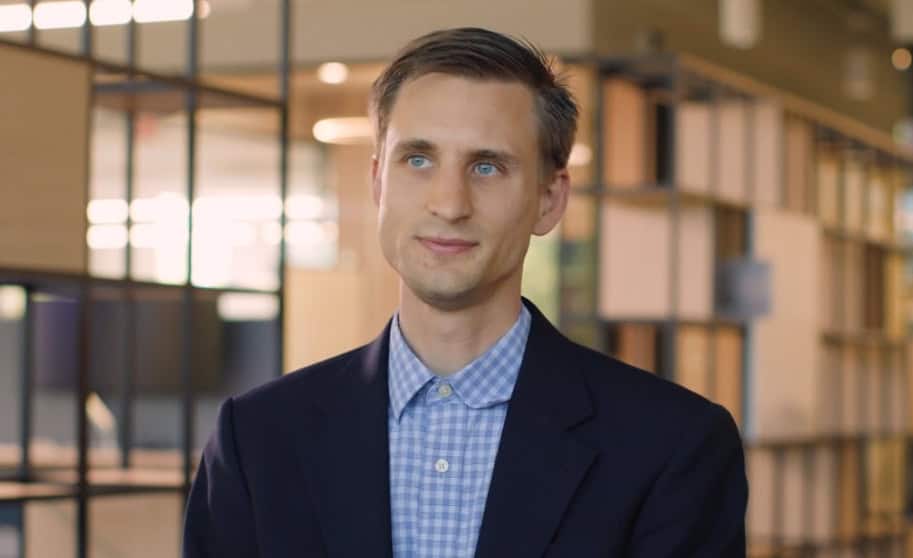
When Ryan Hamerly was a 15-year-old at Boulder High School in Colorado, he spent his summer building a Tesla coil after seeing a classroom demonstration. “I thought that was really, really cool,” he recalls. “I wanted to make one myself, and as a result I ended up studying the theory of electricity and magnetism over one summer.”
In hindsight, Hamerly realizes he didn’t use much theory to construct the coil, which became part of a school physics project. “Most of the design was based on things I had read on the Internet,” he explains, “but I did try to teach myself electricity and magnetism – and it did work in the end.”
In 2006 Hamerly’s interest in physics took him to the California Institute of Technology (Caltech) for his undergraduate studies. Keen to do graduate research, Hamerly was most fascinated by fundamental theoretical problems in quantum field theory, such as dark matter and quantum gravity. But as he started toying between different options, he had a chance encounter with Hideo Mabuchi, an applied physicist at Stanford University.
“One thing that Hideo told me that I thought was particularly fascinating,” says Hamerly, “is that quantum field theory is just a generic tool that applies in many other fields.” He therefore ended up doing a PhD in optical and quantum computing under Mabuchi’s supervision, which he completed in 2016.
Hamerly then moved to Japan, where he studied at the National Institute of Informatics in Tokyo – a time he characterizes as “sort of a postdoc, but more an excuse to travel for a year”. He did, though, get a paper out of it “so it wasn’t wasted”. In Tokyo, Hamerly worked with Mabuchi’s longtime friend Yoshihisa Yamamoto – a quantum optics researcher who had previously led a group at Japanese telecoms giant NTT for over two decades.
Step into industry
When Hamerly returned to the US in 2017, he did a formal postdoc under quantum photonics engineer Dirk Englund at the Massachusetts Institute of Technology (MIT). And in a fortuitous turn of events, Yamamoto also came to the US to establish the Silicon Valley start-up NTT Research, with the intention of forming collaborations with US universities.
“[Yamamoto] just called me up and said they had a position at NTT to work in optical computing,” he says. “At the time it made most sense to stay at MIT working as a collaborator [rather than relocate to the NTT campus] because that was where a lot of our experiments were being done.”
Today, Hamerly is a senior research scientist at NTT Research’s Physics and Informatics (PHI) Lab in Sunnyvale, California. He divides his time between MIT – where his collaboration with Englund continues – and the PHI laboratory, about 15 km from Stanford. He works at the intersection of optics, deep learning and quantum computation. For example, one of Hamerly’s projects looks into ways to reduce the energy consumption of AI data centres using optical interconnects in place of electronic ones.
Researchers hope it might one day be possible to design processors that perform calculations using optical logic that are either impossible, or at least energetically unfeasible, using electronic logic. To this end, in January 2026 Hamerly co-founded Opticore – a company producing photonic integrated circuits for energy-efficient, high-speed AI – with UC Berkeley professors Mengjie Yu and Zaijun Chen, who was previously a postdoc in Englund’s MIT group.
Different setting, same science
Hamerly does not view his place at NTT Research as purely an industry position. “The mission at NTT Research is about generating ideas that will ultimately have some use in industry,” he explains, “but the fundamental focus is on those ideas and on the research.”
The mission at NTT Research is about generating ideas that will ultimately have some use in industry.
His experience at NTT Research has shown him that an industrial lab can be smaller and more focused than one at a university – but that can be a double-edged sword. “[At a university] it’s nice to be able to go into seminar rooms and see a talk from a travelling world expert in a different field,” he says, “but on the other hand, the average person [at NTT] tends to be a lot more experienced and productive than say a graduate student in academia who is still learning.”
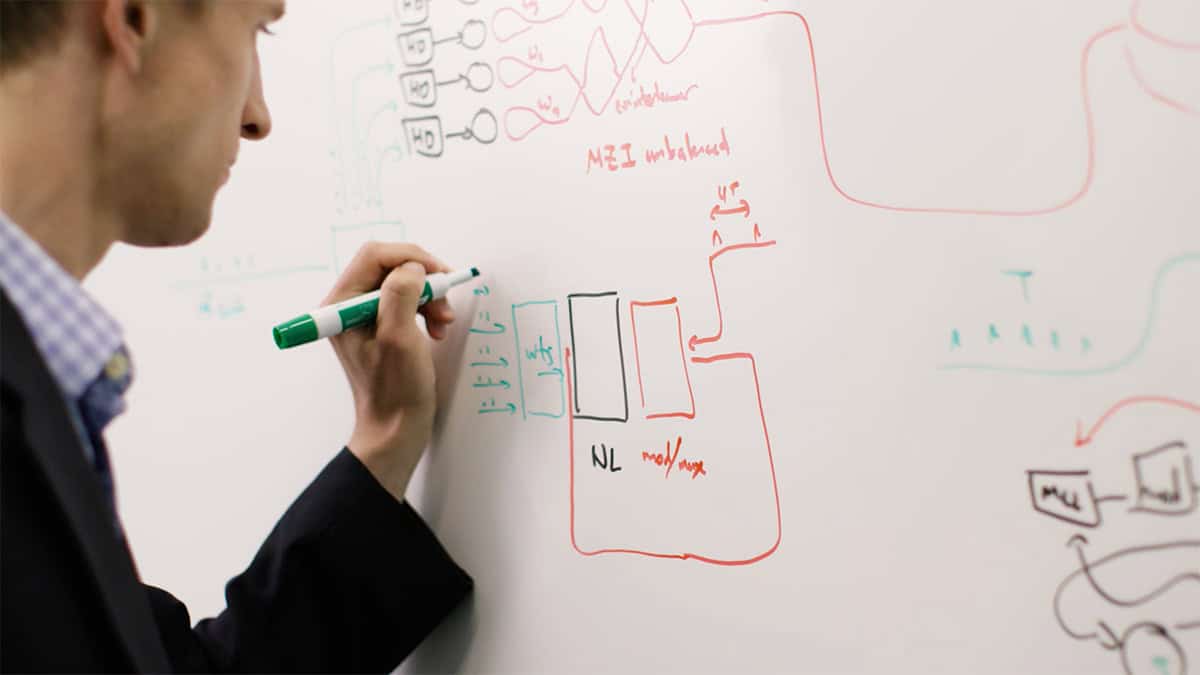
However, the chance to meet and interact with scientists from different areas is still the same. “Science is science, regardless of what institution you’re affiliated with,” he says. “We’re still doing the same things: we do research in a lab, we write up the results, submit them and publish them in journals, and we go to conferences and present our work.”
Hamerly still sees himself as principally a theorist. He spends much of his time writing computer code – occasionally for models that run on a supercomputer but usually for models that can run on his laptop. The rest of his time is focused on writing papers, travelling to present work, responding to reviews or in meetings.
Building up the quantum workforce: an undergraduate route into industry
Looking to the future, Hamerly believes that technology will impact research, but that the core elements of a researcher’s role are likely to remain similar for the foreseeable future. “The job of a researcher before the Internet, for example, is not too different from a post-Internet researcher,” he says, pointing to how you still have to communicate research via papers and conferences, and understand the field by reading others’ publications.
“There will definitely be changes in the way you do every one of these things in the next 10 years, especially with AI, but I don’t see any of them becoming optional.”
For young researchers entering the field, Hamerly advises keeping your options open. He did not envisage himself leaving full-time academia and work in an industrial lab, but switched because it offered a better opportunity to pursue the research he wanted to do. “They are both good routes to do research,” he concludes, “but you might find – based on which offers you get – that one is better than another.”