Ryan Gosling’s film Project Hail Mary turns Andy Weir’s science-heavy novel into an uplifting and expansive space adventure – one that deftly weaves in curiosity, collaboration and friendship. Andrew Glester and Tushna Commissariat explore its science and spectacle
**Major spoilers ahead
“Human beings have a remarkable ability to accept the abnormal and make it normal,” observes Ryland Grace, the main protagonist of Project Hail Mary, as he floats alone in interstellar space, millions of miles from Earth. And yet there is nothing ordinary about the spectacular film released earlier this year, based on Andy Weir’s bestselling 2021 novel of the same name.
With its sweeping plot that spans civilizations and light-years, at its heart, Project Hail Mary is a humorous and uplifting story routed in friendship, survival and what it means to be “human”. It also shines a bright light on international co-operation and scientific problem-solving under great pressure, as the human race is forced to come together in a time of dire need.
Starring Ryan Gosling (who also produced the film), the tale follows Grace, a middle-school science teacher turned extremely unwilling astronaut – “I put the ‘not’ in astronaut! I’ve never done a space walk, I can’t even moonwalk!” Strongarmed into becoming our interstellar saviour, Grace has the self-deprecating charm coupled with enough scientific acumen to make him a lead character that audiences can happily root for.
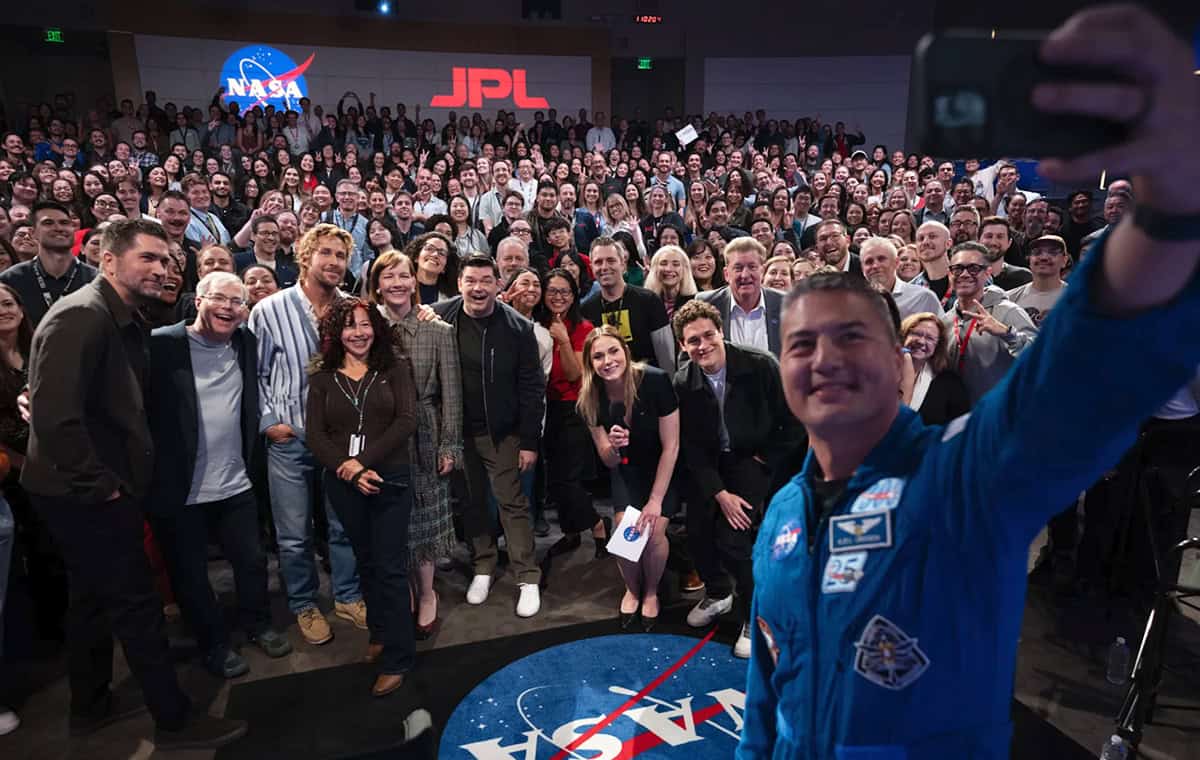
The film is a visual masterpiece, with sequences that visualize the beauty and terror of space, often viewed from Grace’s disorienting and lonely perspective; alongside scenes on an increasingly more frantic Earth in a bid for survival and sunshine. It is directed and produced by Phil Lord and Christopher Miller (The Lego Movie and Spider-Man: Into the Spider-Verse), who are both well known for their funny and fast-paced movie style. If you expected a certain level of inventive energy in their adaption of this story you will not be disappointed, as Project Hail Mary is expansive in every aspect. New cinematic techniques were combined with the centuries old artform of puppetry to simulate the disorienting reality of long-term zero gravity and the unique physiology of alien life for gigantic IMAX screens.
A dual timeline narrative
Project Hail Mary opens with a familiar Weir set-up – a lone scientist in crisis, who must use all his ingenuity and scientific know-how to save the day. Indeed, Grace wakes up aboard a spacecraft, light-years from Earth with no memory of his identity or how he got there. He soon realizes that he is the sole surviving member of the crew on the ship, and as he slowly recovers his memories, he recalls their desperate, one-way mission to save humanity.
Interspersed in flashbacks, we learn that scientists have discovered a so-called “Petrova line” of infrared light between the Sun and Venus. They have worked out that this line is made up of a mysterious micro-organism, which seems to be consuming the Sun’s energy and threatens to plunge our planet into icy doom. Dubbed “astrophage” (Latin for “star eater”), the algae-like microbe has already noticeably dimmed the light that Earth receives from the Sun, and extrapolating, it will cause catastrophic global cooling within 30 years.
A “Petrova Taskforce” is created, made up of scientists and military personnel from across the globe. It is led by the formidable Eva Stratt – perfectly played by German actor Sandra Hüller – who brings a reticent Grace into the fold, who uses his skills as a one-time top molecular biologist to study the unicellular organism. It is Grace who, after some comedic and somewhat DIY experimentation, figures out that the astrophage are capable of absorbing and storing solar radiation; and later expelling it, which serves as a source of propulsion, allowing them to travel at near-light speeds.
Further research shows that all but one of the stars in our galactic neighbourhood are similarly infected by the astrophage. The exception is Tau Ceti, which is 11.9 light-years away from Earth (see box “Around the Sun”) and hosts a few planets of its own. The taskforce decides to send a one-way crewed mission to this special star, to determine what makes it immune to these interstellar interlopers.
Around the Sun
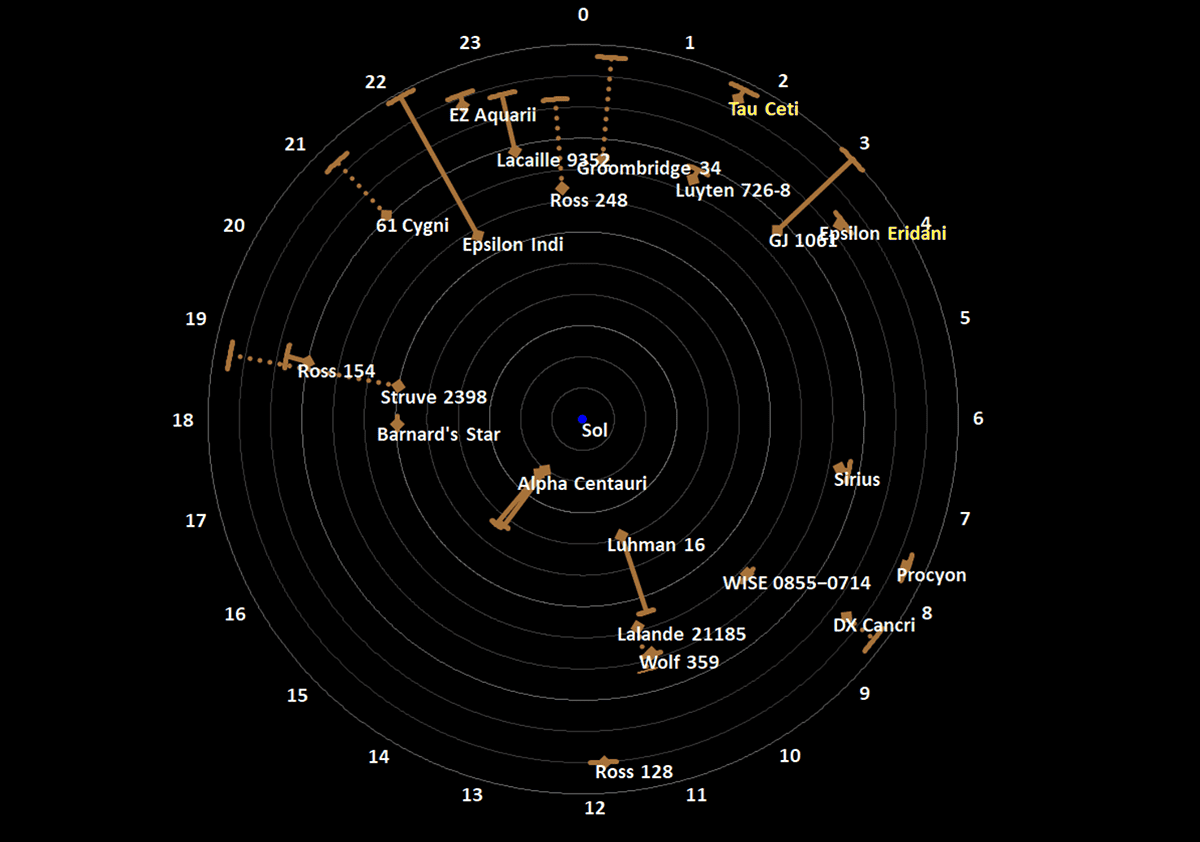
This stellar map is a graphical representation of nearby stars to our own star – Sol – all within 12 light-years of Earth. Each stellar object is jointly marked by two points, a diamond marked point (which shows the location of the stellar objects according to its declination) and a line marked point (which represents the distance in light-years from the centre). The circular lines indicate the distance from the centre by being set apart in one light-year steps.
The map accurately depicts these stars’ distance from Sol and their location in 3D space; to help visualize the distances to nearby stars in our galactic neighbourhood. Both Taue Ceti (2) and Eridani (4) can be seen on the map in the top right-hand quadrant.
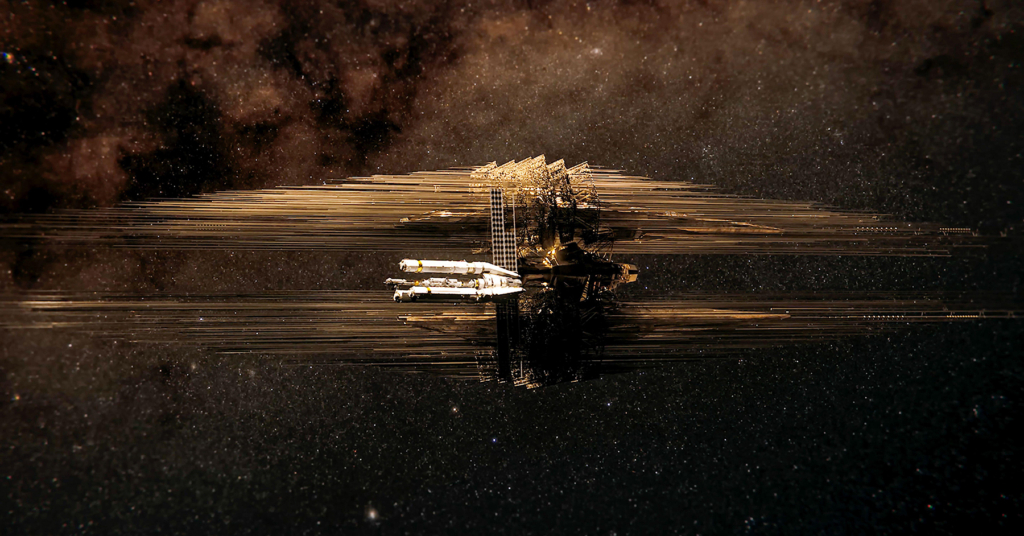
In an interesting twist, it is the astrophage themselves that ultimately fuel the Hail Mary ship, after Grace discovers how to breed them on Earth. With only enough time to breed the required amount of astrophage for a one-way trip – they decide that any findings will be sent back to Earth via a series of much smaller and lighter probes. Despite Tau Ceti being almost 12 light-years away from Earth, it takes the spacecraft only about four years to get there, thanks to the fact that the ship travels at 92% the speed of light. This allows relativistic effects such as time dilation and length contraction come into play.
With this complex set-up, the real story picks up once Grace arrives at Tau Ceti, only to find that he is second in line, with another spaceship already there. Grace soon meets its sole occupant – the alien creature that he refers to as Rocky thanks to its stone-like morphology. Grace learns that Rocky is on the exact same mission as him, and that the alien hails from another nearby astrophage-infested star system called 40 Eridani. The pair soon realize that the only way to save both their planets is to work together.
Alongside Grace and Rocky’s adventures in space, the film does well in bringing in the more sober aspects of the story back on Earth – highlighting the trials and triumphs of the taskforce. These range from the global mobilization of scientists and engineers, working together to build and fuel a light-speed ship in record time; to Stratt’s character bypassing international law to ensure humanity’s survival. Lord and Miller use a distinct visual language to illustrate the two timelines. The Earth sequences look more bleak; while the scenes aboard the Hail Mary use visualizations of waveforms and light-absorption to show how Grace perceives the microscopic threat that is astrophage.
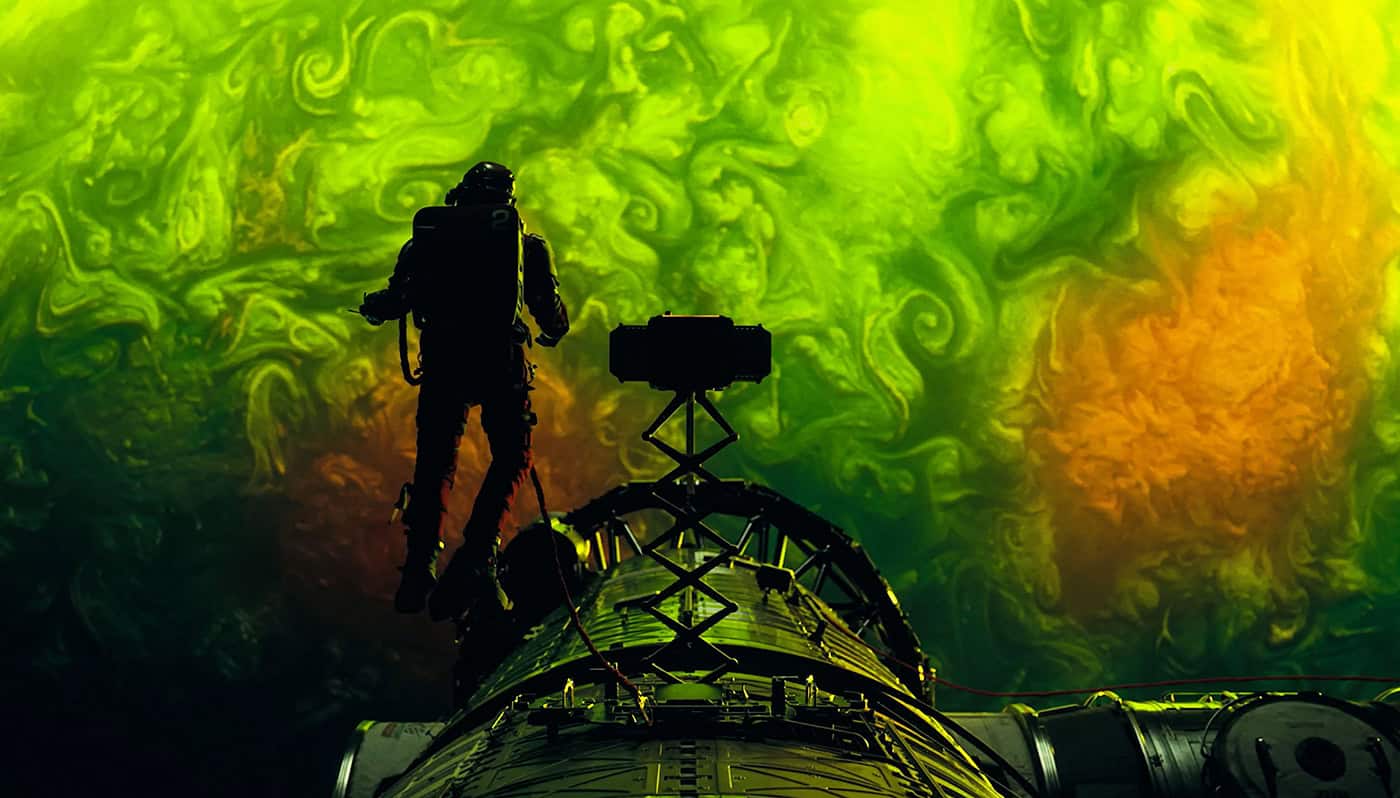
Rocky is one of the most lovable alien creatures to have graced our cinema screens in recent years, brought to life by the clever use of puppetry. The astrophage, by contrast, are meant to evoke fear and intrigue. We are treated to visualizations of how these “black matter” organisms absorb radiation, giving the audience a sense of how matter and energy can be manipulated on a grand scale. Visually, this metaphor continues throughout the film and, ultimately, to the survival of the planet.
Science and fiction, on screen and the page
It is clear that both Weir and the film’s producers and director were keen to highlight science and scientists throughout the book and film. For example, 40 Eridani is a real star system and Weir used astronomical data to build Rocky’s world.
In fact, when the book Project Hail Mary was written, the planet 40 Eridani-B was believed to be real. More recent data has revealed the dimming of the star that inferred the planet’s existence is in fact more likely a result of the composition of the star itself, and the planet most likely does not exist (see box “Exoplanetary exploits”).
In Project Hail Mary, Weir used the real-world observations of stars sometimes dimming for unknown reasons to come up with the idea of the astrophage and its effects on stars. The book also has much more detailed (if scientifically dubious) explanations, using neutrinos and quantum physics, for how astrophage devours starlight and manages to survive on the surface of stars.
Exoplanetary exploits: the science and speculation behind Rocky’s home world
Andy Weir based Rocky’s home planet in a star system that is beloved in science fiction, while existing in reality. 40 Eridani is a triple star system that is about 16.3 light-years from the Sun. Fans of Star Trek might also recognize 40 Eridani as the solar system that is home to planet Vulcan. The system comprises the larger star 40 Eridani A and a binary pair of stars, consisting of a red dwarf (40 Eridani C), and a white dwarf star (40 Eridani B).
The system has been well known and observed for a number of years, so much so that as of 1991, Star Trek creator Gene Roddenberry described how the binary stars would “gleam brilliantly in the Vulcan sky” in a letter to Sky & Telescope magazine.
In Project Hail Mary, Erid (or “40 Eridani A b”) is the closest planet to the main star in the system, with some extreme conditions compared with those found on Earth. For example, the planet’s gravity is more than twice Earth’s, and it has a very dense (28 Earth atmospheres) ammonia-based atmosphere at extremely high pressure. The planet has an average surface temperature of 210 °C – despite this, it is able to have liquid water on its surface, as the high surface pressure raises water’s boiling point above that temperature.
According to Weir, Erid’s dense atmosphere blocks almost all incoming light, meaning that Eridians are “blind” to visible light and use echolocation to “see” and communicate. Erid also has a strong magnetic field that blocks the large amount of radiation a planet so close to a star would be bathed in. The high-pressure environment, meanwhile, meant that Weir had to base Eridian biology on a high-mineral content, stone-like exoskeleton, with a circulatory system using liquid mercury, making it an especially unique alien life form.
In reality, astronomers at one point believed that 40 Eridani A was host to a planet or two, thanks to periodic variations in its radial velocity – a common signature of exoplanets. However, the observed variation was on the scale of 42 days, which is similar to the star’s rotation period, meaning that it was next to impossible to confirm the existence of a planet. After a series of observations over a number of years, as of 2024 astronomers sadly concluded that the radial velocity signal very likely does originate from stellar activity, and not from a planet.
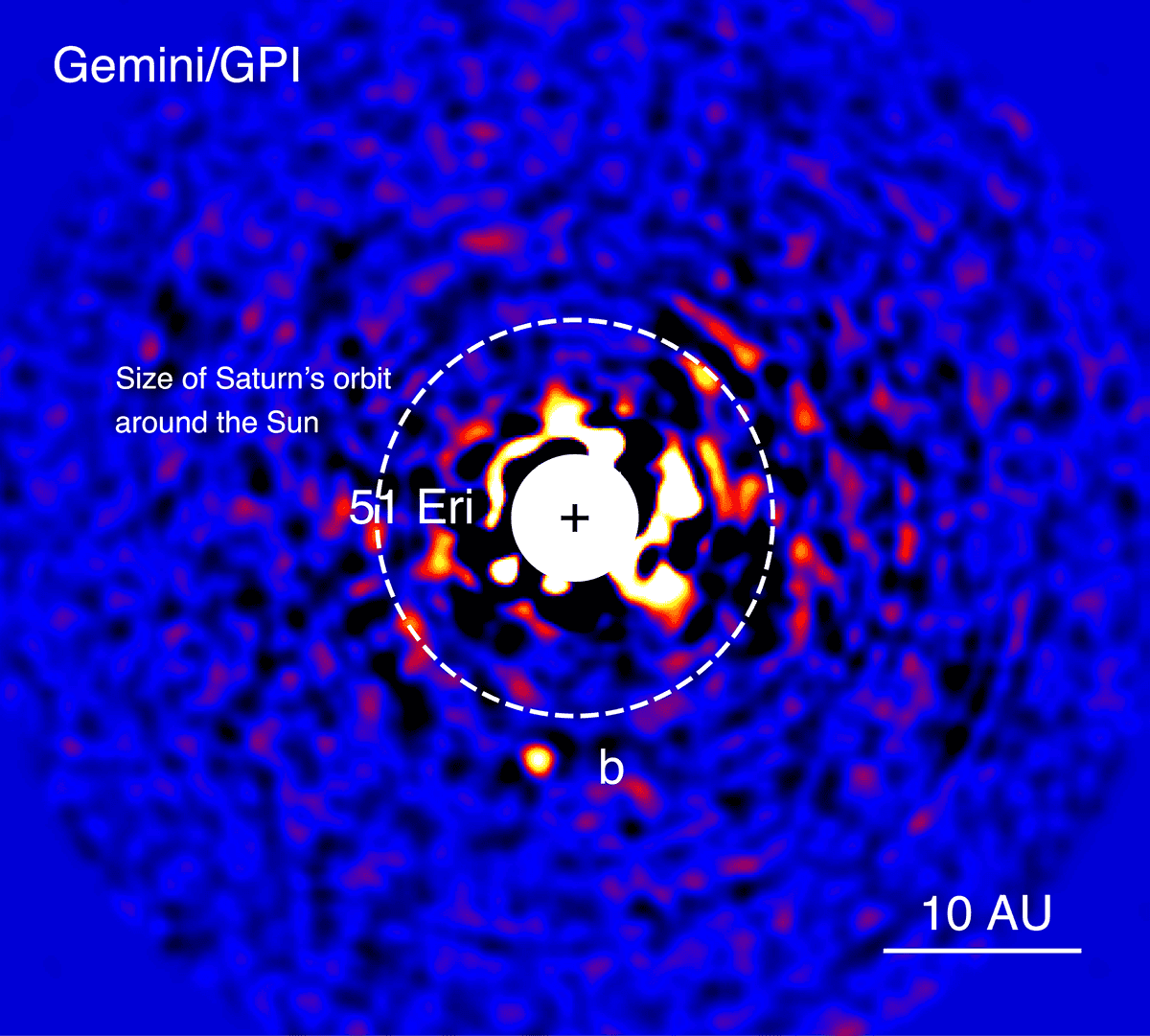
But all is not lost in the Eridian stellar neighbourhood – the not too far away system of 51 Eridani b (roughly 96 light-years from Earth) has a confirmed and directly imaged exoplanet (see image above). Dubbed 51 Eridani b, the Jupiter-sized planet orbits 11 billion miles from its star, a little farther out than Saturn’s orbit in our solar system. As of 2021, NASA announced that its James Webb telescope plans to probe the planet’s atmosphere at infrared wavelengths to learn more about this distant world – and the secrets it currently keeps.
Weir wrote the book before the global COVID-19 pandemic, but it was released in the very midst of it. Indeed, there are many parallels in the way humanity deals with global problems. As we see in Project Hail Mary, the fictional version of our world has this immediate burning issue and while not everybody quite agrees on a plan, there is a global realization and agreement that something must be done, no matter what it takes. Weir is not so convinced that it always works like this though, as he told us that “I do think that the world works together when there’s a common problem, but only if it’s a direct and immediate problem like COVID. We’re not so great at it when it’s a slow burn, like environmental damage.”
Filmmaker and scriptwriter Drew Goddard – who wrote the screenplay for Project Hail Mary as well as Weir’s previous bestselling-book-turned-movie The Martian – reportedly drew up a list of 10 things that he would like to bring from the pages to the film. He achieved nine of them – the missing one was the nuking of the polar ice-caps by Stratt to purposefully trigger global warming. It is a shocking and thought-provoking moment in the book, stripped from the film due to the necessary time it would take to explore and depict such a drastic decision (though one can imagine an entire story based on just that one issue). The film also could have included some more details from the book of the political machinations on Earth, though there are already a lot of ideas to take in, especially for those viewers who have not read the book.
Building a common language
When it comes to depicting an alien, the filmmakers did a great job, not only of realizing Rocky on screen, but also showing the growing friendship between two creatures from distant worlds. Despite their many differences, both Grace and Rocky have been displaced from their homes and tasked with the burden of saving them. To do so, they must overcome their fear of the unknown, and find ways to converse and connect.
On Earth, we are able to communicate in a number of ways – even sometimes between species. In science fiction, science and maths often become a common language. Rocky’s language is decidedly otherworldly. The script, which includes not just the spoken lines but also the complex “musical” language of the Eridian, was developed with linguists and xenobiologists. Via Grace, the audience is able to experience the genuine difficulty of two distinct life-forms learning to communicate for the first time (see box “Words of great encouragement”).
Despite the challenges the pair face in dealing with a culture alien to their own, the two of them go from being fearful and intrigued to amused and friendly; eventually making great sacrifices to help one another.
“Words of great encouragement”
Hannah Little, a linguist and lecturer in communication and media at the University of Liverpool, on the language and communication between Grace and Rocky:
I love Rocky and Grace’s first contact scene – they initially don’t know how the other communicates, but Rocky must find a way to tell Grace to leave the airlock. To do this, he creates a 3D model of Grace and the Hail Mary, to act out that he wants Grace to return to his ship. Grace understands this communication attempt immediately. Without a shared language at the start, the pair must use other strategies to converse, such as using something called “iconicity”. Iconicity is when we use sounds or gestures that depict what we are trying to communicate in some way. Humans often do this using gesture (imagine playing charades) or with drawings (like in Pictionary), but we don’t usually have a 3D printer to hand like Rocky does. This is an excellent opening concept as a 3D model can be a more accurate representation of a human or a ship than a 2D drawing, and it also tells us something about how Rocky perceives the world – he doesn’t have vision that uses light as we do, but instead something more similar to echolocation that can only detect 3D objects.
As they continue to interact, we see Rocky mimicking Grace in raising his index finger: a gesture Grace uses to communicate “can you wait a minute”. Through imitating him, Rocky is able to see what Grace does in response to this gesture and gather data about what the gesture means and the effect it has. This is exactly how humans learn language. When we speak to babies, we are constantly trying to get them to imitate us.
After these initial exchanges, Grace starts to build a translation programme where he logs different sounds Rocky makes and his best guess for what they mean in English. This is where the realism of the movie gets lost: to build reliable translation systems between different human languages, we need an enormous amount of data, even with everything we know about how human languages are produced and structured. It would be a mammoth task to work out what aspects of Rocky’s sounds are meaningful and how those meanings map to human concepts and grammar, but the film depicts this as relatively straightforward. We then suddenly jump forward in time to a point where they have a working translation model without much clue of how long this took. Of course, this has to happen for the sake of the story, and I prefer this as an explanation than some magical universal translator or a fish you put in your ear.
I also love how Rocky’s biology is such that he looks like a strange rocky spider with no discernible face. This makes Project Hail Mary a more exciting exploration of potential alien biology than other films and TV shows where the aliens all look and speak a lot like humans do. But Rocky still communicates with sound, as humans do, and presumably using structures that are very easy to translate. I’m always after depictions of alien communication that get away from a human-centric view of what language can be. It would have been entertaining if Rocky communicated via smell or vibrations or electricity.
“I’m going to have to science the **** out of this.”
Alongside the intriguing linguistics, a side-effect of the interwoven timelines is that viewers are confronted with the reality of scientific progress: it is often messy, desperate and driven by people who are deeply flawed. For the most part, the characters are shown as tenacious individuals, who refuse to give up in the face of a dying sun.
Grace is the embodiment of a reluctant hero. He is also painted as something of a lone voice in academia, having presented a paper at a conference about non-carbon-based life, and being ridiculed for the idea. He is then ostracized by the scientific community, and so turns to being a school-teacher instead, making him a rather unlikely candidate for a space mission.
Despite Grace’s reticence, it turns out he is perfect for the role of saviour of the planet, mainly thanks to his relentless resolve to find the answer, even when armed with minimal resources. Gosling’s face, initially confused, then increasingly determined, fills the screen as we see him try to come to terms with his mission.
It is, however, impossible to know for sure how a person in such total isolation may truly feel or react. This uncertainty is core to the script. The big questions of the film about the value of sacrifice and the necessity of co-operation are left for the audience to decide. The directors are not didactic storytellers, and Weir himself is adamant that his main aim is to entertain. It will be a great bonus if readers and viewers come away with a new understanding of science and the scientific process.
Indeed, this story features many physics concepts, from exoplanetary science to the special theory of relativity; as well as space travel, artificial gravity and a healthy dose of quantum and materials science. Weir contends that the science of Project Hail Mary is sound until you get deep into the quantum level. It is there where he used a literary plot device often referred to as a “MacGuffin” that enabled interstellar travel, using a biological organism.
Becky Smethurst, an astrophysicist at the University of Oxford, recently joined the Physics World Stories podcast, and was delighted that Weir went to such lengths for the science in his narratives. “I think it really surprised me in terms of energy storage,” says Smethurst. “It’s mass-energy equivalence at the crux of the story, if the astrophage can take in the Sun’s energy and store it and then release it later. It’s just e = mc2.”
She goes on to explain that this fundamental physics concept is what allowed for interstellar travel, by harnessing huge amounts of energy to accelerate the spacecraft up to nearly the speed of light. In reality, the issue lies in terms of what kind of single-cell can store that much energy and with that much energy efficiency, which she estimates to be “a billion times more efficient” than any we know on Earth.
But Smethurst goes on to highlight that this is what makes Weir a creative writer, especially when it came to developing the biological and physical mechanisms that allow astrophage to interact with neutrinos. “He invented this whole term in the book called ‘super cross-sectionality’,” she says, “which is fun because it’s sort of a borrowed word from particle physics, when you talk about cross sections of particles and whether they’re likely to intersect. So I like that the idea is obviously sci-fi, but the fact that it’s rooted in some elements of physics and he made that effort to do that, I think was incredible.”
At the heart
Project Hail Mary succeeds as an entertaining space adventure because it trusts its audience to be as smart as its protagonist. It treats astrophysics and molecular biology not as hurdles to the plot, but as the plot itself. Without giving it all away, the story does not end with a straightforward “victory” and much of the lessons learned come from the realization that science is a universal language. In 2026, where global challenges often feel intractable, the film offers a fundamentally sunny outlook. It suggests that when people – or even different species from distant planets – come together to overcome impossible odds, survival is possible.
Using the immense format of IMAX, Project Hail Mary leads us into a total immersion of Grace’s lonely, pressurized world; only to show us that we are never truly alone – as long as we have the tools of discovery, and the ability to overcome our fear of the unknown.