What more can there be to say about Stephen Hawking that hasn’t already been covered in numerous books, movies and documentaries? Andrew Glester talks to Graham Farmelo, who has just published a new authorized biography of one of the greatest physicists of his age
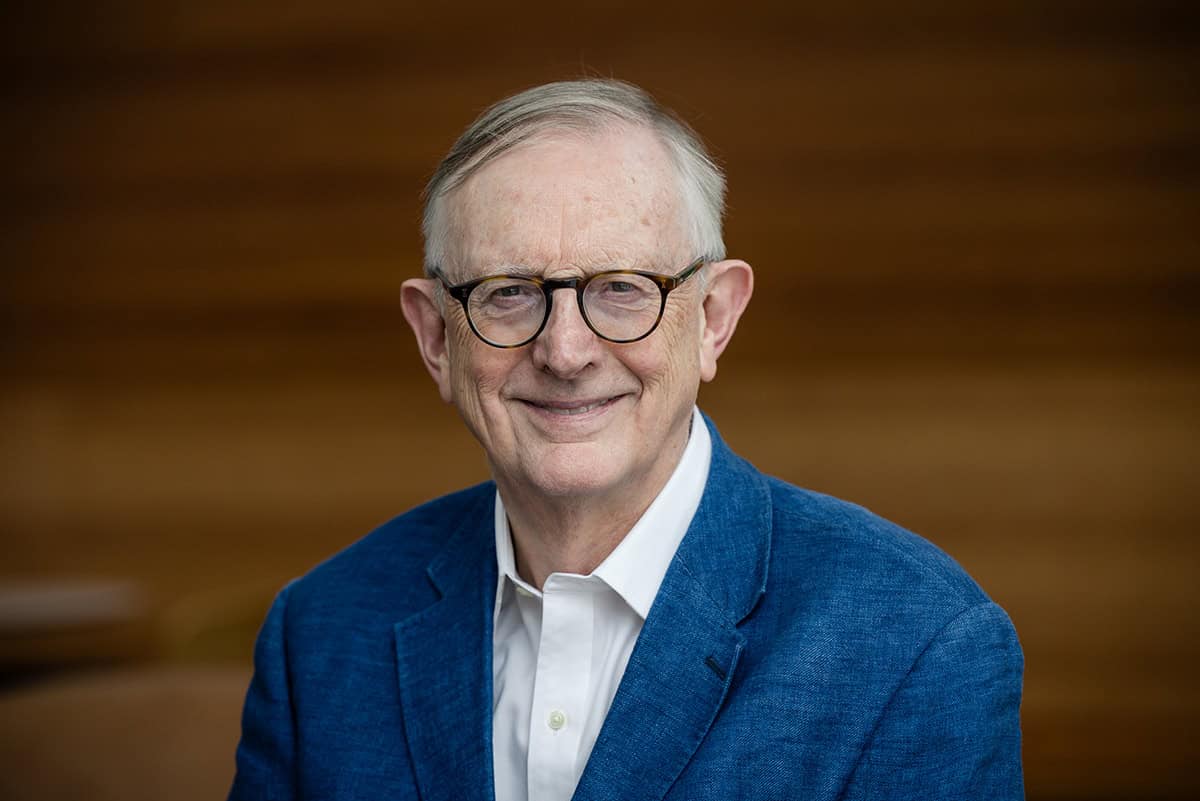
Stephen Hawking was one of the most famous physicists of his era, making decisive contributions to cosmology and astrophysics – notably the physics of black holes. Following his death in 2018 at the age of 78, Hawking’s family invited the biographer and science writer Graham Farmelo to write an authorized biography. Entitled Hawking: His Life and Work, the book has just been published by John Murray.
Andrew Glester, who is a senior lecturer in science communication at the University of the West of England, recently caught up with Farmelo on an episode of the Physics World Stories podcast. A physicist by training, Farmelo also wrote the well-received 2009 biography of Paul Dirac entitled The Strangest Man. So how did he go about writing about a figure as well known and controversial as Hawking? The following is an edited extract of their conversation.
Stephen Hawking is such a widely known figure whose story has been told in books, films and documentaries. How do you approach writing a new biography about him, and what fresh material did you discover?
The first thing I was concerned about was: what is there new to find out about Stephen Hawking? His life story has been told in lots of very good documentaries, books and Hollywood movies so although I was pleased to take on the project, I didn’t know what new material would be available.
In that regard, I count myself as extremely lucky. Not only did I have the Hawking archive at the University Library in Cambridge, but about six months into the project, I also found out from Stephen’s older sister Mary that she was prepared to give me access to Stephen’s parents’ writings.
His father kept a high-quality diary for nearly 60 years – talkative, interesting and not evasive or vacuous – while his mother started writing in about 1970. She was a very talented writer: direct and unforgiving. I also had information shared by Stephen’s friends, notably Kip Thorne – Nobel-prize winner and one of the people who discovered gravitational waves – and his childhood friends John McClenahan and Robert Donovan.
How did the picture of Hawking that emerged from these private diaries and archival materials differ from the pre-existing image you had of him?
It’s a lot more vivid, for a start. When you talk to his school friends, in particular McClenahan, you hear exactly what he was doing at school. And when you combine that with his father’s accounts, you get a multi-dimensional look. So instead of the bland statements you often come across, you actually hear what Stephen was like.
For example, his father knew that Stephen was very good at mathematics and very bright, but thought he was going to fritter this talent away by not concentrating hard enough. I don’t want to sound vacuous, but he only wanted to do things he was interested in. If a teacher didn’t capture his imagination, he barely bothered. The same went for parts of physics that he thought were too trivial. But he had a great maths teacher who really fired him up into the power of pure mathematics.
Looking past Hawking’s public persona, what was the defining personal trait that truly stood out to you when researching his life?
Pretty well everyone has heard of Stephen Hawking (although I did once meet a cab driver in the Midwest US who hadn’t). And they always say what an incredibly brave man he was – clever, funny, with a wit and wry humour. But what’s really striking when you get to know Stephen – through documents and friends – is his colossal determination and stubbornness. The physicist David Gross said he’d met some pretty clever physicists, but none with anything like the determination of Stephen Hawking, which was extraordinary.
If you strip away the worldwide fame and the story of personal adversity, how does Hawking’s contribution to theoretical physics stand up strictly on its own merits?
It’s a bad feature of physicists that they love to rank each other. Enrico Fermi was one of the worst in that regard. He would sit there and debate for hours who was, say, the fourth or fifth best physicist in the world. It’s ridiculous. When novelists do it, we laugh, but physicists love to do this too and it’s nonsense.
Still, I will say that Einstein was the greatest physicist of the 20th century. To me, that’s a slam dunk. But I wanted to see where Hawking stood relative to Einstein and, just below him, Dirac, Heisenberg and Schrödinger – all of whom Stephen regarded as great physicists because they discovered truly fundamental theories of nature. He looked up to those people.
There’s a good case for saying that nobody made more of a difference to our understanding of black holes than Stephen Hawking.
Graham Farmelo
Absolutely nobody, not one person, said: “Well, the guy’s just overrated.” There have been commentators who said, “Well if Hawking weren’t disabled, nobody would have heard of him.” But the overwhelming majority say he was a truly great physicist – one of the great experts in Einstein’s theory of gravity. There’s a good case for saying that nobody made more of a difference to our understanding of black holes than Stephen Hawking.
The turning point for me was when I [asked] one of the great physicists of our time: “How famous would Stephen have been if he were not disabled?” This person – it’s a he – said “Well, he would be as famous as Murray Gell-Mann or Steven Weinberg.” Nobody said to me on the quiet, “Don’t tell anyone, but he really wasn’t that good.”
You do hear that in some disobliging accounts of his life, but I can honestly say the crème-de-la-crème of physicists I spoke to just have no time for that view at all.
Given that motor neurone disease eventually prevented Hawking from writing out complex equations, how did he actually perform those intricate theoretical calculations? Was he doing it all mentally?
Kip Thorne, his great friend, said Stephen was better at that than anybody and these are not simple calculations. He became extremely adept at the visualizations of curved space and time, and connections between different configurations of fields and things. Kip thinks there’s no-one that was as good as him at that. It was an amazing talent.
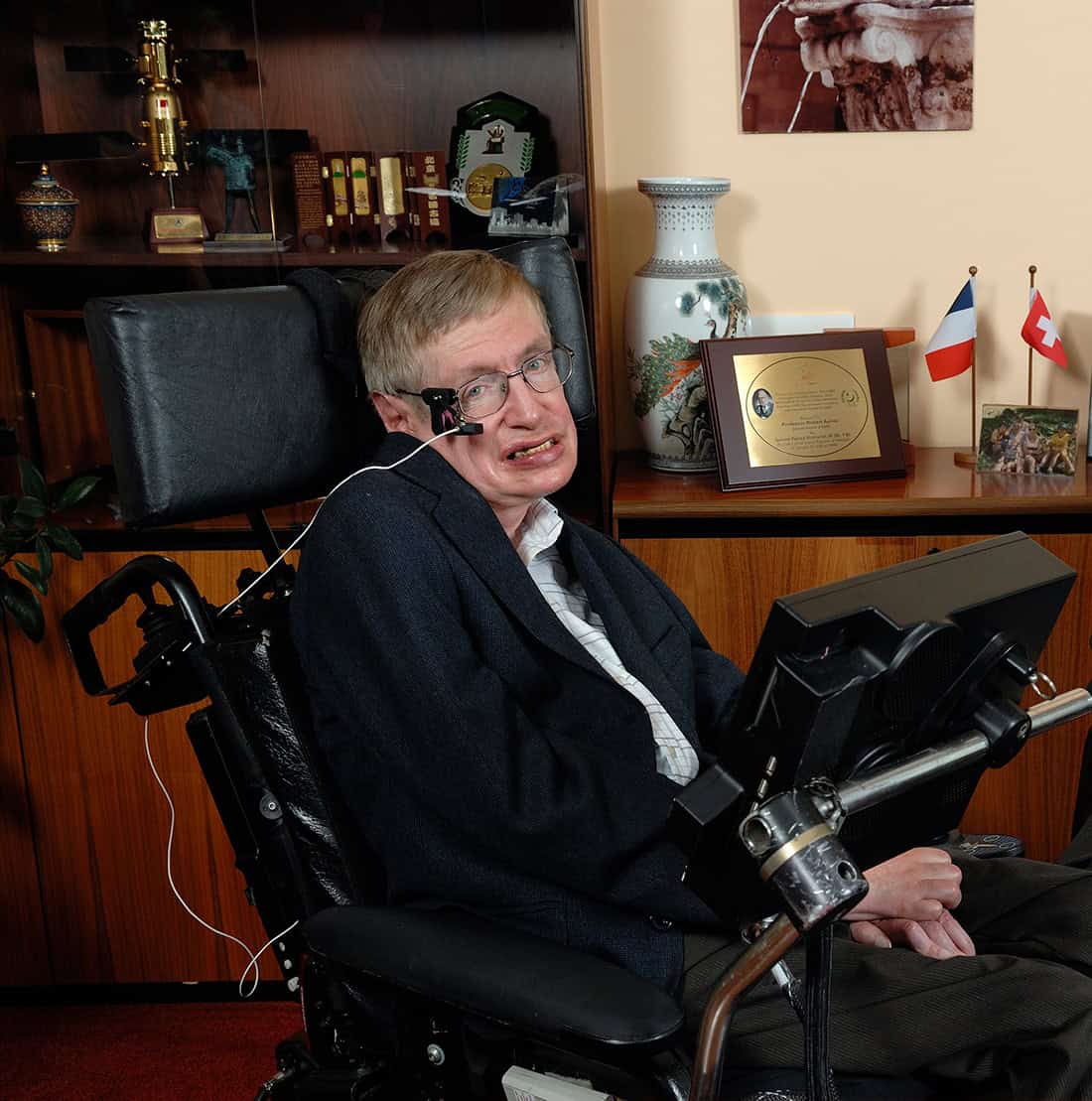
Quite a few of his students said he would give them a calculation, and he sometimes would predict how it would go; he was hardly ever wrong. After the late 1970s, he wasn’t doing many of the calculations alone. He was supported by other people. But make no mistake, he was very closely involved with them.
Some people say, “How could he possibly be involved doing all these calculations in string theory and supergravity?” Well, he had people helping him, but they all say Stephen knew exactly what was going on. This wasn’t somebody who was a passenger. That’s really important to bear in mind.
When writing an authorized biography with close access to the subject’s family, does it become difficult to remain completely objective and write with unvarnished honesty?
You’re right. It’s an authorized biography. His family read everything I wrote. I do try not to be unkind. A biographer who hates or dislikes the subject shouldn’t really be doing it. Yes, an academic may say, “Well there should be no relationship [between a biographer and his subject]”. But I would not want to be unkind to any physicist and, when you see someone who worked with the challenges of Stephen Hawking, it would be unseemly to be mean spirited.
Everyone has personal shortcomings, and you don’t need to be mean spirited to examine them. How did you handle the more complex or less flattering sides of Hawking’s character in the book?
His parents would say he was very selfish. He could occasionally be not as generous as we’d have liked him to have been. In physics, it is expected that you give appropriate credit to other people – even if you can’t stand them or don’t like their work. But Stephen often erred on the side of giving too little credit to other peers in the field.
I didn’t want to paint him like some kind of latter-day saint. He was a human being, just like anybody else – with flaws, strengths and weaknesses. But overall, the big picture is sort of a colossally talented and determined person. As I said, I didn’t want to shy away from the things that were slightly less savoury about him.
Hawking’s name and photograph appeared in the Epstein files, which sparked media headlines. What did your investigation into his presence at that Caribbean conference actually reveal?
That’s true. I’ve looked into it quite closely and have talked with people who were with him there. There were about 20 world-class physicists there and I spoke to one of his carers, who was with him much of the time. And Kip very kindly sent me everything – right from the first announcement of that conference. No mention of Epstein in the conference materials.
The first Kip knew about Epstein was when he was at the meeting in the Caribbean. He described a rather shadowy figure. Epstein was sitting in all these lectures and asking actually pertinent questions and Kip didn’t see Stephen showing the slightest interest in in what Epstein was doing.
Let’s be clear, Epstein was a monster. We now know that. That’s not incorrect. But I don’t know of any evidence that there was anything of Epstein’s horrible side that bled into that meeting. And I can say that hand on my heart.
What key takeaways did you draw from how Hawking coped with his diagnosis and squeezed the most out of life?
One is his attitude to his health. The way he coped with motor neurone disease taught me a lot of lessons. In his correspondence with the great cellist Jacqueline Dupre, who also had a horrible condition that stopped her playing, he said don’t ever feel sorry for yourself. Other people won’t be interested: they don’t want to hear people complaining about their health condition.
Hawking, warts and all: a new biography of a scientific icon
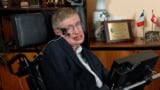
His attitude was: don’t look at your feet, look up at the stars. This constant wish to be positive – to do what you can do, and to do it thoroughly – is incredibly moving. It was extremely powerful because he had such a terrible diagnosis. The knowledge that the trend will always be downwards and yet refusing to compromise – still wanting to travel, still wanting to do physics, still having the joy of a family life – is an absolutely extraordinary story.
My second takeaway is his appetite for life, which was absolutely off the scale. His inquisitiveness and interest, which was so clear even as a 10-year-old, stayed throughout his life. Robert Donovan told me about one of his last discussions with Stephen, who was then in his 70s and started talking about a rap artist. Stephen was a Wagnerian who loved classical music, yet he was saying, “Look there’s something in this.” He really was prepared to give everything a chance.
Life is for living. It’s a terrible cliche, but Stephen did that. And what a life it was. Even if he weren’t disabled, you’d still say: “That guy knew how to live.”
- You can listen to the full interview with Graham Farmelo on the Physics World Stories podcast.