Researchers at the Large Hadron Collider (LHC) have discovered a new particle, the Ξcc⁺, (“Xi cc plus”), a heavier cousin of the proton. The particle’s fleeting existence had made it invisible for decades, but the upgraded LHCb detector captured it in just one year of data, opening a new window into the forces that hold quarks together.
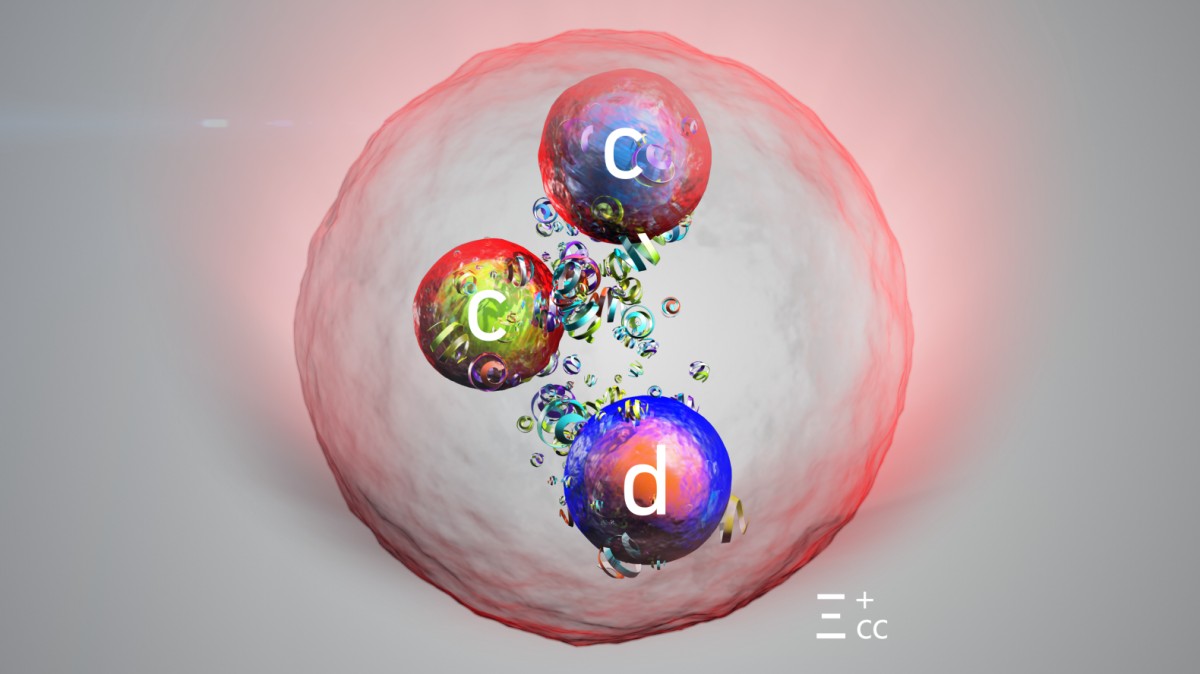
Quarks are the fundamental building blocks of protons and neutrons, which in turn combine to form atomic nuclei. Protons themselves are made from two up quarks and one down quark, held together by the strong force. This is described by a sophisticated theory known as quantum chromodynamics (QCD). The Ξcc⁺ is unusual because it replaces the two up quarks with heavier charm quarks, keeping just one down quark.
“Up and down quarks are labels we give to distinguish the different types of quark,” Tim Gershon of the University of Warwick, told Physics World in an email. “In the Ξcc⁺, both up quarks are replaced by the heavier charm quark. Since the charm and up quarks differ only by their mass – in particular having the same charge – this provides an ideal way to test QCD,” explains Gershon who is spokesperson-elect for LHCb.
This quark content change makes the Ξcc⁺ roughly four times heavier than a proton. Its extremely short lifetime, less than a trillionth of a second, is why previous experiments could not detect it, despite the particle being produced frequently in LHC collisions.
Upgrade was crucial
“The key development that made the observation possible was the upgrade of the LHCb detector,” Gershon says. “We could observe the Ξcc⁺ in one year of data-taking, while we had not been able to do so in a decade of data collected with the original LHCb detector.”
The Ξcc⁺ appears briefly in proton–proton collisions before decaying into three lighter particles: a Λc⁺ baryon, a K⁻ meson, and a π⁺ meson. These decay further into five final particles, including a proton, two K⁻ mesons, and two π⁺ mesons. By reconstructing the trajectories of these particles, researchers saw a sharp signal corresponding to the existence of the Ξcc⁺ particle.
This observation also settles a long-standing question. Over twenty years ago, the SELEX experiment at Fermilab in the US reported hints of the particle. However, the signal could not be confirmed. The LHCb measurement provides a clear, unambiguous detection.
“Studies of particles containing two heavy quarks are very interesting for tests of the QCD binding mechanisms, and this observation provides important new data in that direction,” Gershon says.
LHCb upgrade: CERN collaboration responds to UK funding cut

The discovery relied on upgrades to the LHCb detector. A silicon pixel system called the Vertex Locator tracks particle paths with incredible precision, while a Ring Imaging Cherenkov system identifies particle types based on the light they emit. These improvements allow the detector to collect much larger amounts of data than before, making rare particle discoveries possible.
The discovery of the Ξcc⁺ is just the beginning. Physicists now aim to measure its properties in detail, including its lifetime and additional decay channels. Beyond this, they hope to find even heavier cousins, where one or both charm quarks are replaced by a beauty quark – called Ξbc and Ξbb respectively.
“These may be out of reach with the current LHCb detector – although we will try our best!” Gershon says. “But we do expect to be able to observe them with a future upgrade called LHCb Upgrade II. Unfortunately, the UK funding for this upgrade has recently been put in doubt due to decisions made at the UKRI funding agency. This latest result reiterates the uniqueness of LHCb – no other experiment can make these measurements – and the importance of finding a solution to be able to fund LHCb Upgrade II.”