Scientists in the US have made the first artificial eye using 3D polymer structures. The eye, which is made from individual "ommatidia" -- or single lenses -- arranged in a dome shape, is similar in structure to an insect's compound eye. It was developed by Luke Lee and colleagues at the University of California at Berkeley. Each ommatidium consists of a refractive polymer microlens, a light-guiding polymer cone, and a waveguide that together collect and direct light into an optoelectronics detector that can recognize images. If perfected, such eyes could be used in medicine, environmental monitoring, industry and the military (Science 321 557).

There are two main types of eye in the animal world: camera-like eyes, which use a single lens to focus images onto a retina, and compound eyes, which contain multiple lenses or ommatidia. Humans, birds and many other animals have camera-type eyes, while insects have compound eyes. This allows them to have panoramic vision because the individual ommatidia provide fragments of an image that are then simultaneously combined to rapidly build up a larger overall picture.
Scientists have been interested in making artificial, non-mechanical, eyes for several decades. However, this has only become a real possibility in recent years thanks to advances in polymer processing that allow flexible three-dimensional curved structures to be made. Such structures are similar to the naturally occurring shapes found in the lenses of real eyes.
Two years ago, Lee’s team used tuneable “elastomer membranes” to integrate optoelectronic imager arrays to camera-type eyes. The researchers have now turned their attention to compound eyes and have used a process called “templating” in a photosensitive polymer resin to make thousands of tiny hexagonal-shaped lenses, each measuring just microns across. Each artificial ommatidium is connected to a tube-like waveguide that directs light down into photodetector arrays that then build up an image of an object.
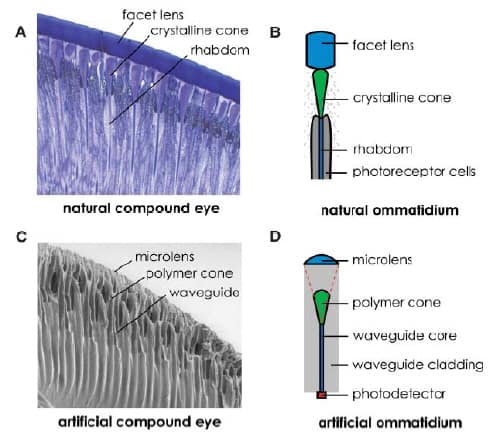
The lenses are arranged in a dome shape so that they project outwards in all directions (figure 1). This configuration provides a wide field of view similar to that of real insect eyes. The structure also helps to guide captured light into the photodetector arrays, just as the crystalline cones in nature direct light onto photoreceptor cells (figure 2).
Such eyes could eventually be used to make high-tech cameras, navigation devices in unmanned vehicles and perhaps even synthetic retinal implants. Other applications include surveillance sensors that could monitor areas over 360° and in real time. Smaller versions of such sensors could also be swallowed and be used to image inside the digestive tract, says Lee.