New IOP president Paul Howarth tells Michael Banks that communicating the relevance of physics to society has never been more important
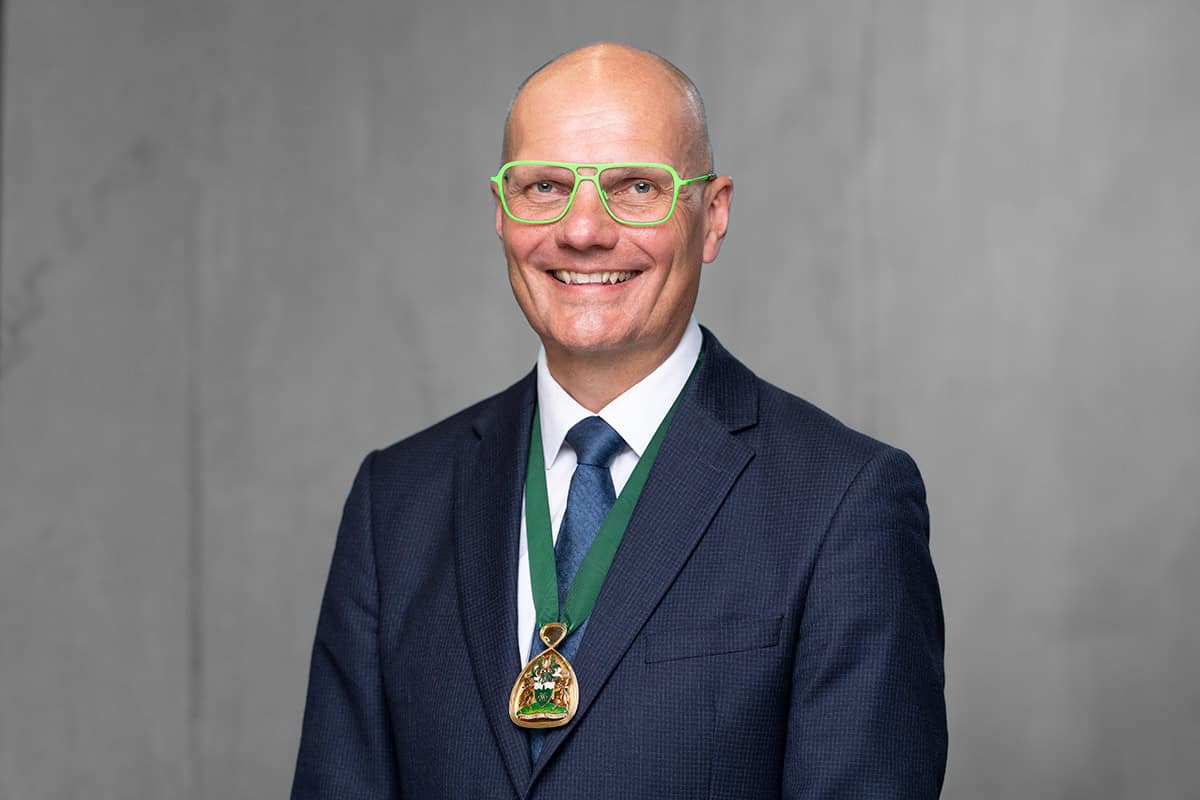
With a PhD in nuclear physics, Paul Howarth has had a long career in the nuclear sector, working on the European Fusion Programme and at British Nuclear Fuels, as well as co-founding the Dalton Nuclear Institute at the University of Manchester. He was a non-executive board director of the National Physical Laboratory and served as chief executive officer of the National Nuclear Laboratory.
Howarth became president-elect of the Institute of Physics (IOP) in September 2025. In February he became IOP president after space physicist Michele Dougherty stepped aside from the role to avoid any conflicts of interest given her position as executive chair of the Science and Technology Facilities Council. Howarth is set to be IOP president until 2029. Physics World recently caught up with Howarth to find out more about his career and vision for physics.
What originally sparked your interest in physics?
I think it probably came from my father. He was a research chemist. We lived in Cheshire near the Jodrell Bank Observatory and its iconic Lovell Telescope. I was fascinated by that and it captivated my interest in astronomy and so I did a degree in physics and astrophysics at the University of Birmingham.
You stayed at Birmingham to do a PhD in nuclear fusion. What attracted you to that field?
It goes back to my interest in astronomy and the ability to use mathematics to describe the universe. Yet by the end of the degree, I was fascinated by nuclear fusion as an energy source and a sustainable means of clean energy for society. During my PhD, I got to work on the JET tokamak in Oxfordshire, which was wonderful. It was when JET was doing its first deuterium-tritium plasma shot, which was an exciting time.
After your PhD, you worked for British Nuclear Fuels. Why did you make that move and what appealed about the commercial side of physics?
In the 1990s there was quite a bit of uncertainty about the direction of nuclear fusion, but I’d always been fascinated by the huge monolith structures of nuclear power stations. So I didn’t hesitate when an opportunity arose to work at Sellafield – a huge site in north-west England with more than 200 nuclear facilities – on understanding the physics of plutonium.
You then served as chief executive officer of the UK’s National Nuclear Laboratory. How did that come about?
At British Nuclear Fuels I was working to build the case for the next generation of nuclear power plants. But in the early 2000s it was less clear that nuclear was going to be part of the UK’s energy policy. So British Nuclear Fuels was broken up into organizations such as the Nuclear Decommissioning Authority. But I was determined to continue to make the case for new nuclear build and ended up helping the UK government create a National Nuclear Laboratory to maintain sovereign nuclear capability, becoming chief executive officer in 2011.
What did that role involve?
We had contracts to support all aspects of the UK’s nuclear programme as well as build the case for future nuclear. We worked on the front end of the fuel cycle, on reactor technology, on future reactors, on legacy waste management and decommissioning. I had the responsibility for running about £2–3bn of critical nuclear real estate and infrastructure.
Many countries, not just the UK, are showing a renewed enthusiasm for nuclear – what do you attribute that to?
Yes, it’s a fascinating time for nuclear. I think things are heading now towards small modular reactors and advanced reactor systems. Larger nuclear plants are more efficient but it is possible to trade that off for smaller plants. This opens up the opportunity for others to potentially invest in nuclear. So we see, for example, individuals like Bill Gates and others who are looking at nuclear power.
That’s the challenge – to effectively support all aspects of physics. I don’t want to be in a position where we are pitching one area against another
Paul Howarth
Do you see parallels with the fusion industry and how that has grown in the past decade?
Absolutely. I think a very similar thing has happened. Of course, there’s still the engineering challenges associated with scaling up fusion but good progress is being made. And other players and entities, like Tokamak Energy and First Light Fusion, are looking at entering the market, which is great.
Having retired from the NNL in 2025, what drew you to the role of IOP president?
It was the opportunity to give something back to physics. Physics is such an important discipline that is needed across all aspects of society and through my time working in physics, I’ve seen the benefits that it brings.
What things excite you as you take up this position?
When we look across society, the impact that physics is having is massive – whether that is in data centres, artificial intelligence, net zero, medicine or even food supplies. One of the things I would like to achieve during my presidency is to qualify and quantify that impact. The role that physics can play is going to be fascinating and to be part of that journey is exciting.
What are your priorities as president?
One is to nudge the dial on getting physics recognized in society as a really valuable and important discipline. This includes making sure that schools are properly equipped and resourced for teaching physics as well as having more teachers with a physics background. This would then hopefully translate into more people studying the subject at A-level and degree level.

UK Research and Innovation (UKRI) recently announced funding changes that will see cuts to particle and nuclear physics. How do you see that impacting physics?
Yes, it’s a challenging time at the moment. We’ve been working hard to ensure that the impact is properly assessed and that we are doing what we can to champion and support some of these critical disciplines in physics. I can understand the direction of travel from UKRI, which is the importance that the investment underpins and supports economic growth. And there are some key critical disciplines such as quantum computing, autonomous system robotics and fusion that continue to be supported and where funding has actually increased. But what we are concerned about is the potential adverse or detrimental effects of a reprioritization that may move funding away from some critical areas in physics, such as particle physics, astronomy and nuclear physics. That is a concern because they are fundamentally important disciplines.
Could there be an impact on people wanting to go into these areas?
What I worry about is the negative impact on university physics departments that work in those areas. It’s also those areas of physics that really captivate people to study the subject. But there is a knock-on effect on other areas too because many people who study physics go into engineering, which is crucial for other industry sectors – whether it’s around detectors, data systems, data acquisition, electronics, power systems, automotive, aerospace, defence or nuclear energy. So I worry that the reprioritization is not properly assessing the impact and the benefit the subjects have.
How is the IOP tackling this issue?
We need to ensure that we fight the case for those areas of physics, because they are so important. We need to find a path that ensures we maintain these critical areas but also ensure that investment is being made to support economic growth as a whole. Michele Dougherty steps aside as president of the Institute of Physics
How do you strike that balance between being vocal about the cuts, but also needing to support emerging areas of physics?
I think that’s the challenge – to effectively support all aspects of physics. I don’t want to be in a position where we are pitching one area against another. It’s the totality of the capability, and that’s all aspects of physics and the interrelationship between those disciplines too. We should celebrate where there is growth in new and exciting areas. But equally, we must protect those areas that are fundamental pillars of physics.
Are there any opportunities even in this difficult situation?
As we continue to engage government and other stakeholders on these funding changes, there is an opportunity to define physics’ impact as a benefit to society as well as big opportunities for science-driven growth arising from increased investment in key areas. I believe that a developed nation like the UK, which has a very good international standing, should continue to invest in all aspects of the discipline.
What other challenges lie ahead?
It is really important that we remain an inclusive discipline and we also need to get our heads around the impact of AI on physics. The IOP has already done some work with the community in this area with the Physics and AI Impact Pathfinder report, which highlighted the role of physics as both enabler and beneficiary of AI, and also explored the discipline-specific views physicists hold regarding AI in science and society. I am interested in us understanding more about what AI means for physics and being a physicist, how we embed AI in the training of physicists so physicists can use it and become better physicists. I would be keen for the IOP to carry out more work to understand the impact it’s clearly going to have.
How do you see the subject evolving over the coming decade?
I think that society is embracing what science and technology, and in particular physics, can do. We need to help ensure that the next generation of physicists are being appropriately trained to become good physicists. In fundamental physics, there are some fascinating things developing like bringing together cosmology and quantum physics, understanding quantum gravity, the nature of time and what’s happening down at the particle physics level. It feels as if something’s coming together. I’d love to be around when physics can finally pull all of that together and go “we’ve got it – the light bulb’s gone on”.
- You can listen to Paul Howarth in conversation with Michael Banks on the 14 May 2026 episode of the Physics World Weekly podcast